


18 Sep RBI Extends Directions for Gauhati Co-op Bank: UPSC Polity Insight
✎ The RBI’s powers to issue directions to co-operative banks under Section 35A read with Section 56 of the Banking Regulation Act, 1949, are exercised to safeguard depositors’ interests and ensure financial stability, with…
Subject Relevance — Where This Topic Fits
- GS Paper III — Indian Economy and issues relating to Planning, Mobilisation of Resources, Growth, Development and Employment | GS Paper III — Role of Financial and Capital Markets in the Indian Economy, Inclusive Growth and Issues Arising therefrom
- Prelims: Banking Regulation Act, 1949, Section 35A and Section 56, Reserve Bank of India (RBI), Co-operative Banks, Regulatory Directions, Financial Stability, Public Interest, Urban Co-operative Banks (UCBs)
- Essay: The Role of Regulatory Bodies in Ensuring Financial Stability: A Case Study of RBI’s Supervisory Powers
Quick Revision: The RBI’s powers to issue directions to co-operative banks under Section 35A read with Section 56 of the Banking Regulation Act, 1949, are exercised to safeguard depositors’ interests and ensure financial stability, with extensions reflecting the need for continued oversight.
Why is this in the news?
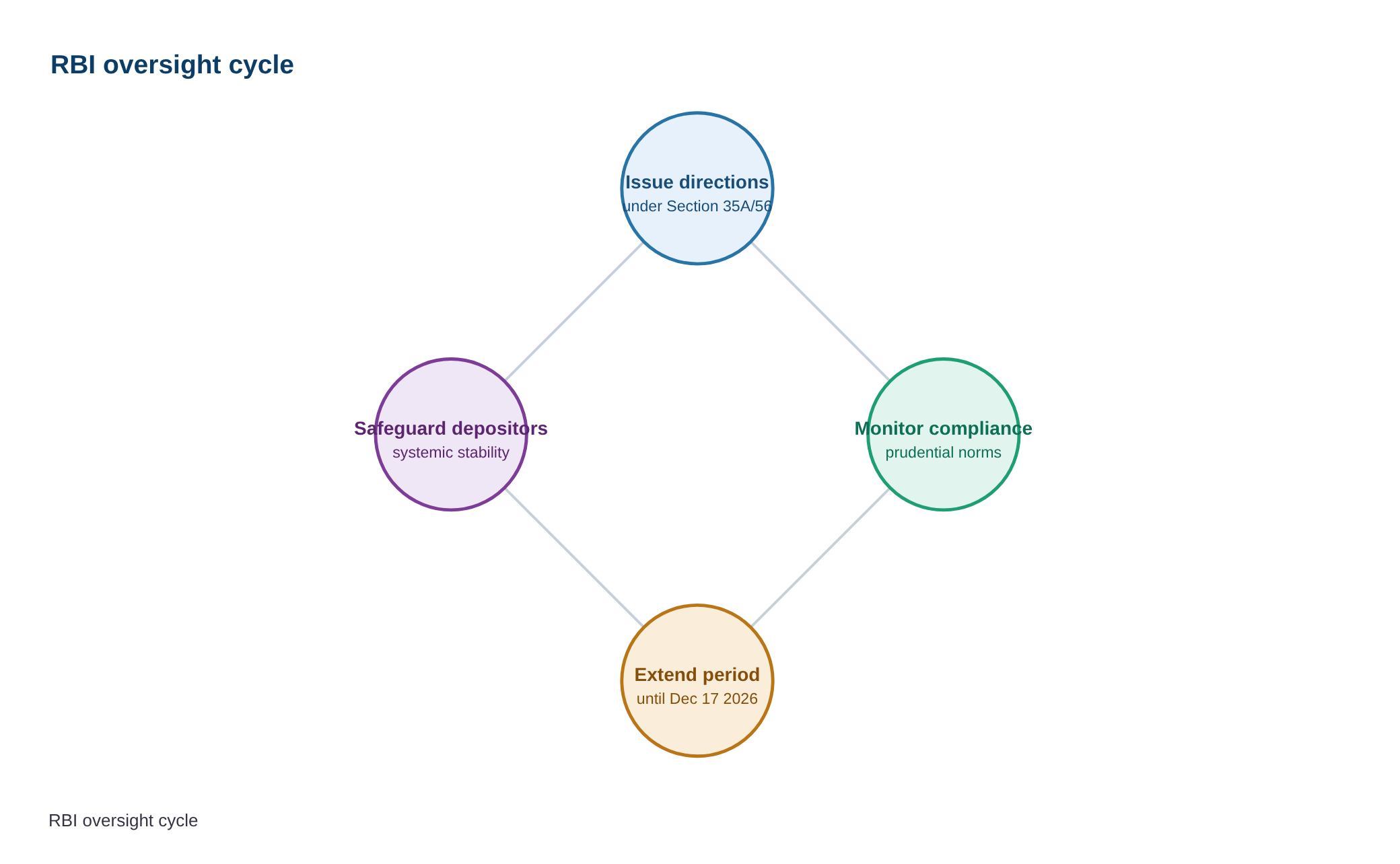
The Reserve Bank of India (RBI) has extended its regulatory directions to The Gauhati Co-operative Urban Bank Ltd., Guwahati, for a further period of three months, until December 17, 2026. This extension, issued under Section 35A read with Section 56 of the Banking Regulation Act, 1949, underscores the RBI’s ongoing supervisory role in addressing governance and financial concerns in co-operative banking institutions. The decision highlights the RBI’s authority to intervene in the operations of co-operative banks to safeguard depositors’ interests and maintain systemic stability in the financial sector.
Background
- The Banking Regulation Act, 1949, empowers the RBI to regulate and supervise banks in India, including co-operative banks, to ensure financial stability and depositor protection.
- Co-operative banks, particularly Urban Co-operative Banks (UCBs), play a critical role in providing financial services to underserved segments of the economy, including small businesses and low-income households.
- The RBI’s regulatory powers over co-operative banks are exercised under specific provisions of the Banking Regulation Act, 1949, including Section 35A (which deals with the power of the RBI to give directions) and Section 56 (which extends these powers to co-operative societies).
- The Gauhati Co-operative Urban Bank Ltd. has been under RBI’s regulatory directions since December 17, 2025, with extensions granted periodically to address specific concerns.
- The RBI’s directions are issued in the public interest and are aimed at ensuring compliance with prudential norms, governance standards, and risk management practices.
- The extension of directions does not imply RBI’s satisfaction with the bank’s financial position but reflects the need for continued oversight to address systemic risks.
What are the RBI’s Regulatory Powers under the Banking Regulation Act, 1949, and How Do They Apply to Co-operative Banks?
- The Banking Regulation Act, 1949, is the primary legislation governing the regulation and supervision of banks in India, including co-operative banks.
- Section 35A of the Act empowers the RBI to issue directions to banks in the interest of banking policy, depositors, or the public. These directions can cover areas such as credit management, investment policies, and operational guidelines.
- Section 56 extends the application of Section 35A to co-operative societies engaged in banking operations, thereby bringing co-operative banks under the RBI’s regulatory ambit.
- The RBI’s powers under these sections are exercised to address governance failures, financial mismanagement, or systemic risks that could threaten depositor confidence or financial stability.
- Regulatory directions issued under Section 35A read with Section 56 are legally binding and must be complied with by the concerned bank. Non-compliance can lead to penalties, including cancellation of banking licences.
- The RBI’s directions are not punitive by default but preventive, aimed at correcting deficiencies and ensuring compliance with prudential norms such as capital adequacy, asset quality, and liquidity management.
- The extension of directions to The Gauhati Co-operative Urban Bank Ltd. reflects the RBI’s ongoing assessment of the bank’s ability to meet regulatory requirements and mitigate risks to depositors and the financial system.
- The RBI’s supervisory role over co-operative banks is part of a broader framework to enhance the resilience of the financial sector, particularly in segments with higher vulnerability to risks.
Key Features
| Feature | Significance |
|---|---|
| Section 35A of the Banking Regulation Act, 1949 | Empowers the RBI to issue specific directions to co-operative banks to ensure compliance with prudential norms, governance standards, and depositor protection. |
| Section 56 of the Banking Regulation Act, 1949 | Provides the RBI with the authority to apply the provisions of Section 35A to co-operative societies engaged in banking, including urban co-operative banks. |
| Extension of Directions | Allows the RBI to maintain regulatory oversight over The Gauhati Co-operative Urban Bank Ltd. beyond the initial six-month period, ensuring continuity in compliance monitoring. |
| Public Interest Criterion | The RBI’s decision to extend the Directions is grounded in the need to safeguard depositor interests and maintain systemic stability in the co-operative banking sector. |
| Review Mechanism | The extension is subject to periodic review, ensuring that the bank’s compliance with the Directions is continuously assessed without undue delay. |
Why it Matters
Regulatory Governance
- Demonstrates the RBI’s proactive role in regulating co-operative banks to prevent financial distress and protect depositors’ funds.
- Highlights the statutory framework under which the RBI can intervene in the operations of co-operative banks to enforce compliance with prudential norms.
- Reinforces the RBI’s mandate to ensure financial stability in the banking sector, particularly in institutions outside the commercial banking domain.
Depositor Protection
- The extension of Directions underscores the RBI’s commitment to safeguarding depositors’ interests in co-operative banks, which often serve marginalised communities.
- Ensures that the bank adheres to governance and financial standards, reducing the risk of insolvency or mismanagement that could erode public trust.
- Aligns with the broader objective of maintaining public confidence in the banking system, including co-operative institutions.
Systemic Stability
- Prevents potential contagion effects that could arise from the failure of a co-operative bank, thereby protecting the broader financial ecosystem.
- Demonstrates the RBI’s use of regulatory tools to address vulnerabilities in the co-operative banking sector, which plays a critical role in financial inclusion.
- Supports the RBI’s broader supervisory framework for co-operative banks, ensuring consistency in enforcement across the sector.
Challenges
1. Regulatory Compliance in Co-operative Banks
- Co-operative banks often face governance challenges due to their unique ownership structure, which can hinder effective regulatory oversight.
- Ensuring uniform compliance with prudential norms across diverse co-operative banking institutions remains a persistent challenge for the RBI.
- The RBI must balance strict regulatory enforcement with the need to support financial inclusion, particularly in rural and semi-urban areas.
UPSC Link: Economic Development – Banking Sector Reforms
2. Depositor Awareness and Trust
- Depositors in co-operative banks may lack awareness of the risks associated with such institutions, leading to complacency or panic during financial distress.
- Rebuilding trust in co-operative banks after regulatory interventions requires sustained communication and transparency from the RBI and the bank management.
- The RBI must address gaps in financial literacy to ensure depositors make informed decisions about their savings.
UPSC Link: Financial Inclusion – Challenges and Strategies
3. Operational Challenges for Co-operative Banks
- Co-operative banks often operate with limited resources, making it difficult to comply with evolving regulatory requirements without adequate support.
- The RBI’s interventions, while necessary, can impose short-term operational constraints on the bank, affecting its ability to serve customers.
- Addressing these challenges requires a collaborative approach between the RBI, bank management, and depositors to ensure sustainable compliance.
UPSC Link: Banking Sector – Challenges in Co-operative Banks
Challenges — UPSC Perspective
| Issue | Concern |
|---|---|
| Governance Deficiencies | Co-operative banks may lack robust governance structures, leading to mismanagement or financial irregularities. |
| Financial Literacy Gaps | Depositors may not fully understand the risks associated with co-operative banks, increasing vulnerability to financial shocks. |
| Resource Constraints | Co-operative banks often operate with limited financial and technical resources, hindering compliance with regulatory norms. |
| Operational Disruptions | Regulatory interventions can disrupt the bank’s operations, affecting customer service and business continuity. |
| Public Trust Erosion | Past instances of mismanagement or failures can erode depositor confidence, making regulatory oversight more challenging. |
Way Forward
- The RBI should conduct a comprehensive risk assessment of The Gauhati Co-operative Urban Bank Ltd. to identify specific areas requiring intervention.
- Enhance depositor awareness programs to educate the public about the risks and safeguards associated with co-operative banks.
- Strengthen the governance framework of co-operative banks by promoting professional management and independent oversight mechanisms.
- Collaborate with state governments to address structural challenges in co-operative banks, such as capital adequacy and operational efficiency.
- Implement a graded regulatory approach, allowing co-operative banks to transition gradually to higher compliance standards without undue disruption.
- Establish a dedicated grievance redressal mechanism for depositors to address concerns promptly and transparently.
- Promote financial inclusion initiatives that integrate co-operative banks with mainstream banking systems to improve oversight and service delivery.
UPSC Value Addition
Keywords for Mains Answer-Writing
Banking Regulation Act, 1949 · Reserve Bank of India (RBI) · Urban Co-operative Banks (UCBs) · Section 35A of Banking Regulation Act, 1949 · Section 56 of Banking Regulation Act, 1949 · Directions to banks · Financial sector regulation · Supervisory powers of RBI · Public interest in banking regulation · Co-operative banking governance · Banking sector reforms · RBI’s regulatory framework for UCBs
Concept Flow
Co-operative banks operate under the Banking Regulation Act, 1949, which empowers the RBI to regulate and supervise their activities. → Section 35A of the Act provides the RBI with the authority to issue specific directions to banks to ensure compliance with prudential norms. → Section 56 extends these powers to co-operative societies engaged in banking, including urban co-operative banks. → The RBI issues Directions to The Gauhati Co-operative Urban Bank Ltd. to address governance or financial irregularities. → The Directions are initially issued for a six-month period but may be extended in the public interest to ensure continued compliance. → The extension is subject to review, allowing the RBI to reassess the bank’s progress and adjust regulatory measures as needed. → This process ensures depositor protection, systemic stability, and adherence to regulatory standards in the co-operative banking sector.
Prelims Practice Questions
Q1. Consider the following statements regarding the powers of the Reserve Bank of India (RBI) under the Banking Regulation Act, 1949:
1. Section 35A empowers the RBI to issue directions to banks in the public interest.
2. Section 56 of the Act provides the RBI with powers to regulate co-operative societies engaged in banking.
3. The RBI can issue directions to co-operative banks under Section 35A read with Section 56 without any time limit.
How many of the above statements are correct?
- Only one
- Only two
- All three
- None
Answer: Only two — Statement 1 is correct as Section 35A empowers RBI to issue directions to banks in public interest. Statement 2 is correct as Section 56 pertains to co-operative societies. Statement 3 is incorrect because the RBI’s directions are time-bound and subject to review, as seen in the RBI’s directive to The Gauhati Co-operative Urban Bank Ltd.
Q2. Assertion (A): The Reserve Bank of India can extend the period of its directives to banks under Section 35A read with Section 56 of the Banking Regulation Act, 1949.
Reason (R): The Banking Regulation Act, 1949, empowers the RBI to issue directions to banks for a fixed period only, and no extensions are permissible.
- Both A and R are true, and R is the correct explanation of A
- Both A and R are true, but R is NOT the correct explanation of A
- A is true, but R is false
- A is false, but R is true
Answer: A is true, but R is false — Assertion (A) is true as the RBI has extended directives to banks under Section 35A read with Section 56. Reason (R) is false because the Act permits extensions, as demonstrated by the RBI’s repeated extensions to The Gauhati Co-operative Urban Bank Ltd.
Q3. Match the following provisions of the Banking Regulation Act, 1949 with their respective powers:
Column I (Provisions) | Column II (Powers)
1. Section 35A | A. Powers to regulate co-operative societies
2. Section 56 | B. Powers to issue directions to banks
3. Section 36AE | C. Powers to supersede the Board of Directors of a bank
4. Section 45 | D. Powers to impose moratorium on banks
Select the correct match:
- 1-B, 2-A, 3-C, 4-D
- 1-A, 2-B, 3-D, 4-C
- 1-D, 2-C, 3-A, 4-B
- 1-C, 2-D, 3-B, 4-A
Answer: 1-B, 2-A, 3-C, 4-D — Section 35A empowers RBI to issue directions to banks (1-B). Section 56 pertains to co-operative societies (2-A). Section 36AE empowers RBI to supersede the Board of Directors (3-C). Section 45 empowers RBI to impose moratorium (4-D).
Mains Practice Question
✍ The Reserve Bank of India (RBI) has extended its directives to The Gauhati Co-operative Urban Bank Ltd. under Section 35A read with Section 56 of the Banking Regulation Act, 1949. Critically examine the constitutional and statutory framework governing the RBI’s powers to issue and extend such directions. Also, discuss the implications of such regulatory interventions for the governance and stability of Urban Co-operative Banks (UCBs) in India. (15 Marks)
Approach: MODEL-ANSWER SKELETON:
1. **Statutory Basis of RBI’s Powers**:
– Section 35A of the Banking Regulation Act, 1949: Empowers RBI to issue directions to banks in the public interest.
– Section 56: Extends RBI’s regulatory authority to co-operative societies engaged in banking.
– Section 35(1) and Section 36: Provide RBI with supervisory and corrective powers, including supersession of boards and imposition of moratorium.
2. **Constitutional Framework**:
– Article 246 read with Entry 45 of the Union List: Grants Parliament exclusive power to legislate on banking and insurance.
– RBI’s autonomy: Derived from the Act and constitutional provisions, ensuring regulatory independence.
3. **Process of Issuance and Extension of Directions**:
– RBI’s discretion: Based on assessments of financial health, governance issues, and public interest.
– Time-bound nature: Directions are issued for specified periods, subject to review (e.g., 6 months, 3 months extensions).
– Public interest criterion: RBI’s satisfaction that extension is necessary to protect depositors and maintain stability.
4. **Implications for Urban Co-operative Banks (UCBs)**:
– Governance reforms: Directions often include restrictions on lending, deposit acceptance, and board operations.
– Depositor protection: Ensures safeguarding of depositors’ interests during periods of financial stress.
– Market confidence: Enhances trust in UCBs, preventing systemic risks.
5. **Challenges and Criticisms**:
– Over-centralisation: RBI’s extensive powers may limit UCBs’ operational autonomy.
– Delayed resolutions: Prolonged directions may exacerbate financial stress for UCBs.
– Need for balanced regulation: Ensuring UCBs’ viability while maintaining regulatory oversight.
6. **Comparative Perspective**:
– Global practices: Similar regulatory frameworks in other jurisdictions (e.g., FDIC in the USA, PRA in the UK).
– Lessons for Indian UCBs: Need for stronger governance, capital adequacy, and risk management.
Balanced conclusion: RBI’s powers are statutorily grounded and constitutionally valid, but their exercise must balance stability with the operational autonomy of UCBs.
Source: RBI
Assam PCS (APSC) — State PCS Practice
Prelims: Under which provision of the Banking Regulation Act, 1949, was the extension of the period for The Gauhati Co-operative Urban Bank Ltd., Guwahati, granted as per the recent directions issued by the Reserve Bank of India?
- Section 35A read with Section 56
- Section 35 read with Section 56
- Section 35A read with Section 6
- Section 35 read with Section 6
Answer: Section 35A read with Section 56 — The extension was granted under Section 35A of the Banking Regulation Act, 1949, which empowers the RBI to issue directions to co-operative banks, read with Section 56 that applies the Act to co-operative societies.
Mains: Critically examine the significance of the Reserve Bank of India’s powers under Section 35A of the Banking Regulation Act, 1949, in ensuring the stability and governance of co-operative banks in Assam. Suggest measures to enhance the regulatory framework for better oversight of such banks in the state.
Generated by AanyaAi for educational purpose.
Related guides on our sites
- Current affairs for upsc 2026
- Best PSIR optional coaching for upsc
- Best PSIR optional teacher for upsc
- Best teacher of PSIR optional for upsc

- कुल्लू: NHPC की पार्वती-2 परियोजना के खिलाफ एफआईआर, 12 सदस्यीय जांच समिति गठित - September 21, 2026
- NHPC Tunnel Leak in Kullu: FIR Filed, 5-Day Probe Deadline for Project Failures - September 21, 2026
- भारत ने जी20 ऊर्जा सहमति में किया शामिल, जानिए प्रमुख समझौते - September 21, 2026

No Comments