


02 Sep RBI Governor at G20 FMCBG Meet: Key Takeaways for UPSC & State PCS Aspirants
✎ The G20 FMCBG meeting is a critical platform for discussing global economic governance, financial stability, and trade imbalances, with outcomes that shape the broader G20 Leaders’ Summit agenda.
Subject Relevance — Where This Topic Fits
- GS Paper II — International Organisations and their Mandates | GS Paper III — Indian Economy and Issues Relating to Planning, Mobilisation of Resources, Growth, Development and Employment | GS Paper III — Effects of Liberalisation on the Economy, Changes in Industrial Policy and their Effects on Industrial Growth
- Prelims: G20, FMCBG, IMF, World Bank, global trade imbalances, excess industrial capacity, non-market policies, chair’s statement, multilateralism, financial stability, debt sustainability
- Essay: Global economic governance in the 21st century: Challenges and opportunities, The role of emerging economies in reshaping international financial architecture
Quick Revision: The G20 FMCBG meeting is a critical platform for discussing global economic governance, financial stability, and trade imbalances, with outcomes that shape the broader G20 Leaders’ Summit agenda.
Why is this in the news?
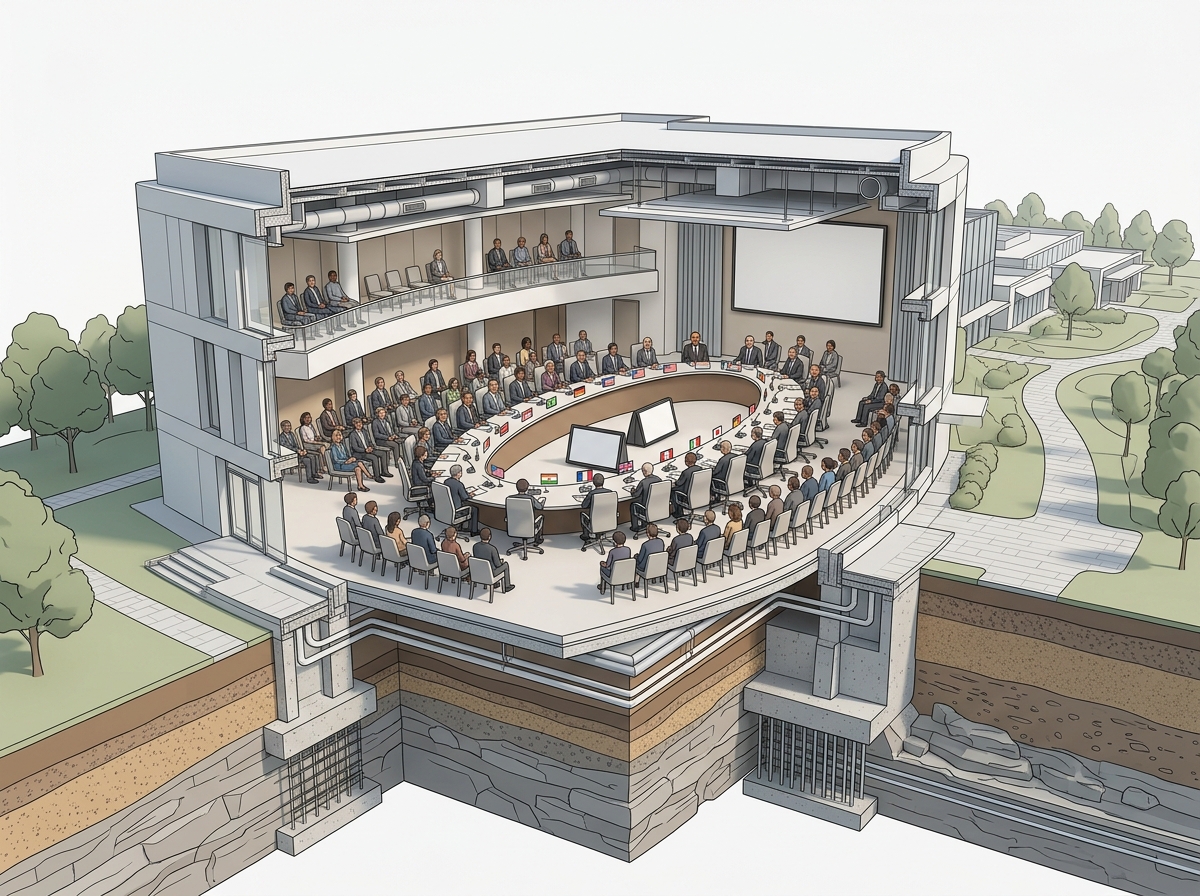
The participation of the Governor of the Reserve Bank of India (RBI) in the G20 Finance Ministers and Central Bank Governors (FMCBG) meeting in Asheville, United States, underscores the significance of multilateral economic governance in addressing contemporary global challenges. The meeting, held under the US G20 presidency, focused on critical issues such as global economic growth, financial stability, rising debt levels, trade imbalances, and reforms to the international financial system. India’s engagement at the meeting, led by the Finance Minister, highlights its role in advocating for the interests of emerging economies while promoting sustainable growth and economic cooperation.
Background
- The G20 was established in 1999 in response to the Asian financial crisis and the growing recognition of the need for coordinated global economic governance among systemically important economies.
- The G20 Finance Ministers and Central Bank Governors (FMCBG) meeting is a key platform for discussing macroeconomic policies, financial regulation, and structural reforms to enhance global economic resilience.
- Global trade imbalances, particularly China’s large trade surplus and excess industrial capacity, have been a persistent concern, with calls for structural reforms to address distortions in global trade flows.
- The failure to issue a joint communique at the meeting reflects underlying tensions among member nations on issues such as non-market policies, trade surpluses, and the need for balanced global growth.
- India’s participation in the G20 FMCBG meeting aligns with its broader strategy to position itself as a hub for manufacturing, technology, and innovation while advocating for the interests of developing economies.
What is the G20 Finance Ministers and Central Bank Governors (FMCBG) Meeting?
- The G20 FMCBG meeting is a biannual gathering of finance ministers and central bank governors from the G20 member countries, alongside representatives from international organisations such as the IMF, World Bank, and OECD.
- The meeting serves as a forum for discussing global economic challenges, including macroeconomic policies, financial stability, debt sustainability, trade imbalances, and structural reforms.
- The FMCBG meeting provides a platform for member countries to coordinate their economic policies and address systemic risks that could impact global financial stability.
- The outcomes of the FMCBG meeting often inform the broader G20 Leaders’ Summit, where heads of state and government deliberate on high-level economic and financial issues.
- The meeting follows the G20’s consensus-based approach, where joint communiqués or chair’s statements are issued to reflect the agreed-upon priorities and commitments of member nations.
- The G20 FMCBG meeting is distinct from the G20 Leaders’ Summit in that it focuses on technical and policy-level discussions rather than high-level political declarations.
- The meeting is chaired by the finance minister and central bank governor of the G20 presidency country, who set the agenda and facilitate discussions among member nations.
- The FMCBG meeting also serves as a platform for bilateral and multilateral engagements on the sidelines, enabling countries to address bilateral economic issues and strengthen economic cooperation.
Key Features
| Feature | Significance |
|---|---|
| Participation of RBI Governor in G20 FMCBG meeting | Represents India’s engagement in multilateral economic governance and financial stability discussions at the global level. |
| India’s emphasis on emerging economies’ needs | Highlights India’s role as a voice for developing nations in global economic policy formulation. |
| Discussions on global debt and financial stability | Addresses systemic risks to the international financial system and the need for coordinated policy responses. |
| Trade imbalances and non-market policies | Focuses on distortions in global trade, particularly excess capacity in China, and their impact on other economies. |
| Chair’s statement instead of a joint communiqué | Reflects divergence among G20 members on key economic issues, underscoring challenges in achieving consensus. |
Why it Matters
Global Economic Governance
- The G20 FMCBG meeting serves as a platform for coordinating macroeconomic policies, financial regulation, and trade practices among major economies.
India’s Strategic Positioning
- India leverages multilateral forums to advocate for sustainable growth, trade facilitation, and investment flows, aligning with its developmental priorities.
Financial Stability and Debt Management
- Discussions on rising global debt and financial imbalances are critical for preventing systemic crises and ensuring long-term economic resilience.
Trade Policy and Industrial Capacity
- The issue of excess industrial capacity in China and its impact on global trade highlights the need for structural reforms and balanced trade policies.
Multilateral Diplomacy and Consensus Building
- The absence of a joint communiqué underscores the challenges in achieving unanimity on contentious economic issues within the G20 framework.
Challenges
1. Global Trade Imbalances
- Excess industrial capacity in surplus economies like China leads to dumping of goods, distorting trade and harming domestic industries in deficit economies.
UPSC Link: GS3: Trade dynamics
2. Rising Global Debt
- High levels of sovereign and corporate debt across nations pose systemic risks to financial stability and economic growth.
UPSC Link: GS3: Fiscal policy
3. Lack of Consensus in G20
- Divergent national interests and policy priorities hinder the formulation of unified economic strategies within the G20 framework.
UPSC Link: GS2: International organisations
4. Protectionism and Non-Market Policies
- Unpredictable trade policies and state interventions distort market mechanisms, exacerbating global economic strains.
UPSC Link: GS3: Trade barriers
5. Climate-Induced Economic Risks
- Escalating climate risks, such as floods, pose long-term economic challenges, particularly for vulnerable economies.
UPSC Link: GS3: Climate change
Challenges — UPSC Perspective
| Issue | Concern |
|---|---|
| Excess industrial capacity in China | Distorts global trade by flooding markets with cheap goods, undermining domestic industries. |
| Rising global debt levels | Increases systemic risks to financial stability and economic growth. |
| Protectionist trade policies | Erode multilateral trade frameworks and exacerbate economic fragmentation. |
| Climate-induced economic disruptions | Impair long-term economic planning and resilience, particularly in vulnerable regions. |
| Divergence in G20 policy priorities | Undermines the effectiveness of multilateral economic coordination and consensus-building. |
| Currency and exchange rate volatility | Disrupts trade flows and investment decisions, adding uncertainty to global economic interactions. |
Way Forward
- Strengthen multilateral frameworks for debt sustainability assessment and crisis management.
- Promote structural reforms in surplus economies to address excess industrial capacity and trade imbalances.
- Enhance coordination among G20 members to develop common standards for non-market policies and state interventions.
- Advocate for climate-resilient economic policies to mitigate long-term risks from climate change.
- Foster dialogue on trade facilitation and dispute resolution mechanisms to reduce protectionist tendencies.
- Encourage greater transparency in fiscal and monetary policies to build trust and reduce economic uncertainty.
- Support capacity-building initiatives for emerging economies to enhance their participation in global economic governance.
UPSC Value Addition
Keywords for Mains Answer-Writing
G20 Finance Ministers and Central Bank Governors (FMCBG) meeting · Reserve Bank of India (RBI) Governor Sanjay Malhotra · global financial stability · international financial architecture reforms · G20 communique and chair’s statement · non-market policies and trade surpluses · Federal Reserve and IMF engagements · emerging economies’ debt and growth · sustainable trade and investment · multilateral economic governance · G20 presidency and consensus-building · structural reforms in global trade
Concept Flow
Rising global debt and trade imbalances → G20 FMCBG meeting for policy coordination → Divergent national interests → Absence of joint communiqué → Chair’s statement as alternative → Challenges in multilateral consensus → Impact on global economic stability → Need for structural reforms and coordinated policy responses
Prelims Practice Questions
Q1. Consider the following statements regarding the G20 Finance Ministers and Central Bank Governors (FMCBG) meeting:
1. The meeting is held under the aegis of the United Nations.
2. The Reserve Bank of India Governor participates in the meeting as part of India’s delegation.
3. The meeting in 2026 was chaired by the US Treasury Secretary.
4. The meeting issued a joint communique that was agreed upon by all member nations.
How many of the above statements are correct?
- Only one
- Only two
- Only three
- All four
Answer: Only three — Statement 1 is incorrect: the G20 is an informal forum, not under the UN. Statement 2 is correct: the RBI Governor is part of India’s delegation. Statement 3 is correct: the US held the G20 presidency in 2026. Statement 4 is incorrect: no joint communique was issued due to dissent by China.
Q2. Assertion (A): The G20 Finance Ministers and Central Bank Governors meeting aims to address global financial imbalances.
Reason (R): The meeting includes discussions on non-market policies and excessive trade surpluses.
Options:
A. Both A and R are true, and R is the correct explanation of A.
B. Both A and R are true, but R is not the correct explanation of A.
C. A is true, but R is false.
D. A is false, but R is true.
Answer: ? — Assertion (A) is true: the G20 FMCBG meeting addresses global financial imbalances. Reason (R) is also true and directly explains the assertion, as discussions on non-market policies and trade surpluses are central to addressing imbalances.
Q3. Which of the following institutions was NOT represented by its Governor/Chair at the G20 Finance Ministers and Central Bank Governors meeting in 2026?
A. Reserve Bank of India
B. Federal Reserve
C. International Monetary Fund
D. World Trade Organization
- A
- B
- C
- D
Answer: D — The Reserve Bank of India, Federal Reserve, and International Monetary Fund were represented. The World Trade Organization does not send its Governor/Chair to the G20 FMCBG meeting.
Mains Practice Question
✍ Critically analyse the significance of the G20 Finance Ministers and Central Bank Governors (FMCBG) meeting in shaping the global financial architecture, with reference to the 2026 edition. (15 Marks)
Approach: MODEL-ANSWER SKELETON:
1. **Introduction (2 marks)**: Define the G20 FMCBG meeting and its mandate under the G20 framework. Highlight its role in addressing global financial stability, trade imbalances, and debt sustainability.
2. **Key Issues Discussed (4 marks)**:
– Global economic growth and financial stability.
– Rising debt levels in emerging economies.
– Trade imbalances, particularly China’s trade surplus and excess industrial capacity.
– Reforms to the international financial system and non-market policies.
– India’s emphasis on sustainable growth, trade, and investment.
3. **Mechanisms and Outcomes (4 marks)**:
– Role of the G20 in consensus-building and policy coordination.
– The 2026 outcome: failure to issue a joint communique due to dissent by China; issuance of a chair’s statement instead.
– Engagement of RBI Governor Sanjay Malhotra with counterparts (e.g., Federal Reserve, IMF) and bilateral discussions (e.g., India-UK trade cooperation).
4. **Challenges and Criticisms (3 marks)**:
– Limitations of the G20 as an informal forum lacking binding authority.
– Divergent national interests and structural reforms required in surplus and deficit nations.
– Protectionism and unpredictable policies exacerbating global economic strains.
5. **Conclusion (2 marks)**: Assess the G20’s relevance in contemporary multilateral financial governance, its strengths in dialogue, and its limitations in enforcing reforms.
Source: orissapost.com
Generated by AanyaAi for educational purpose.
Related guides on our sites
- Current affairs for upsc 2026
- UPSC EPFO syllabus
- Best economics optional coaching for upsc
- Best economics optional teacher for upsc


No Comments