


11 Aug RBI Governor Urges Banks to Fast-Track AI Adoption with Caution
✎ The RBI Governor’s emphasis on 'adopting AI with full understanding' highlights the critical need for banks to balance innovation with robust governance frameworks, including explainable AI, third-party risk management, and…
Subject Relevance — Where This Topic Fits
- GS Paper III — Indian Economy and issues relating to Planning, Mobilisation of Resources, Growth, Development and Employment | GS Paper III — Science and Technology — Developments and their Applications and Effects in Everyday Life | GS Paper III — Security Challenges
- Prelims: Artificial Intelligence (AI), Machine Learning (ML), Regulatory Sandbox, Digital Lending, Cybersecurity, Data Privacy, RBI Guidelines on IT Governance in Banks, Financial Stability, Operational Risk, Third-Party Risk Management
- Essay: The Role of Technology in Governance: Balancing Innovation with Risk Mitigation, Ethical Dimensions of Artificial Intelligence in Public and Private Sectors
Quick Revision: The RBI Governor’s emphasis on ‘adopting AI with full understanding’ highlights the critical need for banks to balance innovation with robust governance frameworks, including explainable AI, third-party risk management, and real-time cybersecurity monitoring to ensure financial stability.
Why is this in the news?
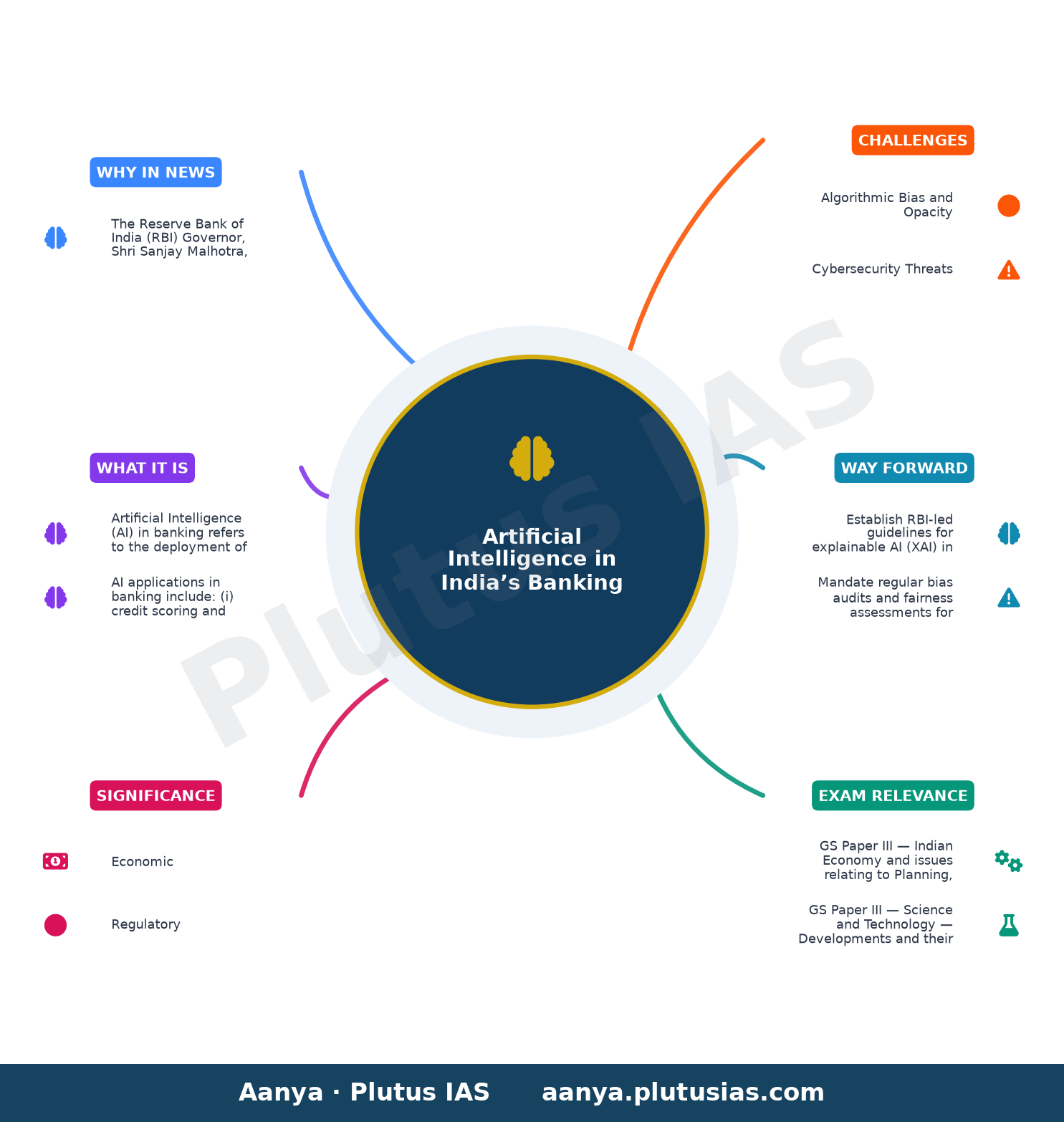
The Reserve Bank of India (RBI) Governor, Shri Sanjay Malhotra, has underscored the urgent need for Indian lenders to accelerate investments in artificial intelligence (AI) while simultaneously cautioning against the associated risks. Addressing an industry event in Mumbai, he highlighted the dual challenge confronting the banking sector: leveraging AI to enhance efficiency and customer service, and mitigating vulnerabilities such as biased decision-making, data privacy breaches, and cybersecurity threats. His remarks reflect a broader global trend where central banks are reassessing the prudential framework governing AI adoption in financial institutions to ensure systemic stability.
Background
- The integration of AI into banking operations has accelerated globally, driven by advancements in machine learning, natural language processing, and automation, which enable lenders to enhance credit underwriting, fraud detection, customer service (via chatbots), and risk management.
- In India, the RBI has progressively formalised guidelines to govern the use of technology in banks, including the ‘Master Direction on Information Technology Governance, Risk, Controls, and Assurance Practices’ (2023) and the ‘Guidelines on Digital Lending’ (2022), which mandate robust IT governance, third-party risk management, and consumer protection measures.
- The RBI’s regulatory sandbox framework, established in 2019, provides a controlled environment for fintech and banks to test AI-driven innovations under relaxed regulatory norms, fostering responsible experimentation.
- Cybersecurity risks in the financial sector have intensified, with the RBI’s ‘Financial Stability Report’ (June 2026) noting a 40% year-on-year increase in cyber incidents targeting Indian banks, underscoring the need for proactive risk management.
- The Finance Minister, Smt. Nirmala Sitharaman, in April 2026, had flagged ‘unprecedented AI-related risks to banks’ and called for pre-emptive measures to secure IT systems, protect customer data, and enable real-time threat intelligence sharing.
- India’s banking sector has demonstrated resilience, with gross non-performing assets (NPAs) declining to a decadal low of 2.8% in March 2026, while credit growth remains robust at 14% year-on-year, providing a stable foundation for digital transformation.
What is Artificial Intelligence in Banking, and Why Does It Matter?
- Artificial Intelligence (AI) in banking refers to the deployment of algorithms, machine learning models, and data analytics to automate decision-making, enhance customer interactions, and optimise operational processes across lending, payments, risk assessment, and fraud detection.
- AI applications in banking include: (i) credit scoring and underwriting using alternative data sources (e.g., utility payments, GST filings); (ii) chatbots and virtual assistants for customer service; (iii) fraud detection via anomaly detection in transaction patterns; (iv) algorithmic trading and portfolio management; and (v) predictive analytics for liquidity and capital planning.
- The adoption of AI is driven by the need for operational efficiency, cost reduction, and personalised customer experiences, particularly in a market like India with over 1.2 billion accounts and a rapidly digitising population.
- However, AI adoption introduces systemic risks, including: (i) **model risk**—errors or biases in algorithms leading to unfair lending practices or incorrect risk assessments; (ii) **data privacy risks**—mishandling of sensitive customer data under the Digital Personal Data Protection Act, 2023; (iii) **cybersecurity threats**—AI-powered phishing, deepfake scams, or adversarial attacks on AI models; and (iv) **third-party dependency risk**—over-reliance on a few technology vendors, creating single points of failure.
- The RBI’s regulatory approach to AI in banking is anchored in the principle of **proportionality**, where the intensity of oversight is calibrated to the materiality of AI usage. This includes mandatory disclosures on AI models, independent validation of algorithms, and continuous monitoring of model performance.
- Globally, central banks such as the European Central Bank (ECB) and the Monetary Authority of Singapore (MAS) have issued guidelines on AI governance, emphasising transparency, explainability, and human oversight to mitigate systemic risks.
- India’s banking sector is uniquely positioned to leverage AI due to its large-scale digital public infrastructure (e.g., UPI, Aadhaar, Account Aggregator Framework), which provides high-quality, consented data for AI-driven innovations.
- The RBI’s call for ‘full understanding’ of deployed AI models underscores the need for banks to invest in explainable AI (XAI) techniques, which allow stakeholders to interpret and challenge algorithmic decisions.
Key Features
| Feature | Significance |
|---|---|
| Accelerated AI adoption in banking | Enhances operational efficiency, reduces costs, and improves customer service through automation and predictive analytics. |
| Human oversight in AI deployment | Mitigates risks of opaque or biased decisions by ensuring accountability and interpretability of AI-driven processes. |
| Vendor dependence risk | Over-reliance on third-party AI models or vendors may expose banks to operational failures, data breaches, or vendor lock-in. |
| Cybersecurity safeguards | Critical to protect against AI-enabled cyber threats, including adversarial attacks, data leaks, and fraudulent transactions. |
| Real-time threat intelligence sharing | Enables proactive defence against evolving cyber risks and systemic vulnerabilities in the financial sector. |
Why it Matters
Economic
- AI integration in banking can boost GDP growth by enhancing financial inclusion, credit availability, and transaction efficiency.
- Reduces systemic risks through improved risk assessment and fraud detection, stabilising the financial ecosystem.
- Enhances India’s global competitiveness in fintech and digital banking, attracting foreign investment.
Regulatory
- RBI’s emphasis on AI governance sets a precedent for balanced innovation and risk management in the financial sector.
- Strengthens prudential norms for AI-driven lending, ensuring fairness and transparency in credit decisions.
- Fosters a culture of responsible AI adoption, aligning with international standards like the EU AI Act and Basel Committee guidelines.
Technological
- AI adoption accelerates digital transformation in banking, reducing manual processes and improving scalability.
- Enables real-time data analysis for credit scoring, fraud detection, and personalised financial services.
- Drives innovation in regulatory technology (RegTech) and supervisory technology (SupTech) for RBI’s oversight.
Challenges
1. Algorithmic Bias and Opacity
- AI models may perpetuate historical biases in lending, excluding creditworthy borrowers from marginalised groups.
- Lack of transparency in AI decisions undermines customer trust and regulatory compliance.
- Mitigation requires bias audits, explainable AI (XAI) frameworks, and diverse training datasets.
UPSC Link: GS3: Technology & Ethics
2. Cybersecurity Threats
- AI systems are vulnerable to adversarial attacks, data poisoning, and deepfake-based fraud.
- Increased digitalisation expands the attack surface for cybercriminals targeting banks.
- Requires robust encryption, zero-trust architecture, and continuous monitoring for anomalies.
UPSC Link: GS3: Cybersecurity
3. Vendor Lock-in and Systemic Risks
- Over-dependence on a few AI vendors may create monopolies, increasing costs and reducing innovation.
- Systemic failures in vendor models could propagate across banks, destabilising the financial sector.
- Solution: Promote open-source AI tools and diversify vendor partnerships.
UPSC Link: GS3: Financial Sector Reforms
4. Data Privacy and Compliance
- AI-driven personalisation relies on sensitive customer data, raising concerns under the Digital Personal Data Protection Act, 2023.
- Cross-border data flows for AI training may conflict with RBI’s data localisation norms.
- Requires strict adherence to consent mechanisms, purpose limitation, and data minimisation principles.
UPSC Link: GS2: Fundamental Rights
5. Skill Gaps and Workforce Disruption
- Banks face a shortage of AI/ML talent, hindering effective deployment and oversight.
- Reskilling programmes are essential to transition traditional banking roles into AI-augmented positions.
- Collaboration with academia and fintech startups can bridge the talent gap.
UPSC Link: GS3: Human Resource Development
6. Geopolitical and Trade Uncertainties
- Global supply chain disruptions and trade wars may impact AI hardware imports and software licensing.
- Sanctions or export controls on critical AI components could delay adoption.
- Diversification of supply chains and domestic R&D investment can mitigate risks.
UPSC Link: GS2: International Relations
Challenges — UPSC Perspective
| Issue | Concern |
|---|---|
| Algorithmic Bias | Perpetuation of historical discrimination in lending decisions. |
| Cybersecurity Vulnerabilities | Increased exposure to AI-enabled fraud and data breaches. |
| Vendor Dependence | Systemic risks from over-reliance on third-party AI models. |
| Data Privacy Risks | Violations of customer confidentiality under evolving regulations. |
| Skill Shortages | Inability to deploy and oversee AI systems effectively. |
| Geopolitical Risks | Disruptions in AI hardware/software supply chains. |
Way Forward
- Establish RBI-led guidelines for explainable AI (XAI) in banking to ensure transparency and accountability.
- Mandate regular bias audits and fairness assessments for AI-driven credit and risk models.
- Promote public-private partnerships to develop indigenous AI tools, reducing vendor dependence.
- Enhance cybersecurity frameworks with AI-specific threat detection and real-time incident response.
- Launch national upskilling programmes in collaboration with IITs, NITs, and fintech firms to address talent gaps.
- Strengthen data governance under the Digital Personal Data Protection Act, 2023, with sector-specific rules for banks.
- Encourage banks to adopt a phased AI adoption strategy, prioritising high-impact areas like fraud detection and customer service.
- Develop a centralised AI registry for banks to track model performance, risks, and compliance.
UPSC Value Addition
Keywords for Mains Answer-Writing
Artificial Intelligence in banking sector · Regulatory oversight of AI systems · Cybersecurity risks in financial institutions · Risk management frameworks for AI adoption · Reserve Bank of India guidelines on AI · Financial stability and AI vulnerabilities · Data privacy in digital banking · Human oversight in automated decision-making · Regulatory sandbox for fintech innovations · Operational risks in AI-driven lending
Constitutional & Policy Linkages
- Article 19(1)(g): Right to carry on any occupation, trade or business — includes digital banking and fintech innovation.
- Article 21: Right to life and personal liberty — encompasses data privacy and protection from AI-driven harms.
- Article 300A: Right to property — includes protection of customer data and financial assets from cyber threats.
Concept Flow
Rapid digitalisation of banking → Increased reliance on AI for efficiency → RBI’s push for accelerated AI adoption → AI adoption enhances operational efficiency but introduces risks → Algorithmic bias, cybersecurity threats, vendor dependence → RBI Governor highlights vulnerabilities → Calls for human oversight, safeguards, and vendor diversification → Regulatory frameworks (e.g., DPDP Act, RBI guidelines) evolve to address risks → Emphasis on transparency and accountability → Banks balance innovation with risk management → Reskilling workforce, adopting XAI, and strengthening cybersecurity → Broader economic impact → Improved financial inclusion, reduced systemic risks, and global competitiveness
Prelims Practice Questions
Q1. Consider the following statements regarding the Reserve Bank of India’s (RBI) stance on Artificial Intelligence (AI) in the banking sector:
1. The RBI Governor has urged lenders to accelerate AI adoption without addressing associated risks.
2. The RBI has identified data privacy and cybersecurity threats as key risks in the wider use of AI.
3. The RBI has cautioned against over-reliance on a small number of AI models or technology vendors.
4. The RBI has mandated all banks to deploy AI systems within one year.
How many of the above statements are correct?
- Only one
- Only two
- Only three
- All
Answer: Only three — Statements 2 and 3 are correct as per the RBI Governor’s remarks. Statement 1 is incorrect because the RBI Governor has explicitly warned about risks associated with AI adoption. Statement 4 is incorrect as no such mandate has been issued.
Q2. Which of the following is NOT a risk identified by the RBI Governor regarding the adoption of Artificial Intelligence in the banking sector?
- Biased or opaque decision-making
- Data privacy threats
- Cybersecurity vulnerabilities
- Increased liquidity risk
Answer: Increased liquidity risk — The RBI Governor identified biased decisions, data privacy threats, and cybersecurity vulnerabilities as risks. Increased liquidity risk is not mentioned in the context of AI adoption.
Q3. Assertion (A): The Reserve Bank of India (RBI) has advocated for stronger safeguards and human oversight in the deployment of Artificial Intelligence (AI) by banks.
Reason (R): The RBI Governor has warned that AI adoption without adequate understanding may expose the banking system to errors.
In the context of the above two statements, which one of the following is correct?
- Both A and R are true, and R is the correct explanation of A.
- Both A and R are true, but R is not the correct explanation of A.
- A is true, but R is false.
- A is false, but R is true.
Answer: Both A and R are true, and R is the correct explanation of A. — Both statements are true. The RBI Governor has emphasized the need for stronger safeguards and human oversight (A) and warned about potential errors due to inadequate understanding of AI systems (R). R correctly explains A.
Mains Practice Question
✍ Artificial Intelligence is transforming the banking sector by enhancing efficiency and customer experience. However, its adoption also introduces significant risks to financial stability, data privacy, and cybersecurity. Critically analyse the regulatory challenges posed by AI in the banking sector, with reference to the Reserve Bank of India’s (RBI) recent directives. Also, examine the role of human oversight in mitigating these risks. (15 Marks)
Approach: Define AI in the context of banking and highlight its transformative potential (e.g., fraud detection, credit scoring, chatbots). Mention the RBI Governor’s recent emphasis on AI adoption and associated risks. {‘regulatory_challenges’: [‘Identify key risks: biased algorithms, opaque decision-making, data privacy breaches, cybersecurity threats, and vendor lock-in risks.’, “Discuss RBI’s regulatory approach: need for stronger safeguards, human oversight, and pre-emptive measures to secure IT systems and customer data.”, “Reference RBI’s April warning on AI-related risks and the call for real-time threat intelligence sharing.”, “Mention global regulatory trends: central banks’ focus on AI risks to financial stability (e.g., Bank for International Settlements’ work on AI governance).”], ‘role_of_human_oversight’: [‘Define human oversight: ensuring accountability, explainability, and fairness in AI-driven decisions.’, “Discuss RBI’s emphasis on banks adopting AI with full understanding of deployed systems.”, ‘Highlight the dilemma: balancing efficiency gains with risk mitigation through human-in-the-loop mechanisms.’, “Cite examples: RBI’s push for robust credit growth and low bad loans as indicators of a stable banking system, buttressed by human oversight.”], ‘comparative_perspective’: [“Compare RBI’s approach with other jurisdictions (e.g., EU’s AI Act, US financial regulators’ guidelines).”, ‘Discuss the trade-off between innovation and regulation: how stringent oversight may slow adoption but prevent systemic risks.’]} Summarize the need for a balanced regulatory framework that fosters AI innovation while safeguarding financial stability, data privacy, and consumer trust. Emphasize the critical role of human oversight in achieving this balance.
Source: Business Standard
Generated by AanyaAi for educational purpose.

- KWML’s Feasibility Reports for Water Metro in 18 Cities: UPSC & PCS Insights - October 3, 2026
- ओडिशा में वन्यजीव अनुसंधान अनुदान कार्यक्रम शुरू, सिमिलिपाल में 300 कैमरे और बढ़ेंगे - October 3, 2026
- India Summons Pakistan High Commission Official Over Violation - October 3, 2026

No Comments