


11 Aug RBI Governor Urges Banks to Speed Up AI Adoption with Caution
✎ AI adoption in banking must be balanced with robust governance frameworks to prevent systemic risks such as biased lending, data breaches, and third-party vendor dependencies, as emphasized by the RBI Governor.
Subject Relevance — Where This Topic Fits
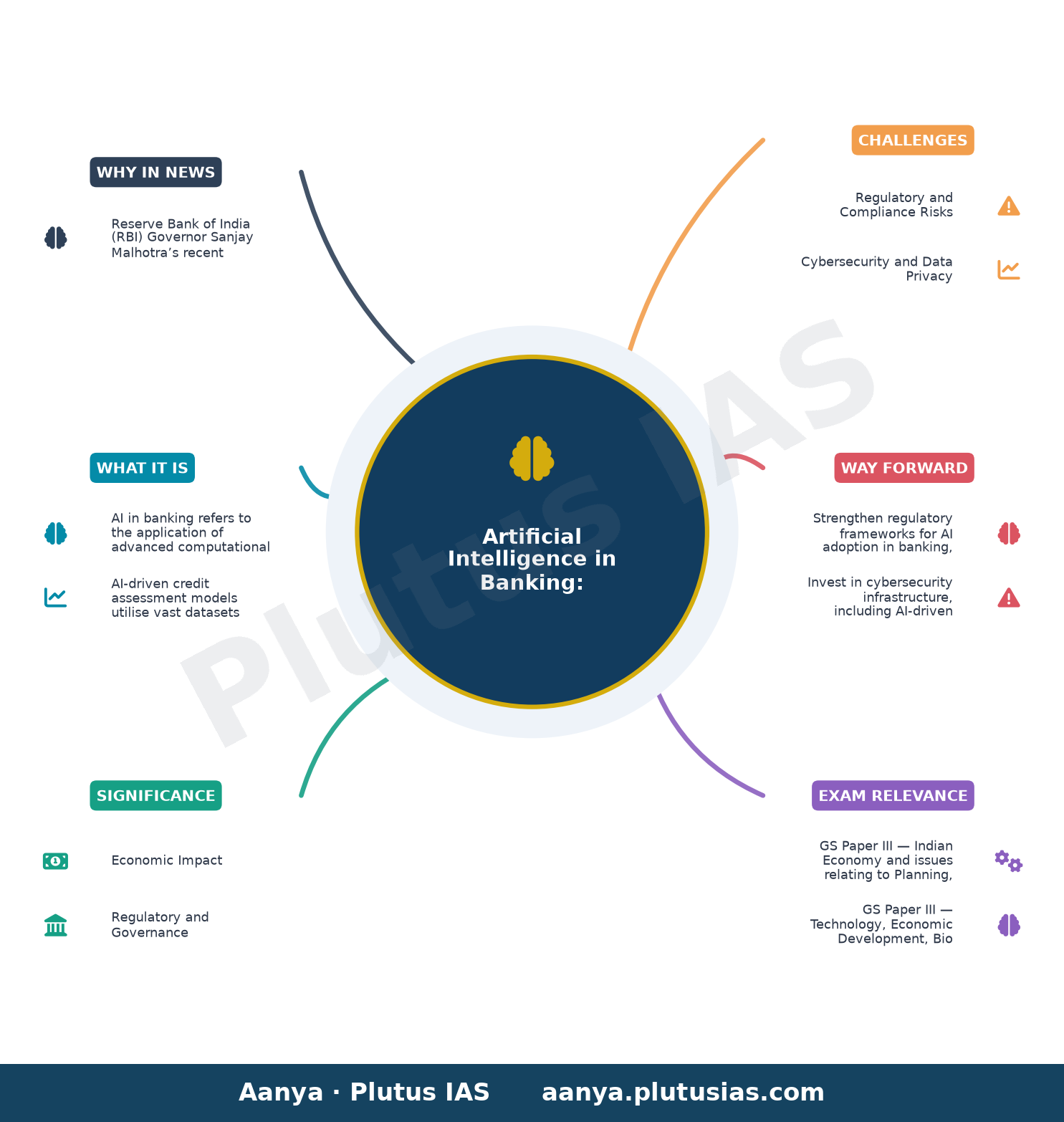
- GS Paper III — Indian Economy and issues relating to Planning, Mobilization of Resources, Growth, Development and Employment | GS Paper III — Technology, Economic Development, Bio diversity, Environment, Security and Disaster Management
- Prelims: Artificial Intelligence (AI), Machine Learning (ML), Cybersecurity, Data Privacy, RBI Guidelines, Financial Stability, Credit Growth, Non-Performing Assets (NPAs), Foreign Exchange Reserves, Geopolitical Risks
- Essay: The Role of Technology in Governance: Balancing Innovation with Risk, Ethical Dimensions of Artificial Intelligence in Public Policy
Quick Revision: AI adoption in banking must be balanced with robust governance frameworks to prevent systemic risks such as biased lending, data breaches, and third-party vendor dependencies, as emphasized by the RBI Governor.
Why is this in the news?
Reserve Bank of India (RBI) Governor Sanjay Malhotra’s recent address to India’s banking sector underscores the urgent need for accelerated adoption of Artificial Intelligence (AI) while simultaneously highlighting systemic risks, including biased decision-making, data privacy breaches, and cybersecurity vulnerabilities. This dual emphasis reflects a critical governance challenge: leveraging AI for efficiency and inclusion while mitigating threats to financial stability and consumer protection.
Background
- The Indian banking sector has witnessed a rapid digital transformation post-2015, driven by initiatives such as the Pradhan Mantri Jan Dhan Yojana (PMJDY) and the push for a cashless economy, which increased the demand for AI-driven solutions in credit assessment, fraud detection, and customer service.
- Global regulatory bodies, including the European Banking Authority (EBA) and the US Federal Reserve, have issued guidelines on AI governance, emphasizing transparency, accountability, and human oversight in automated decision-making systems.
- The Finance Minister, in her April 2026 address, had flagged AI-related risks to banks, calling for pre-emptive measures to secure IT systems, protect customer data, and enable real-time threat intelligence sharing.
What is Artificial Intelligence in Banking?
- AI in banking refers to the application of advanced computational techniques—including machine learning, natural language processing (NLP), and robotic process automation (RPA)—to automate and enhance financial services such as credit scoring, fraud detection, customer service (e.g., chatbots), and algorithmic trading.
- AI-driven credit assessment models utilise vast datasets (e.g., transaction history, utility payments, and social media activity) to evaluate borrower creditworthiness, potentially expanding access to formal credit for underserved segments like MSMEs and low-income households.
- Fraud detection systems powered by AI analyse transaction patterns in real-time to identify anomalies, reducing financial losses from cybercrime and identity theft.
- AI enhances operational efficiency by automating routine tasks (e.g., KYC verification, loan processing), reducing turnaround times, and lowering operational costs for banks.
- Generative AI is being explored for personalised financial advisory services, where AI models generate tailored investment recommendations based on user behaviour and risk profiles.
- AI’s predictive capabilities are leveraged in liquidity management and asset allocation, enabling banks to optimise cash flows and mitigate market risks.
- However, AI adoption is not uniform across banks; large private sector banks and fintech collaborations often lead in implementation, while public sector banks (PSBs) lag due to legacy systems and resource constraints.
Key Features
| Feature | Significance |
|---|---|
| Accelerated AI Adoption in Banking | Enhances operational efficiency, reduces costs, and improves customer service through automation and predictive analytics. |
| Risk of Biased/Opaque Decision-Making | AI models may perpetuate or amplify biases in lending, risk assessment, or fraud detection, undermining fairness and regulatory compliance. |
| Data Privacy and Cybersecurity Threats | Increased digitalisation exposes banks to cyberattacks, data breaches, and unauthorised access, threatening customer trust and financial stability. |
| Vendor Dependency Risks | Over-reliance on third-party AI models or vendors may introduce systemic vulnerabilities, errors, or lack of accountability in critical banking functions. |
| Human Oversight Imperatives | AI deployment must be complemented by robust governance frameworks, audit trails, and human intervention to mitigate risks and ensure accountability. |
Why it Matters
Economic Impact
- AI adoption in banking can enhance productivity, reduce transaction costs, and improve credit accessibility through faster and more accurate risk assessments.
- Efficiency gains from AI may translate into competitive advantages for banks, influencing market share and profitability in the financial sector.
- Resilient financial systems, as highlighted by Governor Malhotra, are critical for sustaining economic growth and macroeconomic stability.
Regulatory and Governance
- The Reserve Bank of India (RBI) is emphasising proactive regulation to address emerging risks in AI deployment, aligning with global best practices in financial governance.
- Centralised oversight ensures consistency in risk management practices across banks, preventing systemic vulnerabilities from disparate AI implementations.
- The RBI’s focus on pre-emptive measures reflects a shift toward anticipatory regulation in response to technological advancements.
Technological and Operational
- AI integration requires significant investment in technology infrastructure, workforce upskilling, and continuous monitoring to ensure reliability and security.
- Banks must balance innovation with risk mitigation, adopting AI solutions that are transparent, explainable, and aligned with ethical guidelines.
- Cyber resilience becomes paramount as AI-driven systems become primary targets for sophisticated cyber threats.
Macroeconomic Stability
- A robust banking sector, supported by AI-driven efficiency, contributes to financial inclusion and economic resilience amid global uncertainties.
- Healthy credit growth and low non-performing assets (NPAs) enhance the sector’s ability to absorb shocks, as noted by the RBI Governor.
- Strong foreign-exchange reserves and contained inflation further bolster India’s economic stability in the face of geopolitical and trade challenges.
Challenges
1. Regulatory and Compliance Risks
- Lack of standardised guidelines for AI adoption in banking may lead to inconsistent risk management practices across institutions.
- Regulatory arbitrage could emerge if banks exploit gaps in oversight to deploy untested AI models.
- Compliance with data protection laws (e.g., DPDP Act, 2023) becomes complex with AI-driven data processing.
UPSC Link: GS3: Financial Inclusion & Technology
2. Cybersecurity and Data Privacy
- AI systems are vulnerable to adversarial attacks, where malicious actors manipulate inputs to deceive models (e.g., deepfake fraud, synthetic identity theft).
- Unauthorised access to AI-driven customer data can lead to identity theft, financial fraud, and reputational damage for banks.
- Cross-border data flows in AI systems raise jurisdictional challenges in enforcing privacy laws.
UPSC Link: GS3: Cyber Security & Data Governance
3. Ethical and Fairness Concerns
- AI models may inherit biases from historical data, leading to discriminatory lending practices or unequal access to financial services.
- Opaque decision-making in AI systems (e.g., black-box algorithms) undermines transparency and customer trust.
- Accountability gaps arise when AI-driven errors occur, complicating liability and redressal mechanisms.
UPSC Link: GS4: Ethics in Governance
4. Operational and Systemic Risks
- Over-reliance on a few AI vendors may create single points of failure, increasing systemic risk in the banking sector.
- AI-driven automation could lead to job displacement in traditional banking roles, necessitating reskilling initiatives.
- Interoperability issues between legacy systems and AI platforms may disrupt banking operations.
UPSC Link: GS3: Banking Sector Reforms
5. Geopolitical and Trade Uncertainties
- Global supply chain disruptions and trade tensions may impact the availability of AI hardware, software, and talent.
- Sanctions or restrictions on technology exports (e.g., semiconductor bans) could hinder AI adoption in Indian banks.
- Geopolitical risks may also influence cyber threat landscapes, increasing the frequency of state-sponsored attacks.
UPSC Link: GS2: International Relations
Challenges — UPSC Perspective
| Issue | Concern |
|---|---|
| Algorithmic Bias | Perpetuation of discriminatory lending or risk assessment practices due to flawed training data. |
| Data Privacy Breaches | Unauthorised access or leakage of sensitive customer data processed by AI systems. |
| Vendor Lock-in | Dependency on proprietary AI models or vendors may limit flexibility and increase costs. |
| Cyber Threats | Sophisticated attacks targeting AI-driven banking systems, including adversarial machine learning. |
| Regulatory Gaps | Lack of clear guidelines on AI governance, accountability, and auditability in banking. |
| Workforce Displacement | Automation of routine tasks may reduce demand for traditional banking roles, necessitating reskilling. |
Way Forward
- Strengthen regulatory frameworks for AI adoption in banking, including mandatory audits, explainability requirements, and bias testing.
- Invest in cybersecurity infrastructure, including AI-driven threat detection, encryption, and zero-trust architectures.
- Promote public-private partnerships to develop indigenous AI solutions, reducing dependency on foreign vendors.
- Enhance workforce upskilling programmes to prepare banking professionals for AI-augmented roles.
- Establish cross-sectoral collaboration (RBI, SEBI, CERT-In) for real-time threat intelligence sharing and coordinated responses.
- Develop ethical guidelines for AI deployment, ensuring fairness, transparency, and accountability in banking operations.
- Encourage banks to adopt open-source AI models where feasible, to enhance transparency and reduce vendor risks.
- Integrate AI governance into existing risk management frameworks, aligning with global standards like the Basel Committee’s AI principles.
UPSC Value Addition
Keywords for Mains Answer-Writing
Artificial Intelligence in banking · Regulation of AI in financial sector · Cybersecurity risks in banking · Data privacy and AI bias · Reserve Bank of India (RBI) guidelines on AI · Financial stability and AI adoption · Digital lending and AI · Cyber resilience in banking · AI governance frameworks · Operational risks in AI deployment · Regulatory sandbox for fintech · Customer protection in AI-driven banking · Third-party risk management in AI · AI and financial inclusion
Concept Flow
RBI Governor highlights AI adoption in banking → Banks face efficiency gains but also new risks (bias, cyber threats) → Regulatory bodies (RBI) call for safeguards and human oversight → Global best practices influence India’s approach → Macroeconomic stability depends on resilient banking systems → Long-term economic growth hinges on balanced AI integration.
Prelims Practice Questions
Q1. Consider the following statements regarding the use of Artificial Intelligence (AI) in the banking sector:
1. AI adoption in banking is primarily driven by the need to enhance operational efficiency and reduce costs.
2. The Reserve Bank of India (RBI) has mandated that banks must deploy AI models developed exclusively in-house.
3. Wider AI adoption in banking introduces risks such as biased decision-making, data privacy concerns, and cybersecurity threats.
4. The RBI Governor has cautioned banks against over-reliance on third-party AI technology vendors.
How many of the above statements are correct?
- Only one
- Only two
- Only three
- All four
Answer: All four — Statements 1, 3, and 4 are correct. Statement 2 is incorrect as the RBI has not mandated in-house AI development but has emphasized understanding and managing risks associated with third-party vendors.
Q2. Assertion (A): The Reserve Bank of India (RBI) has urged banks to accelerate investments in Artificial Intelligence (AI) to enhance efficiency.
Reason (R): AI adoption in banking is expected to reduce the need for human oversight in decision-making processes.
Options:
A. Both A and R are true, and R is the correct explanation of A.
B. Both A and R are true, but R is not the correct explanation of A.
C. A is true, but R is false.
D. A is false, but R is true.
- A
- B
- C
- D
Answer: C — Assertion (A) is true as the RBI Governor has urged banks to accelerate AI adoption. Reason (R) is false because the RBI has also warned about the risks of over-reliance on AI and the need for human oversight.
Q3. Match the following risks associated with AI adoption in banking with their descriptions:
Risks:
1. Biased decision-making
2. Data privacy threats
3. Cybersecurity vulnerabilities
4. Operational failures due to third-party dependence
Descriptions:
A. Exposure to errors or disruptions due to reliance on external AI technology providers.
B. Increased susceptibility to cyberattacks and data breaches.
C. Algorithmic decisions that disproportionately affect certain customer groups.
D. Unauthorized access or misuse of sensitive customer data.
Options:
1-C, 2-D, 3-B, 4-A
1-A, 2-B, 3-C, 4-D
1-D, 2-C, 3-A, 4-B
1-B, 2-A, 3-D, 4-C
- 1-C, 2-D, 3-B, 4-A
- 1-A, 2-B, 3-C, 4-D
- 1-D, 2-C, 3-A, 4-B
- 1-B, 2-A, 3-D, 4-C
Answer: 1-C, 2-D, 3-B, 4-A — The correct match is: 1-C (Biased decision-making), 2-D (Data privacy threats), 3-B (Cybersecurity vulnerabilities), 4-A (Operational failures due to third-party dependence).
Mains Practice Question
✍ Artificial Intelligence (AI) is increasingly being adopted by banks to enhance efficiency, personalise services, and improve risk management. However, its deployment also introduces significant risks to financial stability, consumer protection, and cyber resilience. Critically examine the regulatory and governance challenges posed by AI adoption in the banking sector in India. Also, outline the measures that the Reserve Bank of India (RBI) and banks can take to mitigate these risks while fostering innovation. (15 Marks)
Approach: Introduction: Define AI in banking and its benefits (e.g., fraud detection, credit scoring, chatbots). Highlight the RBI Governor’s recent remarks on AI adoption and associated risks. Regulatory and Governance Challenges:
1. **Bias and Opacity**: Explain algorithmic bias (e.g., discriminatory lending practices) and the challenge of ‘black-box’ AI models. Reference the RBI’s concerns about opaque decision-making.
2. **Data Privacy and Security**: Discuss risks of data breaches, unauthorised access, and compliance with the Digital Personal Data Protection Act, 2023. Cite examples of cyberattacks on banks (e.g., SWIFT breaches).
3. **Third-Party Risk**: Analyse the RBI’s warning about over-reliance on external AI vendors. Discuss operational risks, vendor lock-in, and lack of transparency in third-party AI solutions.
4. **Financial Stability**: Examine systemic risks from widespread AI adoption (e.g., herd behaviour, model failures). Reference global concerns (e.g., Bank of England’s Financial Stability Report).
5. **Regulatory Gaps**: Identify gaps in India’s regulatory framework (e.g., absence of dedicated AI regulations, reliance on sectoral guidelines like RBI’s Master Directions on IT). Measures to Mitigate Risks and Foster Innovation:
1. **RBI’s Role**:
– Strengthen guidelines on AI governance (e.g., model risk management, explainability requirements).
– Expand the regulatory sandbox to test AI-driven fintech solutions with safeguards.
– Mandate human oversight for high-stakes decisions (e.g., loan approvals, fraud detection).
– Enhance cyber resilience frameworks (e.g., RBI’s Cyber Security Framework for Banks).
2. **Banks’ Responsibilities**:
– Invest in AI literacy and upskilling for employees to understand model limitations.
– Implement robust data governance (e.g., anonymisation, encryption, access controls).
– Conduct regular audits of AI models for bias, accuracy, and compliance.
– Diversify AI technology providers to avoid vendor lock-in.
3. **Collaborative Efforts**:
– Industry-wide sharing of threat intelligence (e.g., RBI’s proposed real-time threat intelligence sharing).
– Partnerships with academia and think tanks to develop ethical AI frameworks.
4. **Consumer Protection**:
– Ensure transparency in AI-driven decisions (e.g., right to explanation under the DPDP Act).
– Establish grievance redressal mechanisms for AI-related disputes. Conclusion: Balance the need for innovation with risk mitigation. Emphasise that AI adoption should be gradual, well-governed, and aligned with India’s broader digital public infrastructure (e.g., UPI, Aadhaar, DPDP Act). Highlight the RBI’s role in ensuring a stable and inclusive financial ecosystem.
Source: Business Standard
Generated by AanyaAi for educational purpose.

- KWML’s Feasibility Reports for Water Metro in 18 Cities: UPSC & PCS Insights - October 3, 2026
- ओडिशा में वन्यजीव अनुसंधान अनुदान कार्यक्रम शुरू, सिमिलिपाल में 300 कैमरे और बढ़ेंगे - October 3, 2026
- India Summons Pakistan High Commission Official Over Violation - October 3, 2026

No Comments