


06 Aug RBI releases draft NBFC credit norms: Key changes for UPSC 2026 aspirants
✎ The RBI’s draft directions for NBFC credit facilities aim to enhance prudential norms, governance, and risk management to mitigate systemic risks and align with global financial stability standards.
Subject Relevance — Where This Topic Fits
- GS Paper III — Indian Economy (Financial Sector Regulations)
- Prelims: Non-Banking Financial Companies (NBFCs), RBI Directions, credit risk management, systemic risk, financial stability, regulatory arbitrage, Basel III norms, shadow banking, financial sector reforms
- Essay: Regulatory oversight in India’s financial sector: Balancing innovation and stability
Quick Revision: The RBI’s draft directions for NBFC credit facilities aim to enhance prudential norms, governance, and risk management to mitigate systemic risks and align with global financial stability standards.
Why is this in the news?
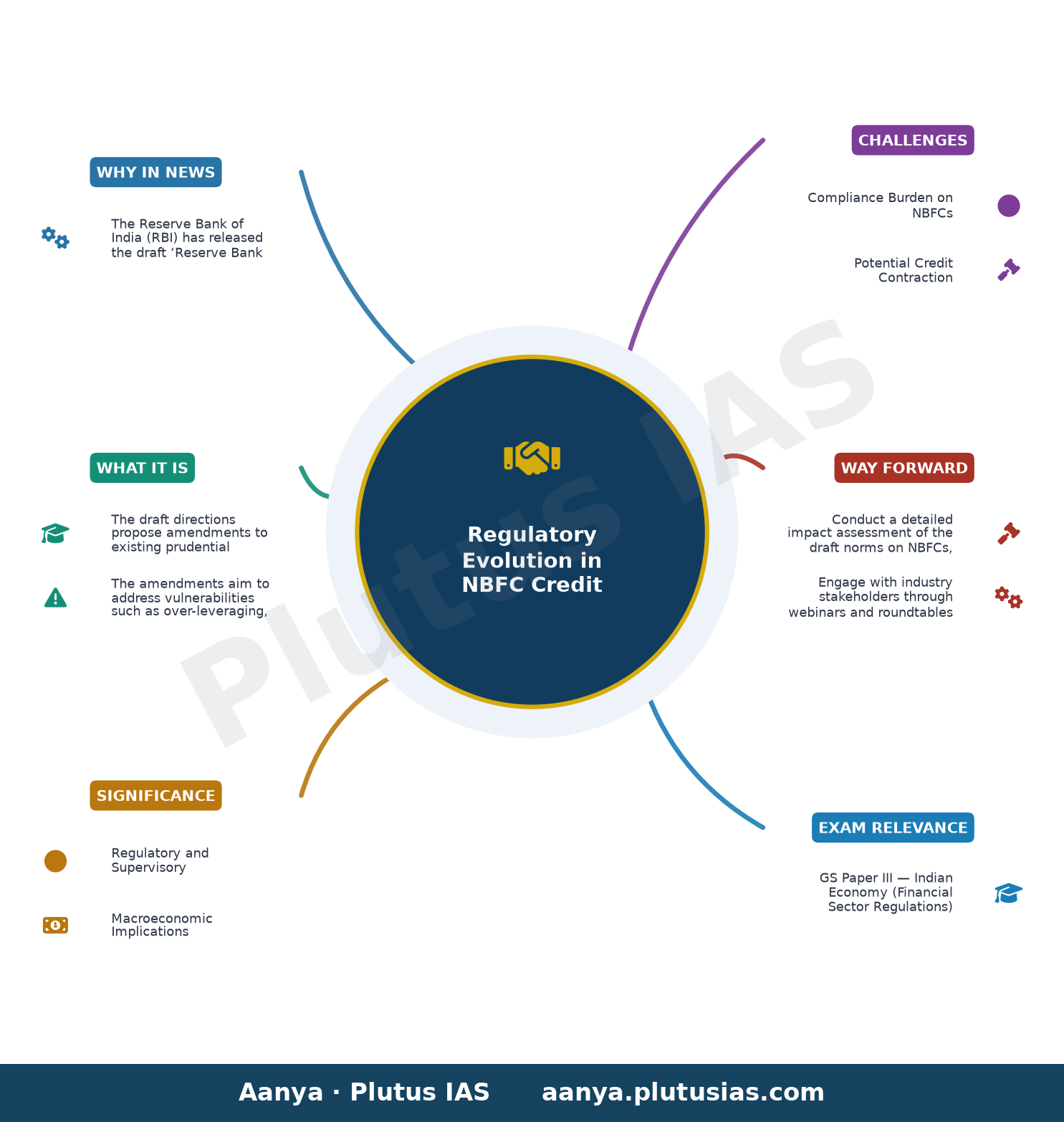
The Reserve Bank of India (RBI) has released the draft ‘Reserve Bank of India (Non-Banking Financial Companies – Credit Facilities) Amendment Directions, 2026’, inviting public comments until August 28, 2026. This regulatory initiative aims to address emerging risks in the NBFC sector by enhancing prudential norms for credit facilities extended by these entities. The move is part of RBI’s ongoing efforts to strengthen the financial ecosystem, particularly in light of recent episodes of stress in the shadow banking segment and the growing interlinkages between NBFCs and the broader financial system.
Background
- The NBFC sector in India has expanded significantly over the past decade, playing a pivotal role in credit intermediation, especially for underserved segments such as MSMEs, retail borrowers, and infrastructure projects.
- NBFCs are regulated by the RBI under the Reserve Bank of India Act, 1934, and the directions issued under Section 45L of the Act empower the RBI to prescribe prudential norms for credit facilities extended by these entities.
- The sector has faced regulatory scrutiny due to instances of liquidity mismatches, asset-liability imbalances, and governance concerns, which were exacerbated during the COVID-19 pandemic and subsequent economic shocks.
- The RBI has progressively tightened norms for NBFCs, including higher capital adequacy requirements, liquidity coverage ratios, and exposure limits, to mitigate systemic risks.
- The draft directions mark a forward-looking regulatory approach, anticipating future risks such as digital lending, fintech collaborations, and climate-related financial risks in credit portfolios.
- Public consultation is a cornerstone of RBI’s regulatory process, ensuring stakeholder engagement and alignment with ground realities before finalising norms.
What are the Reserve Bank of India (Non-Banking Financial Companies – Credit Facilities) Amendment Directions, 2026?
- The draft directions propose amendments to existing prudential norms governing credit facilities extended by NBFCs, including stricter guidelines on loan-to-value (LTV) ratios, risk weights, and exposure ceilings for specific sectors.
- The amendments aim to address vulnerabilities such as over-leveraging, concentration risks, and misalignment between asset and liability profiles in NBFCs.
- Key proposed changes include enhanced disclosure requirements for NBFCs regarding their credit portfolios, particularly for high-risk sectors like real estate, capital markets, and unsecured personal loans.
- The directions seek to align NBFC regulations more closely with global standards, such as Basel III norms, to ensure resilience against macroeconomic shocks and systemic risks.
- The draft also introduces provisions for better governance and risk management frameworks within NBFCs, including board oversight of credit policies and independent risk assessment mechanisms.
- The RBI has proposed stricter norms for large NBFCs (those with assets exceeding ₹5,000 crore) to mitigate their systemic footprint, including higher capital buffers and liquidity requirements.
- The amendments are expected to curb regulatory arbitrage by harmonising norms across different categories of NBFCs, including Core Investment Companies (CICs) and Housing Finance Companies (HFCs).
- The draft directions are part of a broader regulatory agenda to deepen financial inclusion while safeguarding financial stability, particularly in the context of digital lending and fintech partnerships.
Key Features
| Feature | Significance |
|---|---|
| Draft Directions on Credit Facilities for NBFCs | Proposes regulatory amendments to the RBI (Non-Banking Financial Companies – Credit Facilities) Directions, 2016, aimed at enhancing prudential norms for credit exposure by NBFCs. |
| Stakeholder Consultation | Invites feedback from regulated entities (NBFCs, banks, and other stakeholders) via ‘Connect 2 Regulate’ portal or email, ensuring participatory governance in regulatory evolution. |
| Timeline for Feedback | Comments must be submitted by August 28, 2026, allowing a 22-day window for stakeholders to analyze and respond to the draft provisions. |
| Focus on Credit Risk Management | Likely introduces stricter guidelines on exposure norms, risk weights, and asset classification to mitigate systemic risks arising from NBFC credit portfolios. |
| Alignment with Basel-III Norms | Potential integration of Basel-III principles into NBFC credit frameworks to harmonize risk management practices across the financial sector. |
Why it Matters
Regulatory and Supervisory
- Strengthens RBI’s oversight over NBFC credit activities, reducing regulatory arbitrage between banks and non-banks.
- Enhances transparency in credit underwriting and risk assessment by NBFCs, aligning with global best practices.
- Mitigates systemic risks by imposing stricter prudential norms, particularly for large NBFCs with significant credit exposure.
- Supports the RBI’s objective of maintaining financial stability amid rapid growth in NBFC credit disbursement.
Macroeconomic Implications
- Ensures sustainable credit growth by preventing excessive leverage in the NBFC sector, which could lead to asset-liability mismatches.
- Reduces the likelihood of liquidity crises in NBFCs, thereby protecting retail depositors and investors.
- Promotes disciplined lending practices, curbing shadow banking risks that could spill over into the broader financial system.
Stakeholder Impact
- NBFCs may face higher compliance costs due to stricter risk management requirements, particularly for mid-sized and smaller players.
- Banks and financial institutions may benefit from reduced competition from NBFCs in high-risk credit segments, depending on the final norms.
- Retail borrowers could experience tighter credit availability for unsecured loans or SME financing if NBFCs reduce disbursements.
Policy Coherence
- Complements existing RBI frameworks such as the Liquidity Coverage Ratio (LCR) and Net Stable Funding Ratio (NSFR) for NBFCs.
- Aligns with the Financial Stability and Development Council (FSDC) mandate to monitor systemic risks in non-bank financial intermediaries.
Challenges
1. Compliance Burden on NBFCs
- Smaller NBFCs may struggle with the cost of implementing new risk management systems and hiring specialized compliance personnel.
- Increased regulatory scrutiny could deter new entrants into the NBFC sector, limiting financial inclusion.
UPSC Link: Economic Development: NBFCs
2. Potential Credit Contraction
- Stricter exposure norms may reduce the availability of credit for MSMEs, startups, and low-income borrowers who rely heavily on NBFC financing.
- Risk aversion in lending could slow down economic growth, particularly in sectors dependent on NBFC credit.
UPSC Link: Indian Economy: Credit Markets
3. Operational Challenges in Implementation
- NBFCs may face difficulties in realigning their loan portfolios to comply with new risk weights and exposure limits within the stipulated timeline.
- Data gaps in credit history and collateral valuation could hinder accurate risk assessment under the new framework.
UPSC Link: Financial Sector Reforms
4. Systemic Risk Management
- The RBI must balance stricter norms with the need to avoid over-regulation that could stifle innovation in financial services.
- Ensuring uniformity in enforcement across diverse NBFC segments (e.g., housing finance companies vs. microfinance institutions) remains a challenge.
UPSC Link: RBI: Monetary Policy
5. Stakeholder Resistance and Lobbying
- NBFC industry associations may oppose stringent provisions, citing competitive disadvantages vis-à-vis banks.
- Political economy considerations could delay or dilute the final norms, especially if credit flow to key sectors is affected.
UPSC Link: Regulatory Governance
Challenges — UPSC Perspective
| Issue | Concern |
|---|---|
| High Compliance Costs | May disproportionately burden smaller NBFCs, leading to consolidation in the sector. |
| Credit Squeeze for MSMEs | Stricter norms could reduce NBFC lending to micro, small, and medium enterprises, impacting employment generation. |
| Data Infrastructure Gaps | Inadequate credit bureaus and collateral registries may hinder effective risk assessment under new norms. |
| Enforcement Uniformity | Variations in RBI’s supervisory approach across NBFC categories could create regulatory arbitrage. |
| Macroeconomic Trade-offs | Balancing financial stability with credit growth requires calibrated policy adjustments. |
| Industry Resistance | Lobbying by NBFCs may lead to diluted regulations, undermining the RBI’s objectives. |
Way Forward
- Conduct a detailed impact assessment of the draft norms on NBFCs, particularly mid-sized and smaller players, to identify potential bottlenecks.
- Engage with industry stakeholders through webinars and roundtables to gather nuanced feedback on operational challenges.
- Ensure phased implementation of stricter norms to allow NBFCs adequate time for compliance and system upgrades.
- Strengthen credit bureaus and collateral registries to support accurate risk assessment under the new framework.
- Monitor liquidity conditions in the NBFC sector post-implementation to preempt any systemic stress.
- Collaborate with the Ministry of Finance and FSDC to align the norms with broader financial sector reforms.
- Publish a comprehensive FAQ document to clarify ambiguities in the draft directions for regulated entities.
- Establish a dedicated RBI task force to oversee the transition and address grievances from NBFCs.
UPSC Value Addition
Keywords for Mains Answer-Writing
Non-Banking Financial Companies (NBFCs) · Reserve Bank of India (RBI) · Credit Facilities Directions · NBFC regulatory framework · Financial sector regulation · Systemic risk mitigation in NBFCs · NBFC liquidity norms · RBI Directions 2026 · Financial stability · NBFC governance · Credit discipline in NBFCs · Regulatory arbitrage in financial sector
Concept Flow
RBI identifies systemic risks in NBFC credit portfolios → Draft Directions on Credit Facilities for NBFCs (2026) proposed → Stakeholder consultation initiated via ‘Connect 2 Regulate’ → Feedback analyzed and incorporated → Final Directions notified → NBFCs realign credit policies and risk models → Compliance monitoring and enforcement by RBI → Impact on credit markets and economic growth assessed → Policy refinements based on outcomes.
Prelims Practice Questions
Q1. Consider the following statements regarding the Reserve Bank of India’s regulatory powers over Non-Banking Financial Companies (NBFCs):
1. The RBI can issue directions to NBFCs under Section 45JA of the Reserve Bank of India Act, 1934.
2. The draft “Reserve Bank of India (Non-Banking Financial Companies – Credit Facilities) Amendment Directions, 2026” seeks to amend existing directions issued under Section 45L of the RBI Act.
3. The RBI’s regulatory directions to NBFCs are legally binding and enforceable under the Banking Regulation Act, 1949.
How many of the above statements are correct?
- Only one
- Only two
- All three
- None
Answer: Only two — Statement 1 is correct: Section 45JA empowers the RBI to issue directions to NBFCs for the purpose of regulation. Statement 2 is incorrect: The draft directions pertain to credit facilities, which are typically governed by Section 45L (powers to give directions in public interest) rather than Section 45JA. Statement 3 is incorrect: The directions are issued under the RBI Act, 1934, not the Banking Regulation Act, 1949, which applies primarily to banks.
Q2. Assertion (A): The Reserve Bank of India (RBI) has recently invited public comments on draft directions aimed at regulating credit facilities extended by Non-Banking Financial Companies (NBFCs).
Reason (R): The RBI’s draft directions are intended to address systemic risks and enhance the governance framework of NBFCs.
In the context of the above two statements, which one of the following is correct?
- Both A and R are true, and R is the correct explanation of A.
- Both A and R are true, but R is not the correct explanation of A.
- A is true, but R is false.
- A is false, but R is true.
Answer: Both A and R are true, but R is not the correct explanation of A. — Assertion (A) is true: The RBI has invited comments on the draft directions. Reason (R) is also true and correctly explains the purpose of the draft directions, which aim to mitigate systemic risks and strengthen governance in NBFCs.
Q3. Match the following provisions of the Reserve Bank of India Act, 1934 with their corresponding powers:
Column I (Provision) Column II (Power)
A. Section 45JA 1. Power to prohibit the acceptance of fresh deposits
B. Section 45L 2. Power to give directions in public interest
C. Section 45MA 3. Power to regulate the business of NBFCs
D. Section 45NA 4. Power to inspect books of NBFCs
Select the correct match:
- A-3, B-2, C-4, D-1
- A-2, B-3, C-1, D-4
- A-1, B-2, C-3, D-4
- A-3, B-1, C-2, D-4
Answer: A-3, B-2, C-4, D-1 — The correct matches are: A-3 (Section 45JA empowers the RBI to regulate the business of NBFCs), B-2 (Section 45L empowers the RBI to give directions in public interest), C-4 (Section 45MA empowers the RBI to inspect the books of NBFCs), and D-1 (Section 45NA empowers the RBI to prohibit the acceptance of fresh deposits).
Mains Practice Question
✍ Critically evaluate the necessity and potential implications of the Reserve Bank of India’s draft “Reserve Bank of India (Non-Banking Financial Companies – Credit Facilities) Amendment Directions, 2026”. In your answer, highlight the regulatory gaps it seeks to address and analyse its likely impact on the governance, liquidity, and systemic stability of Non-Banking Financial Companies (NBFCs). (15 Marks)
Approach: MODEL-ANSWER SKELETON:
I. Introduction (2 marks):
– Define NBFCs and their role in the Indian financial ecosystem.
– State the significance of the RBI’s regulatory framework for NBFCs under the RBI Act, 1934 (Sections 45JA, 45L, 45MA).
– Briefly mention the context: rising systemic risks in NBFCs and the need for updated directions.
II. Regulatory gaps addressed by the draft directions (4 marks):
– Lack of uniformity in credit underwriting standards among NBFCs.
– Inadequate liquidity risk management frameworks in NBFCs.
– Absence of clear guidelines on related-party transactions and connected lending.
– Weak governance structures, including board oversight and risk management.
– Reference to recent incidents (e.g., IL&FS crisis, DHFL collapse) to illustrate systemic risks.
III. Key provisions of the draft directions (4 marks):
– Proposed amendments to credit appraisal norms, exposure limits, and loan classification.
– Enhanced disclosure requirements for NBFCs.
– Strengthened governance and internal audit mechanisms.
– Liquidity coverage ratio (LCR) and net stable funding ratio (NSFR) norms for large NBFCs.
– Prohibition of evergreening of loans and stricter norms for related-party transactions.
IV. Potential implications (5 marks):
– Positive: Improved financial stability, reduced contagion risk, enhanced investor confidence, and better risk management.
– Negative: Increased compliance burden, higher operational costs for NBFCs, potential reduction in credit availability for certain sectors, and challenges in implementation for smaller NBFCs.
– Comparative analysis: Contrast with existing frameworks (e.g., RBI’s Master Direction on NBFCs, 2016) and global best practices (e.g., Basel III norms for NBFCs).
– Scholarly perspectives: Reference to works by Merton (financial innovation and systemic risk), Diamond and Dybvig (bank runs), or RBI’s Financial Stability Reports.
V. Conclusion (2 marks):
– Summarise the need for balanced regulation that promotes stability without stifling innovation.
– Suggest measures for effective implementation, such as phased rollout, capacity building, and stakeholder consultations.
Source: RBI
Generated by AanyaAi for educational purpose.

- F-35 Stealth Fighter to Feature in India’s Tarang Shakti 2026 Exercise - September 22, 2026
- UPSC Civil Services (Main) Examination 2026 — Sindhi Devanagari Literature Paper II: Question Paper | Plutus IAS - September 22, 2026
- गूगल भी करेगा बाल यौन शोषण सामग्री की सीधे भारतीय अधिकारियों को रिपोर्टिंग - September 22, 2026

No Comments