


05 Aug RBI Releases June 2026 ECB/FCCB/RDB Data: Key Trends for UPSC & PCS
✎ External Commercial Borrowings (ECBs) are foreign currency-denominated loans raised by Indian entities from non-resident lenders, with repayment obligations in foreign currency, and are governed by the RBI’s Track I, II, and III…
Subject Relevance — Where This Topic Fits
- GS Paper III — Indian Economy and Issues Relating to Planning, Mobilisation of Resources, Growth, Development and Employment | GS Paper III — Effects of Liberalisation on the Economy, Changes in Industrial Policy and their Effects on Industrial Growth | GS Paper III — Balance of Payments and Foreign Exchange Reserves
- Prelims: External Commercial Borrowings (ECB), Foreign Currency Convertible Bonds (FCCB), Rupee Denominated Bonds (RDB), Automatic Route vs Approval Route for ECB, Foreign Exchange Management Act (FEMA), 1999
- Essay: The Role of External Commercial Borrowings in India’s Economic Growth: Opportunities and Challenges, India’s Foreign Exchange Reserves: Management, Composition, and Strategic Importance
Quick Revision: External Commercial Borrowings (ECBs) are foreign currency-denominated loans raised by Indian entities from non-resident lenders, with repayment obligations in foreign currency, and are governed by the RBI’s Track I, II, and III maturity frameworks to ensure debt sustainability.
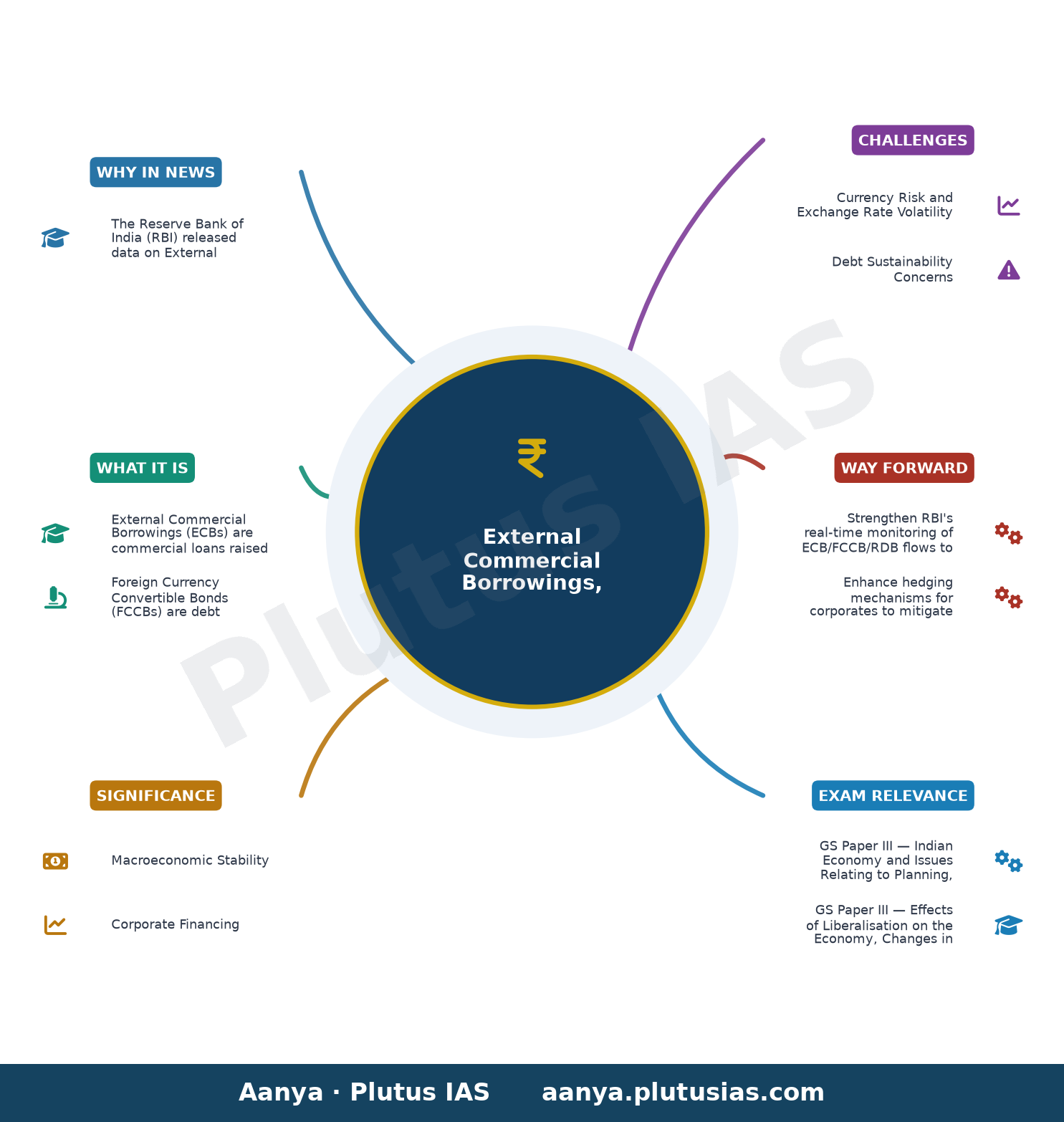
Why is this in the news?
The Reserve Bank of India (RBI) released data on External Commercial Borrowings (ECB), Foreign Currency Convertible Bonds (FCCB), and Rupee Denominated Bonds (RDB) for June 2026, providing insights into India’s external debt composition, capital inflows, and the utilisation of foreign exchange resources. This data is critical for assessing India’s balance of payments, debt sustainability, and the effectiveness of monetary policy in managing external financial flows. The release also highlights trends in borrowing under the Automatic Route versus the Approval Route, reflecting the RBI’s evolving regulatory stance on capital account convertibility.
Background
- The External Commercial Borrowings (ECB) framework in India is governed by the Foreign Exchange Management Act (FEMA), 1999, and is a key component of India’s capital account, facilitating access to foreign funds for domestic entities.
- Foreign Currency Convertible Bonds (FCCBs) are a hybrid instrument combining debt and equity features, issued by Indian corporates in foreign currencies and convertible into equity shares at a predetermined price.
- Rupee Denominated Bonds (RDBs), also known as Masala Bonds, are debt instruments issued by Indian entities in foreign markets but denominated in Indian Rupees, thereby transferring currency risk to the lender.
- The RBI periodically releases data on ECB/FCCB/RDB to monitor capital flows, assess external debt risks, and ensure compliance with macroeconomic stability objectives.
What are External Commercial Borrowings (ECB), FCCBs, and Rupee Denominated Bonds (RDB)?
- External Commercial Borrowings (ECBs) are commercial loans raised by eligible Indian entities from non-resident lenders, with repayment obligations in foreign currency. They are a critical source of foreign exchange for financing large-scale projects in sectors such as infrastructure, manufacturing, and renewable energy.
- Foreign Currency Convertible Bonds (FCCBs) are debt instruments that can be converted into equity shares of the issuing company at a later date. They offer lower interest costs compared to pure debt instruments but carry equity dilution risk for existing shareholders.
- FCCBs are typically issued to foreign investors and are governed by the RBI’s regulations on foreign investment in corporate debt, including sectoral caps and pricing norms.
- Rupee Denominated Bonds (RDBs), or Masala Bonds, are debt instruments issued by Indian entities in foreign markets but denominated in Indian Rupees. This shifts the currency risk from the borrower to the lender, making them attractive during periods of rupee depreciation.
- They are listed on international exchanges and are subject to RBI’s external commercial borrowing guidelines.
- The Automatic Route for ECBs allows eligible borrowers to raise funds without prior RBI approval, subject to compliance with prescribed norms such as all-in-cost ceilings, maturity periods, and end-use restrictions.
- The Approval Route requires prior RBI approval for ECBs that do not meet the criteria for the Automatic Route, particularly for sectors with higher risk profiles or where specific conditions need to be evaluated.
Key Features
| Feature | Significance |
|---|---|
| External Commercial Borrowings (ECB) | Primary source of foreign capital for Indian corporates, enabling large-scale infrastructure and industrial projects with longer maturities and competitive interest rates. |
| Foreign Currency Convertible Bonds (FCCB) | Hybrid instruments combining debt and equity features, offering issuers the option to convert bonds into equity at a predetermined rate, reducing immediate repayment pressure. |
| Rupee Denominated Bonds (RDB) | Bonds issued in Indian Rupees by foreign entities, mitigating currency risk for Indian borrowers and diversifying the investor base for domestic currency-denominated debt. |
| Automatic Route | Permits eligible borrowers to raise ECB/FCCB/RDB up to specified limits without prior RBI approval, streamlining the process and reducing transactional delays. |
| Approval Route | Requires prior RBI or government approval for borrowings exceeding automatic route limits or for sectors with specific regulatory restrictions, ensuring macroeconomic stability and sectoral balance. |
Why it Matters
Macroeconomic Stability
- Facilitates foreign exchange inflows, supporting India’s Balance of Payments (BoP) position and external sector resilience.
- Provides an alternative to volatile portfolio investments, reducing reliance on short-term foreign capital.
- Enhances the depth and liquidity of India’s corporate bond market, fostering financial market development.
Corporate Financing
- Enables large-scale capital expenditure in sectors such as infrastructure, manufacturing, and renewable energy, which are critical for India’s growth trajectory.
- Offers cost advantages over domestic borrowings for creditworthy corporates, given global interest rate differentials.
- Supports refinancing of existing debt, improving corporate balance sheets and debt sustainability.
Monetary Policy Transmission
- Influences domestic liquidity conditions and interest rate dynamics, particularly in segments with high foreign participation.
- Provides a channel for global monetary policy spillovers to the Indian economy, necessitating vigilant monitoring by the RBI.
Sectoral Development
- Supports priority sectors such as renewable energy, affordable housing, and startups through targeted ECB/FCCB/RDB issuances.
- Encourages foreign direct investment (FDI) in associated sectors, aligning with India’s self-reliance (Atmanirbhar Bharat) objectives.
Challenges
1. Currency Risk and Exchange Rate Volatility
- ECBs/FCCBs denominated in foreign currencies expose Indian borrowers to exchange rate risks, particularly in periods of rupee depreciation.
- RDBs mitigate this risk but may face lower investor appetite due to currency mismatch concerns for foreign lenders.
UPSC Link: Monetary Policy Framework
2. Debt Sustainability Concerns
- Excessive reliance on external borrowings can lead to unsustainable debt levels, particularly if global interest rates rise or growth slows.
- Corporate defaults on ECB/FCCB obligations may trigger capital outflows, impacting financial stability.
UPSC Link: Fiscal Responsibility and Budget Management Act
3. Regulatory Arbitrage and Compliance Burden
- Complexity in navigating dual compliance requirements (RBI and host country regulations) for cross-border borrowings.
- Stringent end-use restrictions and reporting norms increase operational costs for borrowers.
UPSC Link: FEMA 1999
4. Global Financial Cycle Spillovers
- Tightening global financial conditions (e.g., US Fed rate hikes) can reduce the availability and increase the cost of ECB/FCCB/RDB financing for Indian entities.
- Contagion risks from geopolitical tensions or sovereign debt crises in emerging markets.
UPSC Link: Global Financial Architecture
5. Sectoral Concentration Risks
- Over-reliance on specific sectors (e.g., real estate, infrastructure) for ECB/FCCB issuances can create asset bubbles and systemic risks.
- Limited participation from MSMEs due to high transaction costs and stringent eligibility criteria.
UPSC Link: Priority Sector Lending
Challenges — UPSC Perspective
| Issue | Concern |
|---|---|
| Exchange Rate Fluctuations | Potential erosion of debt servicing capacity for borrowers with unhedged foreign currency exposure. |
| Debt Servicing Capacity | Risk of default if cash flows from projects funded by ECB/FCCB/RDB do not materialise as projected. |
| Regulatory Compliance | Complexity in meeting RBI’s end-use, all-in-cost, and reporting requirements for cross-border borrowings. |
| Global Liquidity Conditions | Reduced investor appetite during periods of global financial tightening, leading to higher borrowing costs. |
| Sectoral Imbalances | Overconcentration of external borrowings in capital-intensive sectors, exacerbating structural vulnerabilities. |
| Currency Mismatch | Mismatch between foreign currency liabilities and rupee-denominated revenues for borrowers in non-tradeable sectors. |
Way Forward
- Strengthen RBI’s real-time monitoring of ECB/FCCB/RDB flows to pre-empt systemic risks and ensure compliance with end-use norms.
- Enhance hedging mechanisms for corporates to mitigate exchange rate risks, including mandatory currency risk management for large borrowings.
- Rationalise sectoral caps and all-in-cost ceilings for ECB/FCCB/RDB to balance growth needs with debt sustainability.
- Promote RDB issuances by Indian entities to diversify funding sources and reduce reliance on foreign currency debt.
- Expand the investor base for RDBs by engaging with multilateral institutions and sovereign wealth funds.
- Streamline approval processes for sectors critical to India’s green transition (e.g., renewable energy, electric mobility).
- Conduct periodic stress tests on corporates with significant external borrowings to assess debt repayment capacity under adverse scenarios.
UPSC Value Addition
Keywords for Mains Answer-Writing
External Commercial Borrowings (ECB) · Foreign Currency Convertible Bonds (FCCB) · Rupee Denominated Bonds (RDB) · Automatic Route vs Approval Route · Balance of Payments (BoP) · Capital Account Convertibility (CAC) · Foreign Exchange Management Act (FEMA), 1999 · RBI’s regulatory framework for ECBs · Debt sustainability and macroeconomic stability · FDI vs ECB: Complementarity and distinctions · Fiscal and monetary policy coordination · Global financial cycles and India’s external sector · Structural reforms in capital account management
Concept Flow
Global liquidity conditions → Investor appetite for ECB/FCCB/RDB → Capital inflows into India → Corporate borrowing decisions → Project execution and economic growth → Debt servicing and repayment obligations → Feedback loop to global markets.
Prelims Practice Questions
Q1. Consider the following statements regarding External Commercial Borrowings (ECBs) in India:
1. ECBs can be raised under both the Automatic Route and the Approval Route.
2. Rupee Denominated Bonds (RDBs) are a type of ECB.
3. The Reserve Bank of India (RBI) is the sole authority for approving all ECB proposals.
4. FCCBs are convertible into equity shares of the borrowing company at the option of the lender.
How many of the above statements are correct?
- Only one
- Only two
- Only three
- All
Answer: Only three — Statements 1, 2, and 4 are correct. Statement 3 is incorrect as the RBI shares approval authority with the central government for certain categories of ECBs.
Q2. Assertion (A): The Foreign Currency Convertible Bond (FCCB) route allows foreign investors to convert debt into equity at a predetermined price.
Reason (R): FCCBs are structured to provide equity upside to lenders while offering debt-like security to issuers.
Options:
A. Both A and R are true, and R is the correct explanation of A.
B. Both A and R are true, but R is not the correct explanation of A.
C. A is true, but R is false.
D. A is false, but R is true.
Answer: ? — Both the assertion and reason are correct. FCCBs indeed allow conversion into equity at a predetermined price, and the structure provides equity upside to lenders while offering debt-like security to issuers.
Q3. Match the following instruments with their respective characteristics:
Column I (Instrument) | Column II (Characteristic)
————————————-|———————————–
1. External Commercial Borrowings | A. Bonds issued in foreign currency, convertible to equity
2. Foreign Currency Convertible Bonds | B. Bonds issued in Indian Rupees, listed overseas
3. Rupee Denominated Bonds | C. Commercial loans from non-resident lenders in foreign currency
4. Masala Bonds | D. Bonds issued in foreign currency, denominated in INR
Options:
A. 1-C, 2-A, 3-D, 4-B
B. 1-A, 2-C, 3-B, 4-D
C. 1-B, 2-D, 3-C, 4-A
D. 1-D, 2-A, 3-C, 4-B
Answer: ? — 1-C: ECBs are commercial loans from non-resident lenders in foreign currency. 2-A: FCCBs are bonds issued in foreign currency, convertible to equity. 3-D: RDBs are bonds issued in foreign currency but denominated in INR. 4-B: Masala Bonds are a type of RDB listed overseas.
Mains Practice Question
✍ The Reserve Bank of India’s recent release of data on External Commercial Borrowings (ECBs), Foreign Currency Convertible Bonds (FCCBs), and Rupee Denominated Bonds (RDBs) for June 2026 underscores the evolving dynamics of India’s external sector financing. In this context, critically analyse the role of ECBs, FCCBs, and RDBs in India’s balance of payments management and macroeconomic stability. (15 Marks)
Approach: MODEL-ANSWER SKELETON:
1. **Introduction (2 marks)**: Define ECBs, FCCBs, and RDBs. Briefly state their role in India’s external sector financing and the significance of RBI’s regulatory oversight under FEMA, 1999.
2. **ECBs: Mechanism and Macroeconomic Impact (4 marks)**:
– Explain the Automatic Route vs Approval Route for ECBs.
– Discuss how ECBs contribute to India’s capital account, addressing foreign exchange reserves and debt sustainability.
– Cite recent trends (if any) in ECB inflows and their sectoral distribution.
3. **FCCBs and RDBs: Distinctive Features and Policy Implications (4 marks)**:
– Differentiate FCCBs (equity conversion feature) and RDBs (currency denomination in INR but listed overseas).
– Analyse how FCCBs attract foreign investors seeking equity upside while RDBs (e.g., Masala Bonds) help Indian entities hedge currency risk.
– Reference RBI’s guidelines on FCCBs and RDBs, including eligibility criteria and limits.
4. **Balance of Payments and Macroeconomic Stability (3 marks)**:
– Explain the link between ECBs/FCCBs/RDBs and India’s Current Account Deficit (CAD) and Capital Account.
– Discuss the risks: currency mismatch, debt servicing pressure, and global financial cycle exposure.
– Highlight RBI’s prudential norms (e.g., all-in-cost ceilings, minimum maturity requirements) to mitigate risks.
5. **Conclusion and Way Forward (2 marks)**:
– Summarise the role of these instruments in India’s external sector.
– Suggest measures to enhance the efficacy of ECBs/FCCBs/RDBs while ensuring macroeconomic stability, such as:
– Strengthening debt sustainability frameworks.
– Promoting RDBs to reduce currency risk.
– Aligning ECB policies with India’s commitment to gradual capital account convertibility.
Source: RBI
Generated by AanyaAi for educational purpose.

- स्वच्छ सागर सुरक्षित सागर 5.0: 15 लाख लोगों ने ली महासागर संरक्षण की शपथ, जानें पूरा विवरण - September 21, 2026
- 15 लाख लोगों ने ली महासागर संरक्षण की शपथ: स्वच्छ सागर सुरक्षित सागर 5.0 अभियान की सफलता - September 21, 2026
- आईसीआई अगस्त 2026: आधार वर्ष 2022-23 के साथ प्रमुख उद्योगों का प्रदर्शन एवं वृद्धि दर - September 21, 2026

No Comments