


07 Aug RBI Seeks Feedback on Draft Leverage Ratio Norms for Banks by 2026
✎ The leverage ratio, a non-risk-based measure under Basel III, requires banks to maintain Tier 1 capital of at least 3% of total exposure, including both on-balance-sheet and off-balance-sheet items, to curb excessive leverage and…
Subject Relevance — Where This Topic Fits
- GS Paper III — Indian Economy and issues relating to Planning, Mobilisation of Resources, Growth, Development and Employment | GS Paper III — Effects of Liberalisation on the Economy, Changes in Industrial Policy and their Effects on Industrial Growth | GS Paper III — Inclusive Growth and Issues Arising from it | GS Paper III — Government Budgeting
- Prelims: Leverage Ratio, Basel III Accord, Capital Adequacy Norms, RBI Directions on Banking Regulation, Prudential Norms, Tier 1 Capital, Basel Committee on Banking Supervision (BCBS), Commercial Banks in India
- Essay: The Evolution of Banking Regulation in India: From Basel I to Basel III, The Role of Regulatory Frameworks in Ensuring Financial Stability and Economic Growth
Quick Revision: The leverage ratio, a non-risk-based measure under Basel III, requires banks to maintain Tier 1 capital of at least 3% of total exposure, including both on-balance-sheet and off-balance-sheet items, to curb excessive leverage and enhance financial stability.
Why is this in the news?
The Reserve Bank of India (RBI) has released the draft ‘Reserve Bank of India (Commercial Banks – Prudential Norms on Capital Adequacy) Eleventh Amendment Directions, 2026’, proposing amendments to the leverage ratio framework as outlined in Chapter VII of the existing prudential norms. These amendments aim to align Indian banking regulations with the latest Basel Committee on Banking Supervision (BCBS) standard, the ‘Leverage Ratio 2017 Standard’, and are open for public consultation until August 28, 2026. This initiative underscores RBI’s commitment to maintaining financial stability and robustness in the banking sector by adopting globally harmonised prudential norms.
Background
- The Basel Accords, developed by the BCBS, are a set of international regulatory standards designed to ensure that banks maintain adequate capital to meet obligations and absorb shocks arising from financial and economic stress. The Basel III framework, finalised in 2010, introduced stricter capital requirements, liquidity standards, and leverage ratio norms to enhance the resilience of the banking system.
- India, as a member of the BCBS, has progressively implemented Basel norms through the RBI’s prudential guidelines. The first set of Basel norms (Basel I) was adopted in the 1990s, followed by Basel II in the mid-2000s, and Basel III post-2013.
- The leverage ratio, introduced under Basel III, is a non-risk-based measure that complements risk-based capital requirements by limiting the build-up of excessive leverage in the banking system. It is calculated as the ratio of Tier 1 capital to total exposure, including both on-balance-sheet and off-balance-sheet items.
- The RBI’s existing prudential norms on capital adequacy, as outlined in the ‘Reserve Bank of India (Commercial Banks – Prudential Norms on Capital Adequacy) Directions, 2025’, already incorporate Basel III standards. However, the Eleventh Amendment Directions seek to refine the leverage ratio framework to align with the BCBS’s ‘Leverage Ratio 2017 Standard’, which introduces adjustments to the calculation methodology and disclosure requirements.
- The global financial crisis of 2008 highlighted the vulnerabilities in the banking sector, particularly the excessive leverage that amplified systemic risks. The Basel III leverage ratio was introduced to address this by imposing a minimum leverage ratio of 3% to curb excessive risk-taking.
- India’s banking sector, comprising public sector banks, private sector banks, and foreign banks, plays a pivotal role in the country’s financial intermediation and economic growth. Strengthening prudential norms is essential to mitigate systemic risks and ensure the sector’s long-term sustainability.
What is the Leverage Ratio Framework under Basel III?
- The leverage ratio is a non-risk-based supplementary measure introduced under the Basel III framework to constrain the build-up of excessive leverage in the banking system. It acts as a backstop to risk-weighted capital requirements by providing a simple, transparent, and comparable measure of a bank’s leverage.
- The leverage ratio is calculated as the ratio of Tier 1 capital to total exposure, where Tier 1 capital includes Common Equity Tier 1 (CET1) and Additional Tier 1 (AT1) capital. Total exposure encompasses both on-balance-sheet assets and off-balance-sheet items, such as guarantees, commitments, and derivatives.
- Under Basel III, banks are required to maintain a minimum leverage ratio of 3%, meaning that Tier 1 capital must be at least 3% of total exposure. This minimum requirement is intended to prevent banks from taking on excessive leverage that could pose systemic risks.
- The Basel Committee on Banking Supervision (BCBS) issued the ‘Leverage Ratio 2017 Standard’ to refine the calculation and disclosure requirements of the leverage ratio. Key changes include adjustments to the treatment of certain off-balance-sheet items, derivative exposures, and central bank reserves to enhance consistency and comparability across jurisdictions.
- The leverage ratio framework is designed to complement risk-based capital requirements by addressing the limitations of risk-weighted measures, which may not fully capture the risks associated with excessive leverage. It provides a simpler, more transparent metric for regulators and market participants to assess a bank’s financial health.
- The RBI’s Eleventh Amendment Directions aim to align India’s leverage ratio framework with the BCBS’s ‘Leverage Ratio 2017 Standard’ by incorporating these refinements into the existing prudential norms. This includes updating the calculation methodology, disclosure requirements, and definitions of Tier 1 capital and total exposure.
- The implementation of the leverage ratio framework is part of a broader effort by the RBI to enhance the resilience of India’s banking sector. By aligning with international standards, the RBI seeks to ensure that Indian banks are well-prepared to withstand financial shocks and maintain stability in the face of evolving economic conditions.
- The draft directions also invite feedback from stakeholders, including banks, industry associations, and the public, to ensure that the proposed amendments are practical and effective. This participatory approach reflects the RBI’s commitment to regulatory transparency and stakeholder engagement.
Key Features
| Feature | Significance |
|---|---|
| Amendment to Leverage Ratio Framework | Aligns Indian banking regulations with the Basel Committee on Banking Supervision’s ‘Leverage Ratio 2017 Standard’, ensuring harmonisation with global prudential norms. |
| Draft Directions for Public Consultation | Invites stakeholder feedback by August 28, 2026, fostering transparency and regulatory inclusivity in policy formulation. |
| Chapter VII Modification | Specifically targets the leverage ratio framework under the Reserve Bank of India (Commercial Banks – Prudential Norms on Capital Adequacy) Directions, 2025, to enhance risk management. |
| Regulatory Compliance Mechanism | Establishes a structured process for submitting feedback via the ‘Connect 2 Regulate’ portal or direct correspondence, ensuring systematic incorporation of inputs. |
Why it Matters
Regulatory and Financial Stability
- Strengthens the capital adequacy framework of commercial banks by introducing stricter leverage ratio norms, thereby reducing systemic risks in the banking sector.
- Enhances comparability and confidence in Indian banks’ financial health, aligning with international standards to facilitate cross-border banking operations.
- Reduces pro-cyclicality in lending by imposing non-risk-weighted capital requirements, thereby mitigating excessive leverage during economic expansions.
Macroeconomic Impact
- Promotes financial stability by ensuring banks maintain sufficient capital buffers against potential shocks, thereby safeguarding depositors’ interests.
- May influence credit growth dynamics, as stricter leverage norms could constrain aggressive lending practices, particularly in high-risk sectors.
- Supports the Reserve Bank of India’s objective of maintaining price stability and sustainable economic growth through prudent banking regulations.
Global Benchmarking
- Demonstrates India’s commitment to adopting globally accepted financial regulations, enhancing its credibility in international financial forums.
- Facilitates integration with global banking systems, particularly for foreign banks operating in India and Indian banks with international exposure.
Challenges
1. Implementation Complexity
- Banks may face operational challenges in recalibrating their capital structures to comply with the revised leverage ratio framework, particularly smaller institutions with limited resources.
- Requires significant IT and risk management upgrades to ensure accurate computation and reporting of leverage ratios in real time.
UPSC Link: Economic Survey: Banking Sector Reforms
2. Credit Market Disruptions
- Stricter leverage norms could lead to a contraction in credit supply, particularly to MSMEs and retail borrowers, if banks prioritise capital conservation over lending growth.
- Potential for increased borrowing costs as banks pass on the cost of higher capital requirements to customers, impacting affordability and economic activity.
UPSC Link: RBI Annual Report: Credit Growth Trends
3. Regulatory Arbitrage Risks
- Banks may seek to circumvent the leverage ratio norms by engaging in off-balance-sheet activities or shifting exposures to less regulated entities.
- Ensuring consistent enforcement across diverse banking institutions, including cooperative banks and non-banking financial companies (NBFCs), poses a significant challenge.
UPSC Link: Basel III Norms: Compliance Challenges
Challenges — UPSC Perspective
| Issue | Concern |
|---|---|
| Operational Adjustments | Banks may struggle with the technical and administrative changes required to comply with the new leverage ratio norms. |
| Credit Availability | Stricter norms could reduce lending to critical sectors, impacting economic growth and employment. |
| Regulatory Oversight | Ensuring uniform compliance across heterogeneous banking institutions, including regional banks and NBFCs, is complex. |
| Cost of Compliance | Higher capital requirements may increase banks’ cost of operations, potentially reducing profitability. |
Way Forward
- Banks should conduct a gap analysis to identify areas requiring structural or operational adjustments to comply with the revised leverage ratio norms.
- The Reserve Bank of India should provide phased implementation timelines and transitional arrangements to mitigate disruptions in credit markets.
- Enhance supervisory mechanisms to monitor compliance and address regulatory arbitrage risks proactively.
- Conduct public awareness campaigns to educate stakeholders, including borrowers and investors, about the implications of the new norms.
- Collaborate with international financial institutions to ensure alignment with global best practices and facilitate knowledge sharing.
- Encourage the adoption of fintech solutions to automate leverage ratio computations and improve real-time risk management.
- Monitor macroeconomic indicators to assess the impact of the new norms on credit growth, inflation, and overall economic stability.
UPSC Value Addition
Keywords for Mains Answer-Writing
Basel III norms · Leverage Ratio framework · capital adequacy norms · RBI Directions 2025 · Basel Committee on Banking Supervision · banking sector regulation · prudential norms · financial stability · risk-weighted assets · Tier 1 capital · Basel III capital adequacy · regulatory arbitrage · systemic risk · financial sector reforms
Concept Flow
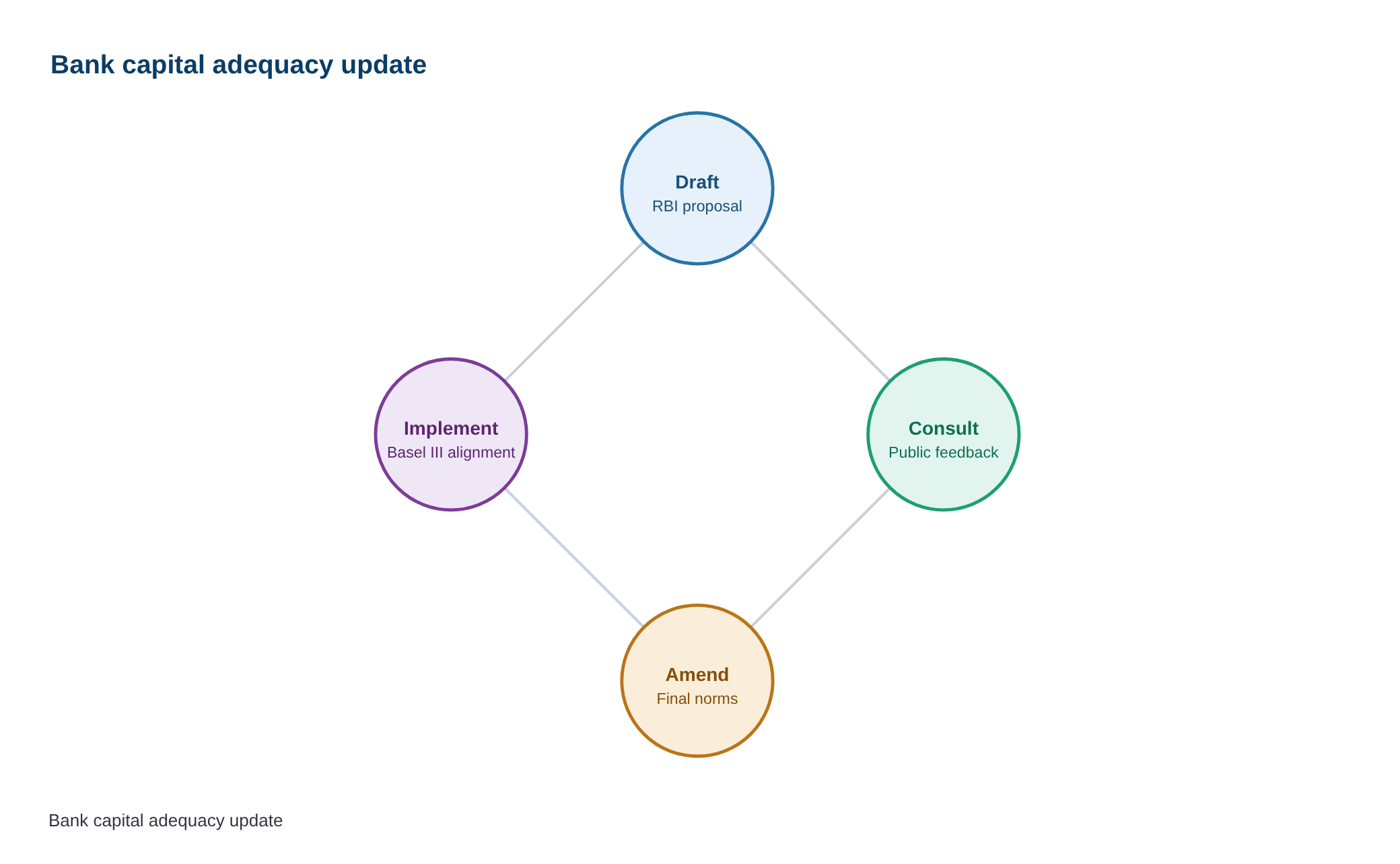
Basel Committee on Banking Supervision introduces the ‘Leverage Ratio 2017 Standard’ to enhance global banking stability. → Reserve Bank of India (RBI) proposes amendments to domestic prudential norms to align with the Basel standard. → Draft directions are released for public consultation, inviting stakeholder feedback to refine the regulatory framework. → Banks assess their capital structures and operational readiness to comply with the revised leverage ratio norms. → Implementation phase begins, with banks adjusting their lending and risk management practices to meet the new requirements. → RBI monitors compliance and macroeconomic impact, making adjustments as necessary to ensure financial stability.
Prelims Practice Questions
Q1. Consider the following statements regarding the Reserve Bank of India’s (RBI) draft directions on capital adequacy norms:
1. The draft directions propose amendments to the Leverage Ratio framework as per the Basel Committee on Banking Supervision’s ‘Leverage Ratio 2017 Standard’.
2. The amendments aim to reduce the capital adequacy requirements for commercial banks.
3. The draft directions are open for public comments until August 28, 2026.
How many of the above statements are correct?
- Only one
- Only two
- All three
- None
Answer: Only two — Statement 1 is correct as the draft directions specifically mention aligning with the Basel Committee’s Leverage Ratio 2017 Standard. Statement 2 is incorrect because the amendments are intended to strengthen prudential norms, not reduce capital requirements. Statement 3 is correct as the RBI has invited comments until August 28, 2026.
Q2. Assertion (A): The Leverage Ratio framework under Basel III is designed to serve as a supplementary measure to the risk-based capital requirements.
Reason (R): It prevents banks from building up excessive leverage and reduces the risk of systemic failure by limiting the ratio of Tier 1 capital to total exposure.
Options:
A. Both A and R are true, and R is the correct explanation of A.
B. Both A and R are true, but R is not the correct explanation of A.
C. A is true, but R is false.
D. A is false, but R is true.
Answer: ? — Assertion (A) is true as the Leverage Ratio is indeed a supplementary measure to risk-based capital requirements. Reason (R) is also true and correctly explains (A), as the Leverage Ratio limits excessive leverage by capping Tier 1 capital relative to total exposure.
Q3. Match the following columns related to banking sector regulations:
Column I (Regulatory Framework)
1. Basel I
2. Basel II
3. Basel III
Column II (Key Features)
A. Introduction of the Leverage Ratio
B. Risk-weighted asset framework
C. Capital adequacy based on credit, market, and operational risks
Options:
1-A, 2-B, 3-C
1-B, 2-C, 3-A
1-C, 2-B, 3-A
1-A, 2-C, 3-B
Answer: ? — Basel I introduced the risk-weighted asset framework (1-B). Basel II expanded this to include capital adequacy based on credit, market, and operational risks (2-C). Basel III introduced the Leverage Ratio as a supplementary measure (3-A).
Mains Practice Question
✍ Critically examine the rationale behind the Reserve Bank of India’s proposal to amend the Leverage Ratio framework for commercial banks in alignment with the Basel Committee on Banking Supervision’s ‘Leverage Ratio 2017 Standard’. Also, analyse the potential implications of this amendment for India’s banking sector stability and financial inclusion objectives. (15 Marks)
Approach: MODEL-ANSWER SKELETON:
1. **Rationale for the Amendment**:
– Explain the purpose of the Leverage Ratio framework under Basel III as a non-risk-based measure to complement risk-weighted capital requirements.
– Highlight the risks of excessive leverage (e.g., 2008 financial crisis) and how the framework mitigates systemic risk.
– Mention the specific objectives of the ‘Leverage Ratio 2017 Standard’ (e.g., harmonization, transparency, and reducing regulatory arbitrage).
2. **Key Provisions of the Amendment**:
– Specify the changes proposed in Chapter VII of the RBI (Commercial Banks – Prudential Norms on Capital Adequacy) Directions, 2025 (e.g., calculation of Tier 1 capital, total exposure measurement).
– Reference the Basel III framework’s minimum Leverage Ratio requirement (typically 3% of Tier 1 capital to total exposure).
3. **Implications for Banking Sector Stability**:
– **Positive**: Enhanced resilience against shocks, reduced likelihood of bank failures, and improved investor confidence.
– **Challenges**: Potential increase in compliance costs for banks, reduced profitability in the short term, and possible credit contraction.
– **Systemic Risk**: Discuss how the amendment may reduce contagion risks in the financial system.
4. **Impact on Financial Inclusion**:
– Analyse whether stricter capital norms may lead to reduced lending to priority sectors (e.g., MSMEs, agriculture) due to higher risk weights.
– Discuss RBI’s role in balancing prudential norms with financial inclusion goals (e.g., Priority Sector Lending Targets, PSL norms).
– Cite recent data or reports (if available) on the correlation between capital adequacy and credit flow to underserved segments.
5. **Comparative Perspective**:
– Compare India’s approach with global practices (e.g., EU, US, or other emerging economies).
– Discuss whether the amendment aligns with India’s commitment to Basel III implementation timelines.
6. **Conclusion**:
– Summarise the net effect: Does the amendment strengthen financial stability without unduly compromising growth or inclusion?
– Provide a balanced view, acknowledging both benefits and trade-offs.
Source: RBI
Generated by AanyaAi for educational purpose.

- गृह मंत्री ने मध्य प्रदेश में गौपालक सम्मेलन का किया उद्घाटन, नए अपराध कानूनों पर प्रदर्शनी का किया शुभारंभ - October 3, 2026
- Jal Arpan: 1850+ Gram Panchayats Join Hands for Rural Water Supply - October 3, 2026
- भारत ने किया 5.56 किमी मुक्त अंतरिक्ष क्वांटम की वितरण लिंक का सफल परीक्षण - October 3, 2026

No Comments