


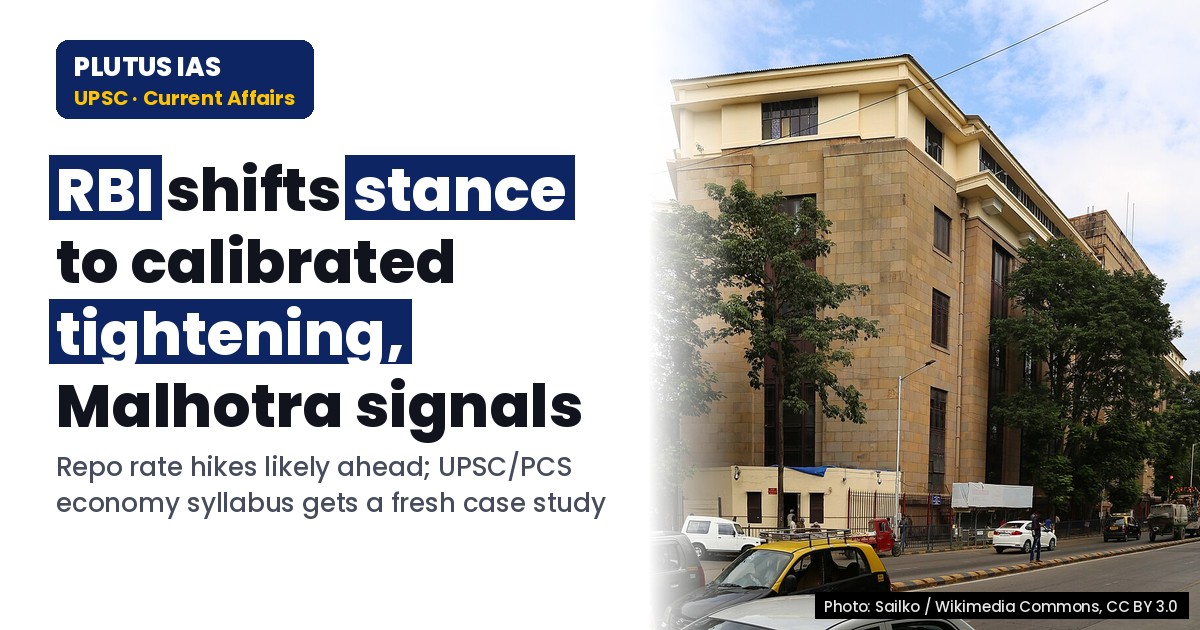
07 Oct RBI Shifts Stance to ‘Calibrated Tightening’: What It Means for UPSC & PCS Aspirants
✎ The RBI’s shift to 'calibrated tightening' signals a bias toward maintaining higher interest rates in the near term to pre-empt inflationary pressures, even as current inflation data shows only marginal increases, reflecting the…
Subject Relevance — Where This Topic Fits
- GS Paper III — Indian Economy: Issues relating to planning, mobilization of resources, growth, development and employment; Inclusive growth and issues arising from it; Government Budgeting
- Prelims: Monetary Policy Committee (MPC), Repo Rate, Calibrated Tightening, Consumer Price Index (CPI), Wholesale Price Index (WPI), Basis Points (bps), Inflation Targeting, Forward Guidance, Fiscal-Monetary Coordination
- Essay: The Role of Central Banks in Economic Stability: Balancing Growth and Inflation, Fiscal and Monetary Policy Synergy in Sustainable Development
Quick Revision: The RBI’s shift to ‘calibrated tightening’ signals a bias toward maintaining higher interest rates in the near term to pre-empt inflationary pressures, even as current inflation data shows only marginal increases, reflecting the central bank’s forward-looking approach to monetary policy.
Why is this in the news?
The Reserve Bank of India (RBI) has shifted its monetary policy stance from ‘neutral’ to ‘calibrated tightening’ while raising the policy repo rate by 25 basis points to 5.5%. This decision, though widely anticipated, introduces a forward-looking commitment to maintaining a higher-for-longer interest rate environment, even as recent inflation data shows only marginal increases. The move underscores the RBI’s proactive stance in pre-empting inflationary pressures and aligning monetary policy with medium-term inflation targets, despite limited changes in current inflation metrics.
Background
- The ‘neutral’ stance previously adopted by the RBI allowed for flexibility in either hiking or cutting rates depending on economic conditions, whereas ‘calibrated tightening’ signals a bias toward rate hikes or at least a pause, with no immediate scope for reductions.
- Recent inflation trends show a gradual increase in CPI from 3.93% in May 2026 to 4.82% in August 2026, while Wholesale Price Index (WPI) inflation remains elevated at 9.92% in August, reflecting persistent cost-push pressures.
- The RBI’s forward guidance is critical as monetary policy operates with a lag of 9-12 months, necessitating pre-emptive action to curb future inflationary risks rather than reacting to past data.
- Global geopolitical developments, such as the West Asia conflict, have contributed to supply-side disruptions, particularly in energy and commodity prices, exacerbating inflationary pressures in specific sectors like commercial cooking gas.
What is ‘Calibrated Tightening’ in Monetary Policy?
- Calibrated tightening refers to a monetary policy stance where the central bank signals a preference for tightening financial conditions through policy rate hikes or maintaining rates at elevated levels, without committing to a definitive path.
- This stance is distinct from an outright ‘hawkish’ bias, as it allows for pauses or even rate cuts if economic conditions warrant, but it removes the possibility of immediate rate reductions in the near term.
- The shift from ‘neutral’ to ‘calibrated tightening’ is a form of forward guidance, where the RBI communicates its intent to keep interest rates higher for longer to anchor inflation expectations and prevent second-round effects.
- The stance is designed to balance growth and inflation objectives by ensuring that monetary policy remains restrictive enough to curb demand-side pressures while avoiding excessive tightening that could stifle economic activity.
- Calibrated tightening is often employed when inflation is trending upward but not yet at crisis levels, allowing the central bank to adjust policy incrementally based on evolving data.
- The RBI’s decision to adopt this stance is influenced by factors such as core inflation trends, inflation expectations of households and businesses, and global economic conditions.
- This approach is consistent with the RBI’s mandate under the Flexible Inflation Targeting Framework (FITF), which prioritizes medium-term price stability while accommodating growth considerations.
- Historically, such stances have been used in periods of rising inflationary pressures, such as during the post-2008 global financial crisis or during supply shocks like the COVID-19 pandemic.
Key Features
| Feature | Significance |
|---|---|
| Repo Rate Increase by 25 bps to 5.5% | This marks the first repo rate hike in over three-and-a-half years, reflecting the RBI’s shift toward monetary tightening to curb inflationary pressures. |
| Shift in Monetary Policy Stance to ‘Calibrated Tightening’ | The change from ‘neutral’ to ‘calibrated tightening’ signals that future policy actions are more likely to be rate hikes or pauses, with rate cuts ruled out in the near term. |
| Forward Guidance on Interest Rates | The RBI’s emphasis on a ‘higher-for-longer’ interest rate environment prepares markets for prolonged elevated borrowing costs, influencing investment and consumption decisions. |
| Inflation Generalisation Across CPI Basket | The number of CPI items with inflation exceeding 4% rose from 65 in January to 110 in August, indicating broadening price pressures beyond headline inflation. |
| Wholesale Price Index (WPI) Trends | WPI inflation remained elevated at 9.92% in August, suggesting persistent cost-push inflationary pressures that may transmit to retail prices with a lag. |
Why it Matters
Monetary Policy Transmission
- The repo rate hike and stance shift directly influence commercial banks’ lending and deposit rates, affecting borrowing costs for households and businesses.
- Higher interest rates may dampen aggregate demand, particularly in sectors sensitive to credit, such as housing, automobiles, and capital goods.
- The transmission mechanism operates with a lag of 9-12 months, meaning the full impact of this policy shift will be observed in mid-2027.
Inflation Management
- The RBI’s mandate to maintain CPI inflation within the 2-6% band (with a medium-term target of 4%) underpins the need for proactive monetary tightening.
- Generalisation of inflation across the CPI basket signals second-round effects, where initial price shocks (e.g., fuel costs) propagate to broader goods and services.
- The RBI’s forward-looking approach requires balancing inflation control with growth sustainability, especially in a post-pandemic recovery phase.
Market and Investor Sentiment
- The shift to ‘calibrated tightening’ provides clarity to financial markets, reducing uncertainty about future monetary policy direction.
- Equity markets may react negatively to higher borrowing costs, while bond yields could rise, reflecting tighter liquidity conditions.
- Foreign portfolio investors (FPIs) may reassess their exposure to Indian assets, given the altered interest rate outlook.
Fiscal-Monetary Coordination
- The RBI’s stance underscores the need for fiscal prudence to avoid exacerbating inflation through excessive government borrowing or subsidies.
- Coordination between monetary and fiscal policies is critical to ensure that inflation control does not stifle economic growth or employment generation.
Challenges
1. Inflation Generalisation and Persistence
- The broadening of price pressures across the CPI basket complicates the RBI’s task of anchoring inflation expectations.
- Persistent WPI inflation suggests that supply-side constraints (e.g., global commodity prices, supply chain disruptions) continue to exert upward pressure on retail prices.
- Second-round effects, where businesses and workers adjust wages and prices in response to initial inflation, risk entrenching inflationary dynamics.
UPSC Link: GS III: Indian Economy – Inflation and its Measurement
2. Growth-Inflation Trade-off
- Higher interest rates, while necessary to curb inflation, may dampen economic growth, particularly in sectors reliant on credit.
- Balancing the need for disinflation with support for post-pandemic recovery poses a significant policy challenge for the RBI.
- Over-tightening risks pushing the economy into a low-growth, high-inflation scenario, akin to stagflation.
UPSC Link: GS III: Indian Economy – Monetary Policy and its Objectives
3. Global Spillovers and External Sector Risks
- The RBI’s policy stance must account for global factors, such as geopolitical tensions (e.g., West Asia conflict) and their impact on commodity prices.
- A stronger-than-expected tightening cycle in advanced economies (e.g., US Fed) could lead to capital outflows from emerging markets like India.
- Exchange rate volatility may transmit imported inflation, further complicating the RBI’s inflation management.
UPSC Link: GS II: International Relations – Global Economic Governance
4. Transmission Lag and Policy Lags
- The delayed impact of monetary policy (9-12 months) makes it difficult to calibrate the timing and magnitude of rate adjustments.
- Data lags (e.g., CPI and WPI releases) may result in policy actions being based on outdated information, reducing their effectiveness.
- The RBI must rely on high-frequency indicators (e.g., inflation expectations, commodity prices) to guide its decisions.
UPSC Link: GS III: Indian Economy – Monetary Policy Transmission
5. Financial Stability Risks
- Prolonged high interest rates may strain the balance sheets of households and businesses, particularly those with high debt levels.
- Banks may face asset quality deterioration if higher borrowing costs lead to defaults in sectors like real estate and MSMEs.
- Systemic risks could emerge if financial institutions are inadequately prepared for a prolonged tightening cycle.
UPSC Link: GS III: Indian Economy – Financial Sector Reforms
Challenges — UPSC Perspective
| Issue | Concern |
|---|---|
| Inflation Generalisation | Broader price pressures reduce the efficacy of targeted policy interventions, requiring a more aggressive monetary response. |
| Growth-Inflation Trade-off | Higher interest rates may suppress growth, particularly in credit-sensitive sectors, complicating the RBI’s dual mandate. |
| Global Spillovers | External shocks (e.g., commodity price volatility) can undermine domestic inflation control efforts, necessitating a nuanced policy stance. |
| Policy Transmission Lag | Delayed effects of rate hikes make it challenging to fine-tune policy, increasing the risk of over- or under-tightening. |
| Financial Stability Risks | Prolonged high rates may exacerbate debt burdens, leading to defaults and stress in the financial system. |
Way Forward
- Enhance the frequency and granularity of inflation monitoring, including high-frequency indicators like fuel prices, food inflation, and core CPI components.
- Strengthen coordination between the RBI and the government to align fiscal measures (e.g., subsidies, import duties) with monetary policy objectives.
- Communicate policy decisions and forward guidance clearly to manage market expectations and reduce volatility.
- Assess the impact of the repo rate hike on key sectors (e.g., housing, automobiles) and consider targeted measures if growth risks materialise.
- Monitor global economic developments, particularly in advanced economies, to anticipate spillovers and adjust policy accordingly.
- Conduct stress tests on financial institutions to gauge their resilience to prolonged high interest rates and potential defaults.
- Evaluate the effectiveness of the ‘calibrated tightening’ stance in anchoring inflation expectations over the medium term.
UPSC Value Addition
Keywords for Mains Answer-Writing
Monetary Policy Committee (MPC) · Repo Rate · Calibrated Tightening · Inflation Targeting · Consumer Price Index (CPI) · Forward Guidance · Policy Stance · Reserve Bank of India (RBI) · Interest Rate Transmission · Macroeconomic Stability · Monetary Policy Framework · Inflation Generalisation · Policy Repo Rate · Wholesale Price Index (WPI) · Medium-Term Inflation Target
Concept Flow
RBI’s Monetary Policy Committee (MPC) observes rising CPI inflation (4.82% in August) and WPI inflation (9.92%), indicating broadening price pressures. → MPC shifts stance from ‘neutral’ to ‘calibrated tightening’ to signal a bias toward further rate hikes, ruling out cuts in the near term. → Repo rate increased by 25 bps to 5.5%, reflecting the RBI’s commitment to disinflation despite moderate recent inflation data. → Higher borrowing costs transmit to banks’ lending rates, reducing aggregate demand and inflationary pressures over 9-12 months. → Financial markets adjust to the ‘higher-for-longer’ interest rate environment, influencing investment, consumption, and capital flows. → RBI continues to monitor inflation generalisation and global risks, with scope for further calibrated tightening if conditions warrant.
Prelims Practice Questions
Q1. Consider the following statements regarding the Monetary Policy Committee (MPC) of the Reserve Bank of India (RBI):
1. The MPC is a statutory body established under the Reserve Bank of India Act, 1934.
2. The MPC consists of six members, including three RBI officials and three external members.
3. The MPC is mandated to maintain Consumer Price Index (CPI) inflation at 4% with a band of 2-6% in the medium term.
4. The Governor of the RBI is the Chairperson of the MPC and has a casting vote in case of a tie.
How many of the above statements are correct?
- Only one
- Only two
- Only three
- All
Answer: All — Statements 1, 2, and 3 are correct. Statement 4 is incorrect as the Governor has a casting vote only in case of a tie, but the MPC consists of six members: three RBI officials (Governor, Deputy Governor in charge of Monetary Policy, and one officer of the RBI) and three external members appointed by the Central Government.
Q2. Assertion (A): The Reserve Bank of India (RBI) has shifted its monetary policy stance from ‘neutral’ to ‘calibrated tightening’.
Reason (R): This shift implies that the RBI is preparing markets for a higher-for-longer interest rate environment.
In the context of the above statements, which of the following is correct?
- Both A and R are true, and R is the correct explanation of A.
- Both A and R are true, but R is not the correct explanation of A.
- A is true, but R is false.
- A is false, but R is true.
Answer: Both A and R are true, and R is the correct explanation of A. — Both Assertion (A) and Reason (R) are true. The shift in stance from ‘neutral’ to ‘calibrated tightening’ by the RBI indicates a more restrictive monetary policy, which is aimed at preparing markets for sustained higher interest rates to curb inflationary pressures.
Q3. Match the following policy stances of the Reserve Bank of India (RBI) with their respective descriptions:
Column I (Policy Stance) | Column II (Description)
1. Accommodative | A. Policy is neither stimulative nor restrictive; neutral stance.
2. Neutral | B. Policy is aimed at reducing inflation by tightening monetary conditions.
3. Calibrated Tightening | C. Policy is aimed at stimulating growth by keeping interest rates low.
4. Withdrawal of Accommodation | D. Policy is aimed at gradually reducing monetary stimulus while avoiding sharp tightening.
Select the correct match:
- 1-C, 2-A, 3-B, 4-D
- 1-B, 2-A, 3-C, 4-D
- 1-C, 2-D, 3-A, 4-B
- 1-D, 2-A, 3-B, 4-C
Answer: 1-C, 2-A, 3-B, 4-D — The correct match is: 1-C (Accommodative: Policy aimed at stimulating growth by keeping interest rates low), 2-A (Neutral: Policy is neither stimulative nor restrictive), 3-B (Calibrated Tightening: Policy aimed at reducing inflation by tightening monetary conditions), 4-D (Withdrawal of Accommodation: Policy aimed at gradually reducing monetary stimulus while avoiding sharp tightening).
Mains Practice Question
✍ The Reserve Bank of India (RBI) has shifted its monetary policy stance from ‘neutral’ to ‘calibrated tightening’. Critically examine the implications of this shift for inflation targeting, economic growth, and financial market stability in India. (15 Marks)
Approach: MODEL-ANSWER SKELETON:
1. **Context and Definition**:
– Briefly define the RBI’s monetary policy stance and the shift from ‘neutral’ to ‘calibrated tightening’.
– Mention the RBI’s statutory mandate under the RBI Act, 1934, and the inflation targeting framework (CPI inflation target of 4% with a band of 2-6%).
2. **Implications for Inflation Targeting**:
– Explain how ‘calibrated tightening’ aims to curb inflation by signaling a restrictive monetary policy.
– Discuss the role of forward guidance in shaping market expectations and anchoring inflationary pressures.
– Reference recent inflation trends (CPI and WPI) and the generalisation of price pressures across the CPI basket.
3. **Impact on Economic Growth**:
– Analyse the trade-off between inflation control and economic growth. Highlight the potential contractionary effects of higher interest rates on investment, consumption, and GDP growth.
– Discuss the RBI’s forward-looking approach, considering the lagged impact of monetary policy (9-12 months).
4. **Financial Market Stability**:
– Examine the impact on bond yields, equity markets, and the exchange rate. Discuss how ‘calibrated tightening’ may reduce liquidity and increase borrowing costs for corporates and households.
– Reference the RBI’s role in maintaining financial stability and the transmission of policy rates to lending rates.
5. **Balancing Act and Challenges**:
– Critically assess the RBI’s ability to balance inflation control with growth objectives, especially in a post-pandemic recovery scenario.
– Discuss the risks of overtightening, including potential spillovers to the real economy and financial sector vulnerabilities.
6. **Conclusion**:
– Summarise the key takeaways and provide a balanced view of the RBI’s policy stance shift.
Source: The Indian Express
Generated by AanyaAi for educational purpose.
Related guides on our sites
- UPSC EPFO syllabus
- Best economics optional coaching for upsc
- Best economics optional teacher for upsc
- Gs Paper 1 Syllabus

- RBI Shifts Stance to ‘Calibrated Tightening’: What It Means for UPSC & PCS Aspirants - October 7, 2026
- राज्यसभा उपाध्यक्ष ने तंजानिया में आईपीयू सभा में लिया भाग - October 7, 2026
- UPSC Alert: Air Marshal Ashutosh Dixit Appointed New Air Chief - October 7, 2026

No Comments