


23 Sep RBI to Conduct Overnight VRRR Auction on Sept 24, 2026: Key Details for UPSC & State PCS
✎ Variable Rate Reverse Repo (VRRR) auctions are RBI’s flexible liquidity absorption tool under LAF, conducted at market-determined rates to manage systemic liquidity and support monetary policy objectives.
Subject Relevance — Where This Topic Fits
- GS Paper III — Indian Economy: Money and Banking, Monetary Policy Framework, Liquidity Management
- Prelims: Reverse Repo Rate, Liquidity Adjustment Facility (LAF), Monetary Policy Committee (MPC), Base Rate, Call Money Market, Bank Rate, Statutory Liquidity Ratio (SLR), Cash Reserve Ratio (CRR), Open Market Operations (OMO), Systemic Liquidity
- Essay: Role of the Reserve Bank of India in maintaining macroeconomic stability, Challenges in liquidity management in a growing economy
Quick Revision: Variable Rate Reverse Repo (VRRR) auctions are RBI’s flexible liquidity absorption tool under LAF, conducted at market-determined rates to manage systemic liquidity and support monetary policy objectives.
Why is this in the news?
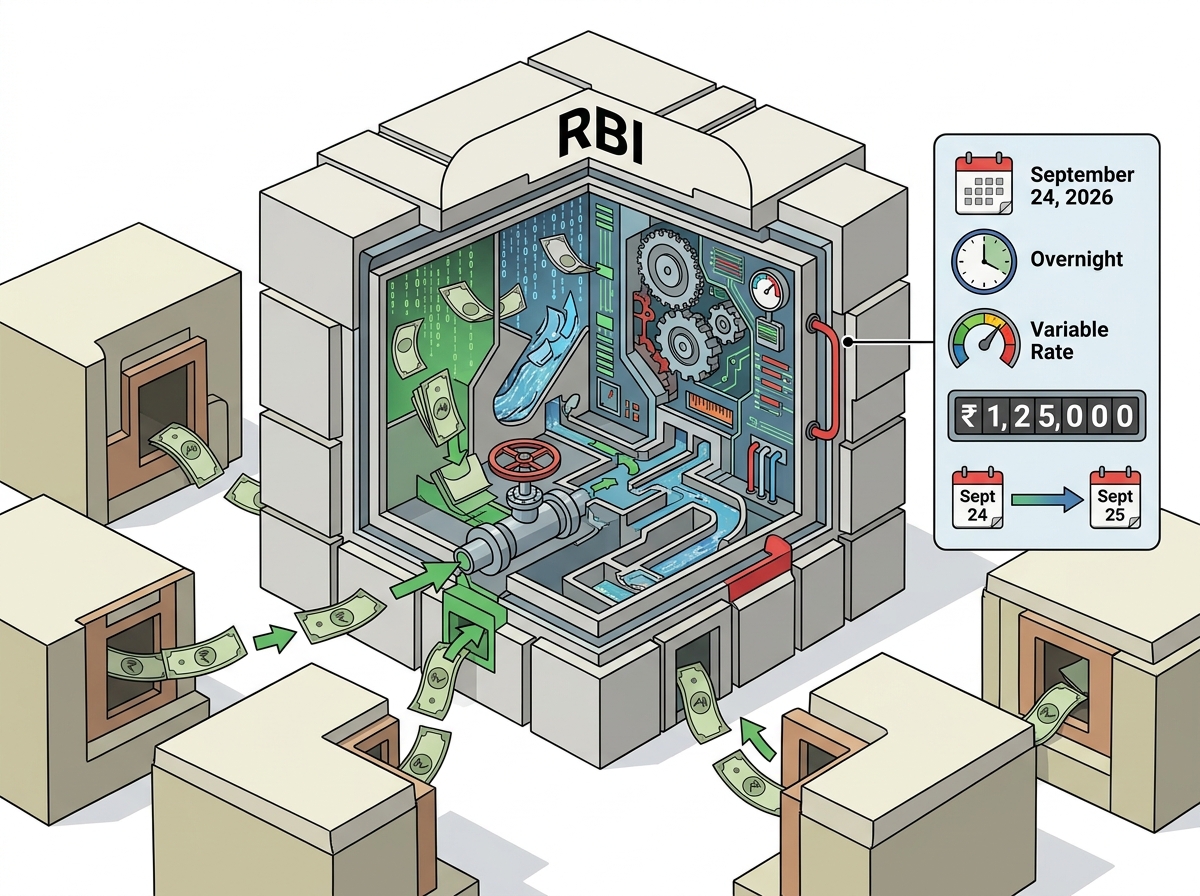
The Reserve Bank of India (RBI) has announced an Overnight Variable Rate Reverse Repo (VRRR) auction under the Liquidity Adjustment Facility (LAF) on September 24, 2026, with a notified amount of ₹1,25,000 crore. This decision reflects the RBI’s proactive stance in managing systemic liquidity conditions, particularly in the context of evolving macroeconomic dynamics and credit demand. The auction is scheduled for a one-day tenor, with reversal on September 25, 2026, and aligns with the operational guidelines issued by the RBI in February 2020.
Background
- The RBI employs the Liquidity Adjustment Facility (LAF) as a key instrument to regulate liquidity in the banking system, balancing excess and deficit liquidity conditions.
- Reverse Repo operations under LAF allow the RBI to absorb surplus liquidity from banks by offering them an interest rate, thereby influencing short-term interest rates and inflation expectations.
- The Variable Rate Reverse Repo (VRRR) mechanism enables the RBI to conduct auctions at market-determined rates rather than a fixed rate, enhancing flexibility in liquidity management.
- Systemic liquidity in India is influenced by factors such as government expenditure, currency in circulation, foreign portfolio investments, and credit growth.
- The RBI’s monetary policy framework, guided by the Monetary Policy Committee (MPC), aims to achieve the primary objective of maintaining price stability while supporting growth.
- Liquidity management is critical to prevent excessive volatility in money markets and to ensure smooth transmission of monetary policy signals to the broader economy.
What is Variable Rate Reverse Repo (VRRR)?
- A Variable Rate Reverse Repo (VRRR) is a monetary policy tool used by the RBI to absorb surplus liquidity from the banking system through auctions conducted under the Liquidity Adjustment Facility (LAF).
- In a reverse repo, banks park their excess funds with the RBI for a specified tenor (e.g., overnight) and earn interest, thereby reducing liquidity in the system.
- Unlike fixed-rate reverse repos, VRRR auctions allow the RBI to set the interest rate dynamically based on market demand, ensuring efficient liquidity absorption.
- The tenor of VRRR auctions can vary from overnight to longer durations, depending on the RBI’s assessment of liquidity conditions and policy objectives.
- The notified amount (₹1,25,000 crore in this case) represents the quantum of liquidity the RBI intends to absorb through the auction.
- VRRR operations are conducted within a specific window (e.g., 09:30 AM to 10:00 AM), and the reversal occurs on the specified date, ensuring precise liquidity control.
- The operational guidelines for VRRR auctions are governed by the RBI’s circulars, such as the one issued on February 13, 2020, which standardizes the process for transparency and efficiency.
- VRRR auctions complement other tools like Open Market Operations (OMO), Cash Reserve Ratio (CRR), and Statutory Liquidity Ratio (SLR) in the RBI’s liquidity management toolkit.
Key Features
| Feature | Significance |
|---|---|
| Variable Rate Reverse Repo (VRRR) | A liquidity management tool under the Liquidity Adjustment Facility (LAF) allowing banks to park surplus funds with the RBI at a variable interest rate, enabling fine-tuning of systemic liquidity. |
| Overnight Tenor | A 1-day maturity instrument, ensuring short-term liquidity absorption to prevent excess liquidity from distorting market rates or fueling inflationary pressures. |
| Notified Amount (₹1,25,000 crore) | The quantum of liquidity targeted for absorption, calibrated based on current and projected liquidity conditions to maintain equilibrium in the banking system. |
| Window Timing (09:30 AM–10:00 AM) | The auction window aligns with the RBI’s operational schedule, ensuring efficient execution and settlement within the same business day. |
| Date of Reversal (September 25, 2026) | The maturity date for the absorbed liquidity, ensuring the RBI’s balance sheet remains neutral over the short term without permanent liquidity withdrawal. |
Why it Matters
Monetary Policy Transmission
- VRRR auctions are a key instrument under the LAF framework, used to manage surplus liquidity in the banking system, thereby influencing short-term interest rates and ensuring alignment with the RBI’s policy stance.
- By absorbing excess liquidity overnight, the RBI prevents downward pressure on money market rates, which could otherwise undermine the effectiveness of the repo rate as a policy tool.
- The variable rate mechanism allows the RBI to signal its liquidity preference dynamically, influencing market expectations and interbank lending rates.
Inflation Management
- Excess liquidity can lead to demand-pull inflation by increasing money supply in the economy. VRRR auctions help sterilise surplus funds, thereby containing inflationary pressures.
- The RBI’s proactive liquidity management through VRRR ensures that monetary policy remains effective in achieving its primary objective of price stability.
- By absorbing liquidity, the RBI reduces the risk of asset price bubbles, particularly in financial markets, where surplus funds could fuel speculative trading.
Financial Market Stability
- VRRR auctions contribute to the stability of financial markets by preventing excessive volatility in short-term interest rates, which can disrupt market confidence.
- The auction mechanism provides a predictable and transparent framework for liquidity management, reducing uncertainty for market participants.
- By maintaining a balanced liquidity position, the RBI ensures that banks have adequate resources for credit intermediation without resorting to excessive risk-taking.
Operational Efficiency
- The RBI’s adherence to operational guidelines (as outlined in Press Release 2019-2020/1947) ensures consistency and predictability in liquidity management operations.
- The overnight tenor of the VRRR auction allows for quick adjustments to liquidity conditions, enabling the RBI to respond swiftly to evolving macroeconomic dynamics.
- The auction’s structured timing and reversal date facilitate seamless settlement, minimising operational risks in the banking system.
Challenges
1. Liquidity Surplus Management
- Persistent surplus liquidity, driven by factors such as government spending, foreign capital inflows, or demonetisation effects, poses a challenge in maintaining monetary policy effectiveness.
- Excess liquidity can lead to a compression of interest rate spreads, reducing the transmission efficiency of policy rates to the broader economy.
- The RBI must balance the need for liquidity absorption with the risk of over-tightening, which could stifle economic growth or disrupt financial markets.
UPSC Link: GS-III: Monetary Policy & Inflation
2. Market Expectations and Communication
- The RBI must communicate its liquidity management strategy clearly to avoid misinterpretation by market participants, which could lead to volatility in interest rates or asset prices.
- Market expectations regarding the quantum and timing of VRRR auctions can influence bidding behaviour, potentially distorting the auction’s intended liquidity absorption.
- Ensuring transparency in the auction process while maintaining operational flexibility is a persistent challenge for the RBI.
UPSC Link: GS-III: Monetary Policy Framework
3. Global Spillover Effects
- Global financial conditions, such as changes in US interest rates or geopolitical events, can significantly impact domestic liquidity conditions, complicating the RBI’s liquidity management efforts.
- Surges in foreign capital inflows or outflows can exacerbate liquidity imbalances, requiring the RBI to adjust its VRRR operations dynamically.
- The RBI must coordinate its liquidity management with global central banks to mitigate spillover risks, particularly in an increasingly interconnected financial system.
UPSC Link: GS-III: Global Financial System
4. Technological and Operational Risks
- The smooth execution of VRRR auctions depends on robust technological infrastructure, including trading platforms, settlement systems, and risk management frameworks.
- Operational risks, such as delays in auction execution or settlement failures, could undermine the RBI’s ability to manage liquidity effectively.
- Cybersecurity threats to the RBI’s digital infrastructure pose a growing risk to the integrity of liquidity management operations.
UPSC Link: GS-III: Financial Inclusion & Digital Payments
Challenges — UPSC Perspective
| Issue | Concern |
|---|---|
| Persistent Liquidity Surplus | Risk of undermining monetary policy transmission and fueling inflationary pressures. |
| Market Expectations Mismatch | Potential volatility in interest rates due to misaligned market perceptions of RBI’s liquidity stance. |
| Global Financial Spillovers | External shocks exacerbating domestic liquidity imbalances, complicating RBI’s management efforts. |
| Technological Vulnerabilities | Operational risks in auction execution and settlement, including cybersecurity threats. |
| Policy Communication Gaps | Risk of misinterpretation leading to unintended market reactions or loss of policy credibility. |
Way Forward
- Enhance transparency in the RBI’s liquidity management strategy by providing forward guidance on VRRR auctions, including expected quantum and frequency, to align market expectations.
- Strengthen coordination with global central banks to anticipate and mitigate spillover effects from international financial conditions on domestic liquidity.
- Invest in technological upgrades to ensure seamless auction execution, settlement, and risk management, including robust cybersecurity frameworks.
- Monitor inflationary pressures and economic growth indicators closely to calibrate the quantum and tenor of VRRR auctions, ensuring alignment with the RBI’s policy objectives.
- Conduct periodic reviews of the LAF framework to assess its effectiveness in managing liquidity and recommend structural improvements to enhance operational efficiency.
- Promote financial literacy among market participants to improve their understanding of the RBI’s liquidity management tools, reducing the risk of misinterpretation.
- Explore the use of alternative liquidity management instruments, such as standing deposit facilities or term repos, to diversify the RBI’s toolkit and enhance flexibility.
UPSC Value Addition
Keywords for Mains Answer-Writing
Monetary Policy Framework · Liquidity Adjustment Facility (LAF) · Variable Rate Reverse Repo (VRRR) · Reverse Repo Rate · Repo Rate vs Reverse Repo Rate · RBI’s Open Market Operations · Liquidity Management in India · Banking System Liquidity · Call Money Market · RBI’s Standing Deposit Facility (SDF) · Quantitative Easing (QE) · Inflation Targeting · RBI’s Policy Stance · Money Market Instruments · Central Bank’s Balance Sheet Management
Concept Flow
Excess liquidity in the banking system due to factors like government spending or capital inflows → RBI assesses current and projected liquidity conditions to determine the need for absorption → RBI announces an Overnight Variable Rate Reverse Repo (VRRR) auction under the LAF → Banks submit bids for the notified amount (₹1,25,000 crore) at variable rates within the auction window → RBI absorbs the liquidity by accepting bids and crediting the corresponding amount to its balance sheet → Liquidity is reversed on the maturity date (September 25, 2026), restoring the pre-auction liquidity conditions → Short-term interest rates remain stable, ensuring effective transmission of monetary policy
Prelims Practice Questions
Q1. Consider the following statements regarding the Variable Rate Reverse Repo (VRRR) auction conducted by the Reserve Bank of India (RBI):
1. The VRRR auction is conducted under the Liquidity Adjustment Facility (LAF).
2. The VRRR involves banks parking surplus funds with the RBI at a variable rate for a fixed tenor.
3. The VRRR auction is used by the RBI to inject liquidity into the banking system.
4. The reversal of funds under VRRR occurs on the same day as the auction.
How many of the above statements are correct?
- Only one
- Only two
- Only three
- All four
Answer: Only two — Statements 1 and 2 are correct. The VRRR is conducted under the LAF, and banks park surplus funds with the RBI at a variable rate. Statement 3 is incorrect because VRRR is used to absorb liquidity, not inject it. Statement 4 is incorrect because the reversal occurs on the next working day (as per the given RBI press release).
Q2. Assertion (A): The Reverse Repo Rate is always lower than the Repo Rate.
Reason (R): The Reverse Repo Rate is the rate at which the RBI borrows from commercial banks, while the Repo Rate is the rate at which the RBI lends to commercial banks.
- Both A and R are true, and R is the correct explanation of A
- Both A and R are true, but R is not the correct explanation of A
- A is true, but R is false
- A is false, but R is true
Answer: Both A and R are true, and R is the correct explanation of A — Both the Assertion (A) and Reason (R) are true. The Reverse Repo Rate is indeed lower than the Repo Rate because the RBI acts as a lender in the Repo operation and a borrower in the Reverse Repo operation, reflecting the risk-return dynamics of the two operations.
Q3. Match the following terms related to RBI’s monetary policy instruments with their correct descriptions:
Column I
A. Repo Rate
B. Reverse Repo Rate
C. Marginal Standing Facility (MSF)
D. Standing Deposit Facility (SDF)
Column II
1. Rate at which banks can borrow overnight from RBI against government securities
2. Rate at which RBI borrows from banks on a short-term basis
3. Rate at which RBI lends to banks against government securities under emergency conditions
4. Rate at which RBI accepts deposits from banks without requiring collateral
- A-1, B-2, C-3, D-4; A-2, B-1, C-3, D-4; A-1, B-2, C-4, D-3; A-3, B-2, C-1, D-4
- answer_list_indexes_to_match_column_i_to_ii_mapping_above
- answer_column_i_to_ii_mapping_above
Answer: ? — A-1 (Repo Rate is the rate at which RBI lends to banks against government securities), B-2 (Reverse Repo Rate is the rate at which RBI borrows from banks), C-3 (MSF is the rate for emergency borrowing by banks against government securities), D-4 (SDF is the rate for RBI’s collateral-free deposit acceptance from banks).
Mains Practice Question
✍ Examine the role and significance of the Variable Rate Reverse Repo (VRRR) auction in the context of the Reserve Bank of India’s (RBI) liquidity management framework. How does the VRRR differ from the Standing Deposit Facility (SDF) in achieving the RBI’s monetary policy objectives? (15 Marks)
Approach: MODEL-ANSWER SKELETON:
1. **Introduction (2 lines)**: Define VRRR and its operational context within the Liquidity Adjustment Facility (LAF).
2. **VRRR’s Role in Liquidity Management (5 lines)**:
– Purpose: Absorbing surplus liquidity from the banking system.
– Mechanism: Banks park surplus funds with RBI at a variable rate for a fixed tenor (e.g., overnight).
– Tenor and Window Timing: Cite the RBI’s press release (e.g., ₹1,25,000 crore, 1-day tenor, 09:30 AM–10:00 AM).
– Reversal Date: Funds are reversed the next working day (e.g., September 25, 2026).
– Link to Monetary Policy Stance: VRRR helps RBI modulate liquidity without altering the Repo/Reverse Repo Rate directly.
3. **Differentiating VRRR from SDF (5 lines)**:
– **VRRR**: Variable rate, collateralised (via government securities), short-term (e.g., overnight), conducted under LAF.
– **SDF**: Fixed rate, collateral-free, available 24×7, introduced in April 2022 to absorb excess liquidity.
– **Purpose**: VRRR is used for fine-tuning liquidity, while SDF is a structural tool for liquidity absorption.
– **Rationale**: SDF reduces reliance on collateralised operations and provides a floor for the call money rate.
4. **Significance in RBI’s Policy Framework (3 lines)**:
– Helps RBI maintain the call money rate within the LAF corridor.
– Supports the inflation-targeting mandate by managing systemic liquidity.
– Enhances transmission of monetary policy signals to the broader economy.
5. **Critique and Limitations (2 lines)**:
– VRRR’s effectiveness depends on banking system liquidity conditions.
– Over-reliance on VRRR may signal stress in liquidity management.
Source: RBI
Generated by AanyaAi for educational purpose.
Related guides on our sites
- Current affairs for upsc 2026
- Best economics optional coaching for upsc
- Best economics optional teacher for upsc
- How to prepare for GS paper 1 for UPSC CSE mains exam

- RBI to Conduct Overnight VRRR Auction on Sept 24, 2026: Key Details for UPSC & State PCS - September 23, 2026
- बिहार सरकार का बड़ा फैसला: कारोबार शुरू करने में होगी आसानी, जानिए कैसे मिलेगा फायदा - September 23, 2026
- Bihar Launches Single Window Portal for 62 Business Services: UPSC & PCS Guide - September 23, 2026

No Comments