


05 Aug RBI to Launch Plastic Notes in 2027: UPSC Economy Current Affairs 2026
✎ Meta’s accountability under India’s IT Rules, 2021, and the RBI’s pilot for plastic currency notes exemplify the dual imperatives of digital governance: safeguarding public trust while modernising infrastructure.
 Meta platformPM Modi videoRBI plastic notes
Subject Relevance — Where This Topic Fits
- GS Paper II — Governance, Constitution, Polity, Social Justice and International Relations (Digital Governance, Platform Accountability) | GS Paper III — Indian Economy and Issues Relating to Planning, Mobilisation of Resources, Growth, Development and Employment (Currency Management, Financial Inclusion)
- Prelims: Digital India, Platform Accountability, RBI Currency Policy, Plastic Currency, Meta (Facebook) Oversight, Digital Sovereignty, NEET PG Controversy, IndiGo Expansion Strategy
- Essay: The ethical responsibilities of digital platforms in democratic societies, Balancing technological innovation with national sovereignty in governance
Quick Revision: Meta’s accountability under India’s IT Rules, 2021, and the RBI’s pilot for plastic currency notes exemplify the dual imperatives of digital governance: safeguarding public trust while modernising infrastructure.
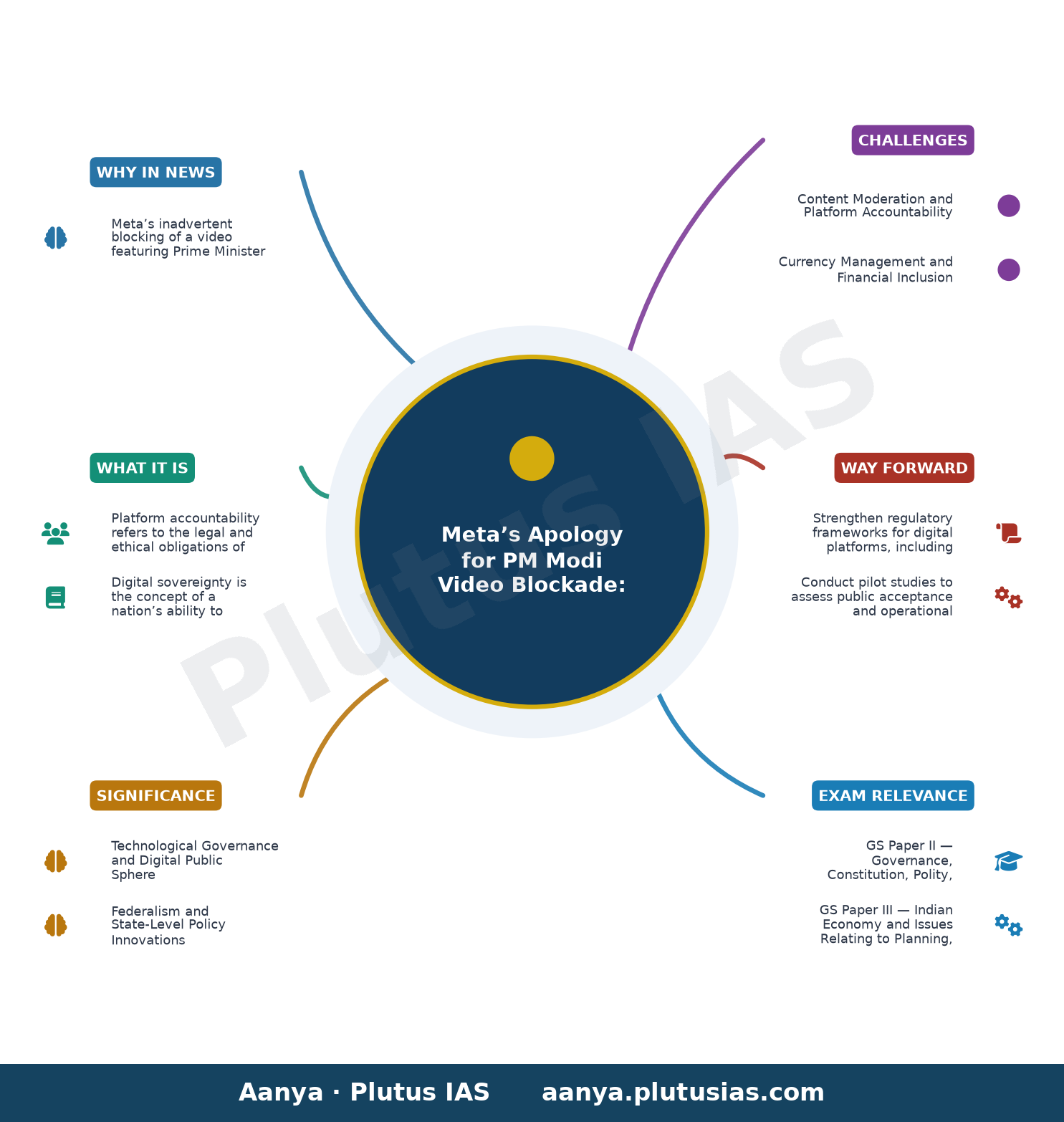
Why is this in the news?
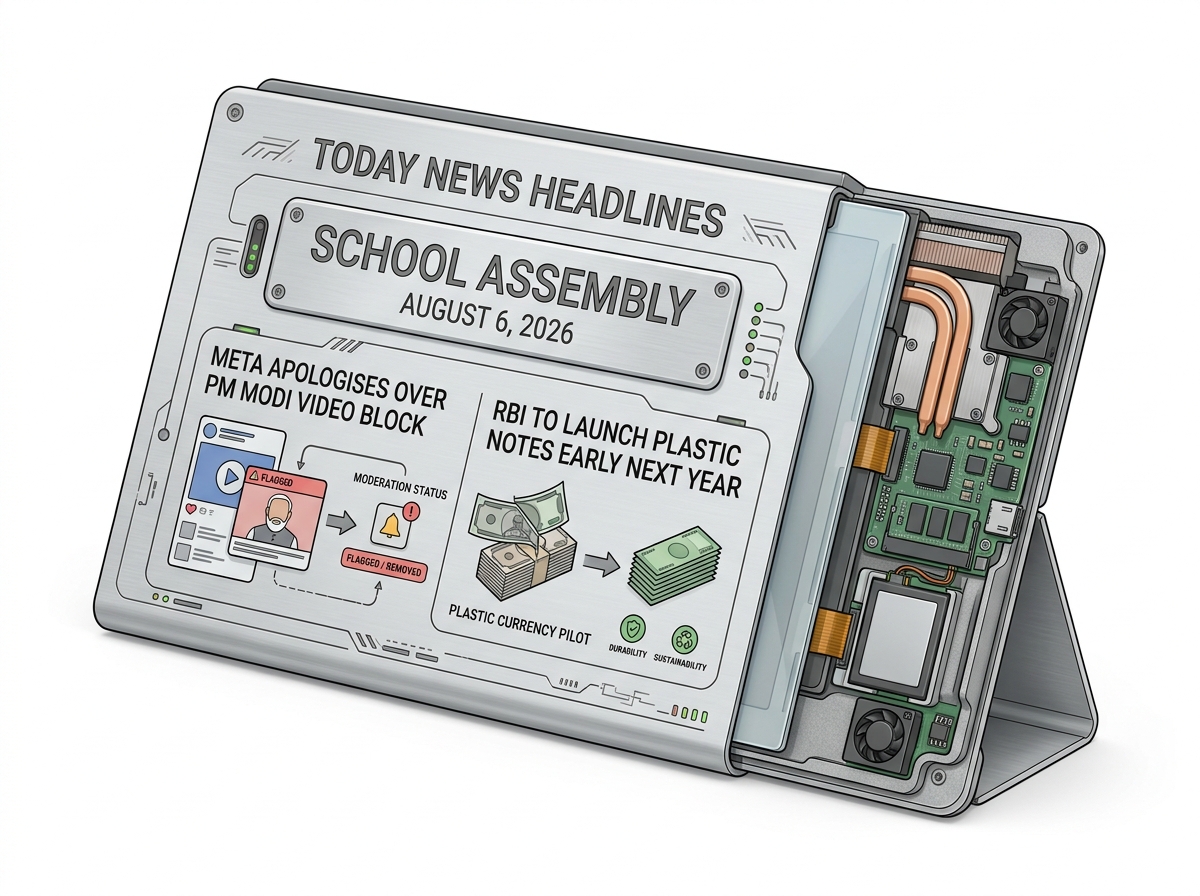
Meta’s inadvertent blocking of a video featuring Prime Minister Narendra Modi has reignited debates on platform accountability, digital sovereignty, and the role of social media in public discourse. This incident, reported by government sources, highlights the intersection of technology, governance, and public trust, particularly in the context of India’s evolving regulatory framework for digital intermediaries. Concurrently, the Reserve Bank of India’s (RBI) announcement to pilot plastic currency notes from the next financial year underscores India’s commitment to modernising its monetary infrastructure while addressing durability and sustainability concerns.
Background
- India’s digital ecosystem has witnessed exponential growth, with over 800 million internet users, making platform accountability a critical governance challenge.
- The Information Technology (Intermediary Guidelines and Digital Media Ethics Code) Rules, 2021, mandate due diligence by digital platforms to prevent misinformation and ensure transparency.
- The RBI’s Currency Management Division has historically explored alternatives to paper currency, including polymer-based notes, to enhance durability and reduce environmental impact.
- India’s draft Digital Personal Data Protection Bill, 2023, seeks to regulate data processing by intermediaries, including social media platforms, aligning with global standards like the EU’s GDPR.
- The NEET PG admission cut-off controversy has highlighted systemic vulnerabilities in India’s examination and admission processes, prompting judicial and administrative scrutiny.
What is Platform Accountability and Digital Sovereignty?
- Platform accountability refers to the legal and ethical obligations of digital intermediaries (e.g., Meta, X, YouTube) to ensure their services do not harm public interest, including through misinformation, censorship, or algorithmic bias.
- Digital sovereignty is the concept of a nation’s ability to govern its digital infrastructure, data flows, and online activities independently, without undue foreign influence or control.
- India’s regulatory framework for platform accountability includes the IT Rules, 2021, which require intermediaries to remove unlawful content within 36 hours of a government directive or court order.
- The incident involving Meta’s blocking of PM Modi’s video raises questions about the platform’s content moderation policies, potential biases in AI-driven censorship, and the adequacy of grievance redressal mechanisms.
- Digital sovereignty is increasingly linked to national security, as seen in debates over data localisation, encryption backdoors, and foreign ownership of critical digital infrastructure.
- The RBI’s pilot for plastic currency notes aligns with global trends, as countries like Australia, Canada, and the UK have adopted polymer notes for their durability and anti-counterfeiting features.
- Plastic currency notes are expected to reduce replacement costs, enhance lifespan (estimated at 5–10 years vs. 2–3 years for paper notes), and improve recyclability.
- The RBI’s phased introduction of Rs 10 and Rs 20 plastic notes will serve as a testbed for broader currency modernisation, with potential expansion to higher denominations.
Key Features
| Feature | Significance |
|---|---|
| Meta’s apology for blocking PM Modi’s video | Highlights the need for robust content moderation policies and accountability of social media platforms in democratic governance. |
| RBI’s pilot launch of plastic currency notes | Aims to enhance durability, reduce replacement costs, and align with global trends in polymer-based currency systems. |
| Tamil Nadu’s first Budget under CM Vijay | Demonstrates state-level welfare prioritisation, fiscal policy direction, and political-economic choices in a federal structure. |
| Telangana’s scrutiny of coaching centres post exam leak | Reflects administrative vigilance in safeguarding competitive examinations and maintaining educational integrity. |
| Massachusetts declaring August 15 as ‘India Day’ | Shows diaspora diplomacy, cultural recognition, and potential soft-power implications for India-US relations. |
Why it Matters
Technological Governance and Digital Public Sphere
- Meta’s error underscores the critical role of digital platforms in shaping public discourse and the necessity of transparent, accountable moderation mechanisms.
- The incident raises questions about algorithmic bias, content filtering, and the balance between free expression and misinformation control in democratic societies.
- RBI’s plastic notes initiative reflects India’s technological adaptability in currency management, with implications for financial inclusion and cost efficiency.
Federalism and State-Level Policy Innovations
- Tamil Nadu’s welfare-focused Budget exemplifies state-level policy experimentation within India’s federal framework, with potential spillover effects on other states.
- Telangana’s proactive measures against exam malpractice highlight the role of sub-national governments in maintaining institutional integrity.
International Relations and Diaspora Engagement
- Massachusetts’ ‘India Day’ declaration is a symbolic gesture of cultural diplomacy, reflecting the growing influence of the Indian diaspora in host nations.
- The US President’s remarks on the Strait of Hormuz could signal geopolitical shifts, with implications for India’s energy security and regional stability.
Challenges
1. Content Moderation and Platform Accountability
- Social media platforms face the dual challenge of preventing misinformation while avoiding over-censorship, particularly during politically sensitive periods.
- The Meta incident highlights the need for clearer regulatory frameworks to hold digital intermediaries accountable for errors in content moderation.
UPSC Link: GS Paper 2: Governance, Transparency & Challenges to Internal Security
2. Currency Management and Financial Inclusion
- The transition to plastic currency notes requires addressing public acceptance, technological adaptability, and potential disruptions in cash-based transactions.
- Ensuring equitable access to digital payment systems remains a challenge, particularly in rural and underserved regions.
UPSC Link: GS Paper 3: Indian Economy, Monetary Policy
3. Educational Integrity and Examination Reforms
- Frequent exam leaks erode trust in competitive examinations and necessitate systemic reforms in assessment design and invigilation.
- The rise of coaching centres, while beneficial for some, poses challenges in regulating quality, affordability, and equity in education.
UPSC Link: GS Paper 2: Issues Relating to Development & Management of Social Sector/Services relating to Education
4. Geopolitical Risks and Energy Security
- The Strait of Hormuz’s potential reopening could alter global oil markets, impacting India’s energy imports and inflation dynamics.
- Geopolitical tensions in West Asia require India to balance strategic autonomy with diplomatic engagement.
UPSC Link: GS Paper 2: Effect of Policies & Politics of Countries affecting India’s Interests
Challenges — UPSC Perspective
| Issue | Concern |
|---|---|
| Regulatory gaps in digital governance | Lack of clear accountability mechanisms for social media platforms in content moderation errors. |
| Public resistance to plastic currency | Potential scepticism or resistance from the public due to unfamiliarity with polymer notes. |
| Systemic vulnerabilities in competitive exams | Recurring exam leaks indicate weaknesses in examination security and transparency. |
| Diaspora integration and soft power | Ensuring sustained engagement with the diaspora without over-reliance on symbolic gestures. |
| Energy supply chain disruptions | Volatility in global oil markets due to geopolitical shifts in West Asia. |
Way Forward
- Strengthen regulatory frameworks for digital platforms, including mandatory transparency reports on content moderation decisions.
- Conduct pilot studies to assess public acceptance and operational feasibility of plastic currency notes before nationwide rollout.
- Enhance examination security by adopting blockchain-based verification systems and AI-driven proctoring tools.
- Establish a federal task force to address recurring exam leaks, involving state governments, examination bodies, and law enforcement.
- Develop a national strategy for diaspora engagement, leveraging cultural and economic ties to enhance India’s global standing.
- Monitor geopolitical developments in West Asia to preemptively address potential disruptions in energy supply chains.
- Promote financial literacy programmes to facilitate the transition to digital and polymer-based currency systems.
- Encourage state governments to adopt welfare-focused budgetary measures while ensuring fiscal sustainability.
UPSC Value Addition
Keywords for Mains Answer-Writing
Meta content moderation controversy · RBI plastic currency · Digital platform accountability · Currency management in India · Financial inclusion and innovation · Social media regulation · Monetary policy instruments · Public trust in institutions · AI-driven content filtering · Sustainability in currency production
Concept Flow
Incident of PM Modi’s video being blocked on Meta → Public scrutiny of digital platform accountability → Need for transparent content moderation policies → Regulatory gaps in digital governance. → RBI’s decision to introduce plastic notes → Pilot project to test durability and cost-efficiency → Public acceptance challenges → Potential nationwide rollout. → Exam leak alert in Telangana → Administrative scrutiny of coaching centres → Systemic vulnerabilities in competitive exams → Need for blockchain/AI-based reforms. → Massachusetts declaring ‘India Day’ → Symbolic cultural diplomacy → Diaspora integration challenges → Potential soft-power benefits for India. → US President’s remarks on Strait of Hormuz → Geopolitical shifts in West Asia → Impact on global oil markets → Implications for India’s energy security.
Prelims Practice Questions
Q1. Consider the following statements regarding the Reserve Bank of India’s (RBI) decision to introduce plastic banknotes:
1. The RBI will introduce Rs 10 and Rs 20 plastic banknotes as part of a pilot project from the beginning of the next financial year.
2. Plastic banknotes are expected to improve durability and reduce the cost of currency management.
3. The introduction of plastic banknotes is solely aimed at enhancing the aesthetic appeal of Indian currency.
How many of the above statements are correct?
- Only one
- Only two
- All
- None
Answer: Only two — Statement 1 is correct as the RBI has announced the introduction of Rs 10 and Rs 20 plastic banknotes from the beginning of the next financial year as part of a pilot project. Statement 2 is also correct as plastic banknotes are known to be more durable and cost-effective in the long run. Statement 3 is incorrect as the primary aim is durability and cost reduction, not aesthetic appeal.
Q2. Assertion (A): The Meta content moderation controversy involving the blocking of the Prime Minister’s video highlights the challenges of AI-driven content filtering on social media platforms.
Reason (R): AI algorithms used by social media platforms are incapable of contextual understanding and often rely on keyword-based filtering, leading to unintended content suppression.
In the context of the above two statements, which one of the following is correct?
- Both A and R are true and R is the correct explanation of A
- Both A and R are true but R is not the correct explanation of A
- A is true but R is false
- A is false but R is true
Answer: Both A and R are true and R is the correct explanation of A — Assertion (A) is true as the incident involving Meta blocking the Prime Minister’s video underscores the challenges of AI-driven content moderation. Reason (R) is also true and correctly explains the assertion, as AI algorithms often lack contextual understanding and rely on simplistic keyword-based filtering, which can lead to unintended suppression of legitimate content.
Q3. Match the following pairs related to recent developments in digital platforms and currency management:
Column I (Institution/Entity) | Column II (Associated Initiative/Controversy)
1. Meta | A. Introduction of plastic banknotes
2. Reserve Bank of India | B. Content moderation controversy involving PM Modi’s video
3. Tamil Nadu Government | C. First state budget with strong welfare focus
4. Telangana Government | D. Tightening scrutiny of coaching centres after exam leak alert
Select the correct match:
- 1-B, 2-A, 3-C, 4-D; 1-A, 2-B, 3-D, 4-C; 1-C, 2-D, 3-A, 4-B; 1-D, 2-C, 3-B, 4-A
- answer_digitized_answer_key_pairing_1-B,2-A,3-C,4-D
Answer: 1-B, 2-A, 3-C, 4-D; 1-A, 2-B, 3-D, 4-C; 1-C, 2-D, 3-A, 4-B; 1-D, 2-C, 3-B, 4-A — The correct matches are: 1-B (Meta is associated with the content moderation controversy involving PM Modi’s video), 2-A (RBI is associated with the introduction of plastic banknotes), 3-C (Tamil Nadu Government is associated with the first state budget with a strong welfare focus), and 4-D (Telangana Government is associated with tightening scrutiny of coaching centres after an exam leak alert).
Mains Practice Question
✍ Critically examine the implications of the Reserve Bank of India’s (RBI) decision to introduce plastic currency notes in India. How does this initiative align with the broader objectives of financial inclusion, sustainability, and technological advancement in the monetary system? (15 Marks)
Approach: MODEL-ANSWER SKELETON:
1. **Introduction (2 marks)**: Briefly introduce the RBI’s decision to introduce plastic currency notes (Rs 10 and Rs 20) as part of a pilot project from the next financial year. Highlight the global context of plastic currency adoption (e.g., Australia, Canada, and the UK).
2. **Advantages of Plastic Currency (5 marks)**:
– **Durability**: Plastic notes last 2-4 times longer than paper notes, reducing replacement costs.
– **Cost-Effectiveness**: Lower long-term costs due to reduced printing and replacement frequency.
– **Security Features**: Enhanced security features (e.g., holograms, transparent windows) to combat counterfeiting.
– **Sustainability**: Reduced environmental impact due to lower paper consumption and longer lifecycle.
– **Technological Integration**: Compatibility with digital payment systems and ATMs.
3. **Challenges and Concerns (5 marks)**:
– **Initial Costs**: High setup costs for printing infrastructure and public awareness campaigns.
– **Public Acceptance**: Resistance from segments of the population unfamiliar with plastic notes.
– **Environmental Trade-offs**: Plastic notes may not be fully biodegradable, raising sustainability concerns.
– **Operational Hurdles**: Potential issues in ATMs and vending machines adapting to plastic notes.
– **Financial Inclusion**: Risk of excluding marginalised groups if digital payment systems are prioritised.
4. **Alignment with Broader Objectives (3 marks)**:
– **Financial Inclusion**: Discuss how plastic notes can facilitate smoother transactions in rural and remote areas where digital infrastructure is weak.
– **Sustainability**: Compare with the environmental impact of paper notes and digital payment systems (e.g., e-waste from digital devices).
– **Technological Advancement**: Highlight how plastic notes can integrate with India’s digital payment ecosystem (e.g., UPI, AePS).
5. **Conclusion (2 marks)**: Summarise the potential benefits and challenges, and suggest measures to ensure a smooth transition (e.g., phased rollout, public awareness campaigns, and stakeholder consultations).
Source: The Indian Express
Generated by AanyaAi for educational purpose.

- Gujarat HC orders FIR in ITS officer’s 2023 custodial death - October 3, 2026
- डीआरआई ने मुंबई एयरपोर्ट पर सोने-हीरे की तस्करी गिरोह का किया पर्दाफाश, 8 गिरफ्तार - October 3, 2026
- Chhattisgarh CM Rural Bus Scheme: 850 Villages Connected in 1 Year - October 3, 2026

No Comments