


06 Aug RBI’s 2026 Draft Directions on NBFC Credit Facilities: Key Changes & UPSC Analysis
✎ The RBI’s draft amendments to NBFC credit facilities aim to strengthen prudential norms, enhance governance, and align with global standards, with a focus on risk management, concentration limits, and early warning systems.
Subject Relevance — Where This Topic Fits
- GS Paper III — Indian Economy: Issues Relating to Growth and Development, Role of Financial Institutions
- Prelims: Non-Banking Financial Companies (NBFCs), RBI Directions, Credit Facilities, Regulatory Compliance, Financial Stability, Systemically Important NBFCs (SI-NBFCs)
- Essay: Regulatory Governance and Financial Sector Reforms in India
Quick Revision: The RBI’s draft amendments to NBFC credit facilities aim to strengthen prudential norms, enhance governance, and align with global standards, with a focus on risk management, concentration limits, and early warning systems.
Why is this in the news?
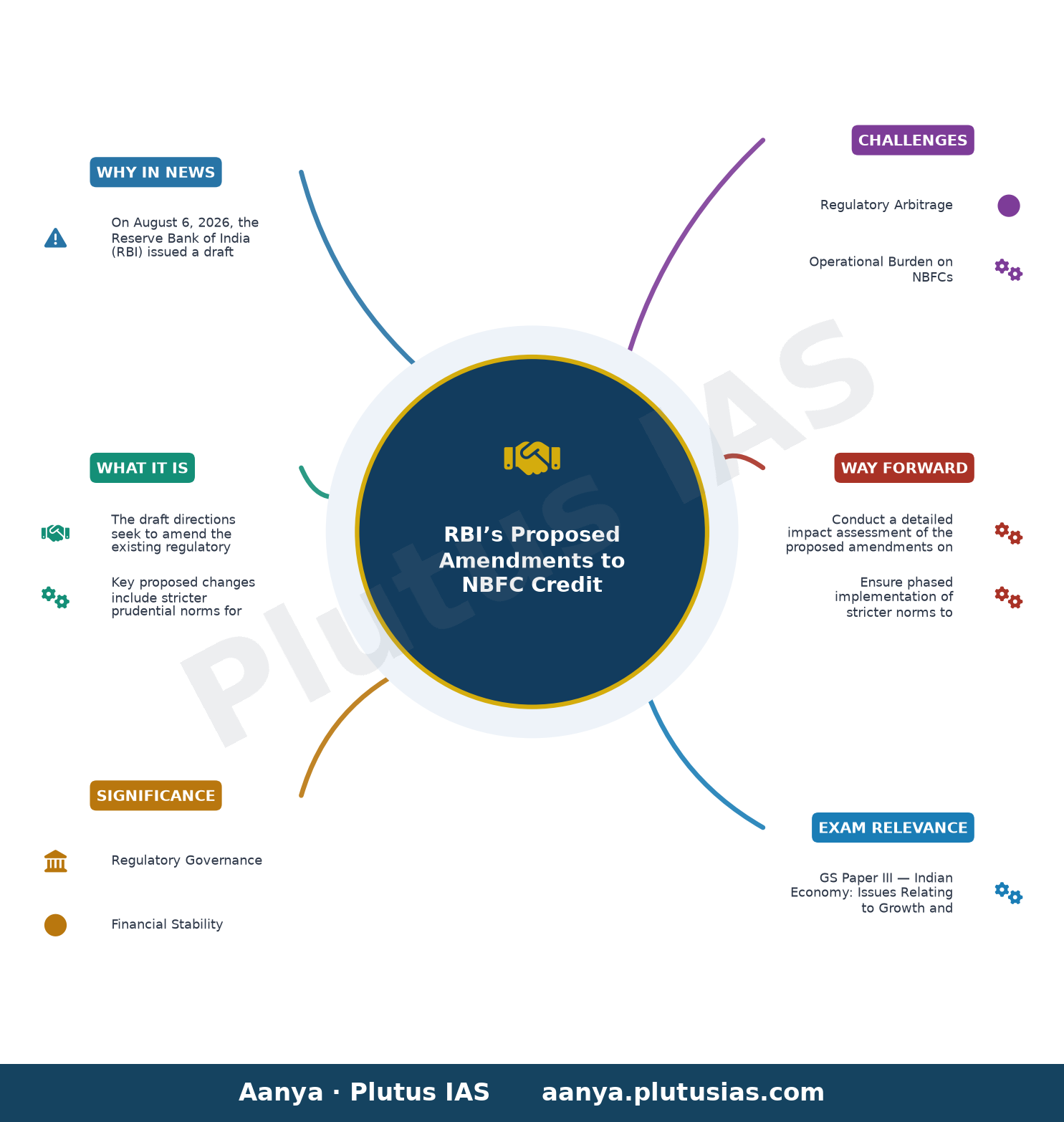
On August 6, 2026, the Reserve Bank of India (RBI) issued a draft notification inviting public comments on the ‘Reserve Bank of India (Non-Banking Financial Companies – Credit Facilities) Amendment Directions, 2026.’ The proposed amendments aim to refine the regulatory framework governing credit facilities extended by NBFCs, addressing evolving risks in the financial sector and enhancing prudential norms. Stakeholders, including regulated entities and industry associations, have been granted until August 28, 2026, to submit feedback, underscoring the RBI’s emphasis on consultative policymaking.
Background
- NBFCs play a critical role in India’s financial intermediation ecosystem, complementing banks by catering to credit demand in sectors underserved by traditional banking, such as micro, small, and medium enterprises (MSMEs), retail borrowers, and infrastructure financing.
- The RBI, as the sectoral regulator, periodically reviews and updates regulatory frameworks to mitigate systemic risks, ensure financial stability, and align with global best practices, particularly in light of the growing interconnectedness between NBFCs and the broader financial system.
- The existing regulatory framework for NBFC credit facilities is primarily governed by the RBI’s Master Direction on NBFCs, issued in 2016, which consolidates guidelines on acceptance of public deposits, prudential norms, and exposure limits.
- Recent episodes of stress in the NBFC sector, including liquidity challenges and asset quality concerns, have prompted the RBI to proactively strengthen regulatory oversight to prevent contagion risks.
- The proposed amendments are part of a broader regulatory agenda to enhance transparency, governance, and risk management within the NBFC sector, aligning with the RBI’s objective of fostering a resilient financial ecosystem.
- Public consultation is a hallmark of the RBI’s regulatory process, ensuring that policy measures are grounded in empirical evidence and stakeholder insights.
What are the Reserve Bank of India (Non-Banking Financial Companies – Credit Facilities) Amendment Directions, 2026?
- The draft directions seek to amend the existing regulatory framework governing credit facilities extended by NBFCs, including norms on exposure limits, asset classification, provisioning requirements, and related-party transactions.
- Key proposed changes include stricter prudential norms for large exposures to prevent concentration risks, enhanced disclosure requirements for off-balance-sheet exposures, and revised guidelines on the classification of stressed assets to improve early warning systems.
- The amendments aim to align NBFC regulations with international standards, such as the Basel III framework, particularly in areas like liquidity coverage ratios (LCR) and net stable funding ratios (NSFR), to ensure parity with banking sector norms.
- The draft directions introduce provisions for the mandatory adoption of robust internal risk management frameworks by NBFCs, including stress testing and liquidity risk management, to mitigate vulnerabilities arising from macroeconomic shocks.
- The RBI proposes to enhance the role of the board of directors in overseeing credit risk management, with explicit responsibilities for approving credit policies, monitoring compliance, and ensuring adherence to regulatory norms.
- The amendments also address governance issues by mandating independent audit mechanisms for credit portfolios and strengthening the oversight of asset-liability committees (ALCOs) in NBFCs.
- The draft directions emphasize the need for NBFCs to adopt technology-driven solutions for credit appraisal and monitoring, including the use of alternative data sources and artificial intelligence to improve underwriting standards.
- Feedback from stakeholders is invited to refine the draft directions, ensuring that the final regulations balance prudential oversight with the operational realities of NBFCs.
Key Features
| Feature | Significance |
|---|---|
| Draft Directions for NBFC Credit Facilities | Proposes amendments to existing regulatory framework governing credit facilities extended by Non-Banking Financial Companies (NBFCs). |
| Public Consultation Process | Invites feedback from regulated entities and stakeholders by August 28, 2026, ensuring stakeholder participation in regulatory evolution. |
| Digital Submission Portal ‘Connect 2 Regulate’ | Facilitates structured and transparent feedback submission on draft regulations. |
| Focus on Credit Risk Management | Likely introduces stricter norms for credit appraisal, monitoring, and provisioning to mitigate systemic risks. |
| Alignment with Basel III Norms | May incorporate international best practices in credit risk management for NBFCs. |
Why it Matters
Regulatory Governance
- Enhances RBI’s supervisory framework for NBFCs, addressing gaps in credit risk management and systemic stability.
- Strengthens the ‘Principle of Proportionality’ in regulation, tailoring norms to the scale and complexity of NBFC operations.
- Promotes transparency and accountability in credit facilitation by NBFCs, reducing information asymmetry.
Financial Stability
- Mitigates systemic risks arising from excessive leverage or mispricing of credit by NBFCs, which can spill over to the broader financial system.
- Reduces the likelihood of NBFC failures that could trigger contagion effects in the financial sector.
- Ensures alignment with global financial stability standards, enhancing India’s credibility in international financial markets.
Consumer Protection
- Strengthens safeguards for borrowers against predatory lending practices by NBFCs, particularly in retail and MSME segments.
- Enhances disclosures and grievance redressal mechanisms for borrowers.
Macroeconomic Impact
- Supports monetary policy transmission by ensuring NBFCs adhere to prudential norms, preventing distortions in credit flow.
- Facilitates inclusive growth by ensuring responsible credit expansion in underserved sectors.
Challenges
1. Regulatory Arbitrage
- Risk of NBFCs circumventing stricter norms by shifting operations to less regulated entities or jurisdictions.
- Requires robust monitoring mechanisms to detect and deter regulatory arbitrage.
UPSC Link: Financial Regulation
2. Operational Burden on NBFCs
- Increased compliance costs due to stricter credit appraisal and monitoring requirements.
- May disproportionately affect smaller NBFCs, necessitating phased implementation or differential norms.
UPSC Link: Financial Regulation
3. Credit Access for MSMEs
- Tighter credit norms may reduce loan availability for MSMEs, which are heavily reliant on NBFC financing.
- Need for balanced regulation to avoid stifling growth in critical sectors.
UPSC Link: MSME Financing
4. Technological Adaptation
- NBFCs may face challenges in adopting advanced credit risk assessment tools and digital compliance systems.
- Requires investment in technology and capacity building.
UPSC Link: Digital Financial Services
5. Cross-Sectoral Spillovers
- Stricter NBFC regulations may impact related sectors such as real estate, infrastructure, and fintech, which rely on NBFC credit.
UPSC Link: Financial Intermediation
Challenges — UPSC Perspective
| Issue | Concern |
|---|---|
| Regulatory Arbitrage | Risk of NBFCs exploiting loopholes to bypass stricter norms. |
| Compliance Costs | Increased operational expenses due to enhanced regulatory requirements. |
| Credit Contraction | Potential reduction in credit availability for MSMEs and retail borrowers. |
| Technological Lag | Delayed adoption of digital tools for credit risk management by smaller NBFCs. |
| Sectoral Impact | Adverse effects on sectors dependent on NBFC financing, such as real estate and infrastructure. |
Way Forward
- Conduct a detailed impact assessment of the proposed amendments on NBFC operations and credit flow to critical sectors.
- Ensure phased implementation of stricter norms to mitigate operational disruptions, particularly for smaller NBFCs.
- Strengthen the ‘Connect 2 Regulate’ portal to facilitate seamless feedback submission and tracking of stakeholder inputs.
- Develop capacity-building programs for NBFCs to adopt advanced credit risk assessment tools and digital compliance systems.
- Collaborate with industry associations to address operational challenges and ensure smooth transition to the new regulatory framework.
- Monitor credit availability for MSMEs and retail borrowers post-implementation to prevent unintended credit contraction.
- Enhance transparency in disclosures and grievance redressal mechanisms to protect borrower interests.
- Align the draft directions with global financial stability standards to enhance India’s regulatory credibility.
UPSC Value Addition
Keywords for Mains Answer-Writing
RBI Directions 2026 · NBFC Credit Facilities · Non-Banking Financial Companies Regulation · Financial Sector Reforms · Credit Risk Management · Systemically Important NBFCs · Basel III Norms · Financial Stability · Regulatory Arbitrage · Credit Concentration Risk · Liquidity Coverage Ratio · Asset-Liability Management
Concept Flow
RBI identifies gaps in NBFC credit risk management → Draft directions proposed to address systemic risks → Public consultation invites stakeholder feedback → Amendments finalized based on inputs → Stricter credit norms implemented → NBFCs adapt to new framework → Credit flow stabilizes → Financial stability enhanced → Macroeconomic stability maintained
Prelims Practice Questions
Q1. Consider the following statements regarding the Reserve Bank of India (RBI):
1. The RBI is the sole regulator of Non-Banking Financial Companies (NBFCs) in India.
2. The RBI issues Directions under Section 45L of the Reserve Bank of India Act, 1934.
3. The RBI’s Directions on credit facilities to NBFCs are aimed at ensuring financial stability and reducing systemic risk.
How many of the above statements are correct?
- Only one
- Only two
- All three
- None
Answer: All three — Statement 1 is incorrect as the RBI shares regulatory oversight of NBFCs with other bodies like SEBI and IRDAI depending on the nature of the NBFC’s activities. Statements 2 and 3 are correct; the RBI derives its regulatory authority from Section 45L of the RBI Act, 1934, and Directions on credit facilities are designed to mitigate systemic risks in the financial sector.
Q2. Assertion (A): The Reserve Bank of India (RBI) has proposed draft Directions to amend credit facility norms for Non-Banking Financial Companies (NBFCs) in 2026.
Reason (R): The amendment aims to align NBFC credit norms with Basel III standards to enhance financial stability.
In the context of the above two statements, which one of the following is correct?
- Both A and R are true, and R is the correct explanation of A
- Both A and R are true, but R is not the correct explanation of A
- A is true, but R is false
- A is false, but R is true
Answer: A is true, but R is false — Assertion (A) is true as the RBI has indeed invited comments on draft Directions for NBFC credit facilities in 2026. Reason (R) is also true, but the amendment’s primary objective is not explicitly stated to be alignment with Basel III; it focuses on credit risk management and systemic stability. Hence, R is not the correct explanation of A.
Q3. Match the following columns regarding regulatory bodies and their primary functions in India:
Column I
A. Reserve Bank of India
B. Securities and Exchange Board of India
C. Insurance Regulatory and Development Authority of India
D. Pension Fund Regulatory and Development Authority
Column II
1. Regulates insurance companies and intermediaries
2. Regulates pension funds and related schemes
3. Regulates banks and non-banking financial companies
4. Regulates securities markets and protects investor interests
Select the correct match:
- A-3, B-4, C-1, D-2; A-1, B-2, C-3, D-4; A-4, B-3, C-2, D-1; A-2, B-1, C-4, D-3
- answer
- explain
- format
- match
Answer: A-3, B-4, C-1, D-2; A-1, B-2, C-3, D-4; A-4, B-3, C-2, D-1; A-2, B-1, C-4, D-3 — The correct matches are: A-3 (RBI regulates banks and NBFCs), B-4 (SEBI regulates securities markets), C-1 (IRDAI regulates insurance companies), and D-2 (PFRDA regulates pension funds).
Mains Practice Question
✍ The Reserve Bank of India (RBI) has released draft “Reserve Bank of India (Non-Banking Financial Companies – Credit Facilities) Amendment Directions, 2026” to strengthen the regulatory framework governing credit facilities extended by Non-Banking Financial Companies (NBFCs). Critically examine the potential implications of these Directions for financial stability, systemic risk mitigation, and the operational flexibility of NBFCs. (15 Marks)
Approach: A full answer must cover the following dimensions:
1. **Context and Objectives**:
– Briefly explain the role of NBFCs in India’s financial ecosystem and the rationale for RBI’s regulatory oversight.
– Identify the stated and unstated objectives of the draft Directions (e.g., credit risk management, liquidity coverage, asset-liability mismatch reduction).
2. **Key Provisions of the Draft Directions**:
– Highlight specific amendments proposed (e.g., stricter norms on credit concentration, enhanced disclosure requirements, or liquidity coverage ratios).
– Link these provisions to existing frameworks such as Basel III norms or the RBI’s earlier Directions on NBFCs.
3. **Impact on Financial Stability and Systemic Risk**:
– Discuss how the Directions may reduce systemic risk by preventing excessive credit growth or concentration in specific sectors.
– Examine the potential for reduced regulatory arbitrage between banks and NBFCs.
– Assess the role of these Directions in aligning with global financial stability standards.
4. **Operational Flexibility of NBFCs**:
– Analyse the potential constraints on NBFCs’ ability to extend credit, particularly for MSMEs, retail borrowers, or niche sectors.
– Discuss the trade-off between regulatory stringency and the growth of NBFCs as alternative credit providers.
5. **Challenges and Criticisms**:
– Evaluate potential implementation challenges, such as compliance costs for NBFCs or the risk of credit crunch in vulnerable sectors.
– Consider criticisms from industry stakeholders regarding the adequacy or excessiveness of the proposed norms.
6. **Comparative Perspective**:
– Compare the RBI’s approach with regulatory frameworks in other jurisdictions (e.g., the US, UK, or EU) for NBFCs or shadow banking entities.
7. **Conclusion**:
– Provide a balanced assessment of whether the Directions strike an appropriate balance between stability and flexibility.
– Suggest complementary measures (e.g., enhanced supervision, digital lending regulations) to address identified gaps.
Source: RBI
Generated by AanyaAi for educational purpose.

- UPSC Civil Services (Main) Examination 2026 — Sindhi Devanagari Literature Paper II: Question Paper | Plutus IAS - September 22, 2026
- गूगल भी करेगा बाल यौन शोषण सामग्री की सीधे भारतीय अधिकारियों को रिपोर्टिंग - September 22, 2026
- Google to Report CSAM Directly to Indian Authorities: Implications for UPSC - September 22, 2026

No Comments