


31 Jul RBI’s Strict FICN Detection Rules: Banks Must Comply by October 2026
✎ FICNs pose a dual threat to economic sovereignty and internal security; banks must impound all detected FICNs and report them to the RBI’s FNV Cell.
Subject Relevance — Where This Topic Fits
- GS Paper III — Money and Banking | GS Paper III — Security Challenges and Internal Security | GS Paper III — Role of Financial Institutions
- Prelims: FICN, RBI Master Direction on Counterfeit Notes, Forged Note Vigilance Cell (FNV Cell), Note Authentication/Sorting Machines, Currency Chest, ATM dispensation, Impounding of FICNs, Penalty for non-compliance, Border districts, Security features of Indian banknotes
- Essay: The menace of counterfeit currency: A threat to economic sovereignty and financial integrity, Technology and governance: Strengthening institutional mechanisms to combat financial crime
Quick Revision: FICNs pose a dual threat to economic sovereignty and internal security; banks must impound all detected FICNs and report them to the RBI’s FNV Cell.
Why is this in the news?
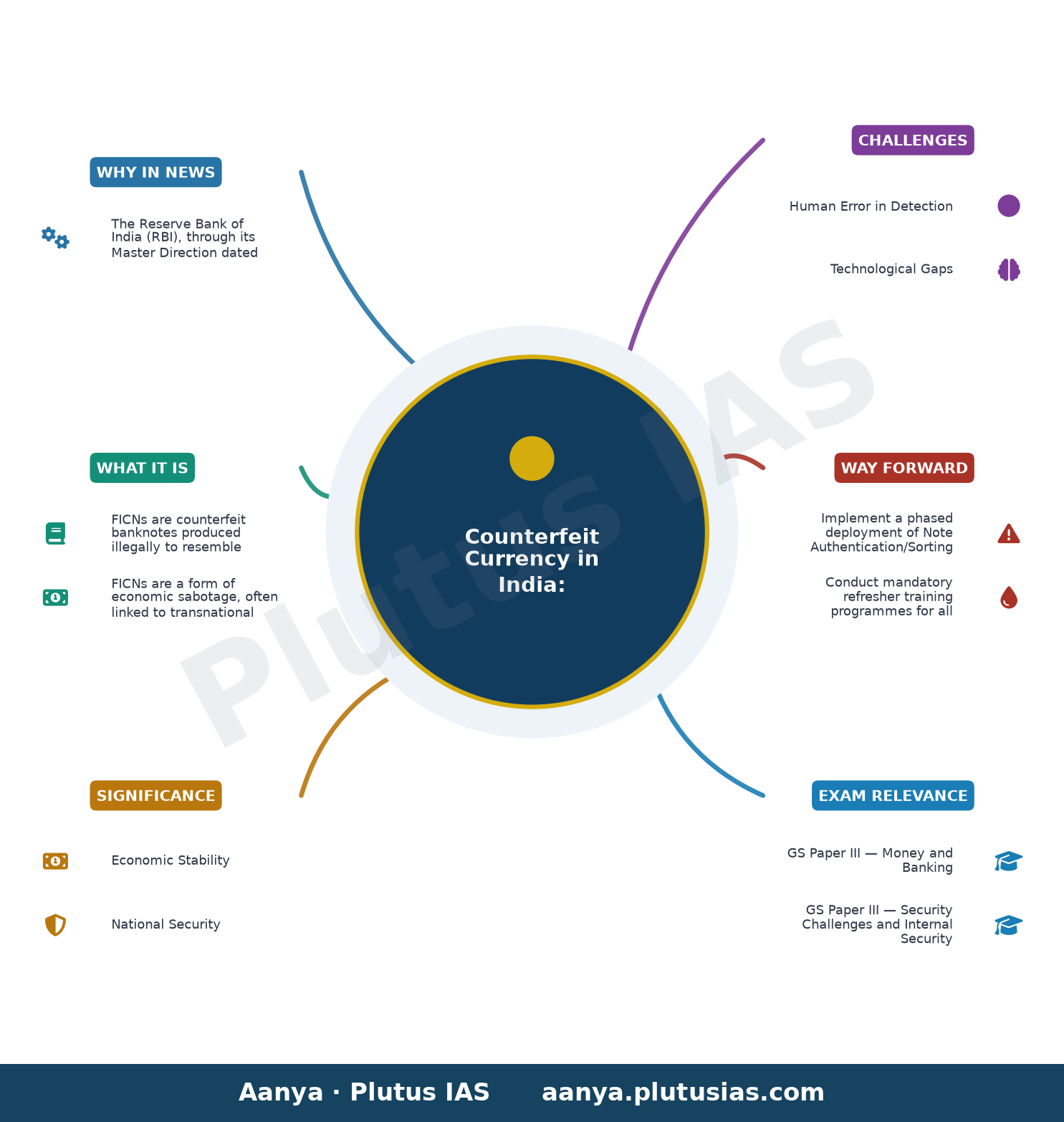
The Reserve Bank of India (RBI), through its Master Direction dated April 1, 2026, has issued comprehensive guidelines to banks for the detection, reporting, and monitoring of Fake Indian Currency Notes (FICNs). This directive, reinforced by a circular dated July 31, 2026, underscores the inadequacies in current bank practices and mandates urgent corrective measures, including targeted training, deployment of detection devices, and enhanced reporting mechanisms. The directive is significant as it reflects the RBI’s heightened vigilance against the proliferation of counterfeit currency, which poses systemic risks to monetary stability and national security.
Background
- Counterfeit currency undermines the integrity of the monetary system and erodes public trust in legal tender, necessitating robust detection and reporting mechanisms.
- India has been a target of counterfeit currency smuggling, particularly near international borders, due to its proximity to regions with known counterfeiting networks.
- The RBI’s Master Direction on Counterfeit Notes (April 1, 2026) supersedes earlier guidelines and integrates technological advancements in currency authentication.
- The Forged Note Vigilance Cell (FNV Cell) within banks serves as the nodal agency for monitoring, reporting, and analysis of FICN trends.
- The proliferation of high-quality counterfeit notes, including those mimicking the ₹2000 denomination, has intensified the challenge for detection systems.
What are Fake Indian Currency Notes (FICNs)?
- FICNs are counterfeit banknotes produced illegally to resemble genuine Indian currency, with the intent to deceive and circulate as legal tender.
- FICNs are a form of economic sabotage, often linked to transnational organised crime syndicates and terrorism financing, as they facilitate illicit financial flows.
- The most commonly counterfeited denominations in India include ₹500 and ₹2000 notes, due to their higher circulation and value.
- Counterfeiters employ advanced techniques such as digital printing, holographic replication, and micro-text manipulation to mimic security features of genuine notes.
- The RBI classifies FICNs into two categories: (a) Indian FICNs, produced domestically, and (b) Foreign FICNs, smuggled into India from abroad, particularly from neighboring countries.
- The detection of FICNs is governed by the RBI’s Master Direction, which mandates the use of Note Authentication/Sorting Machines (NASMs) for automated verification in high-risk branches.
- The circulation of FICNs disrupts monetary policy, inflates the money supply, and imposes costs on the banking system through recalibration and replacement of counterfeit notes.
Key Features
| Feature of Genuine Indian Banknotes | Significance for Detection |
|---|---|
| Watermark | Visible when held against light; contains the portrait of Mahatma Gandhi and electrotype watermark of denomination. |
| Security Thread | Embedded thread with ‘Bharat’ and ‘RBI’ in Hindi and English; changes colour under UV light. |
| Intaglio Printing | Raised printing on portrait, Ashoka Pillar emblem, and RBI seal; tactile feel for visually impaired. |
| Micro-lettering | Tiny text ‘RBI’ or denomination visible under magnification; prevents replication. |
| Optically Variable Ink (OVI) | Colour shifts when viewed from different angles; e.g., ₹2000 note has green to blue shift. |
| Fluorescence | Certain features fluoresce under UV light; e.g., security thread and floral designs. |
| Latent Image | Denomination visible when note is tilted; e.g., ₹2000 note shows ‘2000’ on the right side. |
Why it Matters
Economic Stability
- Prevents erosion of public trust in currency, ensuring seamless transactions and monetary policy effectiveness.
- Mitigates inflationary pressures by curbing circulation of counterfeit notes that distort money supply.
- Reduces costs for banks and businesses associated with detecting and replacing counterfeit currency.
National Security
- Counterfeit currency is often linked to transnational organised crime and terrorism financing, posing a threat to internal security.
- Undermines the integrity of the financial system, enabling illicit activities such as money laundering and drug trafficking.
- Border areas are particularly vulnerable, necessitating enhanced vigilance and technological deployment.
Regulatory Compliance
- Banks are legally obligated to impound and report counterfeit notes under the RBI’s Master Direction, ensuring systemic accountability.
- Non-compliance attracts penalties, reinforcing adherence to anti-counterfeiting protocols.
- Centralised reporting through Forged Note Vigilance Cells (FNV Cells) enables data-driven policy interventions.
Technological Advancement
- Deployment of Note Authentication/Sorting Machines in high-risk districts enhances detection accuracy and efficiency.
- Training programmes for cash-handling staff improve human detection capabilities, reducing reliance on machines alone.
- Continuous innovation in currency design, such as introduction of new security features, strengthens resilience against counterfeiting.
Challenges
1. Human Error in Detection
- Inadequate training of cash-handling staff leads to failure in identifying counterfeit notes, particularly in high-volume transactions.
- Fatigue and lack of refresher training in border areas exacerbate the risk of oversight.
- Solution: Mandatory periodic training with certification; use of machine-assisted verification as a supplementary measure.
UPSC Link: GS3: Money Laundering
2. Technological Gaps
- Insufficient deployment of Note Authentication Machines in rural and border districts, leaving gaps in detection infrastructure.
- High cost of advanced detection devices limits adoption in small cooperative banks and regional rural banks.
- Solution: RBI-directed phased deployment; subsidised procurement for smaller banks; integration with digital monitoring systems.
UPSC Link: GS3: Cyber Security
3. Cross-Border Smuggling
- International borders, particularly with Nepal, Bangladesh, and Pakistan, serve as entry points for counterfeit currency due to porous terrain and unregulated movement.
- Smugglers exploit weak surveillance and lack of coordination between border forces and financial institutions.
- Solution: Strengthened inter-agency coordination; use of AI-driven pattern recognition in currency flows; deployment of mobile detection units.
UPSC Link: GS3: Border Management
4. Legal and Procedural Delays
- Slow reporting and impounding of counterfeit notes due to bureaucratic delays or lack of awareness among bank staff.
- Absence of a unified national database for tracking counterfeit notes hampers real-time monitoring and enforcement.
- Solution: Streamlined reporting protocols; establishment of a centralised FICN tracking portal; mandatory time-bound action by banks.
UPSC Link: GS2: Centre-State Relations
5. Public Awareness Deficit
- General public, including merchants and small businesses, often lacks knowledge of security features, making them vulnerable to accepting counterfeit notes.
- Misconceptions about the legal implications of possessing counterfeit notes deter reporting by individuals.
- Solution: Nationwide awareness campaigns; inclusion of currency literacy in school curricula; public-private partnerships for outreach.
UPSC Link: GS2: Social Empowerment
6. Evolving Counterfeiting Techniques
- Counterfeiters continuously adapt to new security features, employing advanced printing techniques and digital manipulation to replicate notes.
- Emergence of deepfake technology and AI-generated currency images poses a new frontier in counterfeiting threats.
- Solution: RBI’s proactive design updates; collaboration with global forensic agencies; investment in R&D for next-gen security features.
UPSC Link: GS3: Science & Technology
Challenges — UPSC Perspective
| Issue | Concern |
|---|---|
| Inadequate staff training | High risk of human error in detecting counterfeit notes, especially in high-volume branches. |
| Lack of detection infrastructure | Absence of Note Authentication Machines in rural and border districts compromises detection accuracy. |
| Cross-border smuggling | Porous borders facilitate illegal entry of counterfeit currency, particularly from neighbouring countries. |
| Slow reporting mechanisms | Delays in impounding and reporting counterfeit notes undermine regulatory effectiveness. |
| Public apathy | Low awareness among citizens leads to unchecked circulation of counterfeit notes in informal sectors. |
| Technological obsolescence | Outdated detection methods fail to counter sophisticated counterfeiting techniques used by criminals. |
Way Forward
- Implement a phased deployment of Note Authentication/Sorting Machines in all border districts and high-risk branches by March 2027, prioritising districts with historical FICN incidents.
- Conduct mandatory refresher training programmes for all cash-handling staff, with a focus on border areas, by September 2026, and certify staff on detection competencies.
- Establish a centralised FICN tracking portal under the RBI’s FNV Cell to enable real-time monitoring, data analytics, and trend identification for targeted interventions.
- Strengthen inter-agency coordination between RBI, NIA, IB, and border security forces to disrupt cross-border smuggling networks and trace the origin of counterfeit currency.
- Launch a nationwide public awareness campaign, in partnership with banks, schools, and local bodies, to educate citizens on security features and reporting mechanisms for counterfeit notes.
- Introduce incentives for banks and individuals who report counterfeit notes, alongside strict penalties for non-compliance with RBI’s Master Direction on detection and reporting.
- Invest in R&D for next-generation currency security features, including blockchain-based verification and AI-driven anomaly detection in currency flows.
- Integrate FICN detection protocols into the curriculum of banking and financial services training institutes to ensure long-term capacity building.
UPSC Value Addition
Keywords for Mains Answer-Writing
Fake Indian Currency Notes (FICNs) · Counterfeit Currency Detection · Reserve Bank of India (RBI) Master Directions · Currency Management in India · Forged Note Vigilance Cells (FNV Cell) · Border Area Security Measures · Currency Authentication Machines · Financial Crime Prevention · Currency Chest Balances · ATM Dispensation Protocols · Detection of Counterfeit Notes · RBI Penal Provisions for Non-Compliance · Currency Security Features · Financial System Integrity · Monetary Policy and Security
Concept Flow
Cross-border smuggling of counterfeit currency → Infiltration into domestic financial system → Acceptance by uninformed public/merchants → Circulation in informal economy → Detection failure by banks → Regulatory penalties and systemic erosion → Policy intervention via RBI Master Direction → Deployment of detection infrastructure and training → Reduced circulation of FICNs → Enhanced economic and national security.
Prelims Practice Questions
Q1. Consider the following statements regarding the detection and reporting of Fake Indian Currency Notes (FICNs) as per the RBI Master Direction dated April 01, 2026:
1. Banks are mandated to train all cash-handling employees on the security features of genuine banknotes.
2. Counterfeit notes must be impounded but may be returned to the tenderer if the amount is small.
3. All detected FICNs must be reported to the RBI as per prescribed guidelines.
4. Banks are penalised for the detection of counterfeit notes in currency remittances to RBI or ATM dispensations.
How many of the above statements are correct?
- Only one
- Only two
- Only three
- All
Answer: All — Statements 1, 3, and 4 are correct as per the RBI Master Direction. Statement 2 is incorrect because counterfeit notes must be impounded in all cases and not returned to the tenderer.
Q2. Assertion (A): The Reserve Bank of India (RBI) has directed banks to equip branches in districts with international borders with Note Authentication/ Sorting Machines.
Reason (R): This measure aims to enhance the detection and reporting of Fake Indian Currency Notes (FICNs) in high-risk areas.
Options:
A. Both A and R are true, and R is the correct explanation of A.
B. Both A and R are true, but R is not the correct explanation of A.
C. A is true, but R is false.
D. A is false, but R is true.
Answer: ? — Both Assertion (A) and Reason (R) are true, and Reason (R) correctly explains Assertion (A) as the RBI’s directive specifically targets high-risk border areas for enhanced detection capabilities.
Q3. Match the following provisions of the RBI Master Direction on FICNs with their respective timelines:
Column I (Provision)
A. Training of all cash-handling staff
B. Priority training for staff in border areas
C. Submission of Action Taken Report (ATR) for general training
D. Submission of ATR for border area training
Column II (Deadline)
1. September 15, 2026
2. September 22, 2026
3. October 31, 2026
4. November 7, 2026
Options:
A. A-3, B-1, C-4, D-2
B. A-1, B-2, C-3, D-4
C. A-4, B-3, C-2, D-1
D. A-2, B-4, C-1, D-3
Answer: ? — The correct matching is: A-3 (Training of all cash-handling staff by October 31, 2026), B-1 (Priority training for border areas by September 15, 2026), C-4 (ATR for general training by November 7, 2026), and D-2 (ATR for border area training by September 22, 2026).
Mains Practice Question
✍ Critically examine the institutional and procedural mechanisms prescribed by the Reserve Bank of India (RBI) in its Master Direction on Fake Indian Currency Notes (FICNs) to combat counterfeit currency in India. How far does this framework address the challenges posed by cross-border smuggling and technological sophistication in counterfeit production? (15 Marks)
Approach: MODEL-ANSWER SKELETON:
1. **Institutional Mechanisms**:
– Role of the Forged Note Vigilance Cells (FNV Cells) in banks for monitoring, analysis, and outreach.
– RBI’s oversight through Issue Offices and the Department of Currency Management.
– Mandate for training and refresher programs for cash-handling staff, with priority for border areas.
– Provision of Note Authentication/Sorting Machines in high-risk districts.
2. **Procedural Safeguards**:
– Mandatory impounding of counterfeit notes and prohibition on returning or destroying them.
– Reporting requirements for detected FICNs to RBI.
– Penal provisions for non-compliance, including detection in currency remittances, ATM dispensations, or over-the-counter payments.
3. **Challenges Addressed**:
– **Cross-Border Smuggling**: Training prioritisation in border areas and deployment of detection machines.
– **Technological Sophistication**: Focus on security features of genuine banknotes and machine-based authentication.
– **Compliance Monitoring**: RBI’s monitoring mechanism and submission of Action Taken Reports (ATRs).
4. **Limitations and Gaps**:
– Dependence on bank staff training and machine deployment may vary across regions.
– Need for inter-agency coordination (e.g., with NIA, IB, or DRI) for tackling organised counterfeit networks.
– Technological advancements in counterfeit production may outpace detection methods.
5. **Conclusion**:
– The RBI framework is robust in procedural and institutional terms but requires continuous adaptation to evolving threats. Emphasise the need for technological upgrades, inter-agency collaboration, and periodic audits to ensure effectiveness.
Source: RBI
Generated by AanyaAi for educational purpose.

- बॉम्बे हाईकोर्ट ने गणेशोत्सव में ध्वनि एवं वायु प्रदूषण पर उठाई चिंता - September 22, 2026
- Bombay HC Raps Noise, Air Pollution During Ganeshotsav: Key UPSC Perspective - September 22, 2026
- जल जीवन मिशन 2.0: कुशल कार्यबल निर्माण के लिए पहली वर्चुअल सम्मेलन आयोजित - September 22, 2026

No Comments