


17 Nov Recipes for the Ideal Home: How Early Indian Vernacular Cookbooks Shaped Gender and Caste Norms
Recipes for the Ideal Home: How Early Indian Vernacular Cookbooks Shaped Gender and Caste Norms
“The home is the centre of life; it shapes the world more than the world shapes it.”
— George Santayana
Introduction
Early vernacular cookbooks in India emerged at a moment of profound social and cultural transformation. The spread of print technology under British rule, the rise of an educated middle class, and shifting ideas about domesticity created new concerns about how households should be organised and who should manage them. Within this changing landscape, cookbooks in Hindi and other regional languages became more than simple collections of recipes—they evolved into instructional texts that taught readers how to behave, how to preserve caste purity, and how to embody the ideals of the “proper” Hindu home. Addressed primarily to newly educated, newly married middle-class women, these books helped shape expectations around gender roles, ritual order, and household discipline. In doing so, they not only reflected the anxieties of their era but also actively participated in constructing a vision of domestic life that would later feed into broader notions of national culture and identity
Domestic Work and the Ideal Hindu Housewife
Yashoda Devi’s Grhini Kartavya Shastra, Arogyashastra Arthat Pakshastra (1913) blends recipes with detailed instructions on the daily routine of a “proper” housewife. Written for middle-class women in Hindu joint families, the book lays out a schedule in which women rise early, grind spices, chop vegetables, and prepare food throughout the day—establishing domestic work as their central responsibility.
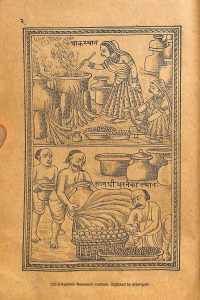
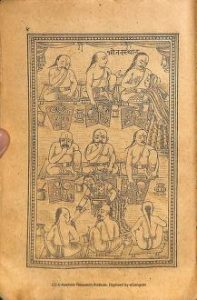
Similarly, Bhakt Bhagwandas’s Ras Vyanjan Prakash (1902) frames cooking as an inherently feminine and even religious duty. He argues that women should take charge of the kitchen because “they are the ones who stay at home,” and the book’s illustrations depict women cooking and serving while men sit and eat, visually reinforcing these gendered expectations.
Although these works may seem like simple recipe collections, they aimed to shape the behaviour of newly educated, newly married middle-class Hindu women. Their emphasis on ritual purity, household discipline, and the gendered division of labour reveals a strong commitment to dominant-caste norms. Produced in an era when the printing press—introduced under British rule—had enabled the widespread circulation of books and periodicals, these cookbooks became tools for promoting a specific vision of domesticity. In doing so, they helped lay the foundations for what later came to be understood as a “national cuisine,” one rooted largely in upper-caste Hindu preferences.
Colonial Modernity, New Professions, and Rising Household Anxiety
Along with the printing press, the British brought in a range of new technologies and administrative systems that profoundly reshaped India’s social and cultural landscape. Long-standing practices in banking, trade, law, and governance were reorganised, giving rise to new professional avenues and specialised occupations. The expanding colonial bureaucracy needed trained personnel, and it was largely dominant-caste Hindu men—those with the resources and education to clear the required examinations—who entered these roles. Yet this new economic security came with its own pressures.
The rhythms of the clock and the routines of colonial offices began dictating their lives. Within these workplaces, fresh hierarchies emerged—ones in which race and Western-style qualifications mattered more than caste status. Many Indian men, especially clerks and other lower-level employees, felt sidelined within the public sphere. This fed a growing anxiety in dominant caste homes: how could one preserve ritual purity and cultural identity while navigating workplaces that demanded conformity to colonial norms and the rejection of what was labelled as “traditional” or “backward” Indian customs?
At the same moment, the anti-colonial movement was gathering force. As scholar Utsa Ray notes, these parallel developments drove nationalist thinkers to romanticise the home. The domestic sphere was reimagined as a protected, sacred space—untainted by the moral corruption of colonial modernity. Against this backdrop, early vernacular cookbooks reinforced long-standing Hindu ideals about family structure, gender hierarchies, and the rules of purity that placed the responsibility of safeguarding the household squarely on women. Many texts hailed married women as grihlaxmis—keepers of the home and protectors of family well-being—whose cooking skills were seen as essential to sustaining life and harmony.
Female Education and Domestic Fears
As more women began receiving formal education, household anxieties only intensified. In Domesticity in Colonial India (2004), Judith Walsh cites one alarmed male writer who famously asked,
“Will the woman who has earned a BA degree cook or scrub utensils?”
Such sentiments echoed widely. Cookbook authors repeatedly insisted that a woman’s true calling lay in household work, warning that modern education might tempt young women to abandon their domestic duties—a threat, in their view, to the stability of Hindu families dependent on women’s labour.
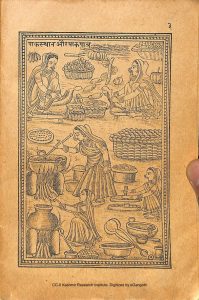
The cover of one of the earliest Hindi confectionery cookbooks, Pakprakash Aur Mithai (1929) by Mataprasad Gupt, captured this tension visually. It depicted one woman kneading dough and frying puris, while another lounged on a diwan reading a book. The message was unmistakable: only one of them represented the ideal housewife. Later editions reinforced this glorified domesticity, showing women working together in bustling kitchens, surrounded by abundant platters of food—a celebration of the traditional domestic order that these texts sought so diligently to preserve.
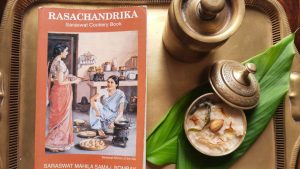
Maniram Sharma’s Pak Chandrika (1926), a bestseller in its time, made the point with direct instruction. Sharma argued that just as nourishing an infant with breast milk was a woman’s foremost responsibility, so too was feeding her family through daily cooking.
To strengthen this argument, many such cookbooks romanticised an imagined Hindu past in which women sustained their households by preparing wholesome and flavourful meals. Any deviation from this ideal—especially among newly married, educated women—was portrayed as idleness or even moral decay. Sharma, for example, lamented that women who did not cook were eroding the foundations of the Hindu household and, by extension, the strength of the nation itself. He criticised young men for turning to street food, describing “outside” meals as unhygienic and morally suspect.
Women Writers and the Reinforcement of Domestic Roles
Although early vernacular cookbooks were predominantly authored by men, women soon entered the field as culinary instructors in print. Their writing tended to be gentler in tone but still firmly promoted conservative ideas about gendered domestic roles.
Yashoda Devi’s Grhini Kartavya Shastra continued to emphasise a strict division of labour within the home, casting women as guardians of both family health and national welfare.
Most women writers supported the idea of female education but insisted it should never compromise household responsibilities. Vrindeshwari Devi, in her mid-twentieth-century cookbook Saras Bhojan Kaise Banayen (How to Cook Tasty Food), cautioned young women not to let schooling distract them from domestic obligations. She famously reminded her readers that:
“Book learning alone cannot sustain a household; our foremost duty is to manage the home, and cooking lies at the centre of that.”
She warned that if a thirsty or hungry guest were greeted not with food but with a display of academic knowledge, it would upend the social expectations that held the household together.
Caste, Vegetarianism, and the Making of a National Cuisine
These early cookbooks did more than prescribe how kitchens should be run—they also contributed to defining a “national cuisine” that mirrored dominant-caste Hindu values. Vrindeshwari Devi championed sattvik food, portraying it as the ideal diet for respectable householders. By excluding meat, eggs, onions, and garlic, sattvik cooking was believed—drawing on Ayurvedic theory—to minimise rajasic qualities associated with passion and tamasic traits linked to lethargy.
Bhagwandas’s Ras Vyanjan Prakash made its caste orientation explicit not only through its strict vegetarian recipes but also through imagery of Brahmin men, marked by their traditional choti, being served by dutiful women.
Vegetarianism dominated these publications, reflecting both the caste identity of authors and the expectations of their intended readership. Sharma defended Pak Chandrika’s refusal to include meat dishes by attributing it to India’s hot climate. Yashoda Devi appealed to Ayurvedic reasoning to argue that a nation’s food should correspond to the moral character of its people. Shailkumari Chaturvedi’s Pak Shastra declared that non-vegetarian dishes had little relevance for “ordinary” families, while Hanumanprasad Sharma’s Aahaar Vigyan used Western anatomical science to claim that human teeth were unsuited to consuming meat.
As historian Charu Gupta observes, this celebration of vegetarianism was not merely cultural—it was also political. These prescriptions emerged at a moment when debates around meat-eating were central to nationalist discourse. Some leaders, such as Swami Vivekananda, advocated meat consumption to counter British portrayals of Indian men as weak. Others—especially upper-caste Hindu nationalists like Mahatma Gandhi—elevated vegetarianism as a marker of moral discipline and purity. This valorisation of vegetarian practices became part of a broader attempt to equate Hindu customs with the essence of the Indian nation.
Conclusion
By examining these early vernacular cookbooks within the wider background of colonial change, emerging middle-class anxieties, and the reshaping of domestic ideals, it becomes clear that these texts were far more than instructional manuals. They were part of a larger cultural project born out of a moment when colonial bureaucracy, new professional hierarchies, and nationalist debates placed enormous pressure on dominant-caste Hindu households to preserve a sense of “tradition.” The home was increasingly imagined as the last untouched sphere of moral purity, and cooking became a symbolic act through which women were expected to safeguard family discipline, caste identity, and cultural continuity. The gendered expectations embedded in these cookbooks thus reflect both the aspirations and insecurities of their time—revealing how food writing became a subtle but powerful instrument for shaping domestic life and defining who belonged to the emerging modern Indian nation.
- Alauddin Khalji’s Revolutionary Price Control Policy: How One Sultan Reinvented the Medieval Indian Economy - November 24, 2025
- From Chains to Crown: The Rise of the Mamluk Sovereigns in Delhi - November 20, 2025
- Reconstructing Medieval India: Chronicles, Narratives, and the People’s Perspective - November 19, 2025

No Comments