


04 Nov Rural Job Scheme: Labour Demand 200 Days Work Amidst Drought
✎ MGNREGA guarantees 100 days of wage employment to rural households, serving as a crucial social safety net and a tool for rural development and poverty alleviation.
Subject Relevance — Where This Topic Fits
- GS Paper II — Government Policies and Interventions; Welfare Schemes for Vulnerable Sections | GS Paper III — Indian Economy and Issues Relating to Planning, Mobilization of Resources, Growth, Development and Employment; Inclusive Growth
- Prelims: MGNREGS, Rural Employment Guarantee Scheme, Drought Relief Works, Wage Payments, Zilla Panchayat, Food for Work Scheme
- Essay: Rural Development and Poverty Alleviation in India, The Role of Social Safety Nets in Mitigating Economic Distress
Quick Revision: MGNREGA guarantees 100 days of wage employment to rural households, serving as a crucial social safety net and a tool for rural development and poverty alleviation.
Why is this in the news?
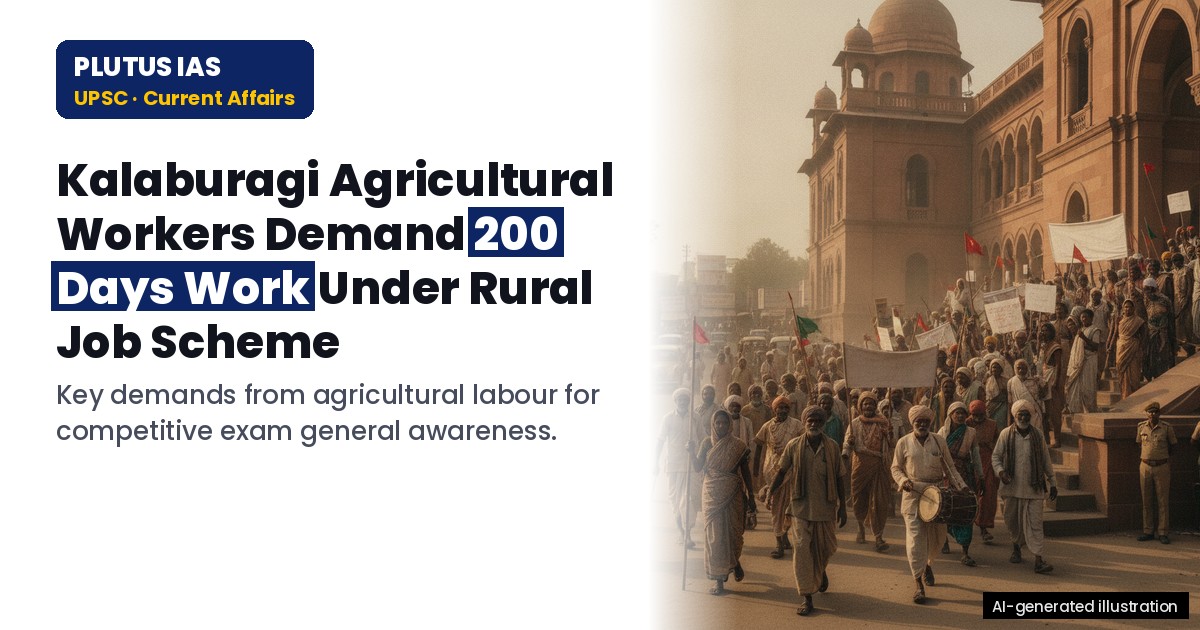
Agricultural labourers in Kalaburagi, Karnataka, under the aegis of the Karnataka Agricultural Workers Union, recently staged a demonstration before the Zilla Panchayat office. Their primary demands included an increase in the guaranteed workdays under the rural employment guarantee scheme from the current 100 days to 200 days annually, timely payment of pending wages, and the immediate initiation of drought-relief works. This protest highlights the severe economic distress faced by agricultural workers, exacerbated by prevailing drought conditions and resultant scarcity of agricultural employment.
Background
- The Mahatma Gandhi National Rural Employment Guarantee Act (MGNREGA) was enacted in 2005, guaranteeing 100 days of wage employment in a financial year to every rural household whose adult members volunteer to do unskilled manual work.
- The scheme aims to enhance livelihood security in rural areas by providing a social safety net for vulnerable populations.
- In times of drought or natural calamities, the central government has the provision to notify an increase in the number of guaranteed workdays beyond 100 days for affected areas.
- Wage payments under MGNREGS are mandated to be made within 15 days of the completion of work, with compensation for delays.
- The Zilla Panchayat, as a district-level administrative body, plays a crucial role in the implementation and monitoring of MGNREGS at the local level.
- Drought conditions significantly impact agricultural productivity, leading to a reduction in farm-based employment opportunities and increasing reliance on schemes like MGNREGS for income support.
What is the Mahatma Gandhi National Rural Employment Guarantee Act (MGNREGA)?
- MGNREGA is a demand-driven, rights-based social security and labour law that guarantees the ‘right to work’ to rural households.
- It provides a legal guarantee for 100 days of wage employment in a financial year to adult members of any rural household willing to do unskilled manual work.
- The primary objective is to enhance the livelihood security of people in rural areas by creating durable assets and strengthening the livelihood resource base of the poor.
- The Act mandates that at least one-third of the beneficiaries should be women, promoting gender equality in the workforce.
- Wages are paid according to the statutory minimum wages for agricultural labourers in the state, unless the Central Government notifies a wage rate for MGNREGA work.
- Unemployment allowance is payable if employment is not provided within 15 days of submitting an application.
- The scheme is implemented by Gram Panchayats, with active involvement of local communities in planning and monitoring works.
- Permissible works under MGNREGA include water conservation and harvesting, drought proofing, irrigation canals, land development, and rural connectivity.
Key Features
| Feature | Significance |
|---|---|
| Increased Guaranteed Workdays | Aims to provide enhanced income security for rural households, particularly during periods of agricultural distress. |
| Timely Wage Payments | Crucial for ensuring the immediate financial stability of workers and preventing accumulation of debt. |
| Drought-Relief Works | Addresses the immediate impact of natural calamities on agricultural livelihoods by creating alternative employment opportunities. |
| Food for Work Scheme Integration | Combats food insecurity alongside income generation, providing a dual benefit to vulnerable populations. |
| Prompt Work Provision | Ensures the efficacy of the employment guarantee scheme by making work available within a stipulated timeframe upon demand. |
Why it Matters
Socio-Economic Significance
- Addresses rural distress exacerbated by drought conditions, preventing distress migration and alleviating poverty.
- Enhances the purchasing power of rural labour, contributing to local economic stability and demand.
- Promotes social equity by ensuring a basic safety net for the most vulnerable sections of the rural populace.
Governance Significance
- Highlights the importance of responsive governance mechanisms, particularly at the local (Zilla Panchayat) level, in addressing citizen grievances.
- Emphasises the need for effective implementation and monitoring of welfare schemes to prevent leakages and ensure intended benefits reach beneficiaries.
- Underscores the role of civil society organisations and labour unions in advocating for the rights and welfare of marginalised communities.
Developmental Significance
- Contributes to sustainable rural development by creating durable assets through public works, such as water conservation structures and rural infrastructure.
- Strengthens the resilience of rural communities against climate-induced shocks like drought by providing alternative livelihood options.
- Reinforces the commitment to inclusive growth by focusing on the welfare of agricultural labour, who form a significant part of the rural workforce.
Challenges
1. Inadequate Work Provision
- The existing guarantee of 100 days (or 125 days in drought-affected areas) may be insufficient to meet the livelihood needs of rural households, especially during prolonged agricultural lean seasons or natural calamities.
- Failure to provide work within the stipulated timeframe (e.g., three days of demand) undermines the scheme’s objective of providing a legal guarantee of employment.
UPSC Link: Poverty and Developmental Issues
2. Delayed Wage Payments
- Non-payment or delayed payment of wages causes significant financial hardship for workers, defeating the purpose of income support and potentially pushing them into debt.
- Operational inefficiencies, such as delays in fund transfers from central to state governments or within state treasuries, often contribute to this issue.
UPSC Link: Government Policies and Interventions
3. Wage Rate Discrepancies
- Reports of nominal muster rolls (NMRs) recording lower wages than the stipulated amount indicate potential corruption or manipulation at the ground level.
- The adequacy of the minimum wage rate itself, in comparison to prevailing market rates and cost of living, is a recurring concern.
UPSC Link: Social Justice
4. Impact of Drought Conditions
- Drought severely reduces agricultural employment opportunities, increasing dependence on rural employment guarantee schemes.
- The increased demand for work during droughts can strain the administrative and financial capacity of the scheme, leading to unmet demands.
UPSC Link: Disaster Management
5. Monitoring and Accountability
- Ensuring transparency and accountability in the implementation of the scheme, from work allocation to wage disbursement, remains a significant challenge.
- Effective grievance redressal mechanisms are essential to address issues faced by workers, such as non-provision of work or delayed payments.
UPSC Link: Transparency & Accountability
Challenges — UPSC Perspective
| Issue | Concern |
|---|---|
| Insufficient Workdays | Existing 100/125 days inadequate for sustained livelihood, especially in distress. |
| Delayed Wage Disbursement | Causes financial hardship, debt, and erodes trust in the scheme’s efficacy. |
| Wage Underpayment | Manipulation of muster rolls leading to workers receiving less than entitled wages. |
| Drought Exacerbation | Increased demand for work during drought strains scheme resources and delivery. |
| Lack of Transparency | Issues in work allocation, measurement, and payment processes hinder accountability. |
Government Initiatives — Must-Memorise for Prelims
- Mahatma Gandhi National Rural Employment Guarantee Scheme (MGNREGS)
- Food for Work Scheme
Way Forward
- Increase the guaranteed number of workdays under the rural employment scheme, particularly in drought-prone or distressed regions, to provide a more robust safety net.
- Implement a robust, technology-driven system for timely wage disbursement, ensuring payments are credited directly to workers’ accounts within the legally mandated period.
- Strengthen social audit mechanisms and vigilance committees at the gram panchayat level to enhance transparency and accountability in work allocation, measurement, and wage payments.
- Integrate drought-relief works proactively into the annual work plans of the rural employment scheme, focusing on water conservation, afforestation, and other climate-resilient activities.
- Enhance the capacity of local administrative bodies (e.g., Zilla Panchayats, Gram Panchayats) in planning, implementing, and monitoring the scheme effectively.
- Ensure the provision of work within the statutory three-day period of demand by maintaining a ready pipeline of approved projects and adequate budgetary allocations.
- Periodically review and revise wage rates under the scheme to ensure they are commensurate with the cost of living and provide a dignified income to workers.
UPSC Value Addition
Keywords for Mains Answer-Writing
Mahatma Gandhi National Rural Employment Guarantee Act (MGNREGA) · rural employment · wage payment delays · drought relief · agricultural labour welfare · social safety nets · distress migration · livelihood security · public works programmes · decentralised governance · Zilla Panchayat · food security
Constitutional & Policy Linkages
- {‘article’: ‘Article 21’, ‘note’: ‘Right to life and livelihood’}
- {‘article’: ‘Article 39(a)’, ‘note’: ‘Right to an adequate means of livelihood’}
- {‘article’: ‘Article 41’, ‘note’: ‘Right to work in certain cases’}
- {‘article’: ‘Article 43’, ‘note’: ‘Living wage for workers’}
Concept Flow
Drought conditions lead to crop damage and agricultural income loss. → Reduced agricultural work opportunities for rural labour. → Increased demand for employment under rural job schemes. → Existing scheme provisions (e.g., 100 days) become insufficient. → Workers face financial hardship due to lack of work and delayed wages. → Demand for increased workdays and improved scheme implementation. → Government intervention required to enhance rural livelihood security.
Prelims Practice Questions
Q1. Consider the following statements regarding the Mahatma Gandhi National Rural Employment Guarantee Act (MGNREGA):
1. It guarantees 100 days of wage employment in a financial year to every rural household whose adult members volunteer to do unskilled manual work.
2. The Act mandates that wages must be paid within 15 days of the work being completed.
3. In drought-affected areas, the number of guaranteed workdays can be extended beyond 100 days.
- Only one
- Only two
- Only three
- None
Answer: Only three — Statement 1 is correct: MGNREGA guarantees 100 days of wage employment to every rural household. Statement 2 is correct: The Act stipulates that wages must be paid within 15 days. Statement 3 is correct: The Central Government may, by notification, extend the period of 100 days of work per household in a financial year for any area where drought or natural calamities have been notified.
Q2. Which of the following bodies is primarily responsible for the implementation and monitoring of MGNREGA at the district level?
- Gram Panchayat
- Block Development Officer
- Zilla Panchayat
- District Collector
Answer: Zilla Panchayat — While Gram Panchayats are the primary implementing agencies, the Zilla Panchayat plays a crucial role in planning, monitoring, and overall supervision of MGNREGA at the district level, including approving the District Perspective Plan.
Mains Practice Question
✍ The Mahatma Gandhi National Rural Employment Guarantee Act (MGNREGA) is a cornerstone of India’s rural development strategy. Examine its role in providing livelihood security to agricultural labour, especially during periods of distress. Further, discuss the persistent challenges in its implementation and suggest measures for improvement. (15 Marks)
Approach: MODEL-ANSWER SKELETON:
1. Introduction: Briefly introduce MGNREGA as a social security measure and a legal right to work.
2. Role in Livelihood Security:
a. Guaranteed employment: 100 days of unskilled manual work.
b. Safety net: Provides income during agricultural lean seasons or distress (e.g., drought).
c. Wage income: Direct transfer to bank accounts, empowering rural households.
d. Gender equity: Mandates 33% participation for women.
e. Asset creation: Focus on water conservation, irrigation, rural connectivity, enhancing agricultural productivity.
3. Persistent Challenges in Implementation:
a. Inadequate workdays: Often less than 100 days provided, as highlighted by the demand for 200 days.
b. Wage payment delays: Non-payment or delayed payment of wages, leading to hardship.
c. Low wage rates: Wages often below market rates or minimum wages in some states.
d. Insufficient budget allocation: Leading to rationing of work or payment delays.
e. Corruption and leakages: Issues with muster rolls, ghost workers, and diversion of funds.
f. Quality of assets: Concerns over durability and utility of created assets.
g. Administrative bottlenecks: Lack of adequate staff, technical support, and capacity building.
h. Drought impact: Increased demand for work during distress, straining resources.
4. Measures for Improvement:
a. Increase guaranteed workdays: Especially in drought-prone or distressed regions, as demanded.
b. Timely wage payments: Strict adherence to the 15-day payment norm, with compensation for delays.
c. Enhance wage rates: Periodically review and align with minimum agricultural wages.
d. Adequate and predictable budget allocation: Based on demand-driven principles.
e. Strengthen grievance redressal mechanisms: Effective social audits, ombudsman, and public information systems.
f. Improve asset quality: Focus on durable, productive assets linked to local needs and climate resilience.
g. Capacity building: Training for Gram Panchayat functionaries and workers.
h. Integration with other schemes: Synergies with agricultural development and food security programmes.
5. Conclusion: Reiterate MGNREGA’s importance and the need for robust implementation to achieve its objectives of rural development and poverty alleviation.
Source: The Hindu
Generated by AanyaAi for educational purpose.
Related guides on our sites
- Anthropology VS PSIR
- Best PSIR optional coaching
- Best PSIR optional coaching online
- Best sociology optional coaching

- ईपीएफओ पेंशन: निजी क्षेत्र के कर्मचारियों की न्यूनतम पेंशन में वृद्धि - November 10, 2026
- तमिलनाडु में ‘एरी’ पोर्टल लॉन्च: जल निकायों के जीर्णोद्धार हेतु ऑनलाइन NOC - November 10, 2026
- DRI Foils Elephant Tusk Trafficking in Assam: UPSC & State PCS - November 10, 2026

No Comments