


11 Aug SAMARTH Scheme: UPSC Focus on Skill Training & Employment in Textile Sector
Financial outlayImplementation PartnersGender inclusionTarget rationalisation✎ SAMARTH is a demand-driven, placement-linked skilling scheme for the organised textile sector, excluding spinning and weaving, implemented via direct fund allocation to 370+ Implementation Partners, with no state/district-wise…
Subject Relevance — Where This Topic Fits
- GS Paper III — Economy: Employment, Skill Development, and MSMEs | GS Paper III — Economy: Government Schemes for Sectoral Development
- Prelims: SAMARTH Scheme, Textile Sector Skill Development, Demand-driven skill programmes, Placement-linked skilling, Implementation Partners (IPs), Revised Estimates (RE) vs Actual Expenditure (AE), Ministry of Textiles, GoI
- Essay: The role of skill development in India’s demographic dividend: A case study of the SAMARTH scheme, Balancing employment generation and inclusivity in government skilling programmes
Quick Revision: SAMARTH is a demand-driven, placement-linked skilling scheme for the organised textile sector, excluding spinning and weaving, implemented via direct fund allocation to 370+ Implementation Partners, with no state/district-wise targets.
Why is this in the news?
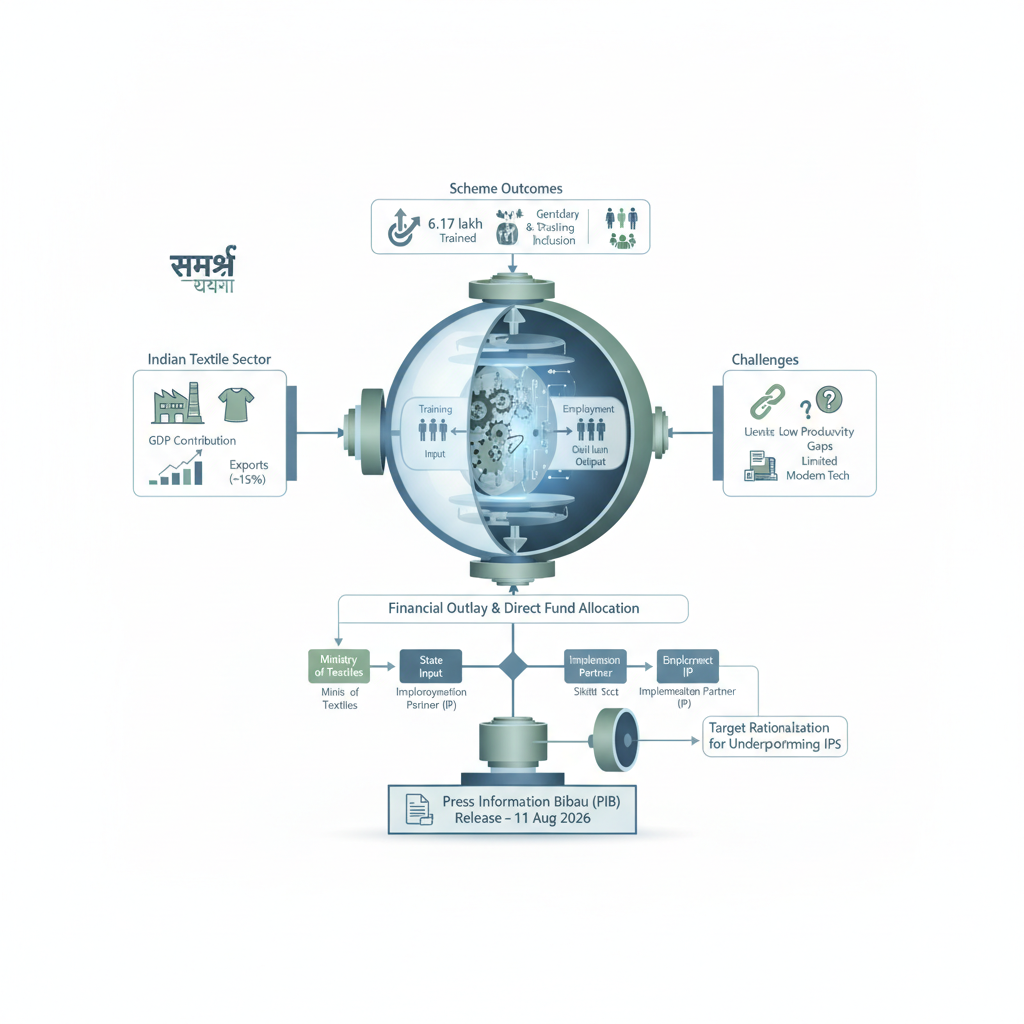
The Press Information Bureau (PIB) released an official statement on 11 August 2026, detailing the financial outlay, implementation mechanism, and outcomes of the SAMARTH Scheme under the Ministry of Textiles. The scheme, operational since 2017, has trained over 6.17 lakh beneficiaries and placed 5.17 lakh individuals in employment, with a notable emphasis on gender and social inclusion. The release also clarified the direct fund allocation to Implementation Partners (IPs), bypassing state or district-wise allocations, and highlighted the rationalisation of targets for underperforming IPs.
Background
- The textile sector is a significant contributor to India’s GDP, employing over 45 million people and accounting for ~15% of the country’s total exports.
- India’s textile industry faces structural challenges, including low productivity, skill gaps, and limited adoption of modern technologies in the unorganised sector.
- The National Skill Development Mission (NSDM), launched in 2015, aims to train 400 million people by 2022 (subsequently extended to 2026) across sectors, including textiles.
- The Pradhan Mantri Kaushal Vikas Yojana (PMKVY) and other central schemes have historically focused on short-term skilling, but sector-specific interventions like SAMARTH address industry-specific demands.
- The SAMARTH Scheme was launched in 2017 to bridge the skill deficit in the organised textile and allied sectors, excluding spinning and weaving, by providing demand-driven, placement-linked training programmes.
- The scheme aligns with the ‘Make in India’ and ‘Atmanirbhar Bharat’ initiatives, emphasising self-reliance in critical sectors.
What is the SAMARTH Scheme?
- The SAMARTH Scheme (Capacity Building in Textile Sector) is a central sector scheme under the Ministry of Textiles, GoI, launched in 2017 to enhance employability in the organised textile and allied industries.
- It covers the entire value chain of textiles, excluding spinning and weaving, and focuses on demand-driven, placement-linked skill development programmes tailored to industry requirements.
- The scheme operates on a decentralised model, where funds are directly allocated to Implementation Partners (IPs) such as textile industry associations, state/central government agencies, and regional organisations.
- Training targets are assigned to IPs, who establish and operate training centres across states and districts based on their approved projects, ensuring flexibility and responsiveness to local labour market needs.
- Funds are released as per the Revised Estimates (RE) and Actual Expenditure (AE), with no state or district-wise allocation, ensuring efficiency in fund utilisation and accountability among IPs.
- The scheme prioritises inclusivity, with significant representation of women (23,102 out of 27,497 beneficiaries in Rajasthan), Scheduled Castes (10,727), and Scheduled Tribes (4,753).
- As of March 2026, 6.17 lakh beneficiaries have been trained, of which 5.17 lakh have been placed in employment, demonstrating a placement rate of approximately 84%.
- The scheme has engaged 370 IPs, including 327 industry associations, 38 government agencies, and 5 regional organisations, with performance-based rationalisation of targets for 97 IPs and cancellation of targets for 32 underperforming partners.
Key Features
| Feature | Significance |
|---|---|
| Objective | Capacity-building and skill development in the organised textile and allied sectors, excluding spinning and weaving, through demand-driven, placement-oriented programmes. |
| Coverage | Pan-India implementation with direct fund allocation to Implementing Partners (IPs), bypassing state/district-wise allocation for flexibility in training centre establishment. |
| Fund Flow Mechanism | Centralised release of funds to 370 IPs, with no state or district-wise earmarking, enabling dynamic adjustment of targets based on performance and progress. |
| Target Achievement | 6.17 lakh beneficiaries trained (certified) since inception, with 5.17 lakh placed in employment by March 2026, demonstrating high placement efficacy. |
| Inclusivity | Significant representation of marginalised groups: 23,102 women, 10,727 Scheduled Castes, and 4,753 Scheduled Tribes among placed beneficiaries in Rajasthan alone. |
| Implementation Partners | Diverse ecosystem of 370 IPs, including 327 textile industry associations/units, 38 government agencies, and 5 regional organisations, fostering public-private collaboration. |
Why it Matters
Economic Development
- Enhances employability in the organised textile sector by aligning skill development with industry demand, addressing the critical gap between labour supply and market requirements.
- Contributes to formalisation of the textile workforce, reducing informality and improving wage standards across the value chain.
- Supports the ‘Make in India’ initiative by creating a skilled labour pool for high-value textile manufacturing and export-oriented industries.
Social Inclusion
- Promotes gender parity in employment through targeted training and placement support for women, aligning with SDG 5 (Gender Equality).
- Facilitates socio-economic upliftment of Scheduled Castes and Scheduled Tribes through inclusive skill development and employment opportunities.
- Reduces regional disparities by enabling IPs to establish training centres in underserved states and districts.
Governance Efficiency
- Demonstrates a results-driven, outcome-based funding model where allocations are tied to performance metrics and progress reviews.
- Ensures transparency and accountability through direct fund transfer to IPs, minimising administrative layers and leakages.
- Showcases adaptive governance by rationalising or cancelling underperforming IPs’ targets, ensuring optimal resource utilisation.
Industry Alignment
- Bridges the skill deficit in the organised textile sector by focusing on high-demand roles in design, merchandising, retail, and allied services.
- Encourages industry-led skill development through partnerships with textile associations and enterprises, ensuring relevance and scalability.
- Supports the transition from unorganised to organised sector employment, enhancing productivity and competitiveness.
Challenges
1. Performance Variability Among IPs
- Inconsistent progress across 370 IPs, with 32 targets cancelled due to poor performance or inactivity, indicating challenges in maintaining uniform quality and outreach.
- Risk of suboptimal utilisation of allocated funds where IPs fail to meet training or placement benchmarks despite financial support.
UPSC Link: GS3: Skill Development & Employment
2. Geographical Disparities in Beneficiary Coverage
- Uneven distribution of training centres and beneficiaries across states, with Rajasthan reporting 27,497 placements but other regions lagging, reflecting implementation gaps.
- Limited penetration in remote or economically backward districts, exacerbating regional imbalances in skill development and employment opportunities.
UPSC Link: GS2: Social Sector Services & Governance
3. Sustainability of Placement Outcomes
- Dependence on industry demand for placements raises concerns about long-term job security, especially in cyclical sectors like textiles.
- Need for post-placement support mechanisms (e.g., mentorship, upskilling) to ensure retention and career progression among beneficiaries.
UPSC Link: GS3: Employment & Labour Reforms
4. Monitoring and Evaluation Framework
- Lack of granular, real-time data on training quality, industry absorption rates, and skill retention post-placement hinders evidence-based policymaking.
- Challenges in standardising assessment criteria across diverse IPs, leading to variability in certification rigour and employability outcomes.
UPSC Link: GS4: Ethics in Governance & Transparency
5. Industry Engagement and Buy-in
- Limited involvement of small and medium enterprises (SMEs) in the textile value chain, which dominate the sector but lack resources to participate in skill programmes.
- Need for stronger industry associations to drive demand articulation and co-funding of training programmes, ensuring alignment with market needs.
UPSC Link: GS3: Industrial Policy & MSMEs
Challenges — UPSC Perspective
| Issue | Concern |
|---|---|
| Variability in IP Performance | Risk of underutilisation of funds and suboptimal outcomes due to inconsistent progress across implementing partners. |
| Geographical Imbalance | Uneven beneficiary coverage across states and districts, with certain regions receiving disproportionate attention. |
| Placement Sustainability | Potential volatility in job retention due to industry demand fluctuations and lack of post-placement support. |
| Data Gaps in Monitoring | Inadequate real-time tracking of training quality, certification standards, and long-term employment outcomes. |
| Industry Participation | Limited engagement of SMEs and informal sector players, restricting the scheme’s reach and relevance. |
Way Forward
- Strengthen the performance monitoring framework by introducing quarterly reviews, third-party audits, and standardised KPIs for IPs to ensure accountability and quality.
- Enhance geographical inclusivity by incentivising IPs to establish training centres in underserved districts through performance-linked grants or tax benefits.
- Develop a post-placement support mechanism, including mentorship programmes, upskilling courses, and industry linkages, to improve job retention and career growth.
- Expand industry engagement by mandating representation of SMEs in IP consortia and offering co-funding incentives for collaborative skill development projects.
- Establish a centralised digital dashboard for real-time tracking of training progress, certification rates, and placement outcomes to enable data-driven decision-making.
- Rationalise the IP ecosystem by phasing out underperforming partners while incentivising high-performing IPs to scale operations and mentor new entrants.
- Integrate the scheme with existing skilling initiatives (e.g., PMKVY, NSDC) to avoid duplication and leverage synergies in resource utilisation and beneficiary outreach.
UPSC Value Addition
Keywords for Mains Answer-Writing
Skill India Mission · Textiles Sector Skill Development · Demand-driven skill programmes · Placement-oriented training · Implementation Partners (IPs) · Ministry of Textiles · Capacity Building in Textiles · National Skill Qualification Framework (NSQF) · Women empowerment through skilling · SC/ST skill inclusion · Skill India Mission convergence · Placement-linked skilling outcomes
Concept Flow
Identification of Skill Gaps in Organised Textile Sector → Design of Demand-Driven Training Programmes → Selection of Implementing Partners (IPs) → Direct Fund Allocation to IPs → Establishment of Training Centres → Trainee Enrolment & Certification → Industry Placement → Post-Placement Support & Retention → Performance Review & Feedback Loop → Rationalisation of IPs Based on Outcomes
Prelims Practice Questions
Q1. Consider the following statements regarding the SAMARTH scheme of the Ministry of Textiles:
1. SAMARTH provides demand-based, placement-oriented skill training across the entire textile value chain excluding spinning and weaving.
2. Under SAMARTH, funds are directly allocated to Implementation Partners (IPs) rather than to states or districts.
3. The scheme mandates a fixed state-wise or district-wise allocation of training targets.
4. As of March 2026, over 6.17 lakh beneficiaries have been trained under SAMARTH, with more than 5.17 lakh placed in jobs.
How many of the above statements are correct?
- Only one
- Only two
- Only three
- All
Answer: All — Statements 1, 2, and 4 are correct. Statement 3 is incorrect as the scheme does not allocate funds or training targets state-wise or district-wise; instead, it allocates targets directly to Implementation Partners who operate across states and districts.
Q2. Assertion (A): The SAMARTH scheme of the Ministry of Textiles is designed to cover the entire textile value chain, including spinning and weaving.
Reason (R): The scheme aims to provide demand-driven, placement-oriented skill training to organised textile and related sectors.
Options:
A. Both A and R are true, and R is the correct explanation of A.
B. Both A and R are true, but R is NOT the correct explanation of A.
C. A is true, but R is false.
D. A is false, but R is true.
Answer: ? — Assertion (A) is false because the SAMARTH scheme explicitly excludes spinning and weaving from its coverage. Reason (R) is true as the scheme is designed to provide demand-driven, placement-oriented skill training in the organised textile and related sectors.
Q3. Match the following columns related to the SAMARTH scheme:
Column I (Component) | Column II (Description)
———————————————–|————————————————
1. Implementation Partners (IPs) | A. Funds are directly allocated to these entities
2. State-wise or district-wise allocation | B. Not applicable under SAMARTH
3. Training targets | C. Allocated directly to IPs, not states/districts
4. Spinning and weaving inclusion | D. Excluded from the scheme’s coverage
Options:
A. 1-A, 2-B, 3-C, 4-D
B. 1-C, 2-B, 3-A, 4-D
C. 1-A, 2-B, 3-C, 4-B
D. 1-C, 2-A, 3-B, 4-D
Answer: ? — Correct matching: 1-A (Funds are directly allocated to Implementation Partners), 2-B (State-wise or district-wise allocation is not applicable), 3-C (Training targets are allocated directly to IPs), 4-D (Spinning and weaving are excluded from the scheme’s coverage).
Mains Practice Question
✍ The SAMARTH scheme, launched by the Ministry of Textiles, represents a significant intervention in the organised textile sector through demand-driven, placement-oriented skill development. Critically examine the design, implementation architecture, and outcomes of the SAMARTH scheme with reference to its alignment with the broader Skill India Mission and the challenges in achieving inclusive skilling. (15 Marks)
Approach: MODEL-ANSWER SKELETON:
1. **Introduction (2 Marks)**
– Define SAMARTH: Ministry of Textiles’ capacity-building scheme for organised textile and related sectors (excluding spinning and weaving).
– State its alignment with Skill India Mission and NSQF.
– Mention the scheme’s objective: demand-driven, placement-oriented skill training.
2. **Design and Implementation Architecture (5 Marks)**
– **Direct Allocation to IPs**: Explain the rationale behind direct fund allocation to Implementation Partners (IPs) rather than state/district-wise allocation. Cite the data (e.g., 370 IPs listed, including 327 textile industry/associations, 38 government agencies, and 5 regional organisations).
– **Flexibility in Training Targets**: Highlight that training targets are allocated to IPs, who operate across states and districts, enabling dynamic and demand-responsive skilling. Mention the rationalisation of targets for 97 IPs and cancellation for 32 IPs due to slow progress.
– **Coverage and Exclusions**: Clarify the exclusion of spinning and weaving and its implications for the textile value chain.
3. **Outcomes and Impact (5 Marks)**
– **Quantitative Outcomes**: Present key data: 6.17 lakh beneficiaries trained, 5.17 lakh placed in jobs (as of March 2026). Highlight state-specific data (e.g., 27,497 beneficiaries in Rajasthan, including 23,102 women, 10,727 SCs, and 4,753 STs).
– **Inclusivity**: Discuss the scheme’s role in promoting gender and social inclusion in skilling (e.g., 84% of Rajasthan beneficiaries are women).
– **Placement Orientation**: Emphasise the scheme’s focus on placement-linked outcomes, aligning with the Skill India Mission’s goals.
4. **Challenges and Limitations (3 Marks)**
– **Geographical Imbalance**: Note that while the scheme operates pan-India, data on regional disparities in training and placement (e.g., higher concentration in certain states) may indicate challenges in reaching remote or underserved areas.
– **Exclusion of Spinning and Weaving**: Discuss the implications of excluding these segments, which are critical to the textile value chain, for the scheme’s comprehensiveness.
– **Monitoring and Rationalisation**: Highlight the need for robust monitoring mechanisms to ensure efficient utilisation of funds and targets, as evidenced by the rationalisation/cancellation of targets for some IPs.
5. **Conclusion (2 Marks)**
– Summarise the scheme’s strengths: demand-driven design, direct allocation to IPs, and strong placement outcomes.
– Acknowledge challenges: exclusions, regional imbalances, and the need for continuous monitoring.
– State the scheme’s contribution to the Skill India Mission and its potential for further scaling, with targeted interventions to address gaps.
Source: PIB (Press Information Bureau)
Generated by AanyaAi for educational purpose.

- KWML’s Feasibility Reports for Water Metro in 18 Cities: UPSC & PCS Insights - October 3, 2026
- ओडिशा में वन्यजीव अनुसंधान अनुदान कार्यक्रम शुरू, सिमिलिपाल में 300 कैमरे और बढ़ेंगे - October 3, 2026
- India Summons Pakistan High Commission Official Over Violation - October 3, 2026

No Comments