


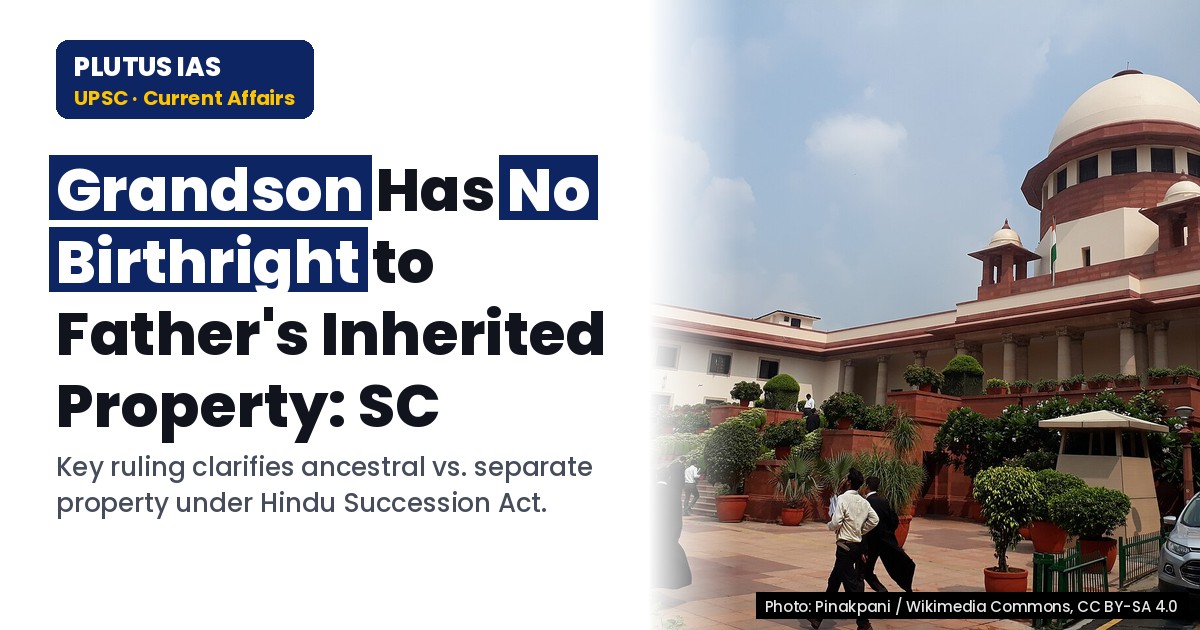
11 Nov SC on Grandson’s Property Rights: Key Ruling
✎ The Supreme Court ruled that property received by a father through partition under Section 8 of the Hindu Succession Act, 1956, becomes his individual property, over which a grandson does not acquire a birthright.
Subject Relevance — Where This Topic Fits
- GS Paper II — Governance, Constitution, Polity, Social Justice | GS Paper I — Indian Society
- Prelims: Hindu Succession Act, 1956, Ancestral Property, Self-Acquired Property, Coparcener, Class I Heirs, Section 8, Hindu Succession Act, Survivorship, Property Rights
- Essay: The evolving landscape of property rights and social justice in India., Judicial pronouncements as instruments of social change and legal clarity.
Quick Revision: The Supreme Court ruled that property received by a father through partition under Section 8 of the Hindu Succession Act, 1956, becomes his individual property, over which a grandson does not acquire a birthright.
Why is this in the news?
The Supreme Court of India recently delivered a significant judgment clarifying the distinction between ancestral and self-acquired property under Hindu law, specifically addressing the rights of a grandson in property inherited by his father. The ruling affirmed that property received by a father through partition among Class I heirs, as per Section 8 of the Hindu Succession Act, 1956, becomes his individual property, over which a grandson does not acquire a birthright.
Background
- The Hindu Succession Act, 1956, governs the inheritance and succession of property among Hindus, Buddhists, Jains, and Sikhs.
- Prior to the 1956 Act, Hindu law of succession was largely governed by various schools of thought, primarily Mitakshara and Dayabhaga, with the Mitakshara school recognising the concept of coparcenary property.
- A coparcener is a person who has a birthright in ancestral property, allowing them to demand partition and preventing the Karta (manager) from alienating the property without their consent.
- Section 8 of the Hindu Succession Act, 1956, specifies the general rules of succession in the case of males, stipulating that the property of a male Hindu dying intestate devolves first upon the heirs specified in Class I.
- The concept of ‘survivorship’ is central to coparcenary property, where the interest of a deceased coparcener passes to the surviving coparceners, not to his heirs by succession.
- The Supreme Court’s decision arose from a case involving a grandson seeking a share in property that his father had received through a partition decree following the death of the grandfather, arguing a birthright as a coparcener.
Key Concepts in Hindu Property Law
- Ancestral Property (Coparcenary Property): This refers to property inherited by a Hindu from his father, grandfather, or great-grandfather. A son acquires a birthright in such property, making him a coparcener.
- Self-Acquired Property (Separate Property): This denotes property acquired by an individual through their own efforts, earnings, or by way of gift, will, or inheritance from a source other than ancestral lineage. The owner has absolute rights over this property.
- Coparcener: An individual who, by birth, acquires an interest in the ancestral property of a Hindu Undivided Family (HUF). Coparceners have the right to demand partition and prevent alienation of the property without consent.
- Hindu Succession Act, 1956: A codified law that brought uniformity to the law of succession among Hindus, replacing diverse customary laws and schools of thought.
- Section 8 of the Hindu Succession Act: This section outlines the general rules of succession for a male Hindu dying intestate (without a will). It prioritises Class I heirs (e.g., son, daughter, widow, mother) for inheritance.
- Survivorship: A principle applicable to coparcenary property where the share of a deceased coparcener passes to the remaining coparceners, not to his personal heirs, unless a partition has occurred.
- Class I Heirs: The primary beneficiaries under Section 8 of the Hindu Succession Act, who inherit the property simultaneously and to the exclusion of other heirs.
Key Features
| Feature | Significance |
|---|---|
| Ancestral/Coparcenary Property | Property inherited from ancestors, where a son acquires a right by birth. The father acts as a manager and cannot alienate it without the consent of other coparceners. |
| Self-acquired/Separate Property | Property earned or acquired by an individual through their own efforts. The individual is the sole and absolute owner, with full rights to dispose of it as they deem fit. |
| Hindu Succession Act, 1956 (Section 8) | Governs the general rules of succession in the case of males dying intestate (without a will). Property devolves upon Class I heirs, who acquire it as their individual property. |
| Class I Heirs | Primary legal heirs specified under the Hindu Succession Act, 1956, who inherit the property of a deceased male intestate. This includes the mother, widow, son, daughter, etc. |
| Survivorship | A mode of succession applicable to coparcenary property, where the interest of a deceased coparcener passes to the surviving coparceners, not to their individual heirs. |
| Succession | The process by which the property, rights, and obligations of a deceased person are transferred to their heirs or beneficiaries, either by will or by law. |
Why it Matters
Legal Clarity and Precedent
- The Supreme Court’s ruling provides definitive legal clarity on the distinction between ancestral and self-acquired property under Hindu law, resolving ambiguities that frequently lead to protracted litigation.
- It establishes a crucial precedent regarding the nature of property received by a Class I heir under Section 8 of the Hindu Succession Act, 1956, affirming it as individual property rather than coparcenary.
Property Rights and Management
- The judgment reinforces the absolute ownership rights of an individual over property acquired through succession under Section 8, empowering them to manage, alienate, or bequeath it without familial encumbrances.
- It clarifies the scope of a coparcener’s birthright, limiting it strictly to ancestral property and preventing its extension to property that has already undergone partition and succession under statutory provisions.
Impact on Family Disputes
- By clearly delineating property types and associated rights, the ruling is expected to reduce the incidence of disputes within Hindu families concerning property inheritance and alienation.
- It provides a clear legal framework for lower courts to adjudicate similar cases, potentially streamlining the judicial process and reducing the burden on the judiciary.
Challenges
1. Awareness and Interpretation
- Ensuring widespread public awareness, particularly among rural populations, regarding the nuanced distinctions between ancestral and self-acquired property and their respective inheritance rules.
- Potential for misinterpretation of the judgment’s scope, leading to continued disputes if the specific conditions under which property becomes ‘individual’ are not fully understood.
UPSC Link: Governance; Social Justice
2. Documentation and Record-Keeping
- The necessity for meticulous documentation of property origins and succession pathways to clearly establish whether a property is ancestral or self-acquired, which is often lacking in informal property transactions.
- Challenges in tracing the historical nature of property, especially in older cases where original acquisition or partition records may be incomplete or unavailable.
UPSC Link: Land Reforms; Governance
3. Gender Equality in Inheritance
- While the judgment clarifies existing law, it indirectly highlights the broader issue of ensuring equitable inheritance rights for women, as the focus remains on male lineal descendants in coparcenary contexts.
- The need for continuous legal reforms to address any remaining disparities in inheritance laws that might disadvantage female heirs, despite the progressive amendments to the Hindu Succession Act.
UPSC Link: Social Justice; Women Empowerment
Challenges — UPSC Perspective
| Issue | Concern |
|---|---|
| Complexity of Hindu Law | The intricate nature of Hindu personal laws, particularly concerning property, often leads to confusion and prolonged legal battles, necessitating clear judicial pronouncements. |
| Informal Property Transfers | Many property transactions and partitions within families occur informally, without proper legal documentation, complicating the determination of property type in future disputes. |
| Litigation Burden | Property disputes constitute a significant portion of civil litigation, contributing to judicial backlog and delays in justice delivery. |
| Protection of Minor’s Rights | Ensuring that the rights and interests of minor heirs are adequately protected in property matters, especially when decisions are made by adult family members. |
| Awareness Deficit | A general lack of public awareness regarding the specific provisions of the Hindu Succession Act and judicial interpretations, leading to uninformed claims and expectations. |
Way Forward
- Promote extensive legal literacy campaigns to educate the public on property rights, inheritance laws, and the distinction between different types of property under Hindu law.
- Encourage formalisation of property partitions and transfers through registered documents to create clear records and prevent future disputes.
- Strengthen alternative dispute resolution mechanisms, such as mediation and conciliation, to resolve family property disputes outside of formal court proceedings.
- Review and update land records and property registration systems to ensure accuracy, accessibility, and transparency, thereby simplifying property tracing and verification.
- Consider legislative amendments to further simplify and clarify complex aspects of inheritance law, ensuring equitable outcomes for all heirs, including women and children.
- Integrate basic legal education on property rights into school curricula to foster early understanding among citizens.
- Facilitate easy access to legal aid and advice for individuals, particularly those from disadvantaged backgrounds, who are involved in property disputes.
UPSC Value Addition
Keywords for Mains Answer-Writing
Hindu Succession Act 1956 · Section 8 Hindu Succession Act · Ancestral Property · Self-acquired Property · Coparcenary Property · Survivorship · Class I Heirs · Property Rights · Supreme Court Judgments · Hindu Law
Concept Flow
Grandfather’s property exists. → Grandfather dies intestate; property devolves to Class I heirs (son, daughter) under Section 8 of Hindu Succession Act, 1956. → Son receives his share; this becomes his individual/separate property. → Grandson claims birthright in this property. → Supreme Court rules grandson has no birthright in father’s individual property acquired via Section 8 succession. → Father’s right to alienate his individual property is upheld.
Prelims Practice Questions
Q1. Consider the following statements regarding property rights under Hindu Law:
1. Under the Mitakshara school, a son acquires an interest in ancestral property by birth.
2. Self-acquired property can be freely alienated by the owner without the consent of heirs.
3. The Hindu Succession Act, 1956, abolished the concept of coparcenary property for daughters.
How many of the above statements are correct?
- Only one
- Only two
- Only three
- None
Answer: Only two — Statement 1 is correct: Under the Mitakshara school, a son acquires a birthright in ancestral property. Statement 2 is correct: Self-acquired property is at the absolute disposal of the owner. Statement 3 is incorrect: The Hindu Succession (Amendment) Act, 2005, made daughters coparceners by birth in their own right in the same manner as sons.
Q2. Which of the following sections of the Hindu Succession Act, 1956, deals with the general rules of succession in the case of males dying intestate?
- Section 6
- Section 8
- Section 14
- Section 30
Answer: Section 8 — Section 8 of the Hindu Succession Act, 1956, lays down the general rules of succession in the case of Hindu males dying intestate (without a will).
Q3. Assertion (A): Property received by a son from his father through succession under Section 8 of the Hindu Succession Act, 1956, becomes the son’s separate property.
Reason (R): Section 8 of the Hindu Succession Act, 1956, provides for devolution by survivorship, thereby creating a coparcenary interest for the son’s descendants.
Select the correct option:
- Both A and R are true, and R is the correct explanation of A.
- Both A and R are true, but R is not the correct explanation of A.
- A is true, but R is false.
- A is false, but R is true.
Answer: A is true, but R is false. — Assertion (A) is true: The Supreme Court has clarified that property received under Section 8 is individual property. Reason (R) is false: Section 8 governs succession, not survivorship, and does not automatically create a coparcenary interest for the son’s descendants in such property.
Mains Practice Question
✍ Examine the distinction between ancestral property and self-acquired property under Hindu Law. Discuss the implications of the Supreme Court’s recent judgment regarding the rights of a grandson in property inherited by his father under Section 8 of the Hindu Succession Act, 1956. (15 Marks)
Approach: MODEL-ANSWER SKELETON:
1. **Introduction:** Briefly define property rights under Hindu Law and the significance of the distinction between ancestral and self-acquired property.
2. **Ancestral Property (Coparcenary Property):**
* Definition: Property inherited from a male ancestor up to four generations.
* Key characteristic: Birthright of sons (and now daughters post-2005 amendment) as coparceners.
* Alienation: Requires consent of all coparceners; father acts as manager.
* Relevant legal framework: Mitakshara school principles.
3. **Self-acquired Property (Separate Property):**
* Definition: Property earned or acquired by an individual’s own efforts, or inherited from certain sources (e.g., maternal side, or through a will).
* Key characteristic: Absolute ownership and disposal rights of the individual.
* Alienation: No consent of heirs required; can be sold, gifted, willed freely.
4. **Supreme Court’s Recent Judgment:**
* Case context: Property inherited by a son from his father (the grandfather of the claimant) after partition among Class I heirs.
* Core ruling: Property received by a son under Section 8 of the Hindu Succession Act, 1956, is his individual/separate property.
* Rationale: Section 8 governs succession, not survivorship. It confers absolute ownership, not a coparcenary interest.
* Implication: A grandson does not acquire a birthright (coparcenary interest) in such property.
* Consequence: The father (son in this context) has the absolute right to alienate (sell, gift) such property without the grandson’s consent.
5. **Implications for Property Rights and Succession:**
* Reinforces the distinction between modes of acquisition (succession vs. survivorship).
* Clarifies the scope of Section 8 of the Hindu Succession Act.
* Impact on family disputes and clarity in property transactions.
6. **Conclusion:** Summarize the importance of the judgment in providing clarity on property devolution and the rights of heirs under Hindu Law.
Source: hindi.news18.com
Generated by AanyaAi for educational purpose.
Related guides on our sites
- Best PSIR optional coaching for upsc
- Best Law optional coaching for upsc
- Best PSIR optional teacher for upsc
- Best teacher of PSIR optional for upsc

- CII पार्टनरशिप समिट: भारत की वैश्विक आर्थिक भूमिका - November 11, 2026
- Garh Ganga Mela: Yogi’s Directives for ‘Mini Kumbh’ - November 11, 2026
- दिल्ली में दिवाली प्रदूषण: पटाखों का 71%, वाहनों का 7% योगदान - November 11, 2026

No Comments