


02 Nov SC Overturns Rajasthan SEC’s Voter Awareness Campaign Ban
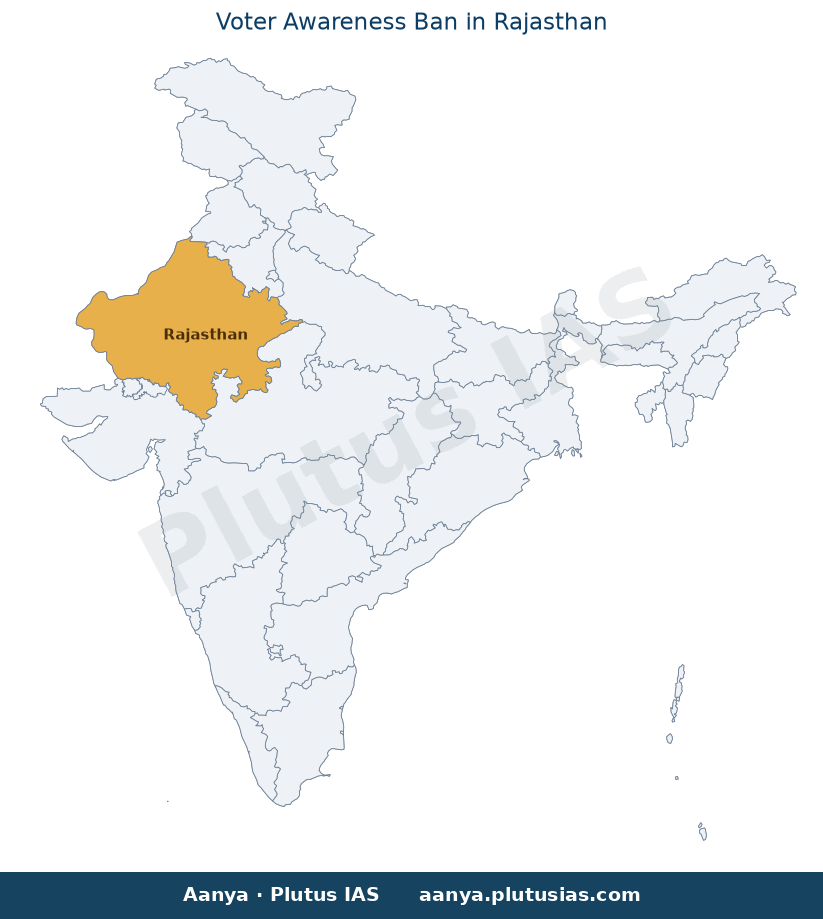
✎ The Supreme Court set aside the Rajasthan State Election Commission's order barring a social organisation from conducting voter awareness campaigns and directed the SEC to reconsider the organisation's application within 48 hours.
Subject Relevance — Where This Topic Fits
- GS Paper II — Polity and Governance | GS Paper II — Indian Constitution — Fundamental Rights | GS Paper II — Role of Civil Society Organisations
- Prelims: Voter awareness campaigns, State Election Commission (SEC), Supreme Court of India, Right to Information, Mizdoor Kisan Shakti Sangathan (MKSS), NOTA (None of the Above)
- Essay: The role of civil society in strengthening democratic processes., Judicial review and its impact on electoral governance in India.
Quick Revision: The Supreme Court set aside the Rajasthan State Election Commission’s order barring a social organisation from conducting voter awareness campaigns and directed the SEC to reconsider the organisation’s application within 48 hours.
Why is this in the news?
The Supreme Court of India recently overturned an order by the Rajasthan State Election Commission (SEC) that had prohibited a social organisation from conducting voter awareness campaigns during ongoing local body elections. The apex court directed the SEC to reconsider the organisation’s application within 48 hours, emphasising that efforts by such organisations to promote voter awareness should be encouraged rather than restricted.
Background
- The Rajasthan State Election Commission had initially denied permission to a social organisation, the Mazdoor Kisan Shakti Sangathan (MKSS), to conduct voter awareness campaigns.
- The SEC’s decision was reportedly based on the imposition of prohibitory orders under Section 163 of the Bharatiya Nagarik Suraksha Sanhita (BNSS) in election-bound areas.
- MKSS co-founder Aruna Roy and Nikhil Dey filed a petition challenging the SEC’s denial of permission.
- The organisation has been conducting voter awareness campaigns, aiming to educate voters on their democratic rights, available electoral choices including NOTA, and to prevent electoral malpractices such as inducements.
- The Supreme Court bench, comprising Chief Justice Suryakant and Justices Joymalya Bagchi and V. Mohana, highlighted that the Election Commission cannot claim a monopoly over voter awareness activities.
- The court’s directive mandates the SEC to reconsider the request for voter awareness campaigns, thereby reinforcing the importance of citizen participation in electoral education.
Voter Awareness Campaigns and Electoral Governance in India
- Voter awareness campaigns are initiatives designed to educate the electorate about their rights, responsibilities, and the electoral process, thereby fostering informed participation.
- These campaigns aim to increase voter turnout, reduce electoral malpractices, and enhance the integrity of democratic elections.
- The Election Commission of India (ECI) and State Election Commissions (SECs) are constitutionally mandated bodies responsible for conducting free and fair elections, which includes promoting voter education.
- Civil Society Organisations (CSOs) play a crucial supplementary role in voter awareness, often reaching grassroots levels and addressing specific community needs.
- The ‘None of the Above’ (NOTA) option, introduced in 2013, allows voters to formally register a vote of rejection for all candidates, and awareness campaigns often educate voters about this option.
- The right to information and freedom of speech and expression, enshrined in Article 19(1)(a) of the Constitution, underpin the ability of organisations to conduct awareness campaigns.
- Judicial interventions, such as the Supreme Court’s ruling in this case, reinforce the constitutional principles of democratic participation and the role of civil society in governance.
- Prohibitory orders, like those under Section 163 of the BNSS (formerly Section 144 of the CrPC), are typically imposed to maintain public order and can sometimes be cited to restrict public gatherings, including awareness campaigns.
Key Features
| Feature | Significance |
|---|---|
| Voter Awareness Campaigns | Crucial for fostering an informed electorate and strengthening democratic participation, ensuring citizens understand their rights and choices. |
| Role of Social Organisations | Non-governmental entities often play a vital role in civic education and outreach, supplementing governmental efforts in areas like voter literacy. |
| Judicial Review of Election Commission Decisions | The Supreme Court’s intervention underscores the judiciary’s role in upholding fundamental rights and ensuring that administrative actions, even by autonomous bodies, are reasonable and constitutional. |
| Right to Information and Expression | Campaigns informing voters about their options, including ‘None Of The Above’ (NOTA), align with the principles of free speech and the right to information, essential for a vibrant democracy. |
| Electoral Integrity | Awareness initiatives aimed at preventing electoral malpractices like inducements for votes contribute directly to the fairness and transparency of the electoral process. |
Why it Matters
Democratic Governance
- Enhances the quality of democratic participation by ensuring voters are well-informed about candidates, electoral processes, and their rights.
- Promotes transparency and accountability in elections by empowering citizens to make choices free from undue influence or misinformation.
Rule of Law and Constitutionalism
- Reaffirms the judiciary’s role in safeguarding fundamental rights, including freedom of speech and expression, even in the context of electoral regulations.
- Establishes a precedent that restrictions on civic engagement, particularly voter awareness, must be justified and proportionate, not arbitrary.
Civil Society Engagement
- Recognises and encourages the positive contribution of social organisations in strengthening democratic institutions and civic education.
- Fosters a collaborative environment where governmental bodies and civil society can collectively work towards electoral reforms and voter empowerment.
Challenges
1. Balancing Regulation and Freedom
- The challenge lies in formulating regulations that prevent misuse or partisan campaigning while not unduly stifling legitimate voter awareness efforts by civil society.
- Distinguishing between neutral civic education and biased political advocacy can be complex for electoral bodies.
UPSC Link: Indian Constitution—fundamental rights; Election Commission—powers and functions
2. Ensuring Uniform Application of Rules
- Maintaining consistency in applying electoral rules across different states and local bodies to avoid arbitrary restrictions on voter awareness initiatives.
- The need for clear guidelines for social organisations to conduct campaigns without infringing upon electoral codes of conduct.
UPSC Link: Federalism; Election Commission—powers and functions
3. Resource Mobilisation for Awareness
- Despite the importance, voter awareness campaigns often face challenges in securing adequate funding and logistical support, especially for grassroots organisations.
- Optimising the reach and impact of awareness campaigns, particularly in remote or underserved areas, remains a persistent challenge.
UPSC Link: Government policies and interventions
Challenges — UPSC Perspective
| Issue | Concern |
|---|---|
| Restriction on Voter Awareness | Potential to disenfranchise voters by limiting access to crucial information about electoral processes and choices. |
| Arbitrary Administrative Orders | Risk of undermining democratic principles if autonomous bodies issue orders without sufficient justification or in violation of fundamental rights. |
| Role of Civil Society | Curtailing the legitimate activities of social organisations can weaken civic engagement and reduce the diversity of voices in public discourse. |
| Electoral Malpractices | Lack of awareness campaigns, particularly those highlighting the illegality of inducements, can exacerbate issues of vote-buying and other irregularities. |
Way Forward
- Develop clear, transparent guidelines for social organisations to conduct voter awareness campaigns, ensuring neutrality and adherence to electoral laws.
- Foster greater collaboration between election commissions and civil society organisations to leverage their respective strengths in voter education.
- Utilise diverse media channels and innovative outreach methods to maximise the reach and impact of voter awareness messages, especially in rural and marginalised communities.
- Regularly review and update electoral regulations to ensure they facilitate, rather than hinder, legitimate civic engagement and democratic participation.
- Strengthen judicial oversight to ensure that any restrictions on fundamental rights, including freedom of expression in the context of voter awareness, are proportionate and legally sound.
- Incorporate feedback from civil society and academic experts into policy-making regarding voter education and electoral reforms.
UPSC Value Addition
Keywords for Mains Answer-Writing
Voter awareness campaigns · Election Commission of India · State Election Commissions · Right to information · Democratic participation · Electoral integrity · Judicial review · Model Code of Conduct · Civil society organisations · Local self-governance
Constitutional & Policy Linkages
- {‘Article 19(1)(a)’: ‘Freedom of speech and expression’}
- {‘Article 324’: ‘Superintendence, direction, control of elections’}
Concept Flow
State Election Commission restricts voter awareness campaign. → Social organisation challenges restriction in Supreme Court. → Supreme Court upholds right to voter awareness. → Court directs SEC to reconsider decision within 48 hours. → Voter awareness campaigns are encouraged, strengthening democracy.
Prelims Practice Questions
Q1. Consider the following statements regarding State Election Commissions (SECs) in India:
1. State Election Commissions are constitutional bodies established under Article 243K of the Constitution of India.
2. The Governor appoints the State Election Commissioner.
3. The State Election Commission is responsible for the superintendence, direction, and control of the preparation of electoral rolls and the conduct of elections to Panchayats and Municipalities.
How many of the above statements are correct?
- Only one
- Only two
- Only three
- None
Answer: Only three — Statement 1 is correct: Article 243K (for Panchayats) and Article 243ZA (for Municipalities) provide for the constitution of State Election Commissions. Statement 2 is correct: The Governor appoints the State Election Commissioner. Statement 3 is correct: The SECs are indeed responsible for conducting elections to Panchayats and Municipalities.
Q2. Assertion (A): The Supreme Court has consistently upheld the importance of voter awareness and education by civil society organisations during elections.
Reason (R): Restricting such campaigns by non-governmental entities can impede democratic participation and the informed exercise of franchise.
Select the correct option:
- Both A and R are true, and R is the correct explanation of A.
- Both A and R are true, but R is not the correct explanation of A.
- A is true, but R is false.
- A is false, but R is true.
Answer: Both A and R are true, and R is the correct explanation of A. — Assertion (A) is true, as demonstrated by the Supreme Court’s recent ruling encouraging voter awareness efforts. Reason (R) is also true, as limiting these campaigns can indeed hinder informed democratic participation. Furthermore, R provides a valid justification for A, making it the correct explanation.
Mains Practice Question
✍ Critically examine the role of the Election Commission of India and State Election Commissions in promoting voter awareness and participation. Discuss the extent to which civil society organisations contribute to these efforts, with reference to recent judicial pronouncements. (15 Marks)
Approach: MODEL-ANSWER SKELETON: Introduction: Briefly define the constitutional mandate of ECI (Art. 324) and SECs (Art. 243K, 243ZA) for electoral management. Role of ECI/SECs in voter awareness: Systematic Voters’ Education and Electoral Participation (SVEEP) programme, use of media, electoral literacy clubs, collaboration with educational institutions. Challenges faced by ECI/SECs in outreach. Contribution of Civil Society Organisations (CSOs): Role in grassroots mobilisation, voter registration drives, education on electoral processes (e.g., NOTA), combating inducements, monitoring electoral malpractices. Mention specific examples like Mazdoor Kisan Shakti Sangathan (MKSS) if relevant. Judicial Pronouncements: Refer to the recent Supreme Court ruling emphasising the encouragement of CSO involvement in voter awareness, citing the principle that SECs cannot monopolise such activities. Arguments for and against CSO involvement: Benefits (reach, specific focus, trust) vs. potential concerns (partisanship, funding transparency). Conclusion: Summarise the synergistic relationship between statutory bodies and CSOs for robust democratic participation, advocating for a collaborative framework.
Source: amarujala.com
Rajasthan PCS (RPSC / RAS) — State PCS Practice
Prelims: Recently, the Supreme Court of India overturned the ban on voter awareness campaigns during elections in Rajasthan and issued a 48-hour ultimatum to the Election Commission. This decision primarily relates to which of the following aspects of the electoral process?
- A. Regulation of election expenditure by political parties.
- B. Ensuring free and fair elections through voter education.
- C. Delimitation of constituencies in the state.
- D. Appointment of election observers in Rajasthan.
Answer: B. Ensuring free and fair elections through voter education. — The Supreme Court’s decision to lift the ban on voter awareness campaigns directly supports the objective of ensuring free and fair elections by educating voters.
Mains: Discuss the significance of voter awareness campaigns in strengthening democratic participation in Rajasthan, especially in light of recent judicial interventions regarding their regulation during elections.
Generated by AanyaAi for educational purpose.
Related guides on our sites
- Anthropology VS PSIR
- Best PSIR optional coaching
- Best PSIR optional coaching online
- Best PSIR optional teacher

- SC Overturns Rajasthan SEC’s Voter Awareness Campaign Ban - November 2, 2026
- दिल्ली में वायु गुणवत्ता बिगड़ी: GRAP-II लागू, जानें प्रभाव - November 2, 2026
- DoPPW Digital Life Certificate Campaign for Pensioners - November 2, 2026

No Comments