


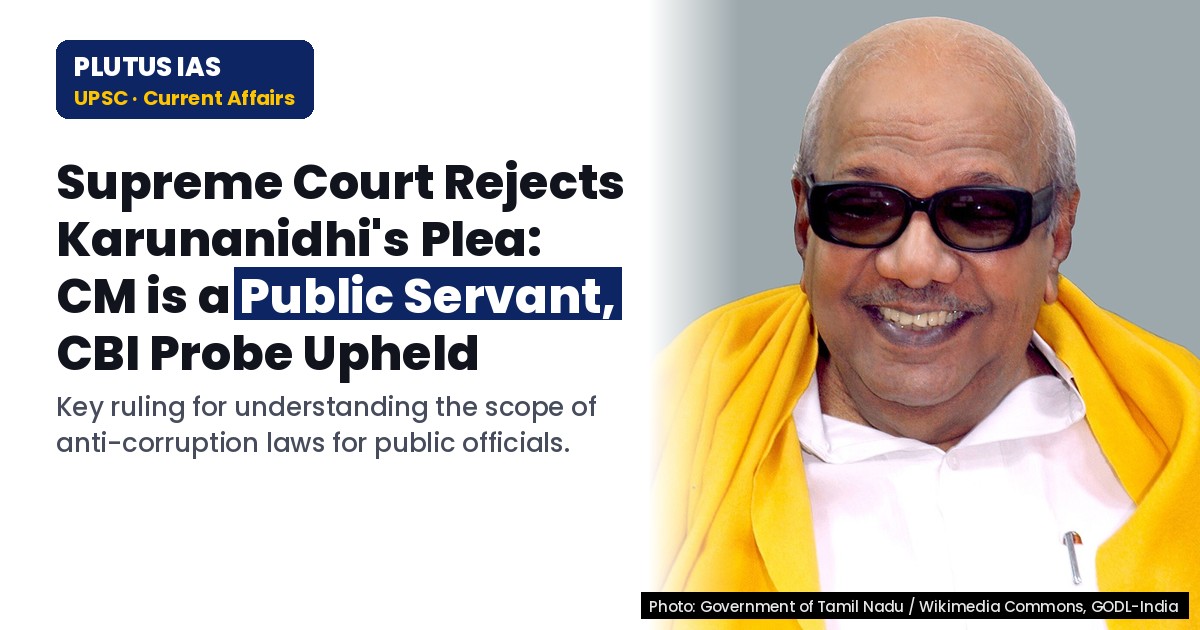
04 Nov SC Ruling: CM as Public Servant & Corruption Probe
✎ The Supreme Court has authoritatively established that a Chief Minister is a 'public servant' under Indian law, making them fully amenable to anti-corruption legislation and judicial scrutiny.
Subject Relevance — Where This Topic Fits
- GS Paper II — Constitution, Polity, Governance | GS Paper IV — Ethics, Integrity, and Aptitude
- Prelims: Chief Minister, Public Servant, Prevention of Corruption Act, Indian Penal Code, Central Bureau of Investigation, Governor’s Sanction, Constitutional Morality, Accountability
- Essay: The Role of Constitutional Institutions in Upholding Probity in Public Life, Accountability and Transparency in Governance: Challenges and Solutions
Quick Revision: The Supreme Court has authoritatively established that a Chief Minister is a ‘public servant’ under Indian law, making them fully amenable to anti-corruption legislation and judicial scrutiny.
Why is this in the news?
The Supreme Court’s historical ruling affirming that a Chief Minister is unequivocally a public servant has recently garnered attention. This judicial precedent, established in response to a case involving alleged corruption during the procurement of wheat in Tamil Nadu in 1976, underscores the legal framework for accountability of high-ranking public functionaries, particularly in the context of the Prevention of Corruption Act and the Indian Penal Code.
Background
- In June 1976, following the dismissal of the M. Karunanidhi-led Tamil Nadu government during the Emergency, the State Chief Secretary initiated a request for a Central Bureau of Investigation (CBI) probe.
- The investigation pertained to allegations of corruption in the procurement of wheat from Punjab, specifically implicating the former Chief Minister and others in abusing official positions for pecuniary gain.
- The alleged abuse involved passing favourable orders to certain firms, resulting in an estimated pecuniary advantage of ₹4 to ₹5 lakh.
- Subsequent to the Governor’s sanction, a charge sheet was filed against the former Chief Minister under relevant provisions of the Indian Penal Code (IPC) and the Prevention of Corruption Act (PCA).
- A petition seeking discharge from the case was dismissed by the Special Court and subsequently upheld by the Madras High Court, leading to the matter’s eventual adjudication by the Supreme Court.
- The core legal contention revolved around whether a Chief Minister, by virtue of their office, falls within the definition of a ‘public servant’ for the purpose of anti-corruption legislation.
The Concept of ‘Public Servant’ in Indian Law
- The term ‘public servant’ is defined under Section 21 of the Indian Penal Code, 1860, encompassing a wide range of individuals holding public office or performing public duties.
- The Prevention of Corruption Act, 1988, which superseded the 1947 Act, also provides an expansive definition of ‘public servant’ in Section 2(c), specifically including persons holding office by virtue of which they are authorised or required to perform any public duty.
- This definition is crucial for prosecuting individuals for offences such as bribery, criminal misconduct, and other forms of corruption committed in their official capacity.
- The Supreme Court’s interpretation has consistently held that constitutional functionaries, including Chief Ministers, are indeed public servants, subject to the same legal scrutiny and accountability as other government officials.
- The rationale behind this broad interpretation is to ensure probity in public life and to prevent those in positions of power from escaping accountability under anti-corruption laws.
- Sanction for prosecution of a public servant is often required under Section 19 of the Prevention of Corruption Act, typically from the appropriate government or authority, which in the case of a Chief Minister, involves the Governor.
Key Features
| Feature | Significance |
|---|---|
| Definition of ‘Public Servant’ | Crucial for establishing accountability and jurisdiction under anti-corruption laws, ensuring that individuals holding high public office are subject to the same legal scrutiny as other government employees. |
| Prevention of Corruption Act (PCA) | A primary legal framework in India designed to combat corruption among public servants, defining offenses and prescribing penalties, thereby upholding integrity in public administration. |
| Indian Penal Code (IPC) Provisions | Sections of the IPC, particularly those pertaining to criminal misconduct and abuse of official position, are applicable to public servants, reinforcing the legal framework against corruption. |
| Role of Central Bureau of Investigation (CBI) | India’s premier investigative agency responsible for probing corruption cases involving central government employees and, in certain circumstances, state government officials, ensuring independent and thorough investigations. |
| Governor’s Sanction for Prosecution | A constitutional requirement in certain cases for initiating legal proceedings against public servants, particularly those holding high office, acting as a safeguard against frivolous prosecutions while also ensuring due process. |
| Judicial Review of Discharge Petitions | The Supreme Court and High Courts play a vital role in reviewing lower court decisions regarding the discharge of accused individuals, ensuring that legal principles are correctly applied and justice is served. |
Why it Matters
Governance and Accountability
- The ruling reinforces the principle that no public office, irrespective of its stature, is beyond the purview of anti-corruption laws, thereby strengthening the accountability framework for elected representatives.
- It underscores the judiciary’s role in interpreting legal definitions to ensure that the spirit of anti-corruption legislation is upheld, preventing potential loopholes that could shield high-ranking officials from prosecution.
- This judgment contributes to public trust in governance by affirming that individuals in positions of power are subject to the same legal standards as other citizens, promoting transparency and ethical conduct.
Legal and Constitutional Implications
- The Supreme Court’s interpretation clarifies the scope of ‘public servant’ under the Prevention of Corruption Act, establishing a precedent for future cases involving high constitutional functionaries.
- It reaffirms the constitutional principle of equality before the law, ensuring that the status of an office does not confer immunity from criminal prosecution for corruption.
- The case highlights the interplay between state and central investigative agencies (CBI) in addressing corruption, particularly when allegations involve state-level functionaries, demonstrating cooperative federalism in law enforcement.
Anti-Corruption Efforts
- The judgment serves as a deterrent against corruption by unequivocally stating that Chief Ministers and similar high-ranking officials are within the ambit of anti-corruption legislation, thereby enhancing the effectiveness of such laws.
- It empowers investigative agencies to pursue cases against individuals holding significant political power, reducing the perception of impunity associated with high office.
- This legal clarity is crucial for strengthening India’s overall anti-corruption framework, aligning it with international best practices that advocate for comprehensive coverage of public officials.
Challenges
1. Defining ‘Public Servant’ Broadly
- Ensuring that the legal definition of ‘public servant’ is sufficiently broad to encompass all individuals exercising public authority, including elected officials, without creating ambiguity or scope for evasion.
- Balancing the need for comprehensive coverage with the distinct roles and responsibilities of various public functionaries, particularly those with constitutional mandates.
UPSC Link: Indian Constitution – Public Services
2. Ensuring Impartial Investigations
- Maintaining the independence and impartiality of investigative agencies like the CBI, especially when probing allegations against high-ranking political figures, to prevent political interference.
- Addressing concerns regarding the potential for misuse of investigative powers for political vendetta, while simultaneously ensuring effective prosecution of genuine corruption cases.
UPSC Link: Governance – Role of CBI
3. Timely Judicial Process
- Expediting trials in corruption cases involving public servants to ensure timely justice, as delays can erode public confidence and allow accused individuals to continue in office.
- Managing the complexities of high-profile cases, which often involve extensive evidence and multiple legal challenges, without compromising the principles of fair trial.
UPSC Link: Judiciary – Judicial Reforms
4. Sanction for Prosecution
- Navigating the requirements for sanction to prosecute public servants, particularly the Governor’s sanction, to ensure it is not used as a tool to impede legitimate investigations or, conversely, to facilitate politically motivated ones.
- Ensuring clarity and consistency in the application of sanction provisions to avoid legal challenges and delays in prosecution.
UPSC Link: Indian Constitution – Governor’s Powers
Challenges — UPSC Perspective
| Issue | Concern |
|---|---|
| Scope of Anti-Corruption Laws | Potential for high-ranking officials to argue for exemption based on their constitutional or elected status, thereby undermining the universality of anti-corruption measures. |
| Independence of Investigative Agencies | Risk of political influence or pressure on agencies like the CBI when investigating powerful political figures, potentially compromising the integrity of investigations. |
| Judicial Backlog and Delays | Protracted legal proceedings in corruption cases, leading to delayed justice and reduced public confidence in the efficacy of the legal system. |
| Abuse of Power | Allegations of public servants abusing their official position for pecuniary advantage, necessitating robust legal frameworks and enforcement mechanisms. |
| Public Trust in Governance | Erosion of public trust when allegations of corruption against high officials are not adequately investigated or prosecuted, impacting the legitimacy of democratic institutions. |
Government Initiatives — Must-Memorise for Prelims
- Prevention of Corruption Act, 1988
Way Forward
- Strengthen the legal definition of ‘public servant’ to explicitly include all elected representatives and constitutional functionaries, leaving no scope for ambiguity.
- Enhance the functional autonomy of investigative agencies like the CBI by providing statutory backing and insulation from political interference, ensuring impartial probes.
- Establish special courts with dedicated infrastructure and judicial personnel to expedite trials in corruption cases, particularly those involving high-profile public servants.
- Implement robust whistleblower protection mechanisms to encourage reporting of corruption without fear of reprisal, thereby aiding investigations.
- Introduce comprehensive asset declaration requirements for all public servants, including elected officials, with provisions for regular audits and public disclosure.
- Promote ethical conduct and integrity in public service through continuous training, awareness campaigns, and the establishment of strong internal vigilance mechanisms.
- Review and streamline the process for sanction of prosecution, ensuring that it acts as a genuine safeguard against frivolous cases without becoming an impediment to legitimate investigations.
UPSC Value Addition
Keywords for Mains Answer-Writing
Public Servant · Prevention of Corruption Act · Chief Minister · Accountability · Constitutional Morality · Rule of Law · CBI · Governor’s Sanction · Abuse of Official Position · Judicial Review · Anti-Corruption Legislation · Executive Accountability
Constitutional & Policy Linkages
- Article 164: Appointment of Chief Minister
- Article 311: Dismissal of public servants
- Article 163: Council of Ministers to aid and advise Governor
Concept Flow
Allegations of corruption against Chief Minister → CBI investigation initiated by Chief Secretary → Governor’s sanction for prosecution obtained → Charge sheet filed under IPC and PCA → Chief Minister’s petition for discharge dismissed by Special Court → Madras High Court upholds Special Court’s decision → Supreme Court reinforces Chief Minister as ‘public servant’
Prelims Practice Questions
Q1. Consider the following statements regarding the legal status of a Chief Minister in India:
1. A Chief Minister is explicitly defined as a ‘public servant’ under the Indian Penal Code (IPC).
2. The Prevention of Corruption Act (PCA) extends its ambit to include a Chief Minister as a public servant.
3. Sanction for prosecution of a former Chief Minister under the PCA is typically granted by the Governor of the state.
- Only one
- Only two
- All three
- None
Answer: All three — Statement 1: The IPC defines ‘public servant’ broadly, and judicial pronouncements have affirmed that a Chief Minister, holding an office by virtue of which they are empowered to perform public duty, falls within this definition. Statement 2: The PCA specifically aims to prevent corruption by public servants, and judicial interpretations have consistently held that a Chief Minister is covered under this Act. Statement 3: As per Section 19 of the Prevention of Corruption Act, 1988, sanction for prosecution of a public servant, including a Chief Minister, is required from the authority competent to remove him from office, which in the case of a Chief Minister, is the Governor.
Q2. Which of the following is NOT a characteristic feature of the Central Bureau of Investigation (CBI)?
- It derives its powers from the Delhi Special Police Establishment Act, 1946.
- It functions under the administrative control of the Ministry of Home Affairs.
- It is the primary investigating agency of the Central Government for corruption cases.
- It can investigate cases in a state only with the consent of the state government, unless directed by a High Court or the Supreme Court.
Answer: It functions under the administrative control of the Ministry of Home Affairs. — The CBI functions under the administrative control of the Department of Personnel and Training (DoPT), Ministry of Personnel, Public Grievances and Pensions, not the Ministry of Home Affairs. Options A, C, and D are correct statements regarding the CBI’s characteristics and powers.
Mains Practice Question
✍ Critically examine the legal and constitutional framework that designates a Chief Minister as a ‘public servant’ in India. Discuss the implications of this designation for accountability and governance, with reference to relevant judicial pronouncements. (15 Marks)
Approach: MODEL-ANSWER SKELETON:
1. **Introduction:** Define ‘public servant’ in a general sense and briefly introduce the legal debate surrounding the Chief Minister’s status.
2. **Legal Framework:**
* **Indian Penal Code (IPC):** Explain how sections like 21 of the IPC define ‘public servant’ broadly to include individuals holding office by virtue of which they are empowered to perform public duty.
* **Prevention of Corruption Act (PCA), 1988:** Detail how the PCA specifically includes individuals holding ‘any office by virtue of which he is authorised or required to perform any public duty’ under its definition of ‘public servant’ (Section 2(c)). Emphasise that a Chief Minister clearly falls within this definition.
3. **Constitutional Context:** Briefly touch upon the constitutional role of the Chief Minister (Articles 163, 164) and how their functions involve public duty and exercise of state power.
4. **Judicial Pronouncements:**
* Reference the specific Supreme Court judgments (e.g., the M. Karunanidhi case, or other similar cases) that have unequivocally affirmed the Chief Minister’s status as a public servant.
* Highlight the rationale behind these judgments, focusing on the nature of the office, the public duties performed, and the need for accountability.
5. **Implications for Accountability and Governance:**
* **Enhanced Accountability:** Discuss how this designation subjects the Chief Minister to anti-corruption laws, ensuring scrutiny and legal recourse against misuse of power.
* **Checks and Balances:** Explain how it reinforces the principle of rule of law, ensuring that even high constitutional functionaries are not above the law.
* **Public Trust:** Emphasise the importance of maintaining public trust in governance by holding leaders accountable.
* **Deterrence:** Argue how it acts as a deterrent against corruption and abuse of official position.
* **Challenges/Debates (Critical Examination):** Briefly acknowledge any debates or complexities, such as the need for sanction for prosecution (Section 19 PCA) and potential for political misuse of such provisions, while maintaining the overall importance of the designation.
6. **Conclusion:** Summarise the critical importance of designating a Chief Minister as a public servant for upholding constitutional morality, transparency, and good governance in a democratic setup.
Source: The Hindu
Generated by AanyaAi for educational purpose.
Related guides on our sites
- Best PSIR optional coaching for upsc
- Best PSIR optional teacher for upsc
- Best teacher of PSIR optional for upsc
- Best PSIR optional coaching in delhi for UPSC

- SC Ruling: CM as Public Servant & Corruption Probe - November 4, 2026
- तमिलनाडु में 50% से अधिक स्टार्टअप महिला-नेतृत्व में: स्टार्टअपटीएन - November 4, 2026
- Tamil Nadu BESS Policy: Energy Storage for Grid Stability - November 4, 2026

No Comments