


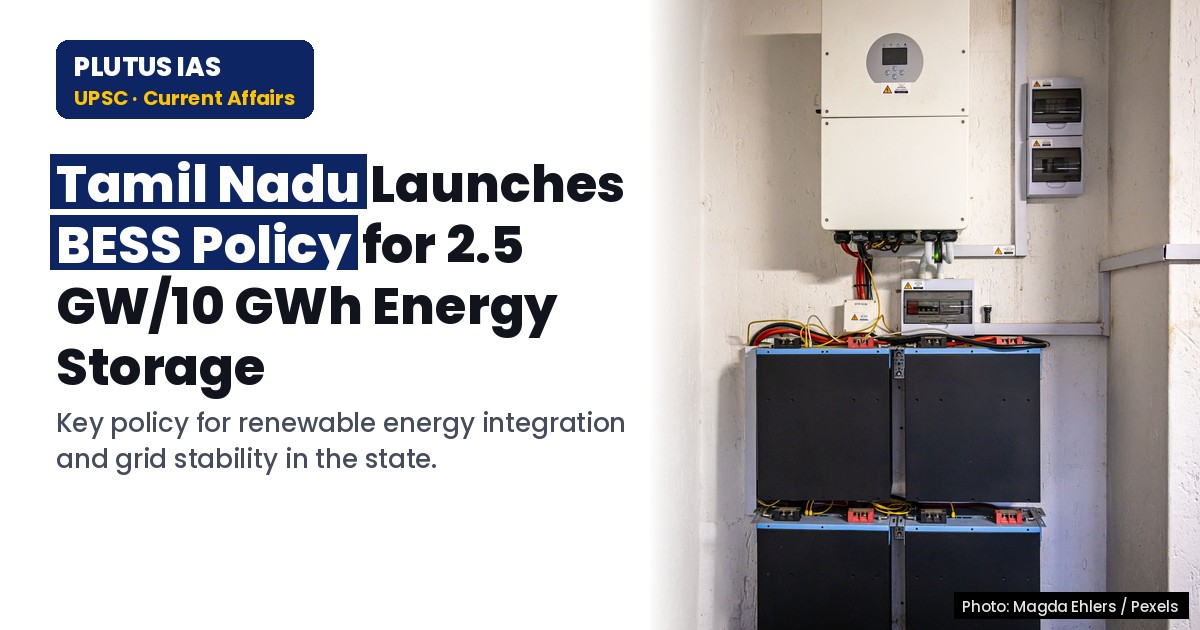
04 Nov Tamil Nadu BESS Policy: Energy Storage for Grid Stability
✎ Battery Energy Storage Systems (BESS) are pivotal for integrating renewable energy, ensuring grid stability, and enhancing energy security by storing surplus power and discharging it during periods of high demand or low renewable…
Subject Relevance — Where This Topic Fits
- GS Paper III — Energy | GS Paper III — Infrastructure | GS Paper III — Environment and Ecology
- Prelims: Battery Energy Storage Systems (BESS), Renewable Energy Integration, Grid Stability, Viability Gap Funding (VGF), Power System Development Fund (PSDF), Energy Security
- Essay: The imperative of sustainable energy transition for India’s economic growth and environmental stewardship., Technological advancements as catalysts for achieving India’s renewable energy targets and enhancing grid resilience.
Quick Revision: Battery Energy Storage Systems (BESS) are pivotal for integrating renewable energy, ensuring grid stability, and enhancing energy security by storing surplus power and discharging it during periods of high demand or low renewable generation.
Why is this in the news?
The Tamil Nadu government has recently unveiled its three-year Battery Energy Storage Systems (BESS) Policy 2026, aiming to deploy 2.5 GW/10 GWh of BESS capacity within this timeframe. This policy is a strategic move to integrate the state’s substantial renewable energy capacity, manage peak demand, and enhance overall grid stability, thereby bolstering energy security and facilitating the transition to a greener energy future.
Background
- India has set ambitious targets for renewable energy capacity addition, aiming for 500 GW by 2030, necessitating robust infrastructure for energy storage and grid management.
- Tamil Nadu possesses a significant installed renewable energy capacity, including 14.5 GW of solar power and 11.6 GW of wind power, making it a frontrunner in renewable energy generation.
- The intermittent nature of solar and wind power necessitates effective energy storage solutions to ensure grid stability and reliable power supply.
- The Central Government has introduced schemes such as the Viability Gap Funding (VGF) for Development of Battery Energy Storage System to promote BESS projects across the country.
- The Power System Development Fund (PSDF) also supports critical transmission and generation projects, including those related to energy storage, to enhance grid reliability.
- State-level policies are crucial for translating national renewable energy goals into actionable projects, addressing specific regional energy demands and infrastructure requirements.
What are Battery Energy Storage Systems (BESS)?
- Battery Energy Storage Systems (BESS) are devices that enable the storage of electrical energy from various sources and discharge it when needed.
- They are crucial for integrating intermittent renewable energy sources like solar and wind into the grid, ensuring a continuous and stable power supply.
- BESS can provide various grid services, including peak shaving (reducing demand during peak hours), frequency regulation, voltage support, and black start capabilities.
- The Tamil Nadu policy encourages both standalone BESS projects and co-located BESS with existing or new renewable energy installations.
- New solar or solar-hybrid renewable energy projects of 1 MW and above, applied on or after the policy’s notification date or commissioned on or after April 1, 2027, are mandated to install BESS capacity of at least 10% of the solar project’s installed capacity.
- Eligible BESS projects will receive a 100% waiver of applicable transmission and wheeling charges, reducing operational costs and enhancing economic viability.
- The Tamil Nadu Power Distribution Corporation (TNPDC) will procure 2,500 MW/10,000 MWh of BESS capacity in the initial phase, demonstrating a commitment to large-scale deployment.
- The Tamil Nadu Green Energy Corporation Limited has been designated as the State Nodal Agency to coordinate, facilitate, and monitor the implementation of BESS projects through a single-window system.
Key Features
| Feature | Significance |
|---|---|
| Targeted Deployment | Aims for 2.5 GW/10 GWh of Battery Energy Storage Systems (BESS) over three years, establishing a clear objective for energy storage capacity. |
| Integration with Existing Renewables | Encourages BESS installation for solar and wind projects of 1 MW and above, facilitating renewable energy integration, peak management, and grid support. |
| Mandatory BESS for New Projects | Mandates BESS capacity of at least 10% of installed capacity for new solar/solar-hybrid projects (1 MW and above) applied/commissioned after specific dates, promoting integrated renewable solutions. |
| Financial Incentives | Offers 100% waiver of transmission and wheeling charges for co-located and standalone BESS, reducing operational costs and enhancing project viability. |
| Procurement by TNPDC | Tamil Nadu Power Distribution Corporation (TNPDC) will procure 2,500 MW/10,000 MWh BESS capacity in the initial phase, ensuring market demand and project off-take. |
| Nodal Agency and Single Window System | Tamil Nadu Green Energy Corporation Limited acts as the State Nodal Agency, offering a single-window system for BESS projects, streamlining approvals and implementation. |
Why it Matters
Energy Security and Grid Stability
- Enhances the reliability of the power grid by mitigating the intermittency of renewable energy sources like solar and wind.
- Supports peak load management, ensuring consistent power supply during periods of high demand.
- Reduces dependence on conventional fossil fuel-based power generation, contributing to energy independence.
Economic Development and Investment
- Attracts investment in the BESS manufacturing and deployment sectors, fostering industrial growth and job creation.
- Reduces transmission and distribution losses by optimising grid operations, leading to cost savings for utilities and consumers.
- Positions Tamil Nadu as a leader in renewable energy integration and advanced energy storage technologies.
Environmental Sustainability
- Facilitates greater penetration of renewable energy into the grid, significantly lowering carbon emissions.
- Contributes to India’s climate change commitments and targets for increasing renewable energy capacity.
- Promotes sustainable energy practices by enabling efficient utilisation of clean energy resources.
Technological Advancement
- Drives research and development in battery technologies, potentially leading to more efficient and cost-effective storage solutions.
- Encourages innovation in grid management and smart grid technologies.
- Builds indigenous capabilities in a critical component of the future energy landscape.
Challenges
1. High Capital Costs
- The initial investment required for BESS projects remains substantial, posing a barrier to widespread adoption.
- Despite incentives, the economic viability of projects can be challenged by the upfront expenditure.
UPSC Link: Economy: Infrastructure (Energy)
2. Technology Evolution and Obsolescence
- Rapid advancements in battery technology can lead to concerns about the long-term relevance and performance of currently deployed systems.
- Ensuring access to the latest and most efficient storage solutions requires continuous policy adaptation and investment.
UPSC Link: Science & Technology: Energy Technologies
3. Supply Chain Dependencies
- Reliance on imported raw materials and components for battery manufacturing can expose projects to geopolitical risks and price volatility.
- Developing a robust domestic supply chain is crucial for long-term sustainability and cost control.
UPSC Link: Economy: Industrial Policy
4. Grid Integration Complexities
- Integrating large-scale BESS into existing grid infrastructure requires sophisticated technical expertise and upgrades.
- Ensuring seamless operation and optimal dispatch of stored energy presents operational challenges for grid operators.
UPSC Link: Infrastructure: Energy Grid Management
5. Safety and Environmental Concerns
- The disposal and recycling of used batteries raise environmental concerns due to hazardous materials.
- Safety protocols for large-scale battery installations, including fire hazards, need stringent adherence and continuous monitoring.
UPSC Link: Environment: Pollution & Degradation
Challenges — UPSC Perspective
| Issue | Concern |
|---|---|
| Financial Viability | High upfront capital expenditure for BESS projects necessitates robust financial mechanisms and continued policy support to ensure commercial attractiveness. |
| Technological Longevity | The rapid pace of battery technology development poses risks of obsolescence for early-stage investments, requiring flexible policy frameworks. |
| Resource Availability | Dependence on critical minerals like lithium and cobalt for battery production raises concerns about supply chain security and price fluctuations. |
| Regulatory Framework | Evolving regulatory landscape for energy storage and grid integration requires clear guidelines and consistent implementation across states. |
| Skilled Workforce | Development and deployment of BESS require a specialised workforce for installation, operation, and maintenance, necessitating targeted skill development programs. |
| Public Perception | Addressing public concerns regarding the safety and environmental impact of large-scale battery storage facilities is crucial for social acceptance and project execution. |
Government Initiatives — Must-Memorise for Prelims
- Viability Gap Funding for Development of Battery Energy Storage System scheme
- Viability Gap Funding Scheme for development of BESS supported through Power System Development Fund scheme
Way Forward
- Establish a dedicated fund or provide enhanced financial incentives, such as production-linked incentives (PLI), to reduce the capital cost of BESS projects and attract private investment.
- Promote indigenous manufacturing of battery components and complete BESS units through research and development support and favourable industrial policies to reduce import dependence.
- Develop and implement robust recycling infrastructure for end-of-life batteries to address environmental concerns and ensure circular economy principles.
- Invest in skill development programs and vocational training to create a qualified workforce for the installation, operation, and maintenance of BESS.
- Facilitate inter-state coordination and standardisation of policies and regulations for BESS deployment to ensure seamless integration into the national grid.
- Encourage pilot projects and demonstration initiatives to test new battery technologies and integration strategies, fostering innovation and learning.
- Strengthen grid infrastructure to accommodate large-scale renewable energy integration with BESS, ensuring grid stability and reliability.
- Implement a dynamic regulatory framework that can adapt to technological advancements and market changes in the energy storage sector.
UPSC Value Addition
Keywords for Mains Answer-Writing
Battery Energy Storage Systems (BESS) · Renewable Energy Integration · Grid Stability · Energy Security · Peak Management · Transmission and Wheeling Charges · Viability Gap Funding (VGF) · Power System Development Fund (PSDF) · State Nodal Agency · Green Energy Corridor · Decentralised Renewable Energy · Energy Transition
Constitutional & Policy Linkages
- Article 246: Distribution of legislative powers (electricity)
- Seventh Schedule, List II, Entry 38: Electricity as state subject
- Seventh Schedule, List III, Entry 38: Electricity as concurrent subject
Concept Flow
Intermittent Renewable Energy Generation → Grid Instability and Demand-Supply Mismatch → Deployment of Battery Energy Storage Systems (BESS) → Enhanced Grid Stability and Peak Load Management → Increased Renewable Energy Integration and Energy Security → Reduced Carbon Emissions and Sustainable Development
Prelims Practice Questions
Q1. Consider the following statements regarding Battery Energy Storage Systems (BESS) in the context of renewable energy:
1. BESS can facilitate the integration of intermittent renewable energy sources like solar and wind into the grid.
2. BESS are primarily used for baseload power generation, replacing conventional thermal power plants.
3. Policies encouraging BESS deployment often include waivers on transmission and wheeling charges to promote adoption.
How many of the above statements are correct?
- Only one
- Only two
- Only three
- None
Answer: Only two — Statement 1 is correct: BESS stores surplus energy from intermittent sources, releasing it when generation is low or demand is high, thereby aiding grid integration. Statement 2 is incorrect: BESS are generally not for baseload power generation but rather for grid balancing, peak shaving, and ancillary services due to their current cost and discharge duration limitations. Statement 3 is correct: Financial incentives like waivers on transmission and wheeling charges are common policy tools to reduce operational costs and encourage BESS installation.
Q2. Which of the following is the primary objective of deploying Battery Energy Storage Systems (BESS) in a grid with high renewable energy penetration?
- To increase the overall installed capacity of thermal power plants.
- To reduce the capital expenditure on new transmission lines.
- To enhance grid stability and manage the intermittency of renewable energy sources.
- To solely provide power during natural disasters.
Answer: To enhance grid stability and manage the intermittency of renewable energy sources. — The primary objective of BESS in a grid with high renewable energy penetration is to enhance grid stability and manage the intermittency of renewable energy sources. This includes functions like peak management, frequency regulation, and voltage support, which are crucial for reliable grid operation with fluctuating renewable generation. While BESS can offer backup during disasters, it is not its primary role in grid integration.
Mains Practice Question
✍ Examine the significance of Battery Energy Storage Systems (BESS) in achieving India’s renewable energy targets and ensuring grid stability. Discuss the policy measures and financial incentives required to accelerate BESS deployment across the country. (15 Marks)
Approach: Introduction: Briefly define BESS and its role in the context of India’s ambitious renewable energy targets and energy transition.
Significance of BESS:
1. Renewable Energy Integration: Explain how BESS addresses the intermittency and variability of solar and wind power, enabling higher penetration of renewables.
2. Grid Stability and Reliability: Discuss its role in frequency regulation, voltage support, peak shaving, and black start capabilities.
3. Energy Security: Highlight how BESS can reduce reliance on fossil fuels and enhance energy independence.
4. Transmission Congestion Management: Mention its potential to defer or reduce investments in new transmission infrastructure.
5. Decentralised Energy Systems: Briefly touch upon its application in microgrids and remote area electrification.
Policy Measures and Financial Incentives:
1. Regulatory Frameworks: Discuss the need for clear regulations for BESS ownership, operation, and market participation.
2. Viability Gap Funding (VGF): Explain the importance of VGF schemes (e.g., ‘Viability Gap Funding for Development of Battery Energy Storage System scheme’) to bridge the cost gap for initial projects.
3. Financial Incentives: Detail measures like waivers on transmission and wheeling charges, capital subsidies, tax benefits, and preferential tariffs.
4. Procurement Mechanisms: Discuss the role of state power distribution companies (e.g., TNPDC) in procuring BESS capacity through competitive bidding.
5. Research and Development (R&D): Emphasise support for indigenous manufacturing and technological advancements in battery chemistry.
6. Single-Window Clearance: Highlight the need for streamlined approval processes through nodal agencies (e.g., Tamil Nadu Green Energy Corporation Limited).
7. Mandatory BESS Integration: Discuss policies requiring BESS installation for new large-scale renewable projects.
Conclusion: Summarise the critical role of BESS in India’s sustainable energy future and reiterate the necessity of a comprehensive policy and incentive framework for its widespread adoption.
Source: The Hindu
Tamil Nadu PCS (TNPSC) — State PCS Practice
Prelims: Consider the following statements regarding the recently released Battery Energy Storage System (BESS) Policy by the Government of Tamil Nadu:
1. The policy aims to promote the adoption of BESS across various applications, including grid-scale, commercial, industrial, and residential sectors.
2. One of the key objectives is to enhance grid stability and integrate a higher share of renewable energy sources into the state’s power mix.
3. The policy primarily focuses on incentivizing the manufacturing of battery components within Tamil Nadu.
Which of the statements given above is/are correct?
- A. 1 only
- B. 2 only
- C. 1 and 2 only
- D. 1, 2 and 3
Answer: C. 1 and 2 only — The Tamil Nadu BESS policy focuses on adoption and integration of BESS for grid stability and renewable energy, not primarily on manufacturing incentives.
Mains: Discuss the key objectives and potential benefits of the Tamil Nadu Battery Energy Storage System (BESS) Policy in achieving the state’s renewable energy targets and ensuring grid stability. (10 marks)
Generated by AanyaAi for educational purpose.
Related guides on our sites
- Anthropology VS PSIR
- Best PSIR optional coaching
- Best PSIR optional coaching online
- Best PSIR optional teacher

- Tamil Nadu BESS Policy: Energy Storage for Grid Stability - November 4, 2026
- उजनी जलाशय: एआई डेटा सेंटर व फ्लोटिंग सोलर से मछुआरों की आजीविका पर संकट - November 4, 2026
- Jantar Mantar Protest Site: Delhi Police to SC - November 4, 2026

No Comments