


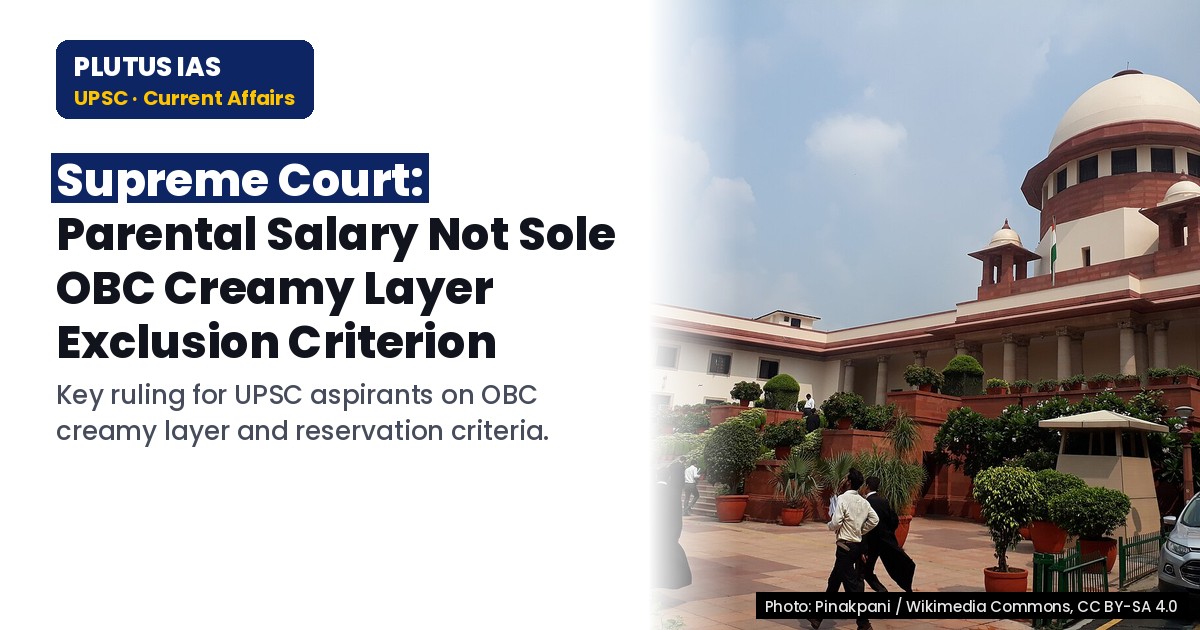
06 Nov SC Upholds OBC Creamy Layer: No Salary as Sole Exclusion
✎ The Supreme Court has reaffirmed that parental income from PSUs or the private sector cannot be the sole criterion for OBC creamy layer exclusion and rejected prospective application of its verdict, ensuring immediate effect on…
Subject Relevance — Where This Topic Fits
- GS Paper II — Governance, Constitution, Polity, Social Justice | GS Paper III — Indian Economy (indirectly, through human resource development)
- Prelims: OBC Creamy Layer, Reservation Policy, Article 16(4), Mandal Commission, DoPT Office Memorandum, Prospective Overruling
- Essay: Social Justice and Affirmative Action: Balancing Equity and Merit, The Role of Judiciary in Shaping Governance and Public Policy
Quick Revision: The Supreme Court has reaffirmed that parental income from PSUs or the private sector cannot be the sole criterion for OBC creamy layer exclusion and rejected prospective application of its verdict, ensuring immediate effect on relevant cases.
Why is this in the news?
The Supreme Court recently reaffirmed its March 11, 2026, verdict, which stipulated that the salary or income of a parent employed in a Public Sector Undertaking (PSU) or the private sector cannot be the sole criterion for determining ‘creamy layer’ exclusion for Other Backward Classes (OBC). The Court also rejected the Centre’s plea for prospective application of the judgment, asserting that there was no compelling justification to defer its implementation. This decision clarifies the applicability of the judgment to specific parties and ongoing cases, while reiterating that already concluded selections and seniorities will not be reopened.
Background
- The concept of ‘creamy layer’ was introduced to ensure that the benefits of reservation reach the most disadvantaged sections within the OBC category, preventing their monopolisation by the affluent.
- The Supreme Court, in the landmark Indra Sawhney & Others vs. Union of India (1992) case, upheld the 27% reservation for OBCs but mandated the exclusion of the ‘creamy layer’.
- The Department of Personnel and Training (DoPT) subsequently issued Office Memoranda (OMs) in 1993 and 2004, outlining the criteria for identifying the creamy layer.
- The 1993 OM, among other things, specified income limits and categories of persons (e.g., constitutional functionaries, Group A/Class I officers) whose children would fall under the creamy layer.
- The recent Supreme Court judgment in Union of India vs. Rohith Nathan (March 11, 2026) addressed the interpretation of these OMs, particularly concerning the income criterion for parents in PSUs and the private sector.
- The Centre had sought a prospective application of the March 11 verdict, meaning the judgment would apply only to future cases and not affect past decisions, which the Court declined.
- The Court has consistently upheld the executive’s prerogative to formulate reservation policies but within the constitutional framework and principles laid down by the judiciary.
What is the OBC Creamy Layer?
- The ‘creamy layer’ refers to the relatively affluent and advanced sections within the Other Backward Classes (OBCs) who are excluded from the benefits of reservation.
- The objective behind the creamy layer concept is to prevent the benefits of affirmative action from being cornered by the economically and socially advanced individuals within the reserved categories, thereby ensuring equitable distribution among the truly backward.
- Criteria for identifying the creamy layer are primarily based on the social, economic, and educational status of the parents, rather than the individual candidate.
- Key exclusion criteria include the constitutional post held by parents, their rank in government service (e.g., Group A/Class I officers), income/wealth, and professional status.
- For individuals whose parents are employed in Public Sector Undertakings (PSUs) or the private sector, the recent Supreme Court judgment clarifies that salary or income alone cannot be the sole determinant for creamy layer exclusion.
- The DoPT Office Memorandum of 1993 and subsequent clarifications provide detailed guidelines for identifying the creamy layer, which are subject to judicial interpretation and executive review.
- The Supreme Court has consistently maintained that the government is at liberty to formulate its policy concerning reservation and creamy layer criteria, provided it aligns with constitutional provisions and judicial pronouncements.
- The concept ensures that reservation, a tool for social justice, serves its intended purpose of uplifting the most disadvantaged sections within the backward classes.
Key Features
| Feature | Significance |
|---|---|
| Reaffirmation of March 11, 2026 Verdict | Establishes the binding nature of the previous judicial pronouncement regarding OBC creamy layer criteria. |
| Exclusion of Salary/Income as Sole Criterion | Clarifies that parental income from PSU or private sector employment alone cannot determine ‘creamy layer’ status for OBC reservation. |
| Rejection of Prospective Application | Ensures immediate implementation of the judgment, preventing deferment of its effects on eligible candidates. |
| Protection of Concluded Seniority/Appointments | Safeguards the stability of existing service structures by preventing the reopening of past selections and promotions. |
| Executive Domain for Policy Formulation | Acknowledges the government’s prerogative to formulate reservation policy and creamy layer criteria, within constitutional limits. |
Why it Matters
Social Justice Implications
- Reinforces the principle of equitable access to public employment for deserving individuals from Other Backward Classes (OBCs) by refining the ‘creamy layer’ exclusion mechanism.
- Aims to ensure that reservation benefits accrue to the truly disadvantaged sections within the OBC category, preventing their monopolisation by economically advanced segments.
- Contributes to the broader objective of reducing socio-economic disparities and promoting inclusive development.
Governance and Public Administration
- Provides clarity on the criteria for OBC reservation, which is crucial for recruitment agencies and administrative bodies in implementing reservation policies.
- Upholds the sanctity of judicial pronouncements and the rule of law in policy implementation, particularly concerning sensitive issues like affirmative action.
- Balances the need for immediate justice for affected parties with the imperative of maintaining administrative stability by protecting concluded processes.
Constitutional and Legal Precedent
- Further elaborates on the interpretation of Article 16(4) of the Constitution, which enables the state to make provisions for reservation in favour of backward classes.
- Sets a precedent for how ‘creamy layer’ is to be identified, moving beyond mere income to consider the status and category of parental employment.
- Highlights the judiciary’s role in guiding the executive on the constitutional parameters of reservation policy, ensuring adherence to principles of equality and non-discrimination.
Challenges
1. Defining ‘Creamy Layer’ Equivalence
- The executive faces the complex task of establishing equivalence between posts in PSUs/private sector and government services for ‘creamy layer’ determination.
- This requires detailed analysis of responsibilities, status, and emoluments across diverse employment sectors, which is inherently challenging and prone to disputes.
UPSC Link: Social Justice: Government policies and interventions for development in various sectors and issues arising out of their design and implementation.
2. Policy Formulation and Stakeholder Consultation
- Developing a comprehensive and constitutionally compliant ‘creamy layer’ policy necessitates extensive consultation with various stakeholders, including legal experts, social scientists, and community representatives.
- Reconciling diverse perspectives and interests while formulating a universally acceptable policy framework can be time-consuming and politically sensitive.
UPSC Link: Polity: Government policies and interventions for development in various sectors and issues arising out of their design and implementation.
3. Ensuring Uniform Implementation
- The new criteria must be uniformly applied across all central and state government recruitment processes to avoid inconsistencies and further litigation.
- Training and sensitisation of recruitment boards and administrative staff are essential to ensure correct interpretation and application of the revised guidelines.
UPSC Link: Governance: Important aspects of governance, transparency and accountability, e-governance- applications, models, successes, limitations, and potential; citizens charters, transparency & accountability and institutional and other measures.
4. Managing Public Expectations and Litigation
- The judgment, while clarifying existing law, may lead to fresh claims and litigation from individuals seeking similar benefits or challenging the new policy framework.
- The government must be prepared to address public expectations and potential legal challenges efficiently to maintain confidence in the reservation system.
UPSC Link: Polity: Structure, organization and functioning of the Executive and the Judiciary.
Challenges — UPSC Perspective
| Issue | Concern |
|---|---|
| Ambiguity in ‘Status and Category’ Criterion | Determining ‘status and category’ of parental posts in diverse sectors (PSU/private) without relying solely on income can be subjective and lead to varied interpretations. |
| Potential for Prolonged Policy Deliberations | The absence of a judicial timeline for policy formulation might lead to delays in establishing clear, comprehensive ‘creamy layer’ guidelines by the executive. |
| Impact on Pending Cases | While the judgment applies to the parties, its interpretation for ‘similarly placed’ individuals in pending cases requires careful adjudication, potentially leading to varied outcomes. |
| Resource Allocation for Policy Review | The government needs to allocate significant administrative and expert resources to review and reformulate the ‘creamy layer’ criteria in line with the court’s directives. |
Way Forward
- The Department of Personnel and Training (DoPT) should expedite the formulation of a revised Office Memorandum (OM) for ‘creamy layer’ criteria, incorporating the Supreme Court’s directives.
- Establish a high-level expert committee comprising legal, administrative, and sociological experts to define ‘status and category’ equivalence across public and private sectors.
- Conduct extensive stakeholder consultations to ensure the new policy is robust, equitable, and addresses the concerns of various communities.
- Develop clear, objective guidelines and illustrative examples to assist recruiting agencies in uniformly applying the refined ‘creamy layer’ criteria.
- Initiate capacity-building programs for officials involved in recruitment processes to ensure accurate interpretation and implementation of the updated policy.
- Establish a transparent mechanism for grievance redressal concerning ‘creamy layer’ determination to minimise litigation and ensure fair outcomes.
- Regularly review the implemented policy to assess its effectiveness and make necessary adjustments based on practical challenges and evolving socio-economic realities.
UPSC Value Addition
Keywords for Mains Answer-Writing
OBC creamy layer · Reservation policy · Social justice · Equality of opportunity · Constitutional provisions for reservation · Judicial review of reservation · Executive policy formulation · Article 16(4) · Indra Sawhney judgment · DoPT guidelines
Constitutional & Policy Linkages
- Article 16(4): State’s power to make reservation for backward classes.
- Article 14: Equality before law and equal protection of laws.
- Article 15(4): Special provisions for advancement of backward classes.
- Article 340: Appointment of a Commission to investigate conditions of backward classes.
Concept Flow
Supreme Court’s March 2026 verdict refines OBC ‘creamy layer’ criteria. → Parental income from PSU/private sector alone deemed insufficient for exclusion. → Supreme Court rejects Centre’s plea for prospective application. → Judgment applies immediately, but concluded selections are protected. → Government directed to formulate new policy based on court’s principles.
Prelims Practice Questions
Q1. Consider the following statements regarding the ‘creamy layer’ concept in Other Backward Classes (OBC) reservation:
1. The creamy layer concept aims to exclude affluent individuals from reservation benefits to ensure that the most deserving within the OBC community receive them.
2. The Supreme Court’s ‘Indra Sawhney and Ors. vs. Union of India’ judgment (1992) introduced the concept of the creamy layer.
3. Income from salary or agricultural land is explicitly excluded from the calculation of the creamy layer threshold for OBCs.
How many of the above statements are correct?
- Only one
- Only two
- Only three
- None
Answer: Only three — Statement 1 is correct: The creamy layer concept was introduced to ensure that reservation benefits reach the socially and educationally backward sections of the OBCs, preventing the benefits from being monopolized by the relatively advanced sections. Statement 2 is correct: The Supreme Court, in its landmark Indra Sawhney judgment, upheld the 27% reservation for OBCs but mandated the exclusion of the ‘creamy layer’ from these benefits. Statement 3 is incorrect: While certain incomes, such as agricultural income, were initially excluded, the criteria have evolved, and the recent Supreme Court verdict specifically addressed the non-determinative nature of salary/income from PSU/private sector employment by itself, implying that the overall economic status is considered, not a blanket exclusion of salary/agricultural income from all calculations.
Q2. Assertion (A): The Supreme Court has reaffirmed that salary or income of a parent employed in a Public Sector Undertaking (PSU) or the private sector cannot by itself be the sole determinative criterion for creamy-layer exclusion for Other Backward Classes (OBC).
Reason (R): The determination of the creamy layer is solely within the executive domain, and the judiciary cannot interpret the criteria set by the government.
Which of the following is correct with respect to the above statements?
- Both A and R are true, and R is the correct explanation of A.
- Both A and R are true, but R is not the correct explanation of A.
- A is true, but R is false.
- A is false, but R is true.
Answer: A is true, but R is false. — Assertion (A) is true: The Supreme Court’s recent verdict explicitly states that salary or income from PSU/private sector employment alone cannot be the determinative criterion for creamy layer exclusion. Reason (R) is false: While the executive formulates reservation policy and creamy layer criteria, the judiciary, particularly the Supreme Court, has the power of judicial review to interpret these criteria in accordance with constitutional principles, as evidenced by the Indra Sawhney judgment and subsequent rulings.
Mains Practice Question
✍ Critically examine the evolution and challenges in the implementation of the ‘creamy layer’ concept within Other Backward Classes (OBC) reservation policy in India. Discuss with reference to recent Supreme Court pronouncements. (15 Marks)
Approach: MODEL-ANSWER SKELETON:
1. Introduction: Briefly define OBC reservation and the genesis of the ‘creamy layer’ concept.
2. Genesis and Constitutional Basis: Refer to Article 16(4) and the landmark ‘Indra Sawhney and Ors. vs. Union of India’ judgment (1992) which mandated the creamy layer exclusion.
3. Evolution of Criteria: Discuss the initial Office Memoranda (OMs) by the Department of Personnel and Training (DoPT) (e.g., 1993 OM) and subsequent amendments/clarifications regarding income, status, and other parameters for creamy layer identification.
4. Challenges in Implementation:
a. Defining ‘Creamy Layer’: Difficulties in establishing clear, consistent, and equitable criteria across different sectors (government, PSU, private).
b. Income vs. Status: The debate on whether income alone or the social/occupational status of parents should be the primary determinant.
c. Data Collection: Challenges in obtaining accurate and verifiable income/status data.
d. Legal Interpretations: Frequent judicial interventions and differing interpretations leading to policy uncertainty.
5. Recent Supreme Court Pronouncements:
a. Reference the ‘Union of India vs Rohith Nathan’ case (March 11, 2026) and the current reaffirmation.
b. Specifically mention the ruling that salary/income from PSU/private sector employment cannot be the sole determinative criterion.
c. Note the Court’s stance on prospective application and the executive’s domain in policy formulation.
6. Impact and Future Directions: Discuss the implications of judicial pronouncements on reservation policy, the need for a comprehensive and consistent policy by the executive, and balancing social justice with administrative feasibility.
7. Conclusion: Summarize the ongoing tension between judicial oversight and executive policy-making in ensuring equitable reservation benefits.
Source: orissapost.com
Generated by AanyaAi for educational purpose.
Related guides on our sites
- Current affairs for upsc 2026
- Best sociology optional coaching for upsc
- Which is best sociology optional coaching for upsc
- Best teacher of sociology optional for upsc

- झारखंड HC: भाइयों की खरीदी जमीन में बहन का हिस्सा नहीं - November 6, 2026
- DSIR’s Special Campaign 6: 100% Target Achievement & Best Practices - November 6, 2026
- मुजफ्फरपुर नगर निगम विस्तार: शहरीकरण और स्थानीय स्वशासन - November 6, 2026

No Comments