


08 Aug Scheme Workers Demand ₹26,000 Minimum Wage & Workload Reduction in Andhra Pradesh
✎ Scheme workers in India, including ASHA, anganwadi, and mid-day meal staff, perform essential social sector functions but remain underpaid and overburdened; their demands for wage revision and workload reduction reflect systemic…
Subject Relevance — Where This Topic Fits
- GS Paper II — Welfare Schemes for Vulnerable Sections of the Population and Issues Arising out of their Design and Implementation | GS Paper III — Issues Relating to Development and Management of Social Sector/Services relating to Health, Education, Human Resources
- Prelims: ASHA workers, Anganwadi workers, Mid-Day Meal Scheme, National Rural Livelihood Mission (NRLM), Minimum Wages Act, 1948, Mahatma Gandhi National Rural Employment Guarantee Scheme (MGNREGS), Social Sector Schemes
- Essay: The ethical imperative of dignified wages for essential workers in a welfare state, Balancing fiscal prudence and social justice in public service delivery
Quick Revision: Scheme workers in India, including ASHA, anganwadi, and mid-day meal staff, perform essential social sector functions but remain underpaid and overburdened; their demands for wage revision and workload reduction reflect systemic gaps in the implementation of welfare schemes.
Why is this in the news?
Scheme workers including ASHA workers, anganwadi workers, mid-day meal staff, and Village Organisation Assistants (VOAs) staged a State-wide protest in Visakhapatnam demanding wage revision, reduced workload, and improved working conditions. The protest highlights long-standing grievances over stagnant wages, excessive administrative burdens, and the erosion of real incomes amid rising inflation, underscoring systemic challenges in the implementation of India’s social sector schemes.
Background
- India’s social sector relies heavily on frontline workers such as ASHA (Accredited Social Health Activists), anganwadi workers, and mid-day meal staff, who form the backbone of programmes like the National Health Mission (NHM), Integrated Child Development Services (ICDS), and the Mid-Day Meal Scheme.
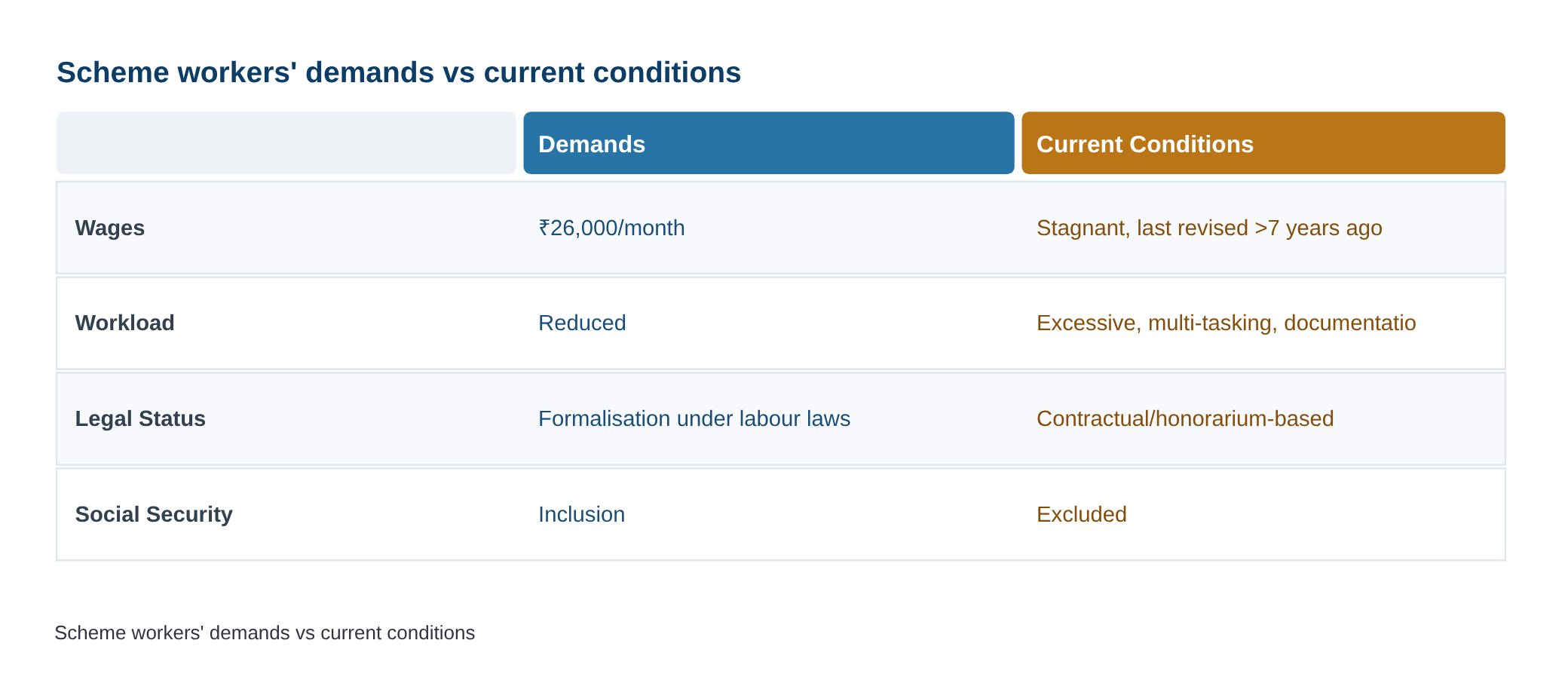
- These workers are typically engaged under contractual or honorarium-based arrangements, with wages determined by state governments and not always aligned with the Minimum Wages Act, 1948, despite their critical role in service delivery.
- The demand for a minimum monthly wage of ₹26,000 reflects the erosion of real wages due to inflation; the last wage revision in many states occurred over seven years ago, with no adjustments for cost-of-living increases.
- Workload concerns include multi-tasking across health, nutrition, and education sectors, excessive documentation demands, and the imposition of digital monitoring tools that add to administrative burden without commensurate support.
- The protest is part of a broader national movement by trade unions, particularly affiliated with the Centre of Indian Trade Unions (CITU), advocating for the formalisation of these workers under labour laws and their inclusion in social security frameworks.
- State governments often cite fiscal constraints to justify delayed wage revisions, despite the central government’s role in funding many of these schemes through centrally sponsored programmes.
Who are Scheme Workers and What Do They Do?
- ASHA workers: Community health workers under the National Health Mission, tasked with maternal and child health, immunisation, and community mobilisation; they act as a bridge between the public health system and rural communities.
- Anganwadi workers: Frontline workers of the Integrated Child Development Services (ICDS) scheme, responsible for early childhood care, nutrition, health check-ups, and pre-school education for children aged 0–6 years.
- Mid-day meal staff: Workers engaged in the Mid-Day Meal Scheme, which provides hot cooked meals to school children in government and government-aided schools to improve nutritional status and school attendance.
- Village Organisation Assistants (VOAs) and Resource Persons (RPs): Personnel engaged under the National Rural Livelihood Mission (NRLM) to facilitate self-help groups, livelihood promotion, and financial inclusion in rural areas.
- These workers operate under precarious employment conditions, often without formal employment contracts, social security benefits, or access to grievance redressal mechanisms.
- Their work is critical to achieving Sustainable Development Goals (SDGs), particularly SDG 2 (Zero Hunger), SDG 3 (Good Health and Well-being), and SDG 4 (Quality Education).
- Despite their pivotal role, they are classified as ‘honorary’ or ‘voluntary’ workers in many states, denying them the protections and entitlements guaranteed under labour laws such as the Employees’ Provident Fund and Employees’ State Insurance.
- The demand for wage revision is not merely economic but also a demand for recognition of their labour as formal employment, with attendant rights to minimum wages, paid leave, and social security.
UPSC Value Addition
Keywords for Mains Answer-Writing
Anganwadi workers · ASHA workers · scheme workers’ rights · minimum wage fixation · workload reduction for frontline workers · public health workforce · Mahatma Gandhi National Rural Employment Guarantee Scheme (MGNREGS) · National Rural Livelihood Mission (NRLM) · wage revision for government employees · social sector schemes · labour rights in India · collective bargaining · Public Distribution System (PDS) · Mid-Day Meal Scheme · Panchayati Raj Institutions · Constitutional provisions for welfare workers
Prelims Practice Questions
Q1. Consider the following statements regarding the Mahatma Gandhi National Rural Employment Guarantee Scheme (MGNREGS):
1. It guarantees 100 days of wage employment in a financial year to every rural household whose adult members volunteer to do unskilled manual work.
2. The wages under MGNREGS are fixed by the State Governments but cannot be less than the statutory minimum wage.
3. The scheme is implemented by the Ministry of Rural Development.
4. The scheme includes provisions for unemployment allowance if work is not provided within 15 days of demand.
How many of the above statements are correct?
- Only one
- Only two
- Only three
- All four
Answer: All four — Statements 1, 3, and 4 are correct. Statement 2 is incorrect as the wages under MGNREGS are fixed by the Central Government in consultation with the State Governments, and must not be less than the statutory minimum wage.
Q2. Assertion (A): The Constitution of India does not explicitly guarantee the right to a minimum wage for all workers.
Reason (R): The Minimum Wages Act, 1948 empowers the appropriate Government to fix minimum rates of wages for scheduled employments.
- Both A and R are true, and R is the correct explanation of A.
- Both A and R are true, but R is not the correct explanation of A.
- A is true but R is false.
- A is false but R is true.
Answer: A is true but R is false. — The Constitution does not explicitly guarantee the right to a minimum wage, but the Minimum Wages Act, 1948 empowers the Government to fix minimum rates of wages. However, the Act does not cover all workers, making R an incomplete explanation of A.
Q3. Match the following schemes with their implementing ministries:
Column I (Scheme) | Column II (Ministry)
1. Mid-Day Meal Scheme | A. Ministry of Women and Child Development
2. Integrated Child Development Services (ICDS) | B. Ministry of Education
3. Mahatma Gandhi National Rural Employment Guarantee Scheme (MGNREGS) | C. Ministry of Rural Development
4. National Rural Livelihood Mission (NRLM) | D. Ministry of Labour and Employment
- 1-B, 2-A, 3-C, 4-D; 1-A, 2-B, 3-C, 4-D; 1-B, 2-A, 3-D, 4-C; 1-A, 2-D, 3-C, 3-B
Answer: 1-B, 2-A, 3-C, 4-D; 1-A, 2-B, 3-C, 4-D; 1-B, 2-A, 3-D, 4-C; 1-A, 2-D, 3-C, 3-B — 1-B (Mid-Day Meal Scheme is implemented by the Ministry of Education), 2-A (ICDS by Ministry of Women and Child Development), 3-C (MGNREGS by Ministry of Rural Development), 4-D (NRLM by Ministry of Rural Development, not Labour and Employment).
Mains Practice Question
✍ The demand for wage revision and reduced workload among frontline scheme workers, such as ASHA and anganwadi workers, reflects systemic challenges in India’s social sector governance. Critically examine the adequacy of existing legal and institutional frameworks in addressing these demands. Also, assess the implications of inadequate wage revisions and excessive workload on the effectiveness of social sector schemes. (15 Marks)
Approach: MODEL-ANSWER SKELETON:
1. **Introduction**: Define frontline scheme workers and their role in public service delivery (e.g., ASHA, anganwadi, mid-day meal staff). Highlight their constitutional and statutory entitlements (e.g., Article 21 right to livelihood, Directive Principles of State Policy under Articles 38, 39, 41, 42).
2. **Legal and Institutional Frameworks**:
– **Minimum Wages Act, 1948**: Powers of appropriate governments to fix minimum wages; limitations (e.g., non-coverage of all workers, delayed revisions).
– **National Rural Employment Guarantee Act (NREGA), 2005**: Provisions for wage fixation and employment guarantee; challenges in implementation (e.g., delayed payments, work-site delays).
– **Integrated Child Development Services (ICDS) Scheme**: Role of anganwadi workers; lack of statutory wage fixation.
– **Constitutional Provisions**: Articles 39(e), 41, and 43A (participation of workers in management); judicial interpretations (e.g., Bandhua Mukti Morcha v. Union of India, 1984).
3. **Systemic Challenges**:
– **Wage Revision**: Delayed revisions (e.g., seven years in the given case) leading to erosion of real wages due to inflation.
– **Workload**: Excessive administrative duties (e.g., data entry, mobile app monitoring) diverting focus from core service delivery.
– **Harassment and Accountability**: Lack of grievance redressal mechanisms; top-down monitoring without adequate support.
4. **Implications on Social Sector Schemes**:
– **Quality of Service Delivery**: Burnout and high attrition among workers leading to poor implementation of schemes (e.g., malnutrition outcomes under ICDS).
– **Equity Concerns**: Marginalised communities (e.g., tribal, rural women) disproportionately affected due to inadequate service coverage.
– **Economic Costs**: Higher long-term costs due to inefficiencies (e.g., repeated training, poor monitoring).
5. **Comparative Perspective**:
– **International Standards**: ILO Convention 131 (Minimum Wage Fixing) and Recommendation 135; India’s compliance gaps.
– **State Initiatives**: Examples of progressive state responses (e.g., Kerala’s ‘Kudumbashree’ model for anganwadi workers).
6. **Way Forward**:
– **Statutory Wage Fixation**: Enactment of a dedicated law for frontline workers’ wages (e.g., like the Code on Wages, 2019).
– **Workload Rationalisation**: Reducing non-core duties; leveraging technology for efficient monitoring.
– **Strengthening Grievance Redressal**: Institutional mechanisms under Panchayati Raj Institutions (PRIs) or local bodies.
– **Judicial Activism**: Landmark judgments (e.g., Rajesh Sharma v. State of U.P., 2017) to address harassment and ensure dignity of work.
7. **Conclusion**: Emphasise the need for a rights-based approach to social sector governance, balancing fiscal prudence with human dignity.
Source: The Hindu
Generated by AanyaAi for educational purpose.

- KWML’s Feasibility Reports for Water Metro in 18 Cities: UPSC & PCS Insights - October 3, 2026
- ओडिशा में वन्यजीव अनुसंधान अनुदान कार्यक्रम शुरू, सिमिलिपाल में 300 कैमरे और बढ़ेंगे - October 3, 2026
- India Summons Pakistan High Commission Official Over Violation - October 3, 2026

No Comments