


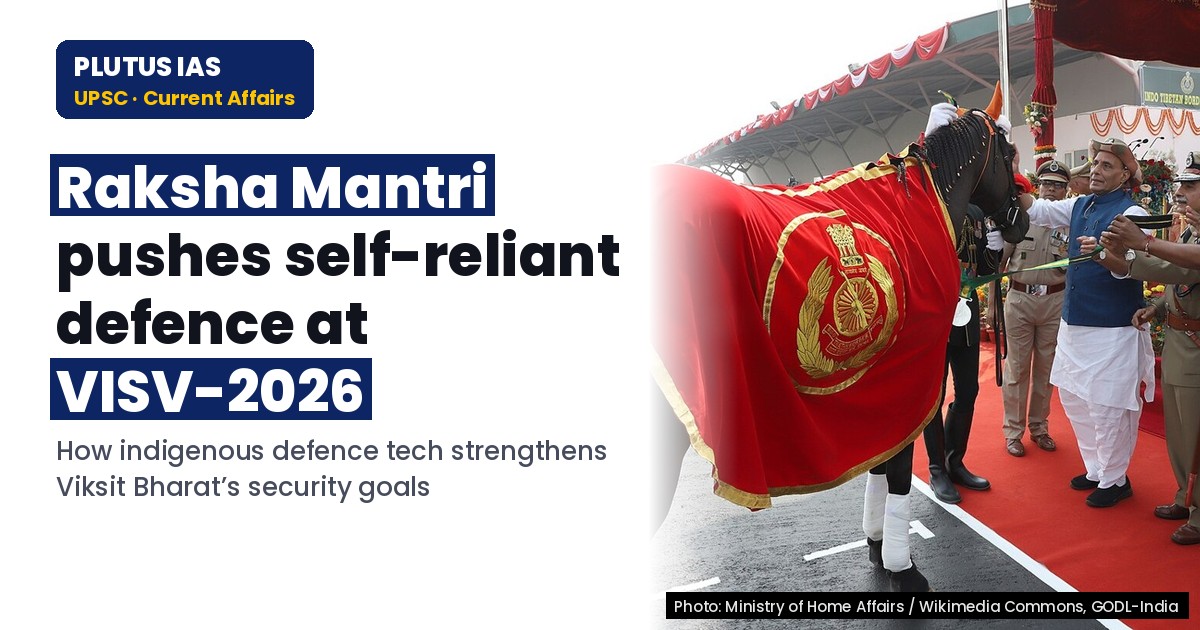
30 Oct Self-Reliance in Defence: Key to Viksit Bharat Vision
✎ The 'Make in India' initiative in defence, operationalised through DAP 2020 and the Strategic Partnership Model, seeks to reduce import dependence by prioritising indigenous design, development, and manufacturing, while…
Subject Relevance — Where This Topic Fits
- GS Paper III — Science and Technology, Defence and Security
- Prelims: Defence Procurement Procedure (DPP), Make in India, Defence Research and Development Organisation (DRDO), DAP 2020, Strategic Partnership Model, Offset Policy, Self-Reliant India (SRI) Index
- Essay: National security and technological sovereignty: Balancing self-reliance with global integration
Quick Revision: The ‘Make in India’ initiative in defence, operationalised through DAP 2020 and the Strategic Partnership Model, seeks to reduce import dependence by prioritising indigenous design, development, and manufacturing, while integrating private sector and startup innovation via iDEX.
Why is this in the news?
The Raksha Rajya Mantri, Shri Sanjay Seth, underscored the criticality of a self-reliant defence ecosystem, positioning indigenous defence manufacturing as a cornerstone for achieving the vision of Viksit Bharat 2047. This emphasis aligns with the government’s sustained policy thrust on reducing import dependence, enhancing domestic capability, and fostering a robust defence industrial base under the broader framework of Atmanirbhar Bharat.
Background
- The Government of India has progressively integrated self-reliance in defence manufacturing into national policy since 2014, with the launch of the ‘Make in India’ initiative and subsequent iterations of the Defence Procurement Procedure (DPP).
- The Defence Procurement Procedure (DPP) 2016 introduced the ‘Make’ category to promote indigenous design, development, and manufacturing, which the Defence Acquisition Procedure (DAP) 2020 retained, while the Strategic Partnership Model (SPM) was introduced to encourage private sector participation in high-technology defence systems.
- India’s defence imports have witnessed a gradual decline from 43% in 2013-17 to 36% in 2018-22, reflecting the impact of policy measures aimed at fostering domestic production (Source: Stockholm International Peace Research Institute — SIPRI).
- The ‘Self-Reliant India’ (SRI) Index, developed by the Department of Defence Production, evaluates progress across 14 key sectors, including aerospace and defence, to benchmark and incentivise indigenous capability-building.
- The Defence Research and Development Organisation (DRDO) has been instrumental in developing critical technologies such as light combat aircraft (Tejas), BrahMos missile systems, and advanced radars, while also supporting the transfer of technology to the private sector.
Self-Reliant Defence Ecosystem: Concept, Components, and Policy Framework
- **Definition and Scope**: A self-reliant defence ecosystem refers to a national capability to design, develop, produce, and maintain defence equipment indigenously, reducing reliance on foreign imports while ensuring technological sovereignty and strategic autonomy.
- **Policy Pillars**: The ecosystem is anchored in the Defence Acquisition Procedure (DAP), the ‘Make’ category, the Strategic Partnership Model (SPM), and the ‘Buy (Indian-IDDM)’ category, which prioritise indigenous solutions in defence procurement.
- **Institutional Architecture**: Key institutions include the Ministry of Defence (MoD), Defence Research and Development Organisation (DRDO), Defence Public Sector Undertakings (DPSUs) such as HAL, BEL, and MDL, and the newly established Defence Space Agency and Defence Cyber Agency.
- **Indigenous Technology Development**: The Defence Research and Development Organisation (DRDO) and private sector entities collaborate on projects like the Advanced Medium Combat Aircraft (AMCA), Pinaka multi-barrel rocket launcher, and indigenous naval platforms to enhance self-sufficiency.
- **Private Sector Participation**: The policy framework encourages private sector involvement through the ‘Make’ category, offset obligations, and the SPM, with over 100 private sector firms now engaged in defence manufacturing, including Tata Advanced Systems, Mahindra Defence, and Bharat Forge.
- **Offset Policy**: The offset policy mandates that foreign defence vendors invest a percentage of the contract value in India through technology transfers, joint ventures, or investment in domestic defence manufacturing, thereby enhancing indigenous capability-building.
- **Startup and MSME Integration**: The Innovations for Defence Excellence (iDEX) initiative, launched in 2018, fosters innovation by providing grants and mentorship to startups and MSMEs working on cutting-edge defence technologies, including drones, AI, and cybersecurity.
- **Export Promotion**: The Defence Export Strategy 2020 aims to position India as a global defence exporter, with a target of USD 5 billion in defence exports by 2025, leveraging indigenous platforms like Tejas, BrahMos, and Akash missile systems.
Key Features
| Feature | Significance |
|---|---|
| Self-Reliant Defence Ecosystem (Aatmanirbhar Bharat in Defence) | Reduces import dependence, enhances strategic autonomy, and fosters indigenous innovation in defence manufacturing. |
| VISV-2026 (Vision for Indigenous Self-Reliance in Defence) | A forward-looking initiative to align defence production with technological advancements and national security imperatives. |
| Defence Industrial Base Expansion | Encourages private sector participation, MSME integration, and FDI in defence manufacturing to build a robust ecosystem. |
| Technology Transfer and R&D Collaboration | Promotes joint ventures with foreign Original Equipment Manufacturers (OEMs) to accelerate technology absorption and indigenisation. |
| Skill Development in Defence Manufacturing | Focuses on upskilling the workforce in advanced manufacturing, AI, robotics, and precision engineering for defence production. |
Why it Matters
Strategic Autonomy
- Reduces vulnerability to geopolitical supply chain disruptions in critical defence equipment.
- Enhances India’s ability to respond to regional security challenges independently.
- Strengthens the nation’s deterrence posture through indigenous capabilities.
Economic Growth
- Creates high-skilled employment opportunities in defence and allied sectors.
- Boosts GDP contribution through increased defence exports and import substitution.
- Stimulates ancillary industries such as electronics, metallurgy, and aerospace.
Technological Advancement
- Drives innovation in dual-use technologies (e.g., drones, AI, cybersecurity) with civilian applications.
- Accelerates the development of next-generation defence platforms (e.g., fighter jets, submarines, missiles).
- Fosters public-private partnerships in cutting-edge research and development.
National Security
- Ensures uninterrupted access to critical defence systems during conflicts or crises.
- Reduces reliance on foreign suppliers for sensitive technologies.
- Supports the integration of emerging technologies (e.g., quantum computing, hypersonics) into defence strategy.
Challenges
1. Technological Lag in Indigenous Systems
- Gaps in core defence technologies (e.g., jet engines, advanced radars) compared to global leaders.
- Limited in-house R&D expenditure in the private sector relative to public sector undertakings.
- Dependence on foreign collaborations for critical components despite indigenisation efforts.
UPSC Link: Science & Tech: Indigenous Tech Development
2. Supply Chain Vulnerabilities
- Over-reliance on specific geographies for raw materials (e.g., rare earth metals, alloys).
- Fragmented MSME ecosystem with limited capacity for high-precision defence manufacturing.
- Logistical bottlenecks in transporting sensitive defence equipment across regions.
UPSC Link: Economy: Supply Chain Resilience
3. Regulatory and Bureaucratic Hurdles
- Complex procurement processes under the Defence Procurement Procedure (DPP) and Make in India guidelines.
- Delays in approvals for defence industrial licenses and foreign collaborations.
- Ambiguity in offset obligations and technology transfer agreements.
UPSC Link: Polity: Defence Procurement Reforms
4. Skilled Manpower Shortage
- Inadequate training infrastructure for advanced manufacturing and emerging technologies.
- Brain drain in critical defence-related fields due to better opportunities abroad.
- Low participation of women in defence manufacturing and R&D roles.
UPSC Link: Social Justice: Skill Development Policies
5. Export Barriers and Market Access
- Stringent export control regimes in potential buyer countries (e.g., ITAR regulations).
- Lack of a unified global marketing strategy for indigenous defence products.
- Competition from established defence exporters with subsidised pricing.
UPSC Link: IR: Defence Exports and Diplomacy
Challenges — UPSC Perspective
| Issue | Concern |
|---|---|
| R&D Investment | Insufficient private sector funding for high-risk, high-reward defence technologies. |
| Ease of Doing Business | Cumbersome licensing and compliance requirements for defence startups. |
| IPR Protection | Weak enforcement of intellectual property rights in joint ventures and technology transfers. |
| Infrastructure Gaps | Inadequate testing and certification facilities for indigenous defence systems. |
| Global Competition | Established defence exporters dominate niche markets with superior pricing and after-sales support. |
Way Forward
- Accelerate technology absorption through structured joint development programmes with global OEMs under the ‘Make in India’ framework.
- Establish Centres of Excellence (CoEs) in collaboration with IITs, DRDO, and private sector for focused R&D in critical technologies.
- Streamline defence procurement by simplifying the DPP and reducing bureaucratic delays in approvals.
- Expand skill development initiatives via partnerships with industry and academia to address manpower shortages.
- Enhance export competitiveness by negotiating bilateral defence cooperation agreements and easing ITAR-related constraints.
- Strengthen MSME integration through targeted financial incentives and capacity-building programmes.
- Promote public awareness campaigns to highlight indigenous defence achievements and foster national pride.
- Leverage the Defence Acquisition Council (DAC) to prioritise indigenous systems in procurement decisions.
UPSC Value Addition
Keywords for Mains Answer-Writing
Self-reliant defence ecosystem · Atmanirbhar Bharat in defence · Defence industrial base · Defence Procurement Procedure 2020 · Make in India in defence · Strategic Partnership Model · Defence Research and Development Organisation · Viksit Bharat 2047 · Defence exports · Offset policy in defence · Public Sector Undertakings in defence · Private sector participation in defence · Defence Acquisition Council · Integrated Guided Missile Development Programme · Defence Production and Export Promotion Council · Defence Industrial Corridors
Concept Flow
National Security Imperatives → Policy Directive (Self-Reliant Defence Ecosystem) → Institutional Framework (DPP, DAC) → Technological Collaboration (JVs, R&D) → Indigenous Production (MSMEs, Private Sector) → Strategic Autonomy (Reduced Imports, Export Growth) → Viksit Bharat @2047
Prelims Practice Questions
Q1. Consider the following statements regarding the Defence Procurement Procedure (DPP) 2020:
1. It introduces the concept of ‘Make in India’ as a separate category for defence procurement.
2. The Strategic Partnership Model (SPM) under DPP 2020 is designed to encourage participation of the private sector in defence production.
3. The Offset Policy under DPP 2020 is mandatory for all defence procurement cases above ₹2,000 crore.
How many of the above statements are correct?
- Only one
- Only two
- All three
- None
Answer: Only two — Statement 1 is correct as DPP 2020 formalises ‘Make in India’ as a distinct procurement category. Statement 2 is correct as the SPM aims to build capacity in identified segments through private sector participation. Statement 3 is incorrect as the Offset Policy is applicable only to procurement cases above ₹2,000 crore involving foreign vendors, not all cases.
Q2. Assertion (A): The Defence Research and Development Organisation (DRDO) is the primary agency responsible for the development of indigenous defence technologies in India.
Reason (R): The DRDO operates under the administrative control of the Ministry of Defence and is mandated to design, develop and produce state-of-the-art defence systems for the Armed Forces.
In the context of the above two statements, which one of the following is correct?
- Both A and R are true and R is the correct explanation of A
- Both A and R are true but R is NOT the correct explanation of A
- A is true but R is false
- A is false but R is true
Answer: Both A and R are true and R is the correct explanation of A — Assertion (A) is correct as DRDO is the principal agency for indigenous defence R&D. Reason (R) is also correct and directly explains the role of DRDO as it is statutorily mandated under the Ministry of Defence to develop defence systems.
Q3. Match the following initiatives with their respective objectives in the context of India’s defence industrial ecosystem:
Column I (Initiative) Column II (Objective)
A. Defence Industrial Corridors 1. Promote indigenous design, development and manufacture of defence equipment
B. Strategic Partnership Model 2. Enhance private sector participation in defence production
C. Offset Policy 3. Facilitate technology transfer and investment in defence manufacturing
D. Make in India (Defence) 4. Develop dedicated industrial hubs for defence manufacturing
Select the correct match using the codes below:
- A-4, B-2, C-3, D-1
- A-2, B-4, C-1, D-3
- A-1, B-3, C-2, D-4
- A-3, B-1, C-4, D-2
Answer: A-4, B-2, C-3, D-1 — A-4: Defence Industrial Corridors are dedicated industrial hubs (e.g., Uttar Pradesh and Tamil Nadu corridors). B-2: Strategic Partnership Model encourages private sector participation in identified segments. C-3: Offset Policy aims to secure technology transfer and investment. D-1: Make in India (Defence) promotes indigenous design and manufacture.
Mains Practice Question
✍ The concept of a ‘self-reliant defence ecosystem’ has been emphasised as a cornerstone for achieving ‘Viksit Bharat 2047’. In this context, critically examine the institutional, policy, and technological frameworks that underpin India’s drive towards defence self-reliance. Also, analyse the challenges in translating this vision into tangible outcomes on the ground. (15 Marks)
Approach: MODEL-ANSWER SKELETON:
1. **Definition and Strategic Importance** (2 marks)
– Define ‘self-reliant defence ecosystem’ as per the Defence Procurement Procedure (DPP) 2020 and the ‘Atmanirbhar Bharat’ initiative.
– State its linkage to ‘Viksit Bharat 2047’ and national security imperatives.
2. **Institutional Frameworks** (3 marks)
– **Defence Acquisition Council (DAC)**: Role in approving capital acquisitions and indigenisation.
– **Defence Research and Development Organisation (DRDO)**: Functions, achievements (e.g., Integrated Guided Missile Development Programme, Tejas), and limitations.
– **Defence Production and Export Promotion Council (DPEPC)**: Role in promoting defence exports and facilitating MSMEs.
– **Public Sector Undertakings (PSUs)**: Hindustan Aeronautics Limited (HAL), Bharat Electronics Limited (BEL), etc., and their contributions.
– **Private Sector Participation**: Strategic Partnership Model (SPM) under DPP 2020 and its objectives.
3. **Policy Frameworks** (3 marks)
– **Defence Procurement Procedure (DPP) 2020**: Categories (Buy Indian, Make in India, Strategic Partnership), Offset Policy, and indigenisation lists.
– **Make in India in Defence**: Objectives, progress, and challenges (e.g., technology transfer, vendor development).
– **Defence Industrial Corridors**: Uttar Pradesh and Tamil Nadu corridors, their objectives, and progress.
– **Export Promotion Policies**: Simplification of export procedures, Defence Exports Promotion Council (DEPC).
4. **Technological Frameworks** (2 marks)
– Indigenous development of platforms (e.g., Tejas, INS Vikrant, Arjun MBT).
– Technology transfer agreements (e.g., with Russia, France, Israel).
– Challenges in R&D: Funding, brain drain, collaboration with academia and industry.
5. **Challenges and Gaps** (3 marks)
– **Policy Implementation**: Slow progress in indigenisation, bureaucratic delays, and procedural complexities.
– **Technological Gaps**: Dependency on foreign components, lack of critical technologies (e.g., jet engines, semiconductors).
– **Private Sector Constraints**: Limited participation due to high entry barriers, lack of long-term contracts.
– **Export Barriers**: Stringent export control regimes, competition from global players.
– **Human Resource Development**: Shortage of skilled manpower in defence R&D and manufacturing.
6. **Way Forward** (2 marks)
– Strengthening public-private partnerships (PPP) in defence R&D.
– Enhancing collaboration with academic institutions (e.g., IITs, DRDO labs).
– Simplifying regulatory frameworks and incentivising MSMEs.
– Leveraging emerging technologies (AI, drones, cybersecurity) for defence modernisation.
Balance of views: Acknowledge successes (e.g., record defence exports in 2023-24) while highlighting systemic challenges (e.g., import dependence, bureaucratic inertia).
Source: PIB (Press Information Bureau)
Generated by AanyaAi for educational purpose.

- UP CM & Railway Minister to Flag Off Vande Bharat Sleeper Trains - October 30, 2026
- पर्यावरण मंत्री ने वायु प्रदूषण नियंत्रण के लिए PAVAN-I3C केंद्र का दौरा किया - October 30, 2026
- Self-Reliance in Defence: Key to Viksit Bharat Vision - October 30, 2026

No Comments