


04 Sep SGB 2021-22 Series VI: Premature Redemption Price & Date Revealed
✎ Sovereign Gold Bonds (SGBs) are government securities linked to gold prices, offering investors a market-linked return with a fixed interest rate of 2.50% per annum, payable semi-annually, and the option for premature redemption…
Subject Relevance — Where This Topic Fits
- GS Paper III — Money and Banking | GS Paper III — Investment Models and Financial Instruments | GS Paper III — Government Budgeting and Fiscal Policy
- Prelims: Sovereign Gold Bond (SGB), premature redemption, IBJA gold price, RBI notification, gold purity standards, financial instruments, government securities, gold monetisation scheme
- Essay: Role of gold in India’s financial system, Government-led financial inclusion through gold-backed instruments
Quick Revision: Sovereign Gold Bonds (SGBs) are government securities linked to gold prices, offering investors a market-linked return with a fixed interest rate of 2.50% per annum, payable semi-annually, and the option for premature redemption after five years at a price determined by the IBJA gold price average.
Why is this in the news?
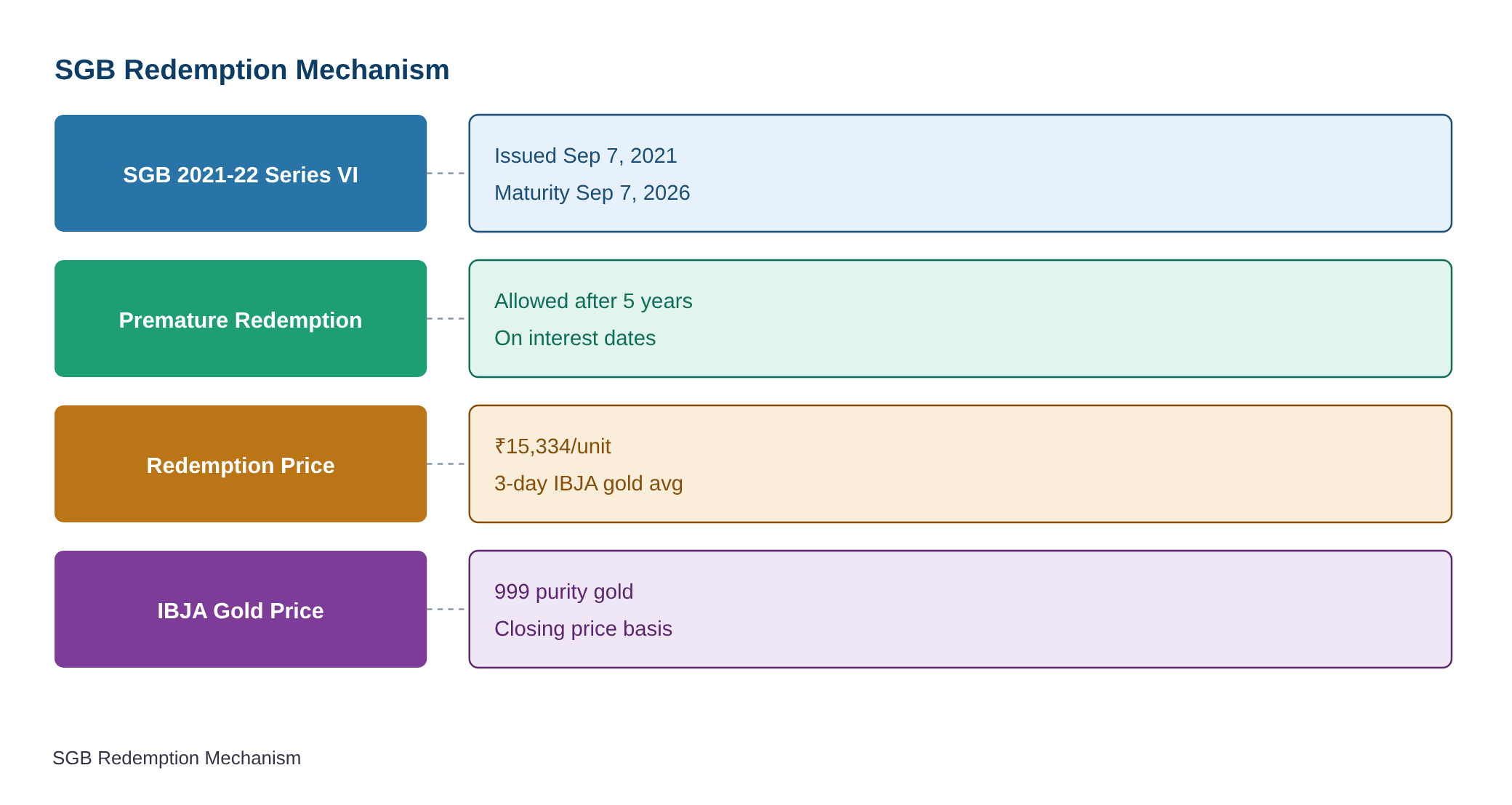
The Reserve Bank of India (RBI) has announced the redemption price for premature redemption of the Sovereign Gold Bond (SGB) 2021-22 Series VI, scheduled for September 7, 2026. This development is significant as it operationalises the premature redemption clause under the SGB Scheme, providing investors with a transparent mechanism to liquidate their holdings after the mandatory five-year lock-in period. The redemption price, set at ₹15,334 per unit, is derived from the three-day average closing price of 999 purity gold as published by the India Bullion and Jewellers Association Ltd (IBJA), underscoring the scheme’s market-linked valuation approach.
Background
- The Sovereign Gold Bond (SGB) Scheme was launched in November 2015 by the Government of India in collaboration with the RBI to reduce the demand for physical gold and shift a portion of household savings from gold to financial assets.
- SGBs are government securities denominated in grams of gold, offering investors an alternative to holding physical gold with added benefits such as interest income and capital gains tax exemptions.
- The scheme allows for premature redemption after the fifth year from the date of issue, subject to the terms specified in the GOI notification dated May 12, 2021 (F.No. 4(5)-B(W&M)/2021).
- Premature redemption is permitted only on interest payment dates, ensuring alignment with the scheme’s cash flow structure.
- The redemption price is determined by the simple average of the closing price of 999 purity gold over the three business days preceding the redemption date, as published by IBJA, ensuring transparency and market linkage.
- The SGB Scheme is part of broader efforts to monetise gold holdings in India and integrate them into the formal financial system.
What is the Sovereign Gold Bond (SGB) Scheme?
- Government of India securities denominated in grams of gold, issued by the RBI on behalf of the Government.
- Designed to provide investors with a substitute for holding physical gold, thereby reducing import dependency and promoting financial savings.
- Offered in denominations of one gram of gold and multiples thereof, with a maximum subscription limit of 4 kg per individual per fiscal year.
- Carries a fixed annual interest rate of 2.50% payable semi-annually, providing an assured return in addition to potential capital gains.
- Tenure of the bonds is eight years, with an option for premature redemption after the fifth year, subject to specified conditions.
- Eligible investors include individuals, HUFs, trusts, universities, and charitable institutions, with NRIs permitted to invest subject to FEMA regulations.
- Issued in both demat and paper form, with the option for investors to hold the bonds in their demat account or as a certificate.
- Tax benefits include exemption from capital gains tax if held till maturity, and TDS is not applicable on interest payments.
Key Features
| Feature | Significance |
|---|---|
| Premature Redemption Eligibility | Permits redemption after the fifth year from the issue date, providing liquidity flexibility to investors while maintaining the long-term investment horizon of the SGB scheme. |
| Redemption Price Calculation | Based on the simple average of the closing price of 999 purity gold over the three business days preceding redemption, ensuring transparency and market-linked valuation. |
| Issue Date and Redemption Due Date | Series VI was issued on September 07, 2021, with premature redemption due on September 07, 2026, marking the completion of five years from the issue date. |
| Redemption Price Determination | The redemption price of ₹15,334 per unit for Series VI is derived from the IBJA gold price average, reflecting current market conditions at the time of redemption. |
Why it Matters
Economic and Financial
- Enhances liquidity for investors in Sovereign Gold Bonds without compromising the sovereign guarantee and capital safety associated with the scheme.
- Provides a market-determined exit option, aligning investor returns with prevailing gold prices and reducing dependency on fixed maturity periods.
- Supports the monetisation of gold holdings, potentially reducing the demand for physical gold and easing pressure on the current account deficit.
Investor Protection and Transparency
- Ensures a transparent and rule-based redemption mechanism, mitigating the risk of arbitrary or subjective valuation.
- Offers a predictable framework for premature redemption, reducing uncertainty for investors who may require liquidity before the maturity period.
Monetary Policy and Gold Market
- Contributes to the development of the domestic gold market by providing a sovereign-backed, tradable instrument linked to gold prices.
- Facilitates price discovery for gold in India, reducing reliance on international benchmarks and strengthening the domestic bullion market.
Fiscal Policy and Government Borrowing
- Supports the government’s fiscal consolidation efforts by providing an alternative investment avenue that reduces the need for physical gold imports.
- Enhances the attractiveness of SGBs as a substitute for gold imports, thereby contributing to macroeconomic stability.
Challenges
1. Price Volatility and Investor Risk
- Exposure to gold price fluctuations may result in lower redemption values if gold prices decline significantly before the redemption date.
- Investors face timing risk, as premature redemption may coincide with periods of low gold prices, affecting realised returns.
UPSC Link: GS-III: Commodity Markets
2. Liquidity Constraints Post-Redemption
- Premature redemption does not guarantee immediate reinvestment opportunities, potentially leaving investors with idle funds.
- Secondary market liquidity for SGBs may be limited, complicating exit strategies for investors seeking to redeem prematurely.
UPSC Link: GS-III: Financial Markets
3. Inflation Hedge Effectiveness
- Gold as a hedge against inflation may underperform during periods of high real interest rates, reducing the attractiveness of SGBs as an inflation hedge.
- Investors may seek alternative assets if gold prices stagnate or decline over the holding period.
UPSC Link: GS-III: Inflation and Asset Classes
4. Operational and Administrative Challenges
- Ensuring seamless redemption processes, including accurate price calculations and timely disbursement of funds, requires robust institutional mechanisms.
- Coordination between the RBI, GOI, and designated banks is essential to avoid delays or discrepancies in redemption procedures.
UPSC Link: GS-III: Public Finance
Challenges — UPSC Perspective
| Issue | Concern |
|---|---|
| Gold Price Volatility | Exposure to market risks may erode investor returns if gold prices decline before redemption. |
| Liquidity Risk | Limited secondary market depth may hinder investors’ ability to exit positions efficiently. |
| Timing Risk | Premature redemption may coincide with unfavourable market conditions, reducing realised value. |
| Administrative Delays | Potential bottlenecks in redemption processing could delay fund disbursement to investors. |
| Reinvestment Risk | Investors may struggle to find equally attractive investment avenues post-redemption. |
Way Forward
- Strengthen secondary market infrastructure for SGBs to enhance liquidity and provide investors with alternative exit options.
- Introduce staggered redemption windows or partial redemption facilities to mitigate timing risks for investors.
- Enhance investor awareness campaigns to educate potential subscribers on the risks and benefits of premature redemption.
- Develop dynamic pricing mechanisms or indexed redemption options to align returns more closely with inflation or alternative asset classes.
- Improve coordination between RBI, GOI, and designated banks to streamline redemption processes and reduce operational delays.
- Explore the integration of SGBs with digital gold investment platforms to broaden accessibility and secondary market participation.
- Conduct periodic reviews of redemption pricing methodologies to ensure they remain reflective of current market conditions.
UPSC Value Addition
Keywords for Mains Answer-Writing
Sovereign Gold Bond Scheme (SGB) · premature redemption · Reserve Bank of India (RBI) · Government of India (GOI) · gold price determination · India Bullion and Jewellers Association Ltd (IBJA) · capital market instruments · financial inclusion · monetisation of gold · fiscal policy instruments · commodity-linked securities · investment diversification
Concept Flow
Issue of SGB 2021-22 Series VI on September 07, 2021 under the Sovereign Gold Bond Scheme. → Eligibility for premature redemption after the completion of five years (September 07, 2026). → Calculation of redemption price based on the simple average of IBJA gold prices over three preceding business days. → Publication of redemption price (₹15,334 per unit) on September 04, 2026. → Investor decision to redeem prematurely or hold until maturity. → Redemption proceeds credited to investor accounts, subject to compliance with KYC and other regulatory requirements.
Prelims Practice Questions
Q1. Consider the following statements regarding the Sovereign Gold Bond (SGB) Scheme:
1. Premature redemption is permitted after the fifth year from the date of issue.
2. The redemption price is based on the closing price of gold of 999 purity as published by the London Bullion Market Association (LBMA).
3. The SGB Scheme was introduced to reduce the demand for physical gold and encourage financial savings.
How many of the above statements are correct?
- Only one
- Only two
- All three
- None
Answer: Only two — Statement 1 is correct as premature redemption is permitted after the fifth year. Statement 2 is incorrect as the price is based on IBJA data, not LBMA. Statement 3 is correct as the scheme aims to monetise gold holdings.
Q2. Assertion (A): The Sovereign Gold Bond Scheme is a financial instrument issued by the Government of India.
Reason (R): The scheme aims to provide a substitute for holding physical gold while offering an interest income to investors.
Options:
A. Both A and R are true, and R is the correct explanation of A.
B. Both A and R are true, but R is NOT the correct explanation of A.
C. A is true, but R is false.
D. A is false, but R is true.
Answer: ? — Both the assertion and reason are true. The SGB is indeed issued by the Government of India, and the scheme provides an interest income to investors, making R the correct explanation of A.
Q3. Match the following columns related to the Sovereign Gold Bond Scheme:
Column I
1. Issuing Authority
2. Redemption Price Determination
3. Premature Redemption Eligibility
4. Objective of the Scheme
Column II
A. After fifth year from the date of issue
B. Government of India
C. Monetisation of gold holdings
D. Simple average of closing price of gold of 999 purity as published by IBJA
Options:
1-A, 2-D, 3-B, 4-C
1-B, 2-D, 3-A, 4-C
1-C, 2-A, 3-B, 4-D
1-D, 2-B, 3-C, 4-A
- 1-A, 2-D, 3-B, 4-C
- 1-B, 2-D, 3-A, 4-C
- 1-C, 2-A, 3-B, 4-D
- 1-D, 2-B, 3-C, 4-A
Answer: 1-B, 2-D, 3-A, 4-C — The correct match is: 1-B (Issuing Authority: Government of India), 2-D (Redemption Price Determination: IBJA), 3-A (Premature Redemption Eligibility: After fifth year), 4-C (Objective: Monetisation of gold holdings).
Mains Practice Question
✍ The Sovereign Gold Bond (SGB) Scheme represents a strategic initiative by the Government of India to monetise gold holdings and promote financial inclusion. Critically examine the design and operational framework of the SGB Scheme, with particular reference to its redemption mechanism and the role of the Reserve Bank of India (RBI). Also, analyse the potential benefits and limitations of the scheme for retail investors. (15 Marks)
Approach: MODEL-ANSWER SKELETON:
1. **Introduction**: Define the SGB Scheme, its launch year (2015), and objectives (reduce physical gold demand, promote financial savings, monetise gold holdings).
2. **Design and Operational Framework**:
– Issued by RBI on behalf of GOI with a fixed tenor (8 years, with exit option after 5 years).
– Denominated in grams of gold, with a minimum investment of 1 gram.
– Interest rate (fixed at 2.5% p.a.) and redemption price linked to gold prices.
– Role of IBJA in determining redemption price (simple average of 999 purity gold prices over 3 business days).
3. **Redemption Mechanism**:
– Premature redemption permitted after the fifth year on interest payment dates.
– Redemption price based on market-linked gold prices, ensuring fair valuation.
– RBI’s role in ensuring transparency and adherence to scheme guidelines.
4. **Benefits for Retail Investors**:
– Provides an alternative to physical gold with added interest income.
– No storage costs or risks associated with physical gold.
– Tax benefits (long-term capital gains tax exemptions if held till maturity).
– Encourages financial inclusion by offering a regulated investment avenue.
5. **Limitations**:
– Market risk: Redemption price fluctuates with gold prices, potentially leading to capital loss.
– Liquidity constraints: Premature redemption is permitted only after the fifth year, limiting flexibility.
– Opportunity cost: Fixed interest rate may not outperform other investment avenues during high inflation periods.
6. **Conclusion**: Balance of benefits and limitations; SGB Scheme serves as a viable financial instrument for gold investors, but awareness and financial literacy are critical for its success.
Source: RBI
Generated by AanyaAi for educational purpose.
Related guides on our sites
- Best PSIR optional coaching for upsc
- UPSC EPFO Test series
- Best PSIR optional test series
- Best PSIR optional teacher for upsc

- विशाखापट्टनम में उच्च जोखिम गर्भावस्था की निगरानी बढ़ाने पर कलेक्टर का निर्देश, जानिए पूरी जानकारी - October 21, 2026
- National Unity Day 2026: Key Preparations & Significance for UPSC - October 21, 2026
- 14वां इंडिया केम 2026: मुंबई में वैश्विक रसायन उद्योग का महाकुंभ - October 21, 2026

No Comments