


17 Aug SIT Exposes Massive Fraud in APPSC Group-I 2018 Recruitment: OMR Tampering & Forgery
✎ The integrity of civil service recruitment processes hinges on strict adherence to prescribed protocols, secure handling of examination materials, and independent forensic verification to detect fraud and uphold meritocracy.
Subject Relevance — Where This Topic Fits
- GS Paper II — Functions and Responsibilities of the Union and the States, Issues and Challenges Pertaining to the Federal Structure | GS Paper II — Role of Civil Services in a Democracy | GS Paper III — Challenges to Internal Security through Communication Networks | GS Paper IV — Ethics and Integrity in Governance
- Prelims: Public Service Commissions, OMR-based examinations, Forensic Science Laboratories, Special Investigation Team (SIT), Recruitment fraud, Barcode-based answer sheets, Civil Services recruitment process
- Essay: Ethical governance in public institutions, The role of transparency in maintaining public trust in recruitment processes
Quick Revision: The integrity of civil service recruitment processes hinges on strict adherence to prescribed protocols, secure handling of examination materials, and independent forensic verification to detect fraud and uphold meritocracy.
Why is this in the news?
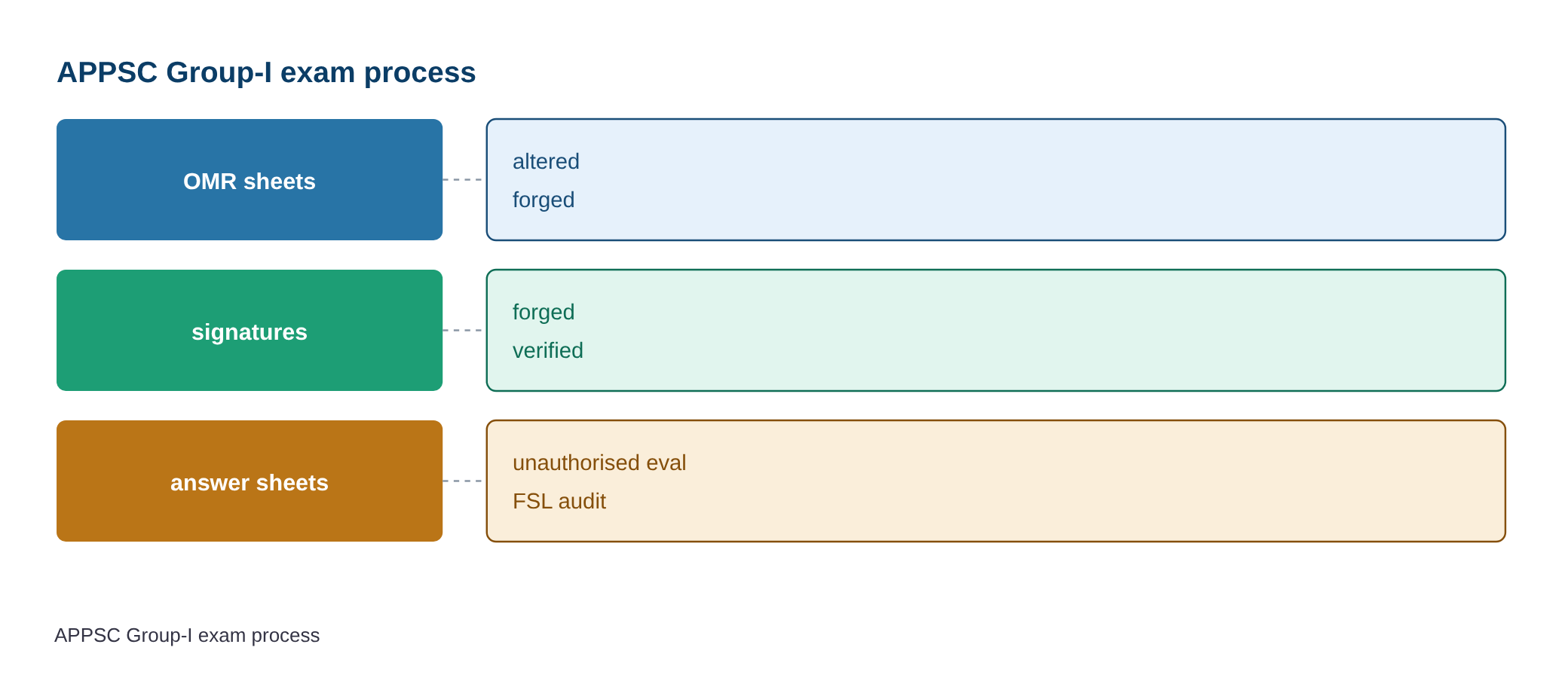
The Special Investigation Team (SIT) probing the Andhra Pradesh Public Service Commission (APPSC) Group-I recruitment process of 2018 has submitted a report detailing systemic irregularities, including manipulation of Optical Mark Recognition (OMR) sheets, forgery of signatures, and unauthorised evaluation of answer sheets. The findings underscore vulnerabilities in the conduct of high-stakes civil service examinations and raise critical questions about the integrity of recruitment processes in public institutions.
Background
- The Andhra Pradesh Public Service Commission (APPSC) conducts recruitment examinations for various Group-I posts in the state, which are pivotal for filling senior administrative and executive positions in the state bureaucracy.
- The Group-I recruitment process for 2018 involved 1.14 lakh applicants, with prelims conducted in May 2019 and mains in December 2020, culminating in the selection of 165 candidates out of 9,679 who qualified for the mains.
- Public Service Commissions (PSCs) in India operate under constitutional provisions (Article 315-323 of the Constitution) and are mandated to ensure fair, transparent, and merit-based recruitment processes.
- The use of OMR sheets for objective-type examinations is a standardised practice in civil service recruitment, designed to minimise human error and ensure uniformity in evaluation.
- The APPSC Rules and the Conduct of Examinations Rules, 1999, prescribe strict protocols for the storage, transportation, and evaluation of answer sheets, including the prohibition of unauthorised access or alteration.
- Forensic Science Laboratories (FSLs) play a crucial role in verifying the authenticity of examination documents, including OMR sheets, through scientific analysis such as signature comparison and ink analysis.
What is the APPSC Group-I 2018 Examination Scandal?
- The scandal involves the alleged manipulation of OMR sheets, forgery of signatures, and unauthorised evaluation of answer sheets in the APPSC Group-I recruitment process conducted in 2018.
- The evaluation process was reportedly entrusted to private firms, bypassing qualified subject experts identified by the APPSC, and involved personnel such as data entry operators, security guards, and private lecturers with no formal evaluation credentials.
- Answer sheets were allegedly shifted from the APPSC strongroom to a resort for 84 days, violating prescribed protocols for secure storage and handling.
- Forensic analysis by the Central Forensic Science Laboratories (CFSL) across multiple centres detected alterations in 718 out of 736 examined OMR sheets, with 160 of the 165 selected candidates showing discrepancies in their OMR sheets.
- Signatures of examiners, scrutinising officers, and camp officers were forged, and duplicate OMR sheets were allegedly printed using the barcode numbers of candidates, indicating a sophisticated and large-scale fraud.
- The scandal has prompted legal and administrative actions, including the submission of the SIT report to the appropriate authorities for further investigation and potential prosecution under relevant laws such as the Indian Penal Code (IPC) and the Prevention of Corruption Act, 1988.
- The case exemplifies the challenges in maintaining institutional integrity in public recruitment processes, particularly in states where administrative oversight may be compromised.
Key Features
| Feature | Significance |
|---|---|
| Alteration of OMR sheets | Undermines the integrity of the examination process by manipulating the evaluation of answer sheets, leading to unfair advantage for certain candidates. |
| Forgery of signatures | Compromises the authenticity of official documents, eroding trust in the recruitment process and the credibility of the recruiting authority. |
| Unauthorised evaluation by unqualified personnel | Violates standard operating procedures for examination evaluation, as only qualified subject experts should assess answer scripts to ensure fairness and accuracy. |
| Use of private firms for evaluation | Raises concerns about conflicts of interest, lack of transparency, and potential manipulation of the selection process through external entities. |
| Shifting of answer sheets to a resort | Violates security protocols for handling sensitive examination materials, increasing the risk of tampering or loss of documents. |
Why it Matters
Governance and Public Trust
- The incident highlights systemic failures in the conduct of competitive examinations, which are critical for merit-based recruitment in public services.
- Erosion of public trust in the APPSC and similar recruitment bodies, as the integrity of their processes is compromised by malpractices.
- Undermines the principle of fair competition, which is fundamental to the legitimacy of civil service recruitment and governance.
Legal and Institutional Accountability
- Exposes weaknesses in the oversight mechanisms of recruitment bodies, necessitating stricter enforcement of examination rules and protocols.
- Raises questions about the role of private entities in sensitive government processes and the need for stringent vetting of such partnerships.
- Highlights the importance of forensic audits in detecting irregularities in examination processes, ensuring accountability for malpractices.
Economic Implications
- Financial losses incurred by the exchequer due to payments made to unqualified evaluators and private firms, amounting to over ₹2.5 crore in this case.
- Potential wastage of public resources if selected candidates are later found to be unqualified or if the recruitment process must be repeated.
Challenges
1. Lack of Transparency in Recruitment Processes
- Over-reliance on private firms for sensitive tasks like answer sheet evaluation, which increases the risk of manipulation and conflicts of interest.
- Inadequate monitoring of examination centers and evaluation sites, allowing for unauthorised access and tampering of answer sheets.
UPSC Link: GS-II: Role of Civil Services in Governance
2. Security Vulnerabilities in Handling Examination Materials
- Failure to maintain the integrity of answer sheets, including their storage and transport, as evidenced by the shifting of documents to a resort for 84 days.
- Lack of stringent protocols for the destruction or re-use of OMR sheets, leading to the alleged printing of 48,442 duplicate sheets.
UPSC Link: GS-II: Functions and Responsibilities of the Union and the States
3. Accountability and Enforcement Gaps
- Inadequate checks on the qualifications and integrity of personnel engaged in evaluation, including data entry operators and security guards.
- Delayed or ineffective action against officials involved in malpractices, as the incident occurred in 2018 but came to light only recently.
UPSC Link: GS-II: Appointment to Various Constitutional Posts
4. Forensic and Investigative Challenges
- Difficulty in detecting alterations in OMR sheets and forged signatures without advanced forensic tools and regular audits.
- Need for multi-location forensic analysis to verify the authenticity of examination materials, as seen in the dispatch of papers to multiple CFSLs.
UPSC Link: GS-III: Challenges to Internal Security through Communication Networks
5. Ethical Dilemmas in Civil Service Recruitment
- Conflict between meritocracy and the pressures of political or personal influence in recruitment processes.
- Moral hazard for candidates who may feel compelled to engage in malpractices due to perceived systemic vulnerabilities.
UPSC Link: GS-IV: Ethics and Human Interface
Challenges — UPSC Perspective
| Issue | Concern |
|---|---|
| Private firms in evaluation | Risk of conflicts of interest and lack of transparency in the recruitment process. |
| Storage and transport of answer sheets | Vulnerability to tampering and loss of sensitive examination materials. |
| Qualifications of evaluators | Unauthorised personnel assessing answer sheets, compromising fairness and accuracy. |
| Forensic verification | Challenges in detecting alterations and forgeries without advanced tools and regular audits. |
| Delayed accountability | Erosion of public trust due to prolonged investigations and lack of timely corrective action. |
Way Forward
- Strengthen the oversight mechanisms of recruitment bodies by mandating regular audits and forensic verification of examination materials.
- Enhance the transparency of recruitment processes by reducing reliance on private firms and ensuring that only qualified subject experts conduct evaluations.
- Implement stringent protocols for the storage, transport, and destruction of answer sheets to prevent tampering and unauthorised access.
- Establish a dedicated grievance redressal mechanism for candidates to report irregularities in the examination process.
- Conduct periodic training and sensitization programs for examination officials on ethical conduct and anti-corruption measures.
- Introduce multi-layered verification systems, including digital tracking of answer sheets and real-time monitoring of evaluation sites.
- Enhance collaboration with forensic laboratories to ensure timely and accurate detection of irregularities in examination materials.
UPSC Value Addition
Keywords for Mains Answer-Writing
Public Service Commission · OMR sheet manipulation · examination malpractice · Special Investigation Team (SIT) · recruitment irregularities · Constitutional bodies · ethical governance · civil service reforms · examination reforms · administrative accountability · forensic examination · procedural lapses in recruitment · UPSC model · transparency in selection processes
Constitutional & Policy Linkages
- [‘Article 14: Equality before Law’, ‘Ensures fairness in recruitment processes.’]
- [‘Article 16: Equality of Opportunity’, ‘Guarantees merit-based selection in public employment.’]
- [‘Article 323: Functions of Public Service Commissions’, ‘Defines the role of recruitment bodies in ensuring transparency.’]
Concept Flow
Notification of Group-I recruitment by APPSC (December 2018) → Conduct of preliminary examination (May 2019) → Mains examination (December 2020) → Evaluation by unauthorised personnel → Alteration of OMR sheets and forgery of signatures → Investigation by SIT → Submission of report highlighting malpractices → Erosion of public trust in recruitment processes.
Prelims Practice Questions
Q1. Consider the following statements regarding the conduct of civil service examinations in India: 1. The Union Public Service Commission (UPSC) conducts examinations for recruitment to the All India Services. 2. The State Public Service Commissions (SPSCs) are constitutional bodies established under Article 315 of the Constitution of India. 3. The Special Investigation Team (SIT) is a statutory body empowered to investigate civil service examination irregularities under the Code of Criminal Procedure, 1973. How many of the above statements are correct?
- Only one
- Only two
- All
- None
Answer: Only two — Statement 1 is correct: UPSC conducts examinations for All India Services. Statement 2 is correct: SPSCs are constitutional bodies under Article 315. Statement 3 is incorrect: SITs are ad hoc bodies constituted for specific investigations and do not derive power from the CrPC.
Q2. Assertion (A): The Special Investigation Team (SIT) investigating the APPSC Group-I 2018 recruitment found alterations in OMR sheets of 718 candidates out of 736 examined. Reason (R): The forensic examination conducted by the Central Forensic Science Laboratories confirmed the presence of tampering in the OMR sheets.
- Both A and R are true, and R is the correct explanation of A
- Both A and R are true, but R is NOT the correct explanation of A
- A is true, but R is false
- A is false, but R is true
Answer: Both A and R are true, and R is the correct explanation of A — Both A and R are factually correct. The SIT report explicitly states that forensic examination confirmed alterations in OMR sheets. R correctly explains A as the forensic evidence substantiates the assertion.
Q3. Match the following provisions of the Constitution of India with their corresponding bodies: Column I (Provision) 1. Article 315 2. Article 324 3. Article 316 4. Article 317 Column II (Body) A. State Public Service Commission B. Election Commission C. Removal of members of State Public Service Commission D. Union Public Service Commission
- 1-A, 2-B, 3-D, 4-C; 1-D, 2-B, 3-A, 4-C; 1-A, 2-D, 3-B, 4-C; 1-B, 2-A, 3-D, 4-C
- answer_string_array_index_to_pair_with_correct_answer_array_index_in_order
Answer: 1-A, 2-B, 3-D, 4-C; 1-D, 2-B, 3-A, 4-C; 1-A, 2-D, 3-B, 4-C; 1-B, 2-A, 3-D, 4-C — Article 315 establishes State Public Service Commissions (SPSCs) and the Union Public Service Commission (UPSC). Article 324 establishes the Election Commission. Article 316 deals with the appointment and conditions of service of members of SPSCs and UPSC. Article 317 deals with the removal of members of SPSCs.
Mains Practice Question
✍ The integrity of civil service recruitment processes is a cornerstone of democratic governance. Critically examine the procedural lapses highlighted in the Special Investigation Team (SIT) report on the Andhra Pradesh Public Service Commission (APPSC) Group-I 2018 recruitment, and suggest institutional reforms to prevent such malpractices. (15 Marks)
Approach: MODEL-ANSWER SKELETON:
1. **Context and Key Irregularities**:
– Briefly outline the APPSC Group-I 2018 recruitment process and the SIT findings: OMR sheet alterations, forged signatures, unauthorised evaluation, and procedural violations (e.g., outsourcing to private firms, lack of transparency in evaluation).
– Cite specific data: 718 OMR sheets altered out of 736 examined, 160 selected candidates with altered OMR sheets, and 89 cases of signature forgery.
2. **Constitutional and Legal Framework**:
– Reference the constitutional provisions governing Public Service Commissions: Article 315 (establishment of SPSCs and UPSC), Article 316 (appointment of members), Article 317 (removal of members), and Article 320 (functions of Public Service Commissions).
– Highlight the UPSC’s model of conducting examinations with strict procedural safeguards (e.g., sealed question papers, CCTV surveillance, and forensic verification).
3. **Institutional and Procedural Failures**:
– **Lack of Transparency**: Outsourcing evaluation to private firms with alleged conflicts of interest (e.g., connection to the then APPSC Secretary).
– **Violation of Rules**: Answer sheets stored in a resort for 84 days, violating APPSC rules and compromising security.
– **Forensic Gaps**: Delayed forensic examination (conducted years after the examination) and reliance on external forensic labs without robust internal checks.
– **Ethical Lapses**: Allegations of mark manipulation in exchange for money, indicating systemic corruption.
4. **Comparative Analysis with UPSC Model**:
– Contrast APPSC’s lapses with UPSC’s model: use of secure strong rooms, biometric verification of candidates, and real-time monitoring of evaluation centres.
– Emphasise UPSC’s practice of appointing retired judges or senior civil servants to oversee sensitive examinations.
5. **Reforms and Recommendations**:
– **Strengthening Institutional Autonomy**: Ensure SPSCs operate independently of executive interference (e.g., through fixed tenure for members and transparent appointment processes).
– **Technological Safeguards**: Mandate use of tamper-proof OMR sheets with blockchain-based tracking, AI-driven answer sheet verification, and real-time CCTV monitoring of evaluation centres.
– **Forensic Protocols**: Establish dedicated forensic labs within SPSCs or partner with NCRB/NIA for prompt forensic analysis of answer sheets.
– **Whistleblower Protections**: Introduce legal protections for whistleblowers reporting malpractices in recruitment processes.
– **Periodic Audits**: Conduct third-party audits of examination processes, including evaluation and result declaration, by retired judges or constitutional authorities.
6. **Conclusion**:
– Stress that the integrity of civil service examinations is non-negotiable for maintaining public trust in governance. Recommend a multi-pronged approach combining technological, institutional, and legal reforms to restore credibility.
Source: The Hindu
Generated by AanyaAi for educational purpose.

- KWML’s Feasibility Reports for Water Metro in 18 Cities: UPSC & PCS Insights - October 3, 2026
- ओडिशा में वन्यजीव अनुसंधान अनुदान कार्यक्रम शुरू, सिमिलिपाल में 300 कैमरे और बढ़ेंगे - October 3, 2026
- India Summons Pakistan High Commission Official Over Violation - October 3, 2026

No Comments