


23 Sep Sitharaman Urges BRICS to Strengthen Tax Voice Amid Global Rule Renegotiations
✎ BRICS tax administrations are strengthening their collective voice in international tax governance through institutional mechanisms like working groups on taxation and revenue statistics, digital tax reforms, and…
Subject Relevance — Where This Topic Fits
- GS Paper II — International Organisations (BRICS) | GS Paper III — Indian Economy (Taxation, Fiscal Policy)
- Prelims: BRICS Tax Heads Meeting, Transfer Pricing Disputes, Faceless Assessment, Pre-filled Income Tax Returns, Mutual Agreement Procedure (MAP), Advance Pricing Agreement (APA), Tax Collaboration Tool, National Academy of Direct Taxes (NADT), VAT Modernisation Report, BRICS Young Tax Professionals Programme
- Essay: Global Tax Governance: Challenges and the Role of Developing Economies, Digital Transformation in Public Administration: Lessons from Tax Reforms
Quick Revision: BRICS tax administrations are strengthening their collective voice in international tax governance through institutional mechanisms like working groups on taxation and revenue statistics, digital tax reforms, and capacity-building initiatives such as the Young Tax Professionals Programme.
Why is this in the news?
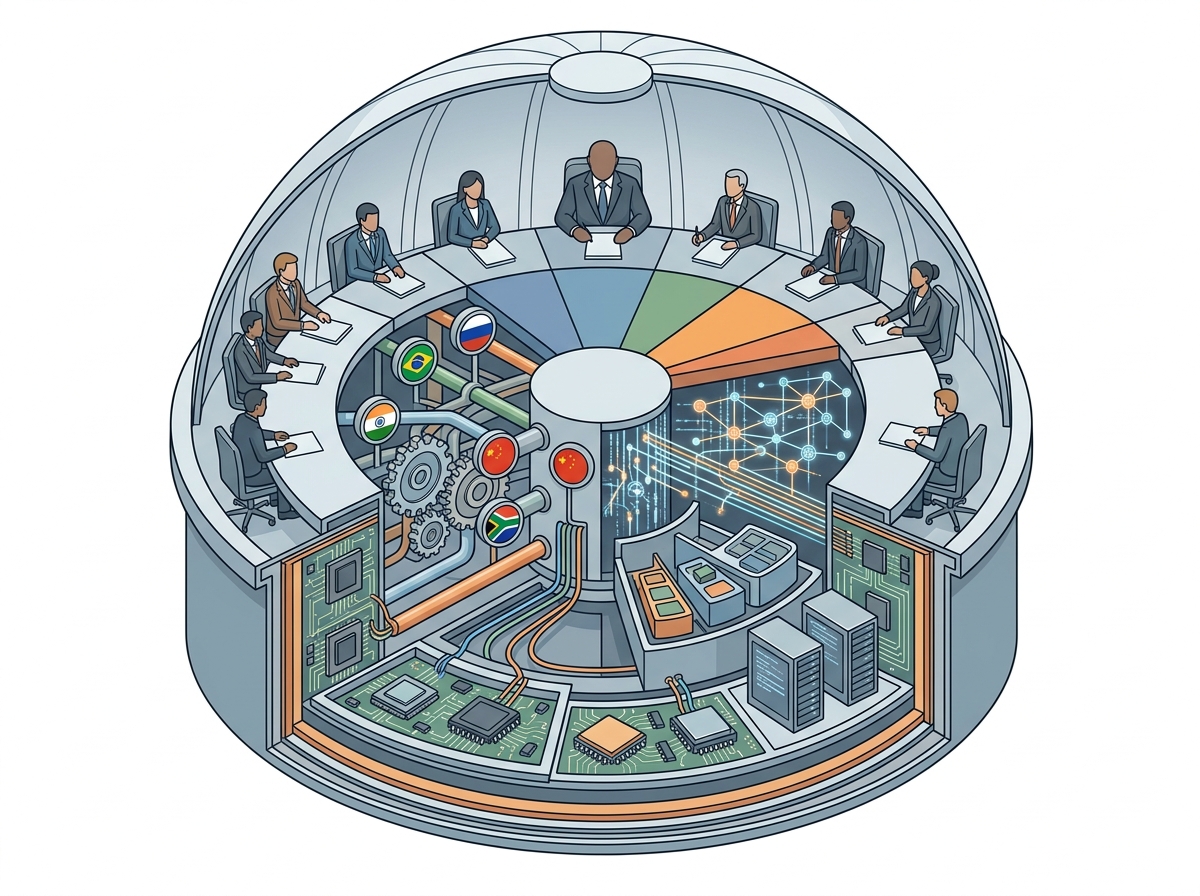
The inaugural BRICS Tax Heads meeting, held in New Delhi under India’s 2026 chairmanship, underscored the necessity for BRICS tax administrations to consolidate their collective voice amid ongoing renegotiations of international tax rules. The event highlighted India’s leadership in proposing institutional mechanisms—such as working groups on international taxation and revenue statistics—to ensure sustained cooperation beyond its term. The discussions also reflected the shift toward digital and data-driven tax administration frameworks, with India’s initiatives like faceless assessment and AI-enabled taxpayer assistance serving as models for BRICS partners.
Background
- The BRICS grouping, comprising Brazil, Russia, India, China, and South Africa, represents major developing economies with significant influence in global economic governance.
- International tax rules, including those under the OECD/G20 Inclusive Framework, are undergoing renegotiation to address challenges posed by digitalisation, base erosion, and profit shifting (BEPS).
- Developing countries, including BRICS members, face disproportionate challenges in transfer pricing disputes due to limited administrative capacity and frameworks designed for advanced economies.
- India’s tax administration reforms, such as faceless assessment and pre-filled returns, have demonstrated the potential of digitalisation to enhance efficiency and transparency in tax governance.
- The BRICS Tax Heads meeting aligns with broader efforts to institutionalise cooperation in tax administration, ensuring that the perspectives of developing economies are adequately represented in global tax policy discussions.
- The meeting also emphasised the role of technology in modernising tax systems, with India’s initiatives serving as a benchmark for other BRICS nations.
What is the BRICS Tax Heads Meeting and its significance?
- The BRICS Tax Heads Meeting is a platform for tax administrators from the five BRICS countries to deliberate on common challenges, share best practices, and strengthen collective bargaining power in international tax negotiations.
- The meeting aims to institutionalise mechanisms for sustained cooperation, including the establishment of permanent working groups on international taxation, transfer pricing, and revenue statistics.
- Transfer pricing disputes disproportionately impact developing countries due to complex cross-border transactions and limited administrative resources, necessitating a collective approach to address systemic inequities.
- India’s tax administration reforms, such as faceless assessment, pre-filled returns, and real-time invoice authentication, exemplify the shift toward digital and data-driven tax governance, which has garnered interest from BRICS partners.
- The proposed BRICS Tax Support Network seeks to provide a practical platform for supporting tax administrations, promoting ease of doing business, and facilitating knowledge exchange among member countries.
- The BRICS Young Tax Professionals Programme, institutionalised as an annual event, aims to nurture a cadre of young tax professionals through cross-learning and capacity-building initiatives.
- The meeting also highlighted the development of tools such as the Tax Collaboration Tool, Tax Knowledge Hub, and Cross-Learning Lab to enhance cooperation and knowledge sharing among BRICS tax administrations.
- The revenue statistics working group is developing a framework tailored to the economic realities of BRICS countries, moving away from frameworks designed for advanced economies.
Key Features
| Feature | Significance |
|---|---|
| Proposal of two BRICS working groups (International Taxation & Transfer Pricing; Revenue Statistics) | Establishes institutional mechanisms to sustain tax cooperation beyond India’s 2026 BRICS chairmanship, ensuring continuity in policy dialogue. |
| BRICS Tax Support Network (under finalisation) | Creates a practical platform for tax administrations to share best practices, resolve disputes, and enhance ease of doing business across member states. |
| Tax Collaboration Tool, Tax Knowledge Hub, and Cross-Learning Lab | Facilitates digital knowledge-sharing and capacity-building among tax officials, leveraging India’s technological advancements in tax administration. |
| VAT Modernisation Report and HR Development Index (under development) | Aims to standardise tax administration metrics and human resource capabilities, aligning them with BRICS-specific economic realities. |
| BRICS Young Tax Professionals Programme (annual event at NADT, Nagpur) | Promotes youth engagement in international taxation, fostering long-term institutional collaboration and expertise exchange. |
Why it Matters
Global Tax Governance
- BRICS countries represent a significant share of global GDP and trade, making their collective voice essential in shaping international tax rules to ensure fairness for developing economies.
- The renegotiation of international tax rules (e.g., OECD’s inclusive framework) requires input from source jurisdictions like BRICS to prevent frameworks that disproportionately disadvantage them.
- Strengthening BRICS tax administrations’ collective bargaining power can counterbalance the dominance of developed economies in global tax policy formulation.
Digital Transformation of Tax Administration
- Transition from paper-based to data-driven and digital tax systems enhances efficiency, transparency, and compliance, reducing administrative burdens and litigation.
- India’s initiatives—faceless assessment, pre-filled returns, real-time invoice authentication, and AI-enabled taxpayer assistance—serve as models for BRICS peers.
- Digitalisation enables real-time data exchange, improving cross-border tax cooperation and reducing transfer pricing disputes.
Institutional Capacity Building
- The proposed working groups and support network institutionalise long-term cooperation, ensuring that tax administration reforms outlast India’s BRICS chairmanship.
- Capacity-building programmes (e.g., Young Tax Professionals Programme) address skill gaps and foster a shared understanding of tax challenges among BRICS tax officials.
- Standardised metrics (e.g., HR Development Index, VAT Modernisation Report) ensure that tax administration reforms are tailored to BRICS economic realities.
Economic Sovereignty and Fair Taxation
- BRICS countries, as major source jurisdictions, face unique tax challenges (e.g., transfer pricing disputes) that require collective solutions to protect their tax base.
- A BRICS-specific framework for measuring tax-system performance ensures that global tax metrics reflect the economic structures of developing economies.
- Strengthening collective tax administration enhances the ability of BRICS nations to negotiate equitable tax treaties and dispute resolution mechanisms.
Challenges
1. Transfer Pricing Disputes
- Transfer pricing disputes disproportionately burden developing countries due to complex global value chains and limited administrative capacity.
- Divergent interpretations of tax treaties and advance pricing agreements (APAs) exacerbate disputes, necessitating harmonised approaches within BRICS.
- The lack of a permanent platform for mutual agreement procedures (MAPs) delays resolution, increasing compliance costs for multinational enterprises.
UPSC Link: GS-III: Taxation, International Trade
2. Digital Taxation and Base Erosion
- The rise of digital economies challenges traditional tax principles, creating gaps in taxing rights and revenue losses for source jurisdictions.
- BRICS countries must coordinate on digital service tax policies to prevent unilateral measures that could lead to trade disputes.
- Ensuring that digital taxation frameworks are inclusive and equitable requires robust data-sharing and administrative cooperation.
UPSC Link: GS-III: Digital Economy, Taxation
3. Administrative Capacity Gaps
- Many BRICS tax administrations lack the technological infrastructure and skilled personnel to implement digital tax systems effectively.
- Inconsistent tax administration practices across member states hinder cross-border cooperation and ease of doing business.
- Limited resources for tax audits and enforcement reduce the deterrent effect on tax evasion and avoidance.
UPSC Link: GS-II: Governance, GS-III: Public Finance
4. Harmonising Tax Metrics
- Existing global tax metrics (e.g., OECD’s tax-to-GDP ratios) are designed for developed economies and may not accurately reflect the tax capacity of BRICS nations.
- Developing a BRICS-specific framework for tax-system performance requires consensus on indicators that account for informal economies and structural differences.
- Standardisation efforts must balance comparability with the need for flexibility to address unique economic conditions.
UPSC Link: GS-III: Public Finance, Taxation
Challenges — UPSC Perspective
| Issue | Concern |
|---|---|
| Transfer Pricing Disputes | Disproportionate administrative burden on developing countries due to complex global value chains and treaty interpretation gaps. |
| Digital Taxation Challenges | Risk of revenue loss and trade disputes due to unilateral digital service tax policies and outdated international tax principles. |
| Administrative Capacity Gaps | Limited technological infrastructure and skilled personnel hinder effective tax administration and enforcement. |
| Harmonising Tax Metrics | Existing global tax metrics may not reflect the economic realities of BRICS nations, leading to misaligned policy frameworks. |
| Institutional Continuity | Ensuring that proposed BRICS tax cooperation mechanisms outlast India’s chairmanship and remain sustainable. |
Way Forward
- Establish the proposed BRICS working groups on International Taxation & Transfer Pricing and Revenue Statistics as permanent bodies to institutionalise cooperation.
- Develop a BRICS-specific framework for measuring tax-system performance, incorporating indicators relevant to developing economies.
- Expand the BRICS Young Tax Professionals Programme to include more member states and focus on emerging tax challenges (e.g., digital economy, carbon taxation).
- Enhance digital infrastructure for tax administration across BRICS nations, leveraging India’s experience with faceless assessment and real-time invoice authentication.
- Strengthen mutual agreement procedures (MAPs) and advance pricing agreements (APAs) through regular exchanges of best practices and joint training programmes.
- Promote cross-border data-sharing agreements to improve transfer pricing audits and reduce disputes, while ensuring data privacy and security.
- Finalise the BRICS Tax Support Network’s terms of reference to create a practical platform for tax administrations to resolve disputes and share resources.
- Conduct periodic reviews of the BRICS Tax Collaboration Tool and Tax Knowledge Hub to ensure they remain relevant and address evolving tax challenges.
UPSC Value Addition
Keywords for Mains Answer-Writing
BRICS Tax Heads Meeting · International tax rules renegotiation · Transfer pricing disputes · Faceless assessment · Pre-filled income tax returns · AI-enabled taxpayer assistance · BRICS Tax Support Network · Tax Collaboration Tool · Revenue statistics framework · Digital transformation of tax administration
Concept Flow
BRICS countries face disproportionate challenges in global tax governance due to their economic structures and administrative capacities. → India proposes institutional mechanisms (working groups, support network) to strengthen collective tax administration and bargaining power. → Digital transformation of tax systems (e.g., faceless assessment) enhances efficiency and serves as a model for BRICS peers. → Capacity-building programmes (e.g., Young Tax Professionals Programme) address skill gaps and foster long-term cooperation. → Harmonised tax metrics and frameworks ensure that global tax rules reflect the realities of developing economies. → Sustainable cooperation mechanisms outlast India’s chairmanship, ensuring continuity in BRICS tax policy dialogue.
Prelims Practice Questions
Q1. Consider the following statements regarding the BRICS Tax Heads Meeting held in September 2026:
1. The meeting proposed the establishment of two new working groups: one on international taxation and transfer pricing, and another on revenue statistics.
2. The proposed working groups are intended to function only during India’s 2026 BRICS chairmanship.
3. The meeting highlighted India’s initiatives such as faceless assessment, pre-filled returns, and real-time invoice authentication.
4. The BRICS Tax Support Network has been operational since 2020.
How many of the above statements are correct?
- Only one
- Only two
- Only three
- All
Answer: Only three — Statements 1 and 3 are correct. Statement 2 is incorrect because the working groups are designed to outlast India’s chairmanship. Statement 4 is incorrect as the BRICS Tax Support Network was proposed and terms of reference are being finalised, not operational since 2020.
Q2. Assertion (A): Transfer pricing disputes disproportionately impact developing countries due to their reliance on traditional tax administration systems.
Reason (R): Developing countries lack the institutional capacity to implement advanced digital tax administration systems.
Options:
A. Both A and R are true, and R is the correct explanation of A.
B. Both A and R are true, but R is NOT the correct explanation of A.
C. A is true, but R is false.
D. A is false, but R is true.
Answer: ? — Both the assertion and reason are true. The reason correctly explains the assertion, as transfer pricing disputes are more burdensome for developing countries due to their limited administrative capacity and reliance on older systems.
Q3. Match the following initiatives proposed or discussed during the BRICS Tax Heads Meeting 2026 with their respective descriptions:
Column I (Initiative) | Column II (Description)
1. Tax Collaboration Tool | A. A platform for supporting tax administrations and promoting ease of doing business across BRICS countries.
2. BRICS Tax Support Network | B. A digital system for real-time authentication of invoices to curb tax evasion.
3. Real-time invoice authentication | C. A tool designed to facilitate knowledge sharing and collaboration among tax administrations.
4. Pre-filled income tax returns | D. A system where tax returns are pre-populated with data from various sources to reduce compliance burden.
Options:
A. 1-C, 2-A, 3-B, 4-D
B. 1-A, 2-C, 3-D, 4-B
C. 1-B, 2-D, 3-A, 4-C
D. 1-D, 2-B, 3-C, 4-A
Answer: ? — 1-C (Tax Collaboration Tool facilitates knowledge sharing), 2-A (BRICS Tax Support Network supports tax administrations), 3-B (Real-time invoice authentication authenticates invoices), 4-D (Pre-filled income tax returns reduce compliance burden).
Mains Practice Question
✍ “The renegotiation of international tax rules must incorporate the perspectives of developing economies to ensure fairness and sustainability.” Critically examine this statement in the context of the BRICS Tax Heads Meeting held in September 2026. Also, assess the role of digital transformation in enhancing tax administration efficiency in these economies. (15 Marks)
Approach: MODEL-ANSWER SKELETON:
1. **Context and Significance of BRICS Tax Heads Meeting (2 Marks)**
– Reference the September 2026 meeting and its focus on strengthening the collective voice of BRICS tax administrations in international tax rule renegotiations.
– Highlight the dual role of BRICS nations as large developing economies and source jurisdictions with significant domestic tax capacity.
2. **Why Developing Economies’ Perspectives Matter (3 Marks)**
– **Transfer Pricing Disputes**: Explain how these disproportionately burden developing countries due to limited administrative capacity and reliance on traditional systems (cite the meeting’s observations).
– **Revenue Frameworks**: Discuss how frameworks designed for advanced economies distort tax realities in developing nations (e.g., inability to adopt OECD-style transfer pricing rules).
– **Institutional Capacity**: Emphasise the need for frameworks that reflect the economic and administrative realities of developing economies (reference the proposed revenue statistics working group).
3. **Digital Transformation in Tax Administration (4 Marks)**
– **Faceless Assessment**: Explain India’s faceless assessment system, its benefits (reduced discretion, increased transparency), and its adoption by BRICS partners.
– **Pre-filled Returns**: Discuss how pre-populated tax returns reduce compliance costs and improve accuracy (cite India’s experience).
– **Real-time Invoice Authentication**: Highlight its role in curbing tax evasion and improving compliance (reference the BRICS Tax Heads Meeting).
– **AI-enabled Assistance**: Explain how AI tools enhance taxpayer assistance and reduce administrative burden.
4. **Challenges and Limitations (3 Marks)**
– **Digital Divide**: Acknowledge disparities in digital infrastructure across BRICS nations.
– **Data Privacy Concerns**: Discuss the need for robust data governance frameworks.
– **Implementation Hurdles**: Highlight the time and resources required to transition from paper-based to digital systems.
5. **Conclusion and Way Forward (3 Marks)**
– Summarise the importance of incorporating developing economies’ perspectives in international tax rules.
– Argue for continued collaboration under the BRICS Tax Support Network and proposed working groups.
– Emphasise the role of digital transformation as a catalyst for fairer and more efficient tax administration globally.
Source: orissapost.com
Generated by AanyaAi for educational purpose.
Related guides on our sites
- Anthropology VS PSIR
- Best PSIR optional coaching
- Best PSIR optional coaching online
- Best PSIR optional teacher

- हिमाचल में कचरा नियम तोड़ने वालों का बिजली-पानी होगा काटा, जानें पूरा मामला - September 23, 2026
- Himachal Pradesh’s Strict Action Against Bulk Waste Generators: Electricity & Water Cut - September 23, 2026
- आंध्र प्रदेश में चार नए पुलिस आयुक्तालयों को कैबिनेट की मंजूरी, जानिए क्या होंगे फायदे - September 23, 2026

No Comments