


30 Sep Sixth Schedule and the Quest for Autonomy: The Case of Ladakh
This article covers “Daily Current Affairs” and Topic details “Sixth Schedule and the Quest for Autonomy: The Case of Ladakh”
SYLLABUS MAPPING
GS–2 – Polity & Governance – Constitutional Provisions, Federalism, and Issues of Regional Autonomy
FOR PRELIMS
What is the Sixth Schedule of the Indian Constitution?
FOR MAINS
Examine the demand for Ladakh’s inclusion under the Sixth Schedule. Discuss the challenges in extending Sixth Schedule provisions.
Why in the News?
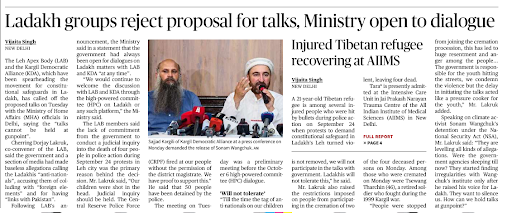
Ladakh has renewed demands for inclusion under the Sixth Schedule following the abrogation of Article 370 (2019) and its designation as a Union Territory without a legislature. With over 97% of its population belonging to Scheduled Tribes, local communities seek safeguards for land, culture, and political autonomy, similar to the Autonomous District Councils in Northeast India, to prevent demographic changes and preserve their identity. The issue also raises debates on constitutional reforms, regional autonomy, and balancing development with national security.
Sixth Schedule of the Indian Constitution
- The Sixth Schedule (Articles 244(2) & 275(1)) provides for autonomy and self-governance to tribal communities in the hill regions of Northeast India.
- Introduced to protect tribal identity, culture, land, and customs from external encroachment while ensuring development within the constitutional framework.
- It continues the British-era policy of limited interference in tribal areas, while formally recognizing traditional systems of governance.
- Data point: Around 12 Autonomous District Councils (ADCs) currently exist across Assam, Meghalaya, Mizoram, and Tripura, covering nearly 5.5 million tribal people (Census 2011).
Provisions that Maintain Autonomy
The Sixth Schedule establishes Autonomous District Councils (ADCs) with legislative, judicial, and executive powers.
1. Autonomous District & Regional Councils – Directly elected bodies (30 members, of which 4 nominated by Governor).
2. Legislative Powers – Laws on land, forests (except reserved), shifting cultivation, village administration, inheritance, marriage, social customs.
Example: Khasi Hills Autonomous District Council regulates marriage and divorce as per Khasi matrilineal customs.
3. Judicial Powers – Village courts/councils adjudicate tribal cases as per customary laws.
Example: Jaintia Hills District Council runs its own courts for customary law disputes.
4. Executive Powers – Administration of primary education, health, sanitation, roads, village planning.
5. Revenue Powers – Levy taxes on markets, professions, animals, vehicles, land revenue, entry of goods.
Example: Bodoland Territorial Council in Assam generates revenue through taxation on trade and natural resources.
6. Safeguards – Governor exercises oversight; State/Parliamentary laws apply only if approved by the council.
7. Areas Covered – Parts of Assam, Meghalaya, Mizoram, and Tripura (not Arunachal, Nagaland, Manipur, as they have separate arrangements).
Why Ladakh Wants Inclusion in the Sixth Schedule?
After abrogation of Article 370 (2019) and creation of UT Ladakh (without legislature):
- Identity & Culture Protection – Ladakh’s population is 97% Scheduled Tribes (Census 2011). Communities fear demographic change and cultural erosion due to migration and commercialization.
Example: Similar fears led to the creation of Bodoland Territorial Region (2003, Assam) under Sixth Schedule to safeguard Bodo identity. - Land & Resource Rights – Desire to protect traditional land ownership, pastures, and forests from external settlers and corporates.
Data: In NE, Sixth Schedule councils restrict land transfer to non-tribals (e.g., Khasi Hills). Ladakh demands the same. - Political Autonomy – Current Ladakh Autonomous Hill Development Councils (LAHDCs) in Leh & Kargil have limited powers compared to ADCs.
- arliamentary Standing Committee (2021) recommended Sixth Schedule status for Ladakh, citing its high tribal concentration.
Challenges in Extending Sixth Schedule to Ladakh
1. Constitutional Limitation – Sixth Schedule explicitly applies to Northeast India. Extending it requires a constitutional amendment.
Example: Tripura ADC (1985) required a constitutional change.
2. Strategic Concerns – Ladakh borders China and Pakistan. The Centre prefers direct control for defense and infrastructure projects (e.g., roads, airfields, military logistics).
3. Balance of Interests – Leh (Buddhist-majority) strongly supports inclusion, while Kargil (Shia Muslim-majority) has mixed views, fearing unequal representation.
4. Development vs. Autonomy – Full autonomy may delay national projects (hydropower, tourism, highways, defense).
Example: In Northeast, delays occurred in infrastructure projects in Garo Hills due to ADC consent procedures.
5. Precedent Effect – Granting Sixth Schedule to Ladakh may inspire similar demands from other tribal areas outside Northeast (e.g., Jharkhand’s Pathalgadi movement, Chhattisgarh tribals).
Way Forward
1. Special Constitutional Safeguard – Either extend the Sixth Schedule or create a “Sixth Schedule Plus” tailored for Ladakh. Example: Bodoland Territorial Council Accord (2020) modified the Sixth Schedule to enhance Bodo rights.
2. Strengthening Hill Development Councils (LAHDCs) – Provide legislative, financial, and judicial powers closer to ADCs.
3. Land & Cultural Protection Laws – Enact state-specific land rights, like Himachal Pradesh (outsiders cannot buy land without permission).
4. Participatory Governance – Ensure balanced representation of Leh & Kargil in any new framework to avoid polarization.
5. Balancing Autonomy & National Security – Develop a model ensuring tribal safeguards without undermining India’s strategic projects in Ladakh.
6. Dialogue & Consensus-Building – Continuous engagement with LAHDC Leh, LAHDC Kargil, civil society, and religious bodies to frame a common roadmap.
Conclusion
The Sixth Schedule protects tribal autonomy in Northeast India by granting ADCs powers over land, customs, law, and governance. Ladakh, with its overwhelming tribal population and fragile ecology, demands similar safeguards post-2019 to prevent demographic and cultural threats. Past precedents like Tripura ADC (1985) and Bodoland Territorial Region (2003, 2020 Accord) show that constitutional innovations are possible. However, strategic sensitivities, constitutional hurdles, and internal diversity in Ladakh require a nuanced solution. A customized “Sixth Schedule Plus” model balancing autonomy, cultural protection, and national security could be the way forward.
Prelims Question
Q. Consider the following statements about the Sixth Schedule of the Indian Constitution:
1. It provides for Autonomous District Councils in the hill regions of Northeast India.
2. Legislative powers of ADCs include law on land, forests, inheritance, and marriage among tribal communities.
3. Sixth Schedule provisions are currently applicable to all Union Territories with tribal populations.
Which of the statements given above is/are correct?
(a) 1 and 2 only
(b) 2 and 3 only
(c) 1 and 3 only
(d) 1, 2, and 3
ANSWER: A
Mains Question
Q. The Sixth Schedule of the Indian Constitution provides special safeguards to tribal areas. Examine the relevance of Sixth Schedule provisions. (250 words)

- Elderly in India: Population, Challenges, and Government Initiatives - October 29, 2025
- Jal Jeevan Mission (JJM): Ensuring Tap Water to Every Rural Household - October 27, 2025
- National Blockchain Framework: Strengthening Governance through Blockchain Technology - October 25, 2025

No Comments