


08 Jan Somnath Swabhiman Parv: Civilisational Continuity, Cultural Assertion and Nation-Building
This article covers “Daily Current Affairs” and From Somnath Swabhiman Parv: Civilizational Continuity, Cultural Assertion and Nation-Building
SYLLABUS MAPPING
GS-1- Indian culture – Somnath Swabhiman Parv: Civilizational Continuity, Cultural Assertion and Nation-Building
FOR PRELIMS
Explain the historical and cultural significance of the Somnath Temple in India’s civilisation
FOR MAINS
Why is the reconstruction of the Somnath Temple after Independence considered symbolically important for India
Why in the News?
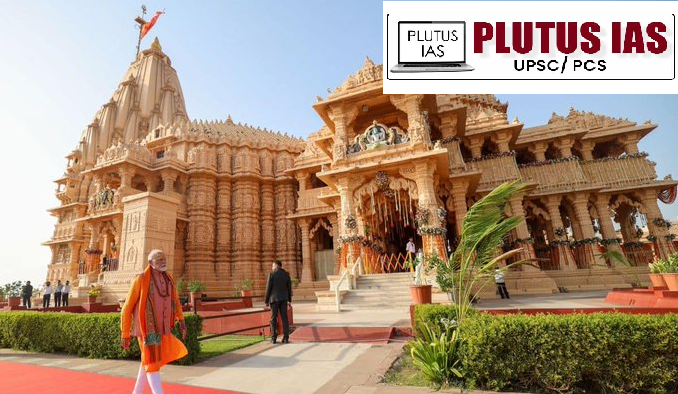
Prime Minister Narendra Modi extended greetings on the commencement of Somnath Swabhiman Parv, a year-long cultural-spiritual programme marking 75 years of the reconstruction of the Somnath Temple (1951–2026). The event commemorates Somnath’s historical resilience after repeated invasions, its reconstruction under leaders like Sardar Patel and K. M. Munshi, and its role as a symbol of India’s civilisational continuity and cultural self-respect.
Somnath in India’s Civilisational Memory
Ancient Sacred Geography : Somnath, one of the twelve Jyotirlingas, occupies a central place in India’s sacred geography, symbolising the integration of spirituality, geography and collective cultural consciousness.
Repeated Destruction and Rebuilding : Despite multiple invasions since 1026 CE, Somnath was reconstructed repeatedly, reflecting an unbroken civilisational impulse to preserve faith, identity and sacred institutions.
Faith Beyond Physical Structures : Somnath survived not merely as stone architecture but as a living idea, sustained through oral traditions, pilgrimages and devotional literature across centuries.
Symbol of Cultural Endurance : The temple represents India’s capacity to absorb shocks, regenerate culturally and assert continuity without erasing its historical experiences.
Civilisational Time Scale : Somnath’s survival over a millennium highlights India’s long-term civilisational perspective, contrasting with short-term political disruptions.
Historical Context: The 1026 CE Attack and After
| Aspect | Explanation |
|---|---|
| Mahmud of Ghazni’s Raid (1026 CE) | The 1026 CE attack on Somnath was part of Mahmud of Ghazni’s series of raids into the Indian subcontinent. It was driven by a combination of economic motives (temple wealth), political ambition to assert supremacy, and symbolic objectives, as Somnath was a prominent religious centre. |
| Political Fragmentation of Early Medieval India | The raid took place in a period marked by regional disunity and the absence of a strong central authority. Fragmented political structures and lack of coordinated defence among Indian kingdoms made important cultural and religious institutions vulnerable to external invasions. |
| Cultural Trauma and Historical Memory | The destruction of Somnath became embedded in collective historical memory as a civilisational trauma. Over time, it shaped narratives of loss, resistance and revival through chronicles, oral traditions and later historical interpretations. |
| Continuity Despite Rupture | Despite repeated destruction, religious practices and reverence associated with Somnath continued. The temple was rebuilt multiple times, reflecting the resilience of cultural traditions and the ability of society to sustain belief systems beyond physical devastation. |
| Lessons from History | Somnath’s history illustrates that cultural endurance depends not only on political power but on collective belief, social continuity and the transmission of values across generations. |
Post-Independence Reconstruction and Nation-Building
Sardar Patel’s Vision : Sardar Vallabhbhai Patel viewed the reconstruction of the Somnath Temple not merely as a religious act but as a civilisational assertion and psychological reconstruction of a newly independent nation. For Patel, Somnath symbolised centuries of resilience despite repeated destruction and thus represented India’s capacity to reclaim dignity after colonial domination. He saw cultural confidence as essential for political unity, especially at a time when the nation was grappling with Partition trauma and integration of princely states. The reconstruction aligned with Patel’s broader nation-building project that sought to restore self-respect without fostering exclusionary nationalism.
Role of K. M. Munshi : K. M. Munshi played a decisive role by providing intellectual justification, organisational leadership and ideological framing to the reconstruction effort. As a constitutionalist, freedom fighter and cultural thinker, Munshi articulated Somnath’s rebuilding as part of India’s historical continuity rather than religious revivalism. He argued that acknowledging civilisational heritage was compatible with constitutional secularism. Munshi’s stewardship of the Somnath Trust ensured transparency, public participation and non-state funding, reinforcing the idea that cultural regeneration could coexist with democratic and constitutional values.
Inauguration in 1951 : The inauguration of the reconstructed Somnath Temple in 1951 by President Dr. Rajendra Prasad carried deep symbolic significance. It marked the first major cultural reconstruction undertaken in independent India, signalling confidence in reclaiming heritage after centuries of political subjugation. Dr. Prasad’s participation underscored the distinction between state neutrality and cultural engagement, as he attended in his personal capacity rather than as an executive authority. The event reflected an evolving understanding of secularism rooted in Indian traditions, rather than strict separation of state and religion.
State and Society Collaboration : The Somnath reconstruction exemplified a collaborative model of nation-building, involving political leaders, religious trusts, historians, artisans and ordinary citizens. The state did not directly fund or control the project, thereby avoiding the charge of religious patronage. Instead, it facilitated moral support while civil society mobilised resources. This model demonstrated how public leadership could enable cultural initiatives without violating constitutional boundaries, offering a template for reconciling heritage conservation with democratic governance.
Cultural Neutrality Debate : The reconstruction of Somnath sparked an important debate on the nature of Indian secularism. Critics argued that involvement of political leaders blurred the line between religion and state, while proponents contended that Indian secularism is not anti-religion but equidistant from all faiths. The episode highlighted India’s unique model of principled cultural pluralism, where acknowledgment of historical and cultural symbols does not imply exclusion of minorities. Somnath thus became a case study in balancing civilisational memory, constitutional morality and inclusive nationalism.
Somnath Swabhiman Parv: Contemporary Significance
Commemoration of 75 Years : Somnath Swabhiman Parv commemorates 75 years of the temple’s rededication (1951–2026), consciously linking post-Independence cultural revival with present-day national self-confidence. The milestone serves as a bridge between the nation-building ethos of early leaders and contemporary India’s renewed emphasis on heritage, identity and cultural diplomacy. By revisiting the historical moment of reconstruction, the Parv situates Somnath not as a relic of the past but as a living symbol of civilisational continuity in a sovereign and self-assured India.
Spiritual and Cultural Programming : The year-long celebrations are designed as a holistic cultural ecosystem, integrating spiritual practices, artistic expression and heritage education. Religious rituals coexist with classical music, dance, lectures, exhibitions and youth-oriented educational initiatives. This multidimensional programming reflects an understanding of culture as a dynamic social force rather than a static tradition, ensuring inclusivity and intergenerational transmission of heritage. The emphasis on community participation reinforces Somnath’s role as a shared cultural space beyond sectarian boundaries.
Symbolic Events : Events such as drone light shows, Omkar Naad (cosmic sound symbolism) and Shaurya Yatra represent a deliberate synthesis of modern technology with ancient symbolism. These spectacles communicate cultural narratives in contemporary idioms, making heritage accessible to younger and global audiences. The fusion reflects India’s evolving self-image as a civilisation that embraces modernity without cultural amnesia, projecting confidence in integrating innovation with tradition rather than treating them as opposites.
Public Participation and Digital Outreach : Extensive use of social media platforms, digital storytelling and online campaigns has transformed the Parv into a participatory cultural movement rather than a location-bound religious event. Citizens contribute through virtual engagements, shared narratives and creative content, fostering a sense of collective ownership. This digital outreach aligns with India’s broader push towards democratisation of heritage, where cultural memory is co-created by society rather than curated exclusively by institutions.
Revival of Civilisational Discourse : At a deeper level, Somnath Swabhiman Parv reinforces contemporary discourse on civilisational resilience, historical memory and indigenous identity. It challenges colonial-era narratives that portrayed Indian history primarily through disruption and decline, instead emphasising continuity and regeneration. The Parv thus functions as a platform for re-examining India’s past through its own epistemic lens, contributing to an ongoing conversation about cultural self-definition within a modern constitutional framework.
Cultural Nationalism, Constitutional Values and Heritage Governance: Integrated Perspectives
Culture as Soft Power and National Cohesion : Somnath illustrates how cultural heritage functions as internal soft power, strengthening social cohesion, while simultaneously enhancing India’s external cultural diplomacy. By projecting a confident yet non-aggressive civilisational narrative, such heritage sites contribute to India’s global image as a plural, ancient and resilient civilisation rooted in ethical traditions rather than ideological dominance.
Inclusive Civilisational Identity and Ethical Remembrance : The Somnath narrative emphasises shared cultural memory and resilience, avoiding grievance-based or exclusionary interpretations of history. Commemoration is framed as ethical remembrance—honouring endurance and regeneration rather than cultivating historical resentment. This approach aligns with India’s pluralistic civilisational ethos and prevents cultural nationalism from sliding into antagonistic identity politics.
Faith, Secularism and Constitutional Morality : Somnath demonstrates India’s distinctive model of secularism based on equal respect for all faiths, rather than strict separation or cultural erasure. State engagement remains symbolic and facilitative, not doctrinal or coercive, reflecting constitutional morality. This balance allows faith-based heritage to be acknowledged within a democratic framework without undermining religious neutrality.
Leadership, Symbolism and Ethical Nationalism : Political leadership has used Somnath symbolically to inspire confidence, unity and moral purpose, especially during periods of transition. Such symbolism, when rooted in constitutional values and inclusivity, fosters ethical nationalism—one that draws strength from culture while remaining anchored in democratic norms and social harmony.
Heritage as Living Tradition, Not Static Monument : Somnath underscores the need to govern heritage as a living, practiced and socially embedded tradition, rather than as frozen archaeology. Cultural festivals, rituals, educational activities and community participation ensure relevance, continuity and adaptability. This approach strengthens intergenerational transmission and deepens societal ownership of heritage.
Developmental, Educational and Technological Dimensions : Heritage initiatives around Somnath contribute to pilgrimage tourism, local economic development and employment generation, linking culture with inclusive growth. Simultaneously, digital tools—such as documentation, drones and social media—expand outreach and historical awareness, particularly among youth. Technology thus becomes an enabler of preservation, education and democratic access to cultural narratives.
Way Forward
Institutionalise Heritage Education – Integrate civilisational sites into school curricula to build historical consciousness.
Strengthen Heritage Governance – Improve coordination between ASI, state governments and temple trusts.
Promote Inclusive Narratives – Frame heritage as shared cultural capital beyond religious boundaries.
Leverage Technology – Use digital platforms for virtual heritage access and documentation.
Community Participation – Empower local communities as custodians of heritage.
Balance Development and Conservation – Ensure tourism growth does not compromise cultural integrity.
Global Cultural Diplomacy – Project sites like Somnath as symbols of India’s civilisational resilience internationally.
Conclusion
Somnath Swabhiman Parv transcends the commemoration of a temple’s reconstruction; it embodies India’s enduring civilisational resilience, cultural self-confidence and ethical continuity. By linking historical memory with contemporary nation-building, the initiative reinforces the idea that India’s identity is sustained not merely through political power, but through collective faith, values and an unbroken cultural consciousness that continues to inspire future generations
link: Best ias coaching in delhi
Q. “Somnath Temple represents not merely a religious structure but the continuity of India’s civilisational ethos.” Examine this statement in the context of India’s historical experiences and post-independence nation-building.

- PRAGATI: A Decade of Cooperative, Outcome-Driven Governance - January 15, 2026
- Iran’s Large-Scale Protests: Political Stability, Public Dissent and Regional Implications - January 14, 2026
- India–Oman CEPA: A Strategic Trade Pact for Jobs, Exports and Regional Integration - January 10, 2026

No Comments