


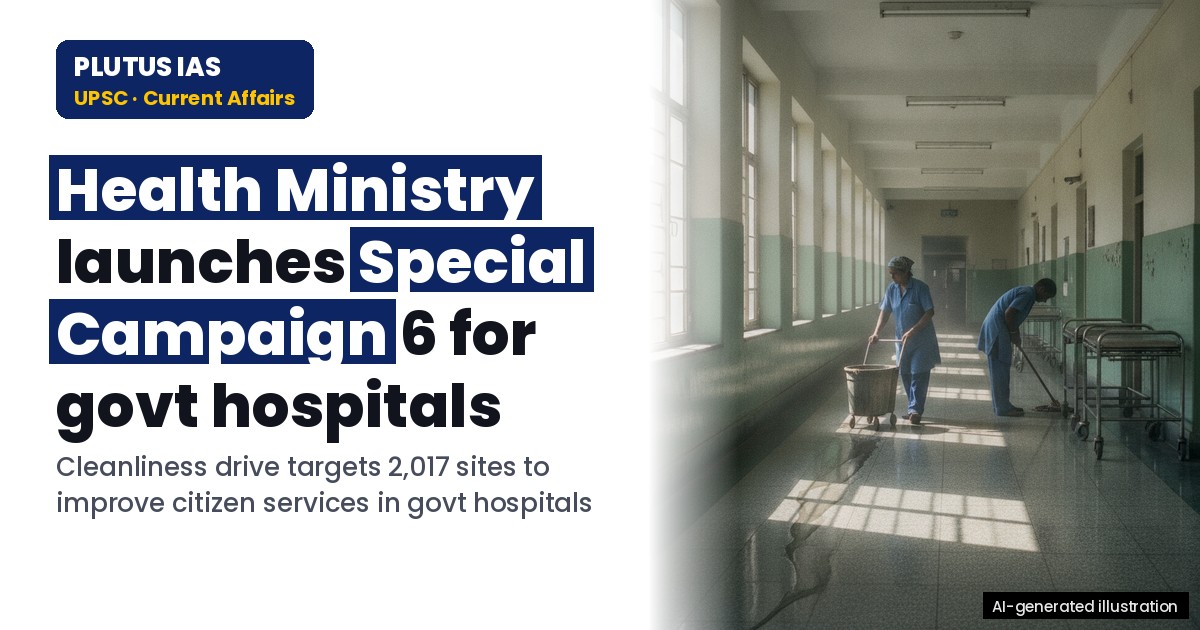
02 Oct Special Campaign 6: Govt Hospitals to Get Clean, Efficient, Citizen-Friendly
✎ Special Campaign 6 is a time-bound initiative by the Ministry of Health and Family Welfare to institutionalise cleanliness, reduce pendency, and enhance citizen-centric governance through cleanliness drives, record management…
Subject Relevance — Where This Topic Fits
- GS Paper II — Governance, Constitution, Polity, Social Justice and International Relations (Administrative Reforms, Public Grievances) | GS Paper III — Environment, Disaster Management, and Good Governance (Waste Management, Administrative Efficiency)
- Prelims: Special Campaign 6, Ministry of Health and Family Welfare (MoHFW), Department of Health and Family Welfare (DoHFW), Administrative Reforms and Public Grievances Department (DARPG), E-governance, Pendency reduction, Institutional cleanliness, Record management, Citizen-centric governance
- Essay: The Role of Administrative Reforms in Enhancing Governance Efficiency, Sustainable Public Service Delivery: Balancing Efficiency and Accountability
Quick Revision: Special Campaign 6 is a time-bound initiative by the Ministry of Health and Family Welfare to institutionalise cleanliness, reduce pendency, and enhance citizen-centric governance through cleanliness drives, record management, and process simplification.
Why is this in the news?
The Department of Health and Family Welfare (DoHFW), under the Ministry of Health and Family Welfare (MoHFW), has launched Special Campaign 6 from 2 October 2026 to 31 October 2026. This campaign aims to institutionalise cleanliness, reduce pendency of cases, and strengthen citizen-centric governance across central government hospitals, affiliated offices, autonomous bodies, and CPSEs under its purview. The initiative aligns with broader administrative reforms to improve efficiency, transparency, and public service delivery in the health sector.
Background
- Special Campaigns are time-bound, mission-mode initiatives launched by the Government of India to address pendency, improve cleanliness, and enhance governance efficiency in government offices.
- The Department of Administrative Reforms and Public Grievances (DARPG) oversees the implementation of these campaigns under the guidance of the Prime Minister’s Office.
- Previous editions of Special Campaigns have focused on reducing physical and digital pendency, improving record management, and promoting cleanliness in government institutions.
- The health sector, being a critical public service domain, requires continuous efforts to streamline administrative processes and ensure efficient service delivery.
- E-governance and digital record management have become essential tools for reducing pendency and improving transparency in government functioning.
- Institutional cleanliness and waste management are integral to creating a conducive work environment and ensuring compliance with environmental norms.
What is Special Campaign 6?
- Special Campaign 6 is a time-bound initiative launched by the Department of Health and Family Welfare (DoHFW) to institutionalise cleanliness, reduce pendency of cases, and enhance citizen-centric governance across its offices and institutions.
- The campaign is being conducted from 2 October 2026 to 31 October 2026, aligning with the Gandhi Jayanti period, symbolising the values of cleanliness and efficiency.
- The campaign targets 2,017 locations across DoHFW’s offices, hospitals, and institutions for cleanliness drives, including the removal of e-waste and obsolete materials.
- A total of 60,012 physical files and 10,020 e-files will be reviewed to reduce non-essential records, improve record management, and streamline administrative processes.
- 12 redundant rules and procedures have been identified for simplification to enhance operational efficiency and reduce bureaucratic hurdles.
- Public grievances and appeals will be prioritised for time-bound resolution to strengthen accountability and transparency in governance.
- The campaign underscores the importance of e-governance in reducing pendency and improving service delivery, particularly in critical sectors like health.
- Institutional cleanliness is being promoted not only for aesthetic purposes but also to create a healthier and more productive work environment.
Key Features
| Feature | Significance |
|---|---|
| Institutionalisation of cleanliness | Promotes hygiene and reduces infection risks in healthcare facilities, aligning with public health governance standards. |
| Reduction of pending cases | Enhances administrative efficiency by resolving backlog, ensuring timely justice and service delivery. |
| Citizen-centric governance | Focuses on grievance redressal and transparency, improving public trust in institutional processes. |
| Physical and digital file review | Streamlines record management, eliminates redundant documentation, and optimises office space utilisation. |
| Simplification of procedures | Reduces bureaucratic hurdles, accelerates decision-making, and enhances operational efficiency. |
Why it Matters
Administrative Reforms
- Demonstrates commitment to Swachh Bharat Mission principles within government institutions.
- Aligns with the Department of Administrative Reforms and Public Grievances (DARPG) mandate for efficiency and transparency.
- Serves as a model for other ministries to adopt similar cleanliness and governance initiatives.
Public Health Governance
- Strengthens infection control measures in healthcare facilities, reducing nosocomial risks.
- Improves operational hygiene in offices handling sensitive health records and services.
- Supports the broader goal of universal healthcare access through efficient institutional functioning.
E-Governance and Digital Transformation
- Accelerates digitisation of records, reducing paper waste and improving accessibility.
- Enhances transparency through digital grievance redressal mechanisms.
- Facilitates data-driven decision-making in health administration.
Resource Optimisation
- Releases valuable office space by clearing obsolete physical and electronic records.
- Generates potential revenue through sale or recycling of e-waste and redundant assets.
- Reduces administrative costs by eliminating redundant processes and files.
Challenges
1. Resistance to Change
- Bureaucratic inertia may hinder adoption of cleanliness and digitisation protocols.
- Staff reluctance to adapt to new record-keeping and grievance redressal systems.
UPSC Link: Civil Service Values – Probity in Governance
2. Data Security and Privacy
- Risk of data breaches during digitisation of sensitive health records.
- Need for robust cybersecurity measures to protect citizen information.
UPSC Link: RTI Act – Section 8 (Exemptions)
3. Resource Constraints
- Limited manpower and financial resources for comprehensive cleanliness drives.
- Potential delays in procurement of cleaning equipment and digitisation tools.
UPSC Link: Budgetary Allocation – Health Sector
4. Inter-departmental Coordination
- Coordination challenges between central, state, and local health authorities.
- Need for seamless integration of digital systems across different agencies.
UPSC Link: Federalism – Centre-State Relations
5. Public Awareness and Participation
- Ensuring citizen engagement in maintaining cleanliness and reporting grievances.
- Overcoming apathy towards institutional cleanliness and governance reforms.
UPSC Link: Citizen Charter – Transparency and Accountability
Challenges — UPSC Perspective
| Issue | Concern |
|---|---|
| Bureaucratic resistance | Low adoption of new protocols due to traditional work culture. |
| Data privacy risks | Potential exposure of sensitive health records during digitisation. |
| Resource limitations | Insufficient funds or staff for comprehensive implementation. |
| System integration gaps | Lack of interoperability between digital platforms of different agencies. |
| Citizen apathy | Low public participation in reporting grievances or maintaining cleanliness. |
Way Forward
- Conduct periodic audits of cleanliness and record management across all designated sites.
- Provide targeted training to staff on digitisation, record-keeping, and grievance redressal.
- Establish a digital dashboard for real-time monitoring of pending cases and cleanliness metrics.
- Collaborate with state health departments to ensure uniformity in cleanliness and governance standards.
- Incentivise staff participation through recognition and rewards for exemplary performance.
- Develop a citizen feedback mechanism to assess the impact of cleanliness and governance reforms.
- Ensure compliance with data protection laws during digitisation of health records.
UPSC Value Addition
Keywords for Mains Answer-Writing
Special Campaign 6 · Swachhata Abhiyaan in Government Hospitals · Administrative Reforms and Public Grievances Department (DARPG) · Citizen-Centric Governance · Pending Cases Disposal · Record Management in Public Offices · E-governance and Digital Records · Institutionalising Cleanliness · Government of India Health Institutions · Public Grievance Redressal · Simplification of Rules and Procedures · Waste Management in Public Offices · E-waste Disposal in Government Sector
Constitutional & Policy Linkages
- Directive Principles of State Policy – Article 47 (Public Health)
- Right to Information – Article 19(1)(a) (Transparency)
Concept Flow
Institutional cleanliness and governance reforms → Improved public health outcomes → Digitisation of records → Enhanced transparency and efficiency → Reduction of pending cases → Timely service delivery and justice → Resource optimisation → Cost savings and space utilisation → Citizen-centric governance → Increased public trust and participation → Administrative reforms → Alignment with national governance standards
Prelims Practice Questions
Q1. Consider the following statements regarding Special Campaign 6 launched by the Department of Health and Family Welfare (DOHFW):
1. The campaign is being conducted under the aegis of the Administrative Reforms and Public Grievances Department (DARPG).
2. It aims to dispose of 60,012 physical files and 10,020 e-files as part of record management.
3. The campaign includes the identification of 2,017 locations for cleanliness activities in government hospitals and offices.
4. The campaign is limited to the headquarters of the Ministry of Health and Family Welfare and excludes subordinate offices.
How many of the above statements are correct?
- Only one
- Only two
- Only three
- All four
Answer: Only three — Statements 1, 2, and 3 are correct as per the press release. Statement 4 is incorrect because the campaign covers all central government hospitals, affiliated and subordinate offices, autonomous bodies, and CPSEs under DOHFW, not just the headquarters.
Q2. Assertion (A): Special Campaign 6 focuses on the disposal of electronic waste (e-waste) in addition to physical waste in government offices.
Reason (R): The campaign aims to free up valuable office space and improve administrative efficiency by removing redundant records and obsolete items.
In the context of the above two statements, which one of the following is correct?
- Both A and R are true, and R is the correct explanation of A
- Both A and R are true, but R is not the correct explanation of A
- A is true, but R is false
- A is false, but R is true
Answer: Both A and R are true, but R is not the correct explanation of A — Both the assertion and reason are true. The campaign explicitly includes the identification and disposal of e-waste as part of its cleanliness and record management objectives. The reason correctly explains the purpose behind the disposal of waste, including e-waste.
Q3. Match the following institutions with their locations as mentioned in the context of Special Campaign 6:
Column I (Institution) | Column II (Location)
————————————————|———————–
A. Assistant Drugs Controller (India) Office | 1. Mumbai
B. Jawaharlal Nehru Port Trust (JNPT) | 2. Delhi
C. Postgraduate Institute of Medical Education | 3. Panvel
and Research (PGIMER), Chandigarh |
D. International Institute for Population | 4. Chandigarh
Sciences (IIPS)
- {‘A-3, B-3, C-4, D-1’: False}
- {‘A-2, B-3, C-4, D-1’: False}
- {‘A-2, B-3, C-1, D-4’: False}
- {‘A-2, B-3, C-4, D-1’: True}
Answer: {‘A-2, B-3, C-4, D-1’: False} — The correct matches are: A. Assistant Drugs Controller (India) Office – Delhi (2), B. Jawaharlal Nehru Port Trust (JNPT) – Panvel (3), C. Postgraduate Institute of Medical Education and Research (PGIMER), Chandigarh – Chandigarh (4), D. International Institute for Population Sciences (IIPS) – Mumbai (1).
Mains Practice Question
✍ Critically examine the significance of Special Campaign 6 in the context of institutionalising cleanliness and record management in government offices. Also, analyse how such campaigns contribute to citizen-centric governance. (15 Marks)
Approach: MODEL-ANSWER SKELETON:
1. **Introduction (2 Marks)**
– Define Special Campaign 6: A time-bound, mission-mode initiative launched by the Department of Health and Family Welfare (DOHFW) under the aegis of the Administrative Reforms and Public Grievances Department (DARPG).
– Objective: To institutionalise cleanliness, dispose of pending cases, and strengthen citizen-centric governance in government offices.
2. **Key Components and Actions (4 Marks)**
– Cleanliness drive: Identification of 2,017 locations for cleanliness activities, including disposal of physical and electronic waste.
– Record management: Review of 60,012 physical files and 10,020 e-files to reduce redundant records and improve efficiency.
– Simplification of procedures: Identification of 12 rules/procedures for simplification to enhance administrative efficiency.
– Public grievance redressal: Expeditious disposal of pending grievances to promote transparency and accountability.
3. **Institutionalising Cleanliness (3 Marks)**
– **Legal and Policy Framework**: Reference to the Swachh Bharat Mission and administrative reforms policies (e.g., DARPG’s guidelines on cleanliness and record management).
– **Role of Institutions**: Highlight the involvement of institutions like PGIMER, JNPT, and IIPS in ensuring compliance.
– **Sustainability**: Discuss how such campaigns can be institutionalised through regular audits, training, and performance monitoring.
4. **Citizen-Centric Governance (4 Marks)**
– **Definition**: Governance that prioritises the needs and expectations of citizens, ensuring transparency, accountability, and responsiveness.
– **Contribution of Campaign 6**:
– **Transparency**: Disposal of redundant records and simplification of procedures reduce opacity in governance.
– **Accountability**: Expeditious disposal of pending cases and grievances enhances trust in public institutions.
– **Efficiency**: Improved record management and cleanliness reduce bureaucratic delays and improve service delivery.
– **Challenges**: Resistance to change, lack of awareness, and resource constraints in implementing such initiatives uniformly.
5. **Conclusion (2 Marks)**
– Summarise the significance of Special Campaign 6 in promoting cleanliness, efficiency, and citizen-centric governance.
– Emphasise the need for long-term institutionalisation of such campaigns to achieve sustainable governance reforms.
Source: PIB (Press Information Bureau)
Generated by AanyaAi for educational purpose.
Related guides on our sites
- Anthropology VS PSIR
- Best PSIR optional coaching
- Best PSIR optional coaching online
- Best PSIR optional teacher

- इंदिरा गांधी प्राणी उद्यान में वन्यजीव सप्ताह का शुभारंभ, जानिए मुख्य गतिविधियां - October 3, 2026
- Sharam Samvad: Govt’s PR Campaign for Labour Codes in Delhi-NCR & Uttarakhand - October 2, 2026
- खादी उत्पादों पर 20% तक छूट: गांधी जयंती पर KVIC की पहल - October 2, 2026

No Comments