


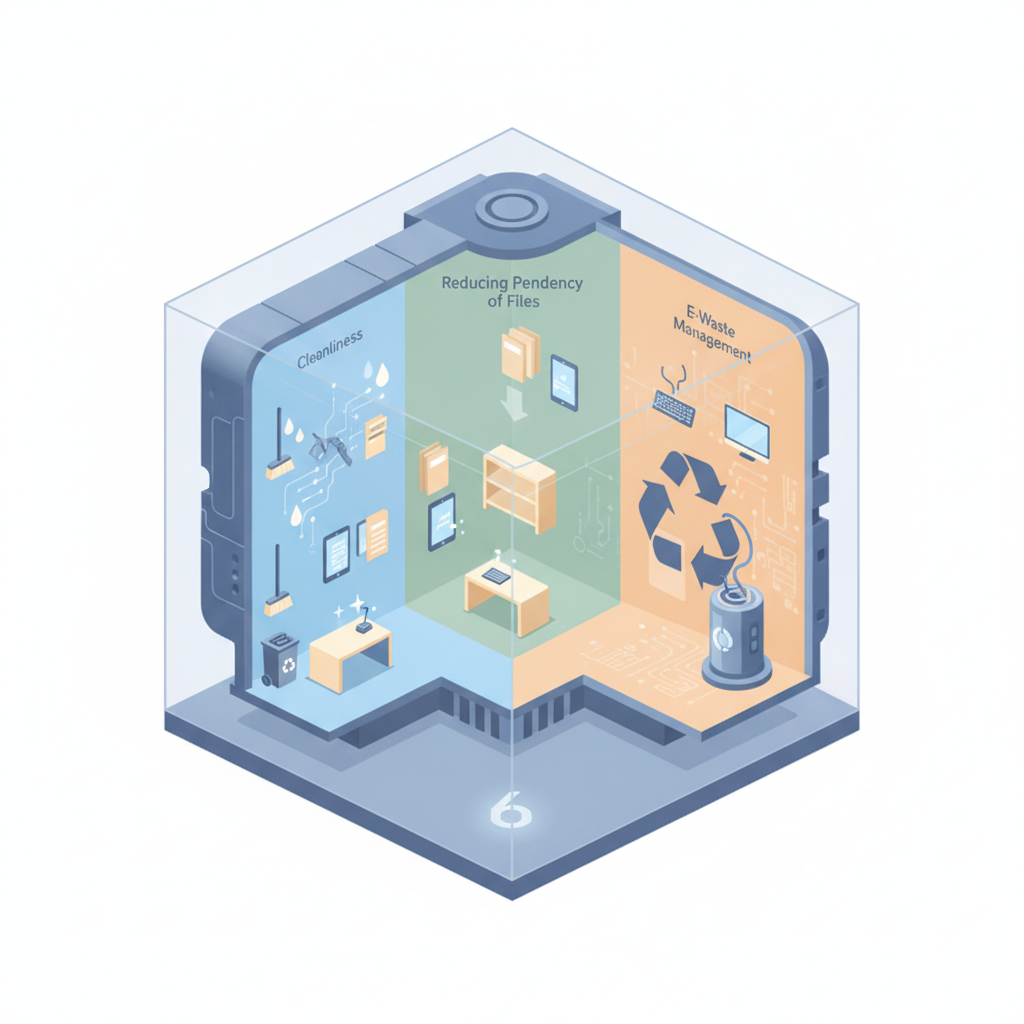
23 Sep Special Campaign 6: Textile Ministry to Focus on E-Waste & Pending Files
✎ Special Campaign 6 (2 Oct–31 Oct 2026) targets cleanliness, pendency reduction, and e-waste management in government offices, with real-time monitoring via https://scdpm.nic.in/specialcampaign6/.
Subject Relevance — Where This Topic Fits
- GS Paper II — Governance, Transparency and Accountability | GS Paper III — Environment and Sustainable Development
- Prelims: Special Campaign 6, E-waste (Management) Rules, 2022, Manual Scavenging Act, 1993, Swachh Bharat Mission 2.0, Digital India, E-office, Parliamentary Assurances, Public Grievances Redressal
- Essay: Governance reforms and administrative efficiency: The role of citizen-centric campaigns, Sustainable resource management: Balancing development and environmental stewardship
Quick Revision: Special Campaign 6 (2 Oct–31 Oct 2026) targets cleanliness, pendency reduction, and e-waste management in government offices, with real-time monitoring via https://scdpm.nic.in/specialcampaign6/.
Why is this in the news?
The Government of India has announced Special Campaign 6, a month-long initiative from 2 October to 31 October 2026, aimed at enhancing cleanliness, reducing pendency of official files, and strengthening e-waste management in government offices. The campaign builds on the outcomes of Special Campaign 5, which achieved measurable improvements in file disposal, space utilisation, and revenue generation through scrap disposal. The focus on e-waste aligns with India’s statutory framework for electronic waste management and reflects the government’s commitment to sustainable administrative practices.
Background
- Special Campaign 5 resulted in the disposal of 6,264 physical files and closure of 274 e-files in the Ministry of Textiles, freeing up 25,498 sq ft of office space and generating ₹11.35 lakh in revenue from scrap disposal.
- E-waste management in government offices is governed by the E-waste (Management) Rules, 2022, which mandate segregation, storage, and environmentally sound disposal of electronic waste.
- The campaign integrates principles of the Swachh Bharat Mission 2.0, which emphasises cleanliness, hygiene, and sustainable waste management in public institutions.
- Digital transformation initiatives such as E-office and Digital India are leveraged to streamline record-keeping and reduce physical file pendency.
- Parliamentary assurances, public grievances, and inter-ministerial references older than three months are prioritised for resolution under the campaign.
What is Special Campaign 6?
- A government-wide initiative to institutionalise cleanliness, reduce pendency of official files, and improve service delivery in government offices.
- Conducted from 2 October to 31 October 2026, with a preparation phase from 15–30 September 2026, and an evaluation phase from 16–30 November 2026.
- The campaign operates in three phases: preparation (identification of targets), implementation (execution of cleanliness and pendency reduction activities), and evaluation (review of outcomes).
- Focus areas include physical and e-file disposal, scrap management, e-waste segregation and disposal, and resolution of public grievances and parliamentary assurances pending beyond three months.
- E-waste management is a key thematic focus in 2026, aligning with the E-waste (Management) Rules, 2022, to ensure environmentally sound disposal of electronic waste generated in government offices.
- A dedicated portal (https://scdpm.nic.in/specialcampaign6/) enables real-time monitoring of progress, with daily updates on targets achieved and pendency reduction.
- The campaign aims to institutionalise cleanliness and efficiency as enduring practices, rather than ad-hoc efforts, by embedding them in routine administrative workflows.
- Outcomes are measured in terms of physical space freed, files disposed, revenue generated from scrap, and reduction in pendency of public grievances and parliamentary assurances.
Key Features
| Feature | Significance |
|---|---|
| Three-phase structure (Preparation, Implementation, Evaluation) | Ensures systematic identification, action, and accountability in governance processes. |
| Focus on e-waste management | Aligns with India’s E-Waste (Management) Rules, 2022, promoting environmental sustainability in government operations. |
| Digital monitoring portal (scdpm.nic.in) | Facilitates real-time transparency and public oversight of campaign progress. |
| Scientific disposal of redundant records | Optimises physical and digital storage, reducing bureaucratic inefficiencies. |
Why it Matters
Governance Efficiency
- Reduces pendency in official files, enhancing administrative responsiveness to citizen grievances and parliamentary assurances.
- Promotes a culture of accountability through structured review mechanisms in government offices.
- Aligns with the broader objective of ‘Minimum Government, Maximum Governance’ by streamlining bureaucratic processes.
Environmental Sustainability
- Integrates e-waste management into routine governance, reducing hazardous waste accumulation in public offices.
- Supports India’s commitment under the Basel Convention and national e-waste policies.
- Encourages adoption of circular economy principles in government operations.
Transparency and Citizen Engagement
- Publicly accessible portal enables citizens to track progress, fostering trust in government initiatives.
- Demonstrates proactive measures to address public complaints and appeals, improving service delivery.
Challenges
1. Operationalising E-waste Management
- Ensuring compliance with E-Waste (Management) Rules, 2022, particularly in decentralised government offices.
- Training staff in safe handling and disposal protocols to prevent environmental contamination.
- Coordinating with certified e-waste recyclers to ensure ethical and legal disposal.
UPSC Link: GS-III: Environmental Pollution & Degradation
2. Data Integrity in Digital Records
- Maintaining accuracy and security of e-files during review and disposal processes.
- Preventing data loss or corruption while transitioning from physical to digital archives.
UPSC Link: GS-II: Governance, Transparency & Accountability
3. Sustaining Momentum Post-Campaign
- Avoiding relapse into pre-campaign levels of pendency and inefficiency.
- Institutionalising periodic reviews to ensure long-term adherence to cleanliness and record-keeping standards.
UPSC Link: GS-II: Public Administration
Challenges — UPSC Perspective
| Issue | Concern |
|---|---|
| Lack of standardised e-waste disposal infrastructure | Risk of improper handling leading to environmental and health hazards. |
| Resistance to digitisation among staff | Slows transition to paperless governance, increasing storage and retrieval costs. |
| Inadequate inter-ministerial coordination | Delays resolution of cross-departmental references and parliamentary assurances. |
| Public apathy towards government portals | Reduces effectiveness of transparency tools in driving citizen participation. |
Way Forward
- Establish a dedicated e-waste collection cell in each ministry with trained personnel.
- Mandate annual audits of physical and digital records to prevent re-accumulation of pendency.
- Integrate the campaign’s metrics into the Annual Performance Review of government officers.
- Develop a national e-waste management guideline for government offices, aligned with CPCB standards.
- Launch a public awareness drive to educate citizens on reporting e-waste and using the monitoring portal.
- Create a feedback mechanism for staff to report bottlenecks in implementation.
- Partner with NGOs and private recyclers to ensure sustainable e-waste disposal chains.
UPSC Value Addition
Keywords for Mains Answer-Writing
Special Campaign 6 · Swachhata Abhiyan · Government of India · E-waste management · Administrative reforms · Pending files · Record management · Government accountability · Public grievances redressal · E-governance · Sustainable administration · Citizen-centric governance · Administrative efficiency · Cleanliness drives · Digital India · Government waste reduction
Constitutional & Policy Linkages
- Article 51A(g): Fundamental Duty to protect and improve the natural environment.
Concept Flow
Government operations generate physical and digital waste → Accumulation of pendency and environmental hazards → Launch of Special Campaign 6 with three-phase structure → Identification and disposal of redundant records and e-waste → Improved administrative efficiency and environmental compliance → Long-term institutionalisation of cleanliness and record-keeping standards.
Prelims Practice Questions
Q1. Consider the following statements regarding Special Campaign 6 launched by the Government of India:
1. The campaign is conducted annually from 2 October to 31 October.
2. It focuses exclusively on e-waste management and does not address pending official files.
3. The campaign includes a preparation phase (15–30 September), an implementation phase (2 October–31 October), and an evaluation phase (16–30 November).
4. The campaign uses a dedicated portal (https://scdpm.nic.in/specialcampaign6/) for daily monitoring of progress.
How many of the above statements are correct?
- Only one
- Only two
- Only three
- All
Answer: All — Statements 1, 3, and 4 are correct. Statement 2 is incorrect as the campaign addresses both e-waste management and pending official files.
Q2. Assertion (A): The Special Campaign 6 aims to improve citizen experience by reducing pendency in government offices.
Reason (R): The campaign includes a dedicated phase for the review and disposal of pending files, public grievances, and parliamentary assurances.
In the context of the above two statements, which one of the following is correct?
- Both A and R are true, and R is the correct explanation of A.
- Both A and R are true, but R is not the correct explanation of A.
- A is true, but R is false.
- A is false, but R is true.
Answer: Both A and R are true, but R is not the correct explanation of A. — Both the assertion and reason are true. The campaign’s focus on reducing pendency (including public grievances and parliamentary assurances) directly contributes to improving citizen experience.
Q3. Match the following phases of Special Campaign 6 with their respective durations:
Column I (Phase) Column II (Duration)
A. Preparation Phase 1. 2 October – 31 October 2026
B. Implementation Phase 2. 15–30 September 2026
C. Evaluation Phase 3. 16–30 November 2026
Select the correct match using the codes below:
- A-2, B-1, C-3
- A-1, B-2, C-3
- A-3, B-1, C-2
- A-2, B-3, C-1
Answer: A-2, B-1, C-3 — The correct match is: Preparation Phase (A) – 15–30 September 2026 (2); Implementation Phase (B) – 2 October–31 October 2026 (1); Evaluation Phase (C) – 16–30 November 2026 (3).
Mains Practice Question
✍ Critically analyse the significance of the Special Campaign 6 in the context of administrative reforms in India. How does it address the challenges of pendency, record management, and e-waste in government offices? Also, evaluate its potential to enhance citizen-centric governance. (15 Marks)
Approach: MODEL-ANSWER SKELETON:
1. **Introduction (2 Marks)**
– Define Special Campaign 6 as a government initiative under the broader Swachhata Abhiyan framework.
– State its objectives: reducing pendency, improving record management, and promoting e-waste management.
– Mention its three-phase structure (Preparation, Implementation, Evaluation) and the timeline.
2. **Addressing Pendency in Government Offices (4 Marks)**
– **Challenges**: High pendency of files, public grievances, parliamentary assurances, and inter-ministerial references.
– **Mechanisms**: Identification and disposal of pending files, review of Cabinet notes, and PMO references.
– **Data**: Reference to Special Campaign 5 achievements (e.g., disposal of 19,376 files, closure of 274 e-files).
– **Impact**: Reduction in backlog and improved efficiency in decision-making.
3. **Record Management and Digital Governance (4 Marks)**
– **Challenges**: Fragmented record-keeping, physical file overload, and lack of digitization.
– **Mechanisms**: Review and closure of e-files, sorting of physical files, and disposal of redundant records.
– **Link to E-governance**: Emphasis on digital record-keeping and the role of platforms like the dedicated portal (https://scdpm.nic.in/specialcampaign6/).
– **Benefits**: Space optimization, cost savings, and improved accessibility.
4. **E-waste Management (3 Marks)**
– **Challenges**: Growing e-waste from government offices and its environmental impact.
– **Mechanisms**: Scientific disposal, segregation, and recycling of e-waste.
– **Link to Circular Economy**: Promotion of sustainable practices and compliance with e-waste management rules.
5. **Enhancing Citizen-Centric Governance (2 Marks)**
– **Mechanisms**: Reduction in pendency of public grievances and parliamentary assurances.
– **Impact**: Improved responsiveness and accountability of government offices.
– **Long-term Vision**: Institutionalization of cleanliness and efficiency as a cultural norm in governance.
6. **Conclusion (2 Marks)**
– Summarize the campaign’s role in transforming administrative culture.
– Highlight its potential as a model for other sectors and its alignment with Sustainable Development Goals (SDGs).
– Acknowledge limitations (e.g., scalability, sustainability post-campaign) and suggest measures for continuity.
Source: PIB (Press Information Bureau)
Generated by AanyaAi for educational purpose.
Related guides on our sites
- Anthropology VS PSIR
- Best PSIR optional coaching
- Best PSIR optional coaching online
- Best PSIR optional teacher

- Special Campaign 6: Textile Ministry to Focus on E-Waste & Pending Files - September 23, 2026
- चुनाव आयोग ने ‘असहमति रिपोर्ट’ पर सर्वसम्मत फैसला लिया, जानिए पूरा मामला - September 23, 2026
- Election Commission Rejects Dissent Report: Key Implications for UPSC Aspirants - September 23, 2026

No Comments