


29 Sep Stampedes in India: Lessons from the Karur Tragedy
This article covers “Daily Current Affairs” and Topic details “Stampedes in India: Lessons from the Karur Tragedy”
SYLLABUS MAPPING
GS–3 – Disaster Management – Disaster and Disaster Management; Challenges, Preparedness, and Mitigation
FOR PRELIMS
What is a stampede (crowd crush) and its distinguishing features.
FOR MAINS
Discuss the Structural and administrative causes of stampedes.
Why in the News?
A massive crowd crush at a TVK rally in Karur, Tamil Nadu, claimed the lives of 39 people and injured over 80 others. Most victims were young adults aged 18–30. The incident occurred after thousands of supporters gathered from 9 a.m. onwards, waiting for actor-politician Vijay, who arrived hours late. As his convoy reached the venue around 7 p.m., the crowd surged to catch a glimpse of him. The narrow, unplanned venue, lack of adequate police deployment, and insufficient exits turned the gathering into a death trap.
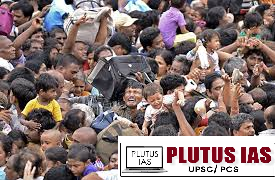
What is a Stampede?
A stampede (crowd crush, crowd surge, or crowd turbulence) occurs when excessive crowd density leads to loss of movement control. Research shows that when density crosses 6–7 persons per square meter, individuals lose autonomy, causing domino-like falls, compressive asphyxia, and trampling deaths. The WHO notes that 90% of stampede deaths are due to suffocation and chest compression, not physical trampling.
Stampede as a Disaster
- Under the Disaster Management Act, 2005, stampedes are classified as “man-made disasters”.
- Unlike floods or earthquakes, they arise from human negligence, poor planning, and mismanagement.
- Yet, stampedes often receive less policy priority compared to natural disasters.
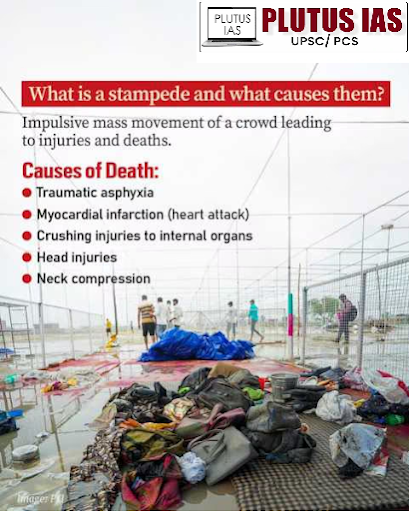
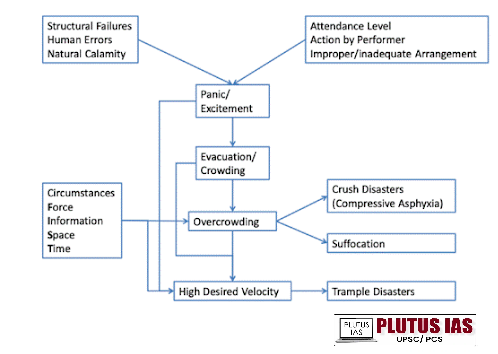
Causes of Stampedes
1. Structural / Administrative Failures
-Lack of site surveys and safety audits before event approval
-Poorly designed venues with narrow entry/exit points
-Inadequate medical facilities and emergency response teams
2. Overcrowding
-No cap on numbers; organizers encourage mass mobilization
-Absence of ticketing/pass systems even in political/religious events
3. Security & Policing Gaps
-Low police-to-crowd ratio (India has ~150 police personnel per lakh population vs UN norm of 222)
-No training in crowd control or disaster response
4. Behavioral Triggers
-Panic due to rumours, fire, or sudden noise
-Over-enthusiasm: rushing to see a celebrity, leader, or deity
-Fatigue, hunger, or heat stress among waiting crowds
5. Delayed or Mismanaged Schedules
-Karur example: Long waiting hours, leader’s delayed arrival, surge upon entry
-Ratangarh (2013): panic due to false rumours
Constitutional & Legal Provisions
- Article 21: Right to life → includes right to safe participation in public gatherings.
- Disaster Management Act, 2005: Covers stampedes as man-made disasters; mandates planning, preparedness, response.
- Indian Penal Code (IPC):
-Section 304A: Causing death by negligence
-Sections 336, 337, 338: Acts endangering life or causing grievous hurt - Supreme Court Directives:
-In Union of India vs State of Gujarat (2012), SC directed states to ensure proper safety measures at religious sites. Called for Standard Operating Procedures (SOPs) for crowd control. - NDMA Guidelines (2014): Laid down protocols for crowd density monitoring, evacuation drills, coordination between organizers & police.
- State Disaster Management Authorities: Expected to regulate permissions for large gatherings, though implementation remains weak.
Challenges in Addressing Stampedes
1. Implementation Deficit: NDMA guidelines exist but are rarely enforced.
2. Political & Religious Pressure: Organisers focus on crowd size as prestige over safety.
3. Weak Coordination: No seamless link between police, local bodies, health services, and organisers.
4. Infrastructural Shortcomings:
-Lack of emergency exits, barricades, signage
-Poor lighting, inadequate first-aid posts
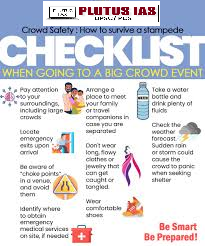
5. Public Awareness: Attendees rarely know safe behaviour in large gatherings (e.g., avoiding pushing, staying calm).
6. Data Deficit: No central database of stampede deaths in India.
-NCRB records stampedes under “other accidents,” making policy targeting difficult.
Way Forward
1. Policy Reforms:
-Mandatory safety audits before granting permissions for gatherings >5,000 people.
-Legal liability fixed on organizers, political parties, and religious trusts for negligence.
2. Technological Integration:
-Drones, AI, CCTV to monitor crowd density in real-time.
-Mobile apps/QR passes to track entry numbers and regulate flows.
3. Infrastructure & Logistics:
-Wider entry/exit routes, one-way flow systems.
-Emergency evacuation routes with visible signage.
-Mobile medical units and ambulances stationed nearby.
4. Capacity Building:
-Police and volunteers trained in psychology of crowds, evacuation drills.
-Mock drills before major events.
5. Public Awareness:
-Campaigns on safe behavior in crowds (like Japan’s crowd-safety drills).
-Announcements during events about exits and emergency protocols.
Conclusion
The Karur stampede of 2025 is not an isolated tragedy but part of a disturbing pattern in India’s event management culture. Repeated loss of life highlights systemic negligence rather than rare accidents.
As India hosts increasingly large religious, political, and cultural gatherings, crowd safety must be treated as a core governance priority.
The right to life under Article 21 is meaningless unless public spaces are made safe and secure. With planning, accountability, technology, and public awareness, stampedes can be made a thing of the past rather than a recurring headline.
Prelims Question
Q. The term “Compressive Asphyxia”, often reported in the context of stampedes, refers to:
a) Death caused due to heart attack from overexcitement in large gatherings.
b) Inability to breathe due to chest compression when the crowd density is very high.
c) Death caused by being trampled underfoot in uncontrolled crowds.
d) Suffocation due to smoke inhalation during fires at mass gatherings.
ANSWER: B
Mains Question
Q. Stampedes during religious, cultural, and political gatherings are recurrent in India. Examine the socio-cultural and behavioral factors that make large crowds vulnerable to such disasters. (250 words)

- Elderly in India: Population, Challenges, and Government Initiatives - October 29, 2025
- Jal Jeevan Mission (JJM): Ensuring Tap Water to Every Rural Household - October 27, 2025
- National Blockchain Framework: Strengthening Governance through Blockchain Technology - October 25, 2025

No Comments