


08 Aug Startup India Seed Fund Scheme: A Game-Changer for Young Entrepreneurs in India
✎ The Startup India Seed Fund Scheme (SISFS) provides up to ₹50 lakh in collateral-free funding to DPIIT-recognised startups within two years of incorporation, enabling rapid commercialisation of innovations.
Subject Relevance — Where This Topic Fits
- GS Paper III — Economy: Start-up Ecosystem, Government Schemes, Financial Inclusion
- Prelims: Startup India Seed Fund Scheme (SISFS), Startup India initiative, collateral-free loans, CII, CUTM, MedTech Zone, Banking Regulation Act, 1949 (Section 18 for collateral requirements), NITI Aayog
- Essay: The role of government schemes in fostering innovation and entrepreneurship in India, Youth as the vanguard of India’s economic transformation
Quick Revision: The Startup India Seed Fund Scheme (SISFS) provides up to ₹50 lakh in collateral-free funding to DPIIT-recognised startups within two years of incorporation, enabling rapid commercialisation of innovations.
Why is this in the news?
The Chairman of the Confederation of Indian Industry (CII), Visakhapatnam, highlighted the Startup India Seed Fund Scheme (SISFS) as a transformative initiative for young entrepreneurs during the inauguration of the ‘Vikasit Bharat-Human Capital Conclave’ at Centurion University of Technology and Management.
Background
- The Startup India initiative was launched by the Government of India in 2016 to foster innovation, drive economic growth, and generate employment by supporting startups across sectors.
- The Startup India Seed Fund Scheme (SISFS), operationalised in 2021, aims to provide financial assistance to early-stage startups for proof-of-concept, prototype development, product trials, market entry, and commercialisation.
- The scheme is implemented by the Department for Promotion of Industry and Internal Trade (DPIIT) under the Ministry of Commerce and Industry, with a corpus of ₹945 crore allocated for the period 2021–2025.
- CII, as a premier industry body, regularly engages with government policies to advocate for conducive business environments and skill development initiatives.
- Centurion University of Technology and Management (CUTM) in Vizianagaram is a private university focused on skill-based education and entrepreneurship, aligning with the scheme’s objectives.
- The MedTech Zone in Andhra Pradesh is a dedicated facility for medical technology innovation, reflecting the government’s emphasis on sector-specific startup ecosystems.
What is the Startup India Seed Fund Scheme (SISFS)?
- Objective: To provide financial support to early-stage startups for ideation, proof-of-concept, prototype development, product trials, market entry, and commercialisation.
- Eligibility: Startups recognised by DPIIT, incorporated not more than two years ago, and with a viable business idea or innovation in technology or intellectual property.
- Funding Mechanism: Grants up to ₹20 lakh for proof-of-concept or prototype development, and up to ₹50 lakh for market entry, product trials, or scaling operations.
- Collateral-Free Loans: Facilitates access to bank credit without the requirement of collateral security, reducing financial barriers for young entrepreneurs.
- Implementation: Administered through the State/UT nodal agencies, incubators, and accelerators, with a transparent selection process based on innovation potential.
- Impact: Aims to bridge the funding gap for early-stage startups, fostering a culture of innovation and reducing dependence on external investors.
- Alignment with Startup India: Complements other initiatives such as Startup India Hub, Startup India International Summit, and Atal Innovation Mission.
- Monitoring and Evaluation: Regular reviews by DPIIT to ensure efficient utilisation of funds and measurable outcomes in terms of job creation and economic growth.
Key Features
| Feature | Significance |
|---|---|
| Startup India Seed Fund Scheme (SISFS) | Provides financial assistance (up to ₹20 lakh for proof of concept and ₹50 lakh for early-stage startups) to young entrepreneurs, reducing the initial capital burden and fostering innovation-driven enterprises. |
| Collateral-free bank loans | Facilitates access to credit for first-time entrepreneurs by eliminating the requirement for tangible security, thereby lowering entry barriers to formal finance. |
| Integration with academic institutions | Leverages Centurion University’s conclave to align skill development with emerging technological trends, ensuring graduates are industry-ready. |
| Focus on human capital development | Emphasises upskilling through structured programmes, addressing the mismatch between academic curricula and industry demands in dynamic sectors like medtech and biotechnology. |
| Public-private partnership model | Encourages collaboration between government initiatives (SISFS), corporate entities (Apitoria Pharma), and educational institutions to create an ecosystem conducive to startups. |
Why it Matters
Economic Growth
- Stimulates job creation by supporting scalable startups, particularly in high-growth sectors such as pharmaceuticals and medtech.
- Enhances India’s position as a global startup hub by reducing financial constraints for young innovators.
- Promotes indigenous R&D through seed funding, reducing reliance on foreign capital for early-stage ventures.
Social Equity
- Bridges the urban-rural divide by enabling aspiring entrepreneurs from Tier-II/III cities to access funding and mentorship.
- Empowers women and marginalised communities by lowering financial barriers to entrepreneurship.
Educational Reforms
- Accelerates the integration of industry-relevant skills into academic curricula, aligning with the National Education Policy (NEP) 2020’s emphasis on vocational training.
- Encourages universities to adopt outcome-based education, fostering a culture of innovation among students.
Strategic Autonomy
- Reduces dependence on imported technologies by funding startups in critical sectors like pharmaceuticals and medtech.
- Strengthens India’s supply chain resilience through localised innovation in high-tech industries.
Challenges
1. Implementation Gaps
- Delayed disbursement of funds due to bureaucratic hurdles, which may discourage early-stage entrepreneurs from applying.
- Lack of awareness among potential beneficiaries, particularly in rural and semi-urban areas, limiting the scheme’s reach.
UPSC Link: GS3: Startup ecosystem in India
2. Skill Mismatch
- Academic curricula often lag behind technological advancements, resulting in graduates lacking industry-relevant skills.
- Limited industry-academia collaboration restricts the practical application of theoretical knowledge.
UPSC Link: GS2: Education system reforms
3. Access to Mentorship
- Insufficient structured mentorship programmes for seed-funded startups, increasing the risk of failure due to lack of guidance.
- Over-reliance on informal networks, which may not be accessible to all aspiring entrepreneurs.
UPSC Link: GS3: Startup ecosystem in India
4. Regulatory Hurdles
- Complex compliance requirements for startups, including tax filings and labour laws, which can deter young entrepreneurs.
- Inconsistent interpretation of regulations across states creates operational challenges for multi-location startups.
UPSC Link: GS2: Ease of doing business
5. Funding Sustainability
- Limited follow-on funding options for startups post-seed stage, leading to premature stagnation.
- Dependence on government schemes may not be sustainable in the long term without private sector participation.
UPSC Link: GS3: Startup ecosystem in India
Challenges — UPSC Perspective
| Issue | Concern |
|---|---|
| Awareness deficit | Low penetration of SISFS in Tier-II/III cities and rural areas due to inadequate outreach programmes. |
| Bureaucratic delays | Slow processing of applications and disbursements under SISFS, discouraging timely utilisation of funds. |
| Curriculum rigidity | Static academic syllabi in universities fail to incorporate emerging technologies like AI, IoT, and biotechnology. |
| Mentorship scarcity | Limited availability of industry experts to guide seed-funded startups, increasing failure rates. |
| Regulatory fragmentation | Divergent state-level policies on startups create compliance burdens for multi-state operations. |
| Follow-on funding gap | Insufficient private and venture capital support for startups after the seed stage. |
Government Initiatives — Must-Memorise for Prelims
- Startup India Seed Fund Scheme (SISFS)
- Atal Innovation Mission (AIM)
- Skill India Mission
Way Forward
- Strengthen outreach programmes to enhance awareness of SISFS among aspiring entrepreneurs, particularly in rural and semi-urban regions.
- Streamline the disbursement process under SISFS by leveraging digital platforms and reducing bureaucratic interference.
- Revise university curricula to include modular courses on emerging technologies, in collaboration with industry partners.
- Establish structured mentorship networks connecting seed-funded startups with industry experts and successful entrepreneurs.
- Simplify regulatory compliance for startups by introducing a unified portal for registrations and filings.
- Encourage private sector participation in follow-on funding through tax incentives and public-private partnerships.
- Promote state-level uniformity in startup policies to reduce operational complexities for multi-location ventures.
- Integrate SISFS with academic institutions to create incubation centres, fostering a culture of innovation from the grassroots.
UPSC Value Addition
Keywords for Mains Answer-Writing
Startup India Seed Fund Scheme (SISFS) · Ministry of Commerce and Industry · collateral-free funding for startups · entrepreneurship development · innovation ecosystem · skill development in higher education · technology adaptation in curricula · Centurion University of Technology and Management · Confederation of Indian Industry (CII) · Vizianagaram startup ecosystem
Concept Flow
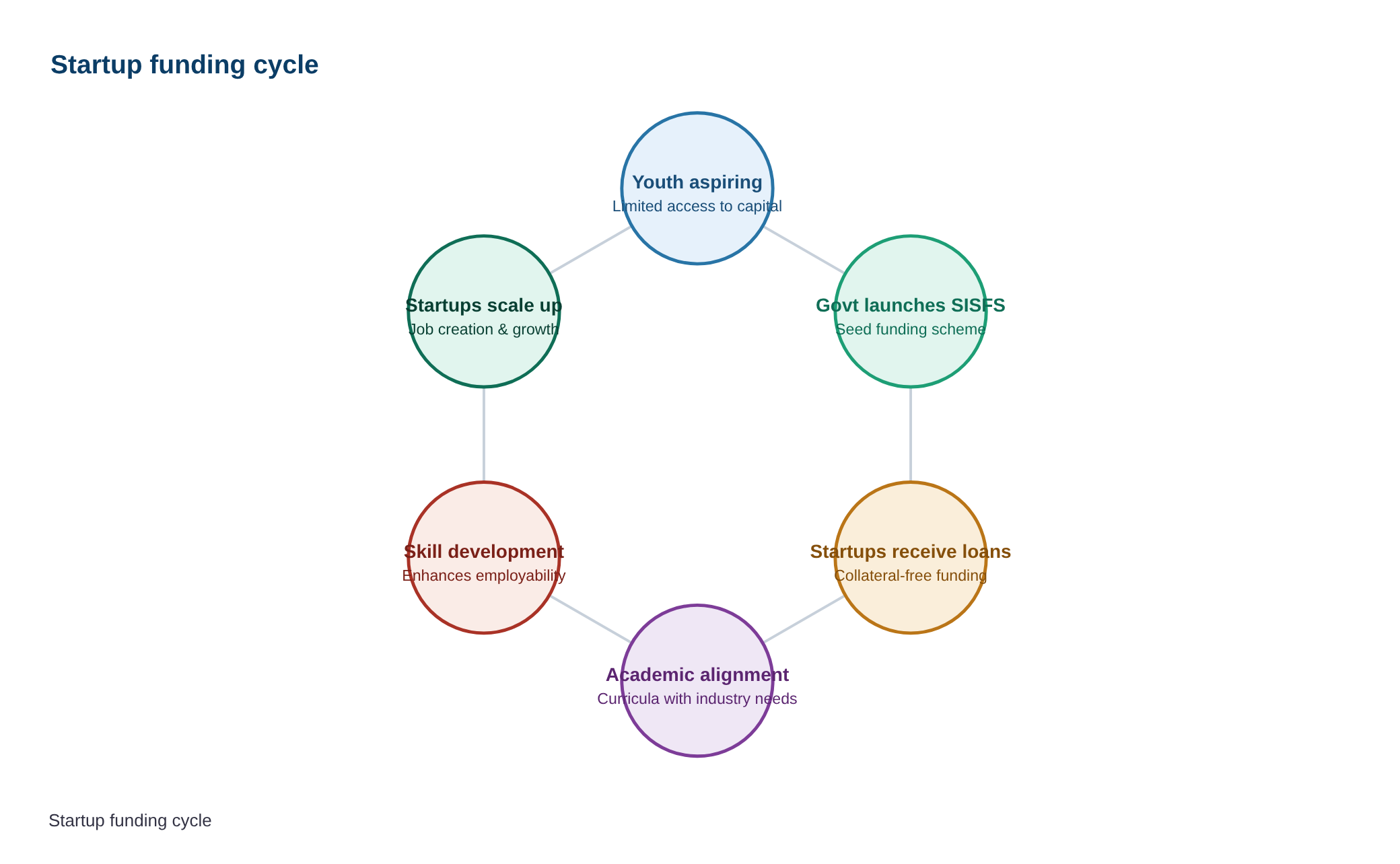
Youth aspiring for entrepreneurship → Limited access to initial capital → Government launches SISFS to provide seed funding → Startups receive collateral-free loans → Academic institutions align curricula with industry needs → Skill development enhances employability and innovation → Startups scale up, creating jobs and driving economic growth → Reinvestment in R&D and further entrepreneurial ventures.
Prelims Practice Questions
Q1. Consider the following statements regarding the Startup India Seed Fund Scheme (SISFS):
1. It is administered by the Ministry of Commerce and Industry.
2. It provides collateral-free funding to eligible startups.
3. The scheme is exclusively for startups in the IT sector.
4. Academic institutions are not eligible to receive funds under this scheme.
How many of the above statements are correct?
- Only one
- Only two
- Only three
- All
Answer: Only three — Statements 1 and 2 are correct. SISFS is administered by the Department for Promotion of Industry and Internal Trade (DPIIT) under the Ministry of Commerce and Industry and provides collateral-free funding. Statement 3 is incorrect as the scheme supports startups across sectors, not exclusively IT. Statement 4 is incorrect as academic incubators are eligible to receive funds.
Q2. Assertion (A): The Startup India Seed Fund Scheme aims to reduce the reliance of startups on external funding sources.
Reason (R): The scheme provides seed funding to startups, thereby reducing their initial capital requirements.
Options:
A. Both A and R are true, and R is the correct explanation of A.
B. Both A and R are true, but R is not the correct explanation of A.
C. A is true, but R is false.
D. A is false, but R is true.
- A
- B
- C
- D
Answer: A — Both the assertion and reason are true. The SISFS provides seed funding to startups, which reduces their initial capital requirements and decreases their reliance on external funding sources. The reason correctly explains the assertion.
Q3. Match the following initiatives with their respective ministries/departments:
Initiative
1. Startup India Seed Fund Scheme
2. Skill India Mission
3. Atal Innovation Mission
4. Make in India
Ministry/Department
A. Ministry of Skill Development and Entrepreneurship
B. NITI Aayog
C. Ministry of Commerce and Industry
D. Ministry of Electronics and Information Technology
Options:
1. 1-A, 2-B, 3-C, 4-D
2. 1-C, 2-A, 3-B, 4-D
3. 1-B, 2-A, 3-D, 4-C
4. 1-D, 2-B, 3-A, 4-C
- 1
- 2
- 3
- 4
Answer: 2 — Startup India Seed Fund Scheme is administered by the Ministry of Commerce and Industry (1-C). Skill India Mission is under the Ministry of Skill Development and Entrepreneurship (2-A). Atal Innovation Mission is under NITI Aayog (3-B). Make in India is under the Ministry of Commerce and Industry (4-D).
Mains Practice Question
✍ The Startup India Seed Fund Scheme (SISFS) is often hailed as a transformative initiative for fostering entrepreneurship among youth in India. Critically examine its objectives, operational mechanisms, and the challenges it faces in achieving its goals. Also, assess its potential to bridge the gap between academia and industry. (15 Marks)
Approach: MODEL-ANSWER SKELETON:
1. **Objectives of SISFS (3 points)**:
– Provide financial assistance to startups for proof of concept, prototype development, product trials, and market entry.
– Reduce dependence on external funding by offering early-stage capital.
– Foster innovation and entrepreneurship among youth, aligning with the ‘Viksit Bharat’ vision.
2. **Operational Mechanisms (4 points)**:
– Administered by the Department for Promotion of Industry and Internal Trade (DPIIT), Ministry of Commerce and Industry.
– Funds are disbursed through selected incubators and accelerators, ensuring targeted support.
– Collateral-free funding up to ₹20 lakh for proof of concept and ₹50 lakh for scaling up.
– Focus on startups recognized by DPIIT, ensuring credibility and compliance.
3. **Challenges (4 points)**:
– **Awareness and Accessibility**: Limited reach in tier-2 and tier-3 cities, with a concentration in metropolitan areas.
– **Bureaucratic Delays**: Slow disbursement of funds due to procedural hurdles and stringent eligibility criteria.
– **Sectoral Bias**: Overemphasis on tech-driven startups, sidelining traditional and grassroots innovations.
– **Monitoring and Evaluation**: Lack of robust mechanisms to track the impact and sustainability of funded startups.
4. **Bridging Academia-Industry Gap (4 points)**:
– **Skill Development**: Encourages universities to revise curricula to include entrepreneurship and technology adaptation (e.g., Centurion University’s initiatives).
– **Incubation Hubs**: Establishes linkages between academic institutions and industry through incubators, fostering collaborative research and innovation.
– **Real-World Exposure**: Provides students with hands-on experience in startups, bridging the theory-practice divide.
– **Policy Synergy**: Aligns with the National Education Policy (NEP) 2020’s emphasis on skill development and entrepreneurship.
5. **Conclusion (1 point)**:
– While SISFS is a commendable step toward fostering entrepreneurship, its success hinges on addressing accessibility, bureaucratic inefficiencies, and sectoral inclusivity. Strengthening academia-industry linkages will ensure a sustainable innovation ecosystem.
Source: The Hindu
Generated by AanyaAi for educational purpose.

- KWML’s Feasibility Reports for Water Metro in 18 Cities: UPSC & PCS Insights - October 3, 2026
- ओडिशा में वन्यजीव अनुसंधान अनुदान कार्यक्रम शुरू, सिमिलिपाल में 300 कैमरे और बढ़ेंगे - October 3, 2026
- India Summons Pakistan High Commission Official Over Violation - October 3, 2026

No Comments