


09 Aug Supreme Court Considers Transferring Tamil Nadu DVAC Case Against ED Officer to CBI
Supreme CourtEnforcement DirectorateDVAC caseCBI transferCentral agency✎ The Supreme Court’s deliberation on transferring a Tamil Nadu DVAC case against an ED officer to a central agency underscores the need to balance federal autonomy with institutional accountability in corruption investigations…
Subject Relevance — Where This Topic Fits
- GS Paper II — Functions and responsibilities of the Union and the States, issues and challenges pertaining to the federal structure, devolution of powers | GS Paper III — Challenges to internal security through communication networks, role of institutions like CBI and ED in combating corruption
- Prelims: Enforcement Directorate (ED), Directorate of Vigilance and Anti-Corruption (DVAC), Central Bureau of Investigation (CBI), Prevention of Corruption Act, 1988, Code of Criminal Procedure (CrPC), 1973, Lokpal and Lokayukta Act, 2013, federal structure, concurrent list, Union List, State List, bribery, money laundering, Section 17A of Prevention of Corruption Act
- Essay: Federalism in India: Balancing autonomy and accountability in corruption investigations, The role of investigative agencies in preserving institutional integrity and public trust
Quick Revision: The Supreme Court’s deliberation on transferring a Tamil Nadu DVAC case against an ED officer to a central agency underscores the need to balance federal autonomy with institutional accountability in corruption investigations, particularly when central government employees are involved.
Why is this in the news?
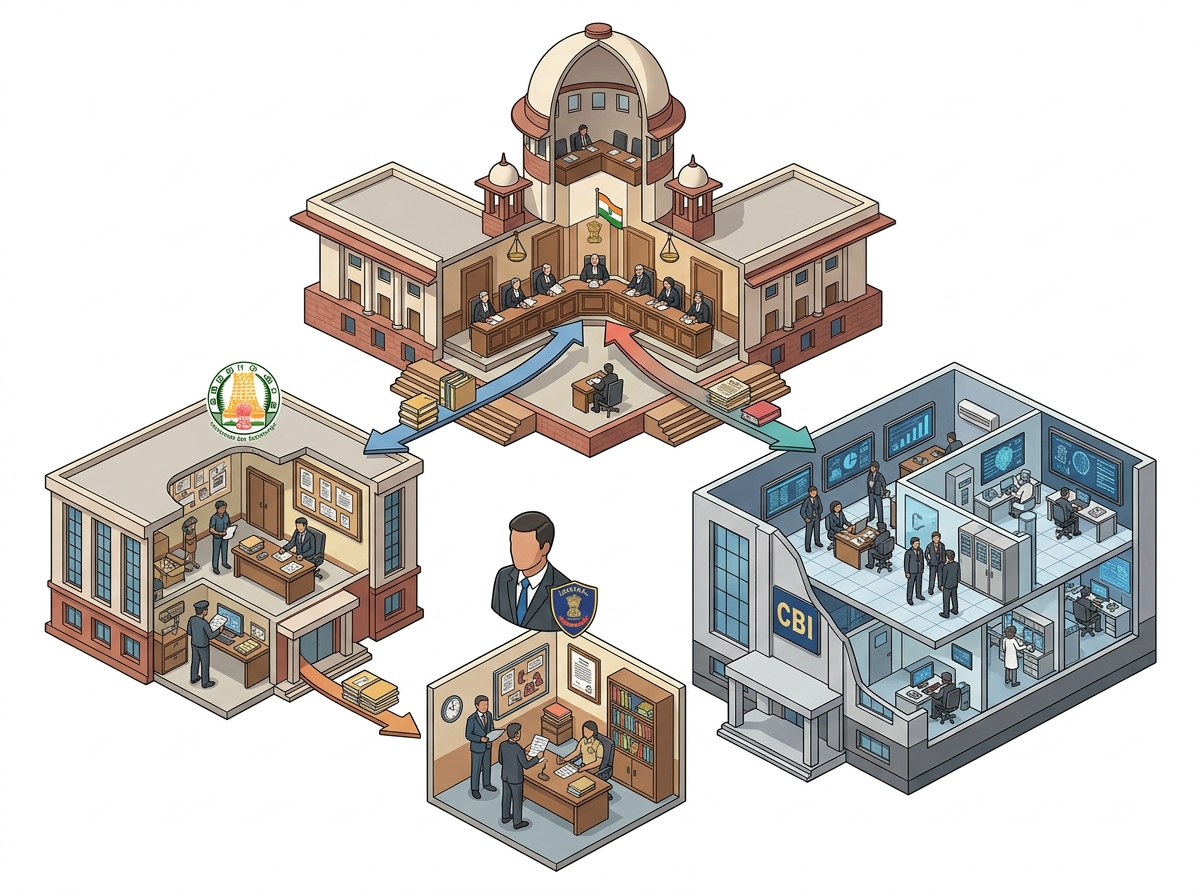
The Supreme Court is currently examining a plea by the Enforcement Directorate (ED) to transfer a corruption case against one of its officers, Ankit Tiwari, from the Tamil Nadu Directorate of Vigilance and Anti-Corruption (DVAC) to a central agency such as the CBI. The case involves allegations of bribery against Tiwari, a Central government employee, which the ED argues should be investigated by a central agency due to the officer’s status and the potential for political vendetta. The apex court’s deliberations highlight the broader tensions between central and state investigative agencies, particularly in cases involving officers of central agencies operating within state jurisdictions.
Background
- The ED argued that the DVAC’s actions were retaliatory, stemming from the central agency’s aggressive enforcement of money laundering cases and raids against politicians and former ministers in Tamil Nadu.
- The Supreme Court had earlier stayed the DVAC proceedings in January 2024.
- The case raises questions about the appropriate agency for investigating offenses committed by central government employees, particularly when such offenses occur within state jurisdictions.
- The apex court has also proposed examining whether political vendetta or institutional rivalry is influencing the actions of both central and state agencies, underscoring the need for a mechanism to screen such motivations.
Key aspects of the jurisdictional conflict in corruption investigations involving central and state agencies
- The **Enforcement Directorate (ED)** is a central agency under the Department of Revenue, Ministry of Finance, tasked with enforcing the provisions of the **Foreign Exchange Management Act (FEMA), 1999** and the **Prevention of Money Laundering Act (PMLA), 2002**. It operates under the Union government but conducts investigations across states.
- The **Directorate of Vigilance and Anti-Corruption (DVAC)** is a state-level agency in Tamil Nadu responsible for investigating corruption cases involving state government officials and other individuals within the state’s jurisdiction. Its mandate is derived from state laws and the Constitution’s **Schedule VII (State List)**.
- The **Central Bureau of Investigation (CBI)** is a central agency that investigates serious crimes, including corruption, and operates under the Union government. Its jurisdiction is derived from the **Delhi Special Police Establishment Act, 1946**, which allows it to investigate cases in states only with the consent of the state government or under specific conditions.
- The **Prevention of Corruption Act, 1988** governs offenses of corruption in India. **Section 17A** of the Act, introduced in 2018, mandates prior sanction from the competent authority before investigating or prosecuting a public servant for offenses committed during the discharge of official duties. This provision has been a subject of debate regarding its impact on the autonomy of investigative agencies.
- The **Code of Criminal Procedure (CrPC), 1973** outlines the procedural framework for criminal investigations and trials in India. **Section 220** allows for the transfer of cases from one court to another, while **Section 406** permits the Supreme Court to transfer cases from one state to another in the interest of justice.
- The **Lokpal and Lokayukta Act, 2013** established the Lokpal at the central level and Lokayuktas at the state level to investigate allegations of corruption against public functionaries. However, these bodies have limited investigative powers compared to agencies like the CBI or DVAC.
Key Features
| Feature | Significance |
|---|---|
| Transfer of DVAC case to Central agency | Ensures impartial investigation, mitigates perceived bias in State-led probes against Central officials. |
| Supreme Court’s refusal to lift stay on proceedings | Maintains legal scrutiny while allowing broader constitutional questions to be examined. |
| ED’s argument of ‘political vendetta’ | Highlights inter-governmental friction in federal investigations, particularly in Opposition-ruled States. |
| Allegation of bribery against ED officer | Demonstrates systemic risks of corruption within enforcement agencies, necessitating robust oversight. |
| Proposed mechanism to screen political motivations | Aims to prevent misuse of investigative agencies for partisan purposes, preserving institutional integrity. |
Why it Matters
Constitutional and Federal Implications
- The case underscores tensions between Union and State governments in investigative autonomy, particularly under Article 256 and 257 of the Constitution.
- The Supreme Court’s intervention reflects its role as the guardian of federal balance, ensuring no agency acts beyond its constitutional mandate.
- The issue of ‘political vendetta’ introduces the concept of ‘cooperative federalism’ versus ‘adversarial federalism’ in governance.
- The case raises questions about the jurisdiction of Central agencies in States where political opposition exists, testing the limits of Article 355 (duty of Union to protect States).
Institutional Integrity and Accountability
- The alleged bribery by an ED officer highlights systemic vulnerabilities in enforcement agencies, necessitating stricter internal oversight mechanisms.
- The case exemplifies the need for transparent, independent probes to maintain public trust in investigative bodies like the ED and DVAC.
- The Supreme Court’s scrutiny of motives behind agency actions reinforces the principle of ‘rule of law’ over ‘rule by agency’.
- The refusal to lift the stay on proceedings signals judicial caution in balancing investigative autonomy with judicial oversight.
Economic and Governance Impact
- Corruption within enforcement agencies undermines economic governance, particularly in sectors like healthcare where bribery allegations arise.
- Prolonged legal uncertainty in such cases can deter foreign and domestic investment due to perceived instability in regulatory enforcement.
- The case may influence future Centre-State collaborations in tackling economic offences, particularly money laundering and corruption.
- A precedent set here could redefine the operational boundaries of Central agencies in State jurisdictions, impacting governance efficiency.
Challenges
1. Federalism and Agency Jurisdiction
- Determining whether a Central government employee’s offence should be investigated by a State agency or a Central agency remains unresolved.
- The risk of ‘political vendetta’ in agency actions threatens the impartiality of investigations, particularly in Opposition-ruled States.
- Lack of a clear constitutional or statutory framework to resolve inter-agency disputes over jurisdiction in corruption cases.
- Potential erosion of public trust in investigative agencies if perceived as tools for partisan agendas rather than impartial enforcement.
UPSC Link: GS-II: Federalism, Centre-State Relations
2. Institutional Corruption and Oversight
- Allegations of bribery within the ED highlight systemic failures in internal accountability mechanisms.
- Ensuring transparency in agency operations while maintaining operational secrecy to prevent leaks that could compromise investigations.
- Balancing judicial oversight with operational independence of investigative agencies to prevent undue interference.
- Addressing the perception of bias in agency actions, particularly when targeting political opponents or allies.
UPSC Link: GS-II: Transparency & Accountability in Governance
3. Legal and Procedural Delays
- Prolonged judicial scrutiny can lead to delays in justice delivery, eroding public confidence in the legal system.
- The stay on proceedings since January 2024 exemplifies how legal technicalities can stall substantive justice.
- Ensuring timely resolution of such cases to prevent misuse of legal processes for political or personal gains.
- Developing expedited mechanisms for cases involving high-ranking officials to avoid prolonged uncertainty.
UPSC Link: GS-II: Judiciary and Judicial Reforms
Challenges — UPSC Perspective
| Issue | Concern |
|---|---|
| Federal jurisdiction disputes | Lack of clear constitutional provisions to resolve Centre-State agency conflicts in corruption cases. |
| Perceived political bias in investigations | Risk of investigative agencies being weaponised for partisan purposes, undermining democratic institutions. |
| Systemic corruption within enforcement agencies | Corruption allegations against ED officers threaten the credibility of anti-corruption drives. |
| Judicial delays in high-profile cases | Prolonged stays on proceedings can lead to erosion of public trust and delayed justice. |
| Operational secrecy vs. transparency | Balancing the need for secrecy in investigations with demands for transparency to prevent misuse. |
| Inter-agency rivalry and coordination gaps | Lack of structured mechanisms for Centre-State agencies to collaborate effectively in complex cases. |
Way Forward
- The Supreme Court should expedite the formulation of a clear constitutional or statutory framework to delineate the jurisdiction of Central and State agencies in corruption cases involving Central government employees.
- Parliament should consider enacting a ‘Federal Investigative Agencies Act’ to define the roles, powers, and accountability mechanisms of agencies like the CBI, ED, and DVAC in cross-jurisdictional cases.
- Strengthen internal oversight mechanisms within the ED and other enforcement agencies to prevent systemic corruption, including mandatory whistleblower protections and independent audit committees.
- Establish a neutral, multi-member panel comprising retired judges, bureaucrats, and civil society representatives to review cases where political vendetta is alleged, ensuring impartial scrutiny.
- Promote inter-agency coordination through formalised protocols for information-sharing and joint investigations, reducing rivalry and improving efficiency.
- The Union Government and State Governments should engage in structured dialogue to resolve Centre-State disputes over investigative autonomy, possibly through the Inter-State Council.
- Encourage the judiciary to adopt time-bound frameworks for high-profile cases involving constitutional or federal disputes to prevent undue delays.
- Enhance public awareness campaigns to educate citizens on the roles and limitations of investigative agencies, fostering trust in their operations.
UPSC Value Addition
Keywords for Mains Answer-Writing
Supreme Court · DVAC · Enforcement Directorate · Central Bureau of Investigation · federalism in India · corruption investigation · CBI autonomy · jurisdictional conflict · money laundering · bribery cases · Centre-State relations · judicial intervention · independent probe agencies · political vendetta · money laundering cases
Constitutional & Policy Linkages
- Article 256: Duty of States to comply with Union laws and directions.
- Article 257: Control of Union over States in certain cases.
- Article 355: Duty of Union to protect States against external aggression and internal disturbance.
- Article 356: Provisions in case of failure of constitutional machinery in States (relevant for political interference concerns).
Concept Flow
Allegation of bribery by ED officer → DVAC initiates probe → ED argues political vendetta and seeks case transfer → Supreme Court stays proceedings → ED petitions for transfer to CBI → Supreme Court examines federal jurisdiction and motives → Broader debate on Centre-State agency autonomy → Potential constitutional framework for resolving such disputes.
Prelims Practice Questions
Q1. Consider the following statements regarding the Directorate of Vigilance and Anti-Corruption (DVAC) in India:
1. DVAC is a state-level anti-corruption agency established under the provisions of the Prevention of Corruption Act, 1988.
2. The DVAC operates under the administrative control of the State Government and reports to the State Vigilance Commission.
3. The Supreme Court has the power to transfer cases from DVAC to the Central Bureau of Investigation (CBI) under Article 136 of the Constitution of India.
How many of the above statements are correct?
- Only one
- Only two
- All
- None
Answer: All — Statements 1 and 2 are correct as DVAC is a state-level agency under the State Government and operates under the State Vigilance Commission. Statement 3 is incorrect because the Supreme Court’s power to transfer cases is not specifically under Article 136 but under its inherent jurisdiction to ensure justice.
Q2. Assertion (A): The Enforcement Directorate (ED) is a statutory body under the Ministry of Finance, Government of India.
Reason (R): The ED was established under the provisions of the Prevention of Money Laundering Act, 2002, and is headed by a Director who is appointed by the Central Government.
- Both A and R are true, and R is the correct explanation of A
- Both A and R are true, but R is not the correct explanation of A
- A is true, but R is false
- A is false, but R is true
Answer: Both A and R are true, but R is not the correct explanation of A — The ED is indeed a statutory body under the Ministry of Finance, established under the PMLA, 2002, and its Director is appointed by the Central Government. Thus, both the assertion and reason are true, and the reason correctly explains the assertion.
Q3. Match the following agencies with their respective jurisdictions:
| Column I (Agency) | Column II (Jurisdiction) |
|———————————|———————————————|
| 1. Directorate of Vigilance and Anti-Corruption (DVAC) | A. Central Government employees and cases involving Union subjects |
| 2. Central Bureau of Investigation (CBI) | B. State-level anti-corruption cases |
| 3. Enforcement Directorate (ED) | C. Economic offences and money laundering |
| 4. Lokpal | D. Anti-corruption in public servants |
Select the correct match:
- 1-B, 2-A, 3-C, 4-D
- 1-A, 2-B, 3-C, 4-D
- 1-D, 2-C, 3-B, 4-A
- 1-C, 2-D, 3-A, 4-B
Answer: 1-B, 2-A, 3-C, 4-D — The correct matches are: DVAC (B) for state-level anti-corruption cases, CBI (A) for cases involving central government employees and union subjects, ED (C) for economic offences and money laundering, and Lokpal (D) for anti-corruption in public servants.
Mains Practice Question
✍ The Supreme Court’s consideration of transferring a bribery case against an Enforcement Directorate (ED) officer from the Tamil Nadu Directorate of Vigilance and Anti-Corruption (DVAC) to a Central agency underscores the persistent tension between federalism and institutional autonomy in India’s anti-corruption framework. Critically analyse the constitutional and institutional dimensions of this issue. Also, examine the implications of such transfers on the federal structure of governance. (15 Marks)
Approach: MODEL-ANSWER SKELETON:
I. Constitutional and Institutional Framework:
– Federalism in India: Distribution of powers between Centre and States under the Seventh Schedule (State List Entry 1, 2, and 8).
– Articles 245–255: Legislative and executive relations; doctrine of pith and substance.
– Article 355: Duty of the Union to protect States against external aggression and internal disturbance.
– Role of anti-corruption agencies: DVAC as a state agency under the State Vigilance Commission; CBI as a central agency under the Delhi Special Police Establishment Act, 1946.
– Supreme Court’s jurisdiction: Article 136 (special leave to appeal) and inherent powers to ensure justice.
II. Institutional Autonomy and Conflicts:
– Autonomy of ED: Statutory body under PMLA, 2002; operational independence vs. Centre’s control.
– Allegations of political vendetta: Centre-State tensions in Opposition-ruled States (e.g., Tamil Nadu); ED’s role in registering cases against politicians.
– Judicial precedents: Vineet Narain v. Union of India (1998) on CBI autonomy; State of West Bengal v. Committee for Protection of Democratic Rights (2010) on federalism.
III. Implications of Transfers:
– Federalism: Centralisation vs. State autonomy; erosion of State’s investigative powers.
– Institutional integrity: Need for independent probes free from political interference.
– Judicial role: Balancing Centre-State relations with the need for impartial justice.
– Consequences: Potential misuse of central agencies for political purposes; impact on public trust.
IV. Balanced View and Way Forward:
– Need for a mechanism to screen allegations of political vendetta (e.g., independent oversight body).
– Strengthening State-level agencies with adequate resources and autonomy.
– Role of the Supreme Court in defining clear guidelines for such transfers.
V. Conclusion:
– Reiterate the need to balance federalism, institutional autonomy, and judicial oversight while addressing corruption.
Source: The Hindu
Generated by AanyaAi for educational purpose.

- KWML’s Feasibility Reports for Water Metro in 18 Cities: UPSC & PCS Insights - October 3, 2026
- ओडिशा में वन्यजीव अनुसंधान अनुदान कार्यक्रम शुरू, सिमिलिपाल में 300 कैमरे और बढ़ेंगे - October 3, 2026
- India Summons Pakistan High Commission Official Over Violation - October 3, 2026

No Comments