


28 Jul Supreme Court Directs Speedy Probe into Ram Temple Donation Case
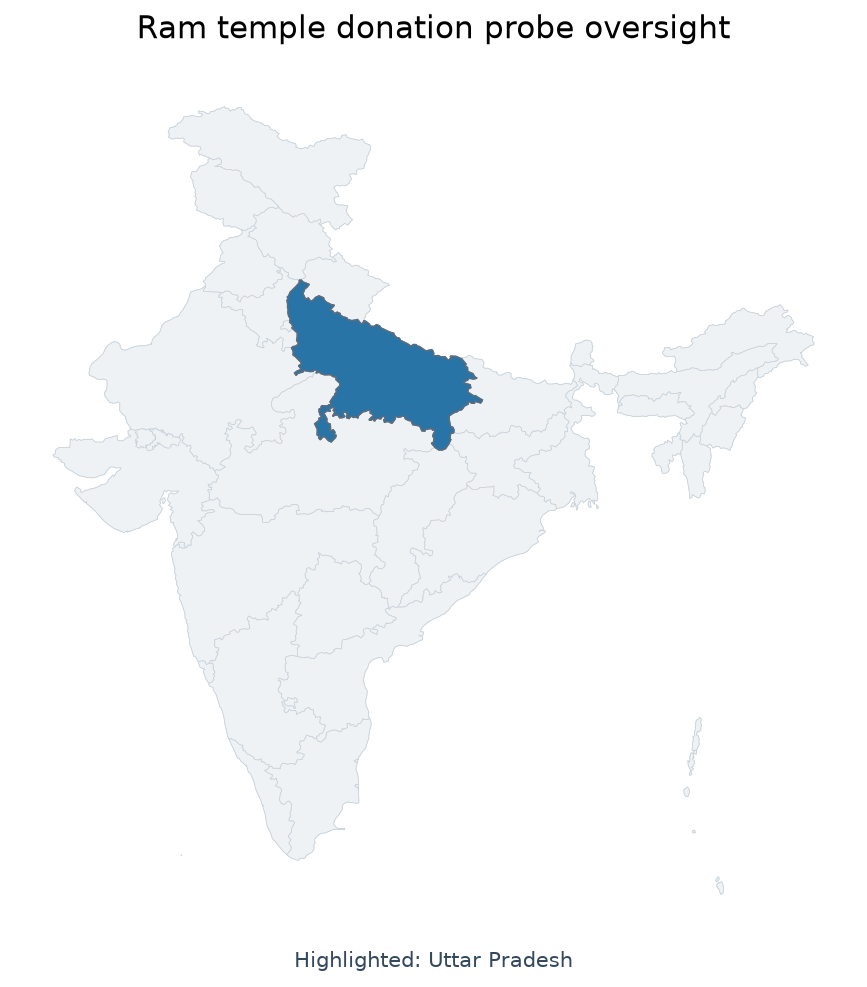
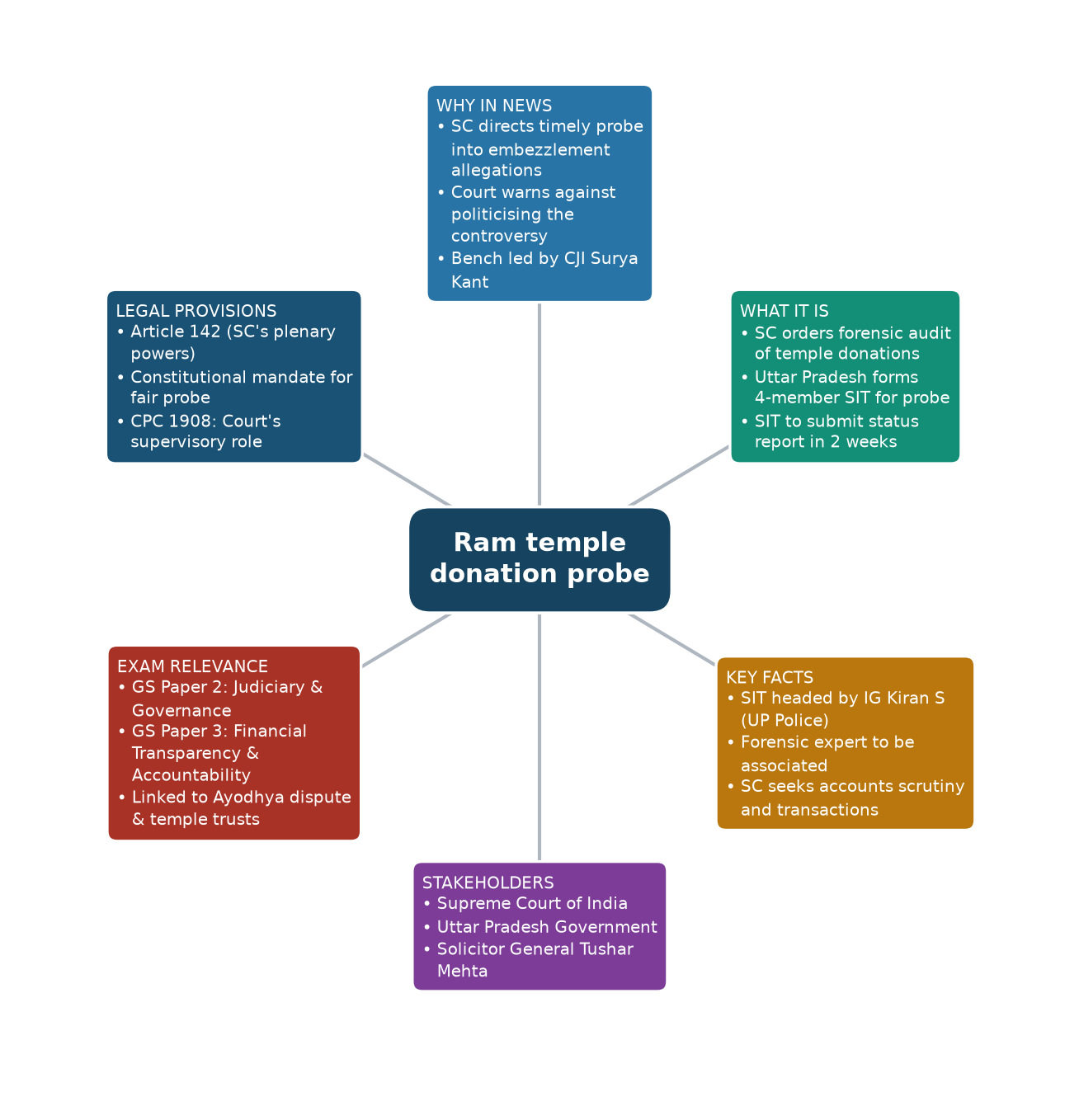
Map & concept mind-map: Ram temple donation probe oversight
Subject Relevance — Where This Topic Fits
- GS Paper II — Polity and Governance (Judicial Review, Constitutional Morality, Fundamental Rights) | GS Paper III — Economy (Financial Transparency, Fraud Prevention, Regulatory Oversight)
- Prelims: Article 26 (Freedom to Manage Religious Affairs), Article 29 and 30 (Cultural and Educational Rights), Right to Information Act, 2005, Forensic Audit, Special Investigation Team (SIT), Constitutional Morality, Judicial Activism, Public Trust Doctrine, Financial Accountability in Religious Institutions
- Essay: Ethical Governance vs. Religious Sentiment: Balancing Transparency and Faith, The Role of Judiciary in Upholding Constitutional Values in Socio-Religious Matters
Quick Revision: The Supreme Court’s directive in the Ram temple donation case underscores the constitutional mandate for financial transparency in religious institutions, governed by Articles 25-28 and the Public Trust Doctrine, with forensic audits ensuring impartiality and accountability.
Why is this in the news?
The Supreme Court’s directive to the Uttar Pradesh government for a speedy, qualitative, and impartial probe into alleged financial irregularities in donations received by the Ram temple in Ayodhya underscores the judiciary’s role in ensuring financial transparency in religious institutions. This case highlights the intersection of constitutional principles, judicial oversight, and public trust in religious organizations, particularly in the context of large-scale public donations. The Court’s emphasis on forensic audit and time-bound investigation reflects growing concerns over financial mismanagement in institutions of public significance.
Background
- The Ram temple in Ayodhya, constructed following the Supreme Court’s 2019 verdict in the Ayodhya dispute case, has become a focal point for public donations, necessitating stringent financial oversight to prevent misuse.
- The Uttar Pradesh government constituted a Special Investigation Team (SIT) in response to allegations of embezzlement in temple donations, following judicial directives to ensure accountability.
- The case assumes significance in the context of India’s pluralistic society, where religious institutions often manage substantial public funds, raising questions about transparency and accountability.
- The Supreme Court’s intervention reflects its proactive stance in ensuring that religious institutions adhere to constitutional principles of financial probity and public trust.
- The case also ties into broader debates on the regulation of religious institutions under Articles 25-28 of the Constitution, which guarantee religious freedom while imposing reasonable restrictions for public order and morality.
- Judicial precedents, such as the 2012 judgment in the Sri Adi Visheshwara Temple case (Kerala), have emphasized the need for transparency in temple management, reinforcing the public trust doctrine.
What is the Ram Temple Donation Case and Its Legal Framework?
- The case pertains to allegations of embezzlement or mismanagement of donations received for the temple’s construction and maintenance, prompting judicial scrutiny.
- The Supreme Court’s directive to the Uttar Pradesh government to constitute a Special Investigation Team (SIT) with forensic audit expertise underscores the need for a qualitative and impartial probe.
- The legal framework governing this case includes constitutional provisions such as Article 26 (freedom to manage religious affairs).
- The Public Trust Doctrine, a judicial principle, mandates that religious institutions manage public funds with transparency and accountability, ensuring no misuse occurs.
- The case also highlights the role of the judiciary in balancing religious freedoms with the need for financial transparency, particularly in institutions of public significance.
- Forensic audits, as suggested by the Court, involve detailed examination of financial records to detect fraud, embezzlement, or mismanagement, ensuring a qualitative probe.
Key Features
| Feature | Significance |
|---|---|
| Constitution of SIT | Ensures structured, multi-agency investigation under judicial oversight to address allegations of financial irregularities in temple donations. |
| Forensic Audit Integration | Mandates inclusion of forensic accounting expertise to scrutinise financial records, enhancing credibility and precision of probe. |
| Time-bound Reporting | Directs submission of status report within two weeks, ensuring accountability and adherence to judicial timelines. |
| Judicial Oversight | Bench headed by CJI Surya Kant ensures transparency and impartiality, preventing politicisation of the controversy. |
| State Compliance | Uttar Pradesh government’s swift action in constituting SIT demonstrates responsiveness to judicial directives. |
Why it Matters
Judicial Governance
- Reinforces the Supreme Court’s role as the guardian of constitutional morality and financial probity in matters of public trust.
- Demonstrates proactive judicial intervention to safeguard public funds and maintain institutional credibility.
- Sets a precedent for judicial oversight in cases involving religious institutions and large-scale public donations.
Financial Accountability
- Highlights the need for robust financial auditing mechanisms in institutions managing substantial public contributions.
- Emphasises the importance of transparency to prevent misappropriation and build public trust in institutional governance.
- Underscores the role of forensic audits in detecting and deterring financial irregularities.
Rule of Law
- Affirms that no entity, including religious institutions, is above the scrutiny of law in matters of financial integrity.
- Ensures that allegations of embezzlement are investigated impartially, regardless of the institution’s religious or social significance.
- Reinforces the principle that justice must be seen to be done, irrespective of the scale or sensitivity of the matter.
Challenges
1. Politicisation of Religious Institutions
- Risk of external actors leveraging the controversy for political gains, potentially undermining the impartiality of the probe.
- Need to insulate the investigation from partisan influences to ensure fair and objective outcomes.
UPSC Link: GS-II: Role of Religion in Politics
2. Financial Transparency in Religious Institutions
- Lack of standardised financial reporting mechanisms in religious trusts, complicating audit processes.
- Potential resistance from institutional stakeholders to external scrutiny, necessitating judicial and administrative pressure.
UPSC Link: GS-III: Financial Governance
3. Operational Delays in Investigations
- Complexity of financial transactions and large-scale data analysis may lead to procedural bottlenecks.
- Need for specialised expertise to expedite forensic audits without compromising thoroughness.
UPSC Link: GS-II: Judicial Reforms
4. Public Trust and Perception
- Allegations of financial mismanagement can erode public confidence in religious institutions.
- Ensuring transparent communication of probe findings to maintain societal trust.
UPSC Link: GS-IV: Ethics in Governance
5. Legal and Administrative Coordination
- Requires seamless coordination between judicial, executive, and forensic audit teams.
- Potential conflicts between state agencies and central investigative bodies must be preemptively addressed.
UPSC Link: GS-II: Centre-State Relations
Challenges — UPSC Perspective
| Issue | Concern |
|---|---|
| Political Interference | Risk of partisan actors influencing probe outcomes or public narratives. |
| Data Complexity | Large-scale financial records require advanced forensic tools for accurate analysis. |
| Institutional Resistance | Religious bodies may oppose external audits, citing autonomy concerns. |
| Time Constraints | Two-week deadline for status report may pressure thoroughness of investigation. |
| Public Perception | Mismanagement allegations can fuel distrust, requiring proactive transparency. |
| Expertise Shortage | Limited availability of forensic auditors with domain-specific experience. |
Way Forward
- Constitute a dedicated forensic audit wing within the SIT, comprising experts from the Comptroller and Auditor General (CAG) and Reserve Bank of India (RBI) for specialised oversight.
- Develop a standardised financial reporting framework for religious institutions to ensure transparency and ease of audit.
- Establish a grievance redressal mechanism for donors to report irregularities directly to the SIT or a judicial oversight body.
- Mandate quarterly disclosures of donation utilisation by the Shri Ram Janmabhoomi Teerth Kshetra Trust to maintain public trust.
- Strengthen inter-agency coordination between the SIT, CBI, and state police to prevent jurisdictional conflicts.
- Introduce whistle-blower protection measures to encourage insiders to report financial misconduct without fear of retaliation.
- Publish a detailed status report after the two-week deadline, outlining findings, next steps, and timelines for further action.
UPSC Value Addition
Keywords for Mains Answer-Writing
Ram Mandir Trust · Ayodhya dispute · Constitutional morality · Judicial activism · Forensic audit · Special Investigation Team (SIT) · Transparency in religious institutions · Public trust doctrine · Financial accountability · Separation of religion and state · Article 26 of the Constitution · Right to worship · Criminal breach of trust · Judicial review of executive actions · Uttar Pradesh government
Constitutional & Policy Linkages
- Article 14: Equality before law and equal protection of laws in financial governance of public trusts.
- Article 25: Freedom of religion balanced with state’s duty to ensure financial probity in religious institutions.
- Article 26: Right of religious denominations to manage their affairs, subject to public welfare and judicial oversight.
Concept Flow
Allegations of financial embezzlement in Ram temple donations → Supreme Court takes suo motu cognisance → Directs UP government to constitute SIT → SIT includes forensic audit expert → Court mandates time-bound status report → Judicial oversight ensures transparency → Findings to guide further remedial action.
Prelims Practice Questions
Q1. Which constitutional provision primarily governs the right to manage religious affairs in India?
- Article 25
- Article 26
- Article 27
- Article 28
Answer: Article 26 — Article 26 guarantees the right to manage religious affairs, subject to public order, morality, and health. It is central to disputes involving religious institutions such as the Ram Mandir Trust.
Q2. The Supreme Court’s direction for a forensic audit in the Ram temple donation case is most closely related to which of the following principles?
- Doctrine of pith and substance
- Principle of natural justice
- Doctrine of colourable legislation
- Principle of financial accountability
Answer: Principle of financial accountability — The forensic audit is aimed at ensuring financial accountability and transparency in the management of donations, which falls under the principle of financial accountability in public and religious institutions.
Q3. Which of the following institutions is empowered to constitute a Special Investigation Team (SIT) under the Code of Criminal Procedure, 1973?
- Supreme Court
- State Government
- Central Government
- Both State and Central Governments
Answer: Both State and Central Governments — Under Section 220 of the Code of Criminal Procedure, 1973, both the State and Central Governments are empowered to constitute an SIT for investigation into serious offences.
Mains Practice Question
✍ The Supreme Court’s intervention in the Ram temple donation case underscores the tension between religious freedom and financial accountability. Critically examine the constitutional and ethical dimensions of this issue, with reference to the principles of judicial review and public trust doctrine.
Approach: Begin by defining the constitutional framework governing religious institutions (Article 25 and 26) and the public trust doctrine. Analyse the Supreme Court’s role in ensuring transparency and accountability, citing the direction for a forensic audit and SIT. Discuss the ethical implications of managing public donations in religious contexts, balancing religious freedom with the need for financial integrity. Conclude by evaluating whether judicial activism in such matters strengthens or undermines constitutional morality.
Source: Hindustan Times
Generated by AanyaAi for educational purpose.

- सुप्रीम कोर्ट ने चुनाव आयोग को दिल्ली में ‘यांत्रिक’ SIR नोटिस पर सावधानियां बरतने को कहा - September 22, 2026
- ‘स्वच्छता ही सेवा-2026’ अभियान: सरकारी विभागों में स्वच्छता क्रांति, जानिए मुख्य बिंदु - September 22, 2026
- DFPD Launches ‘Swachhata Hi Seva-2026’ Campaign for Clean India Mission - September 22, 2026

No Comments