


21 Oct Supreme Court Extends AP Municipal Poll Deadline to October 25 for YSRCP
✎ The State Election Commission, as a constitutional body under Article 243K, is empowered to conduct elections to urban local bodies, and its decisions are subject to judicial review to ensure adherence to constitutional…
Subject Relevance — Where This Topic Fits
- GS Paper II — Polity and Governance — Constitutional Bodies (State Election Commission) | GS Paper II — Polity and Governance — Judicial Review and Constitutional Remedies | GS Paper II — Polity and Governance — Federalism and State-Level Institutions | GS Paper III — Internal Security — Law and Order Management in Electoral Contexts
- Prelims: State Election Commission (SEC), Article 243K, Article 243ZA, prima facie case, urban local bodies (ULBs), electoral violence, nomination process, judicial review, CCTV surveillance, compliance report
- Essay: Electoral integrity and the role of constitutional institutions in preserving democratic processes, Balancing electoral timelines with the right to fair participation in a federal polity
Quick Revision: The State Election Commission, as a constitutional body under Article 243K, is empowered to conduct elections to urban local bodies, and its decisions are subject to judicial review to ensure adherence to constitutional principles and electoral fairness.
Why is this in the news?
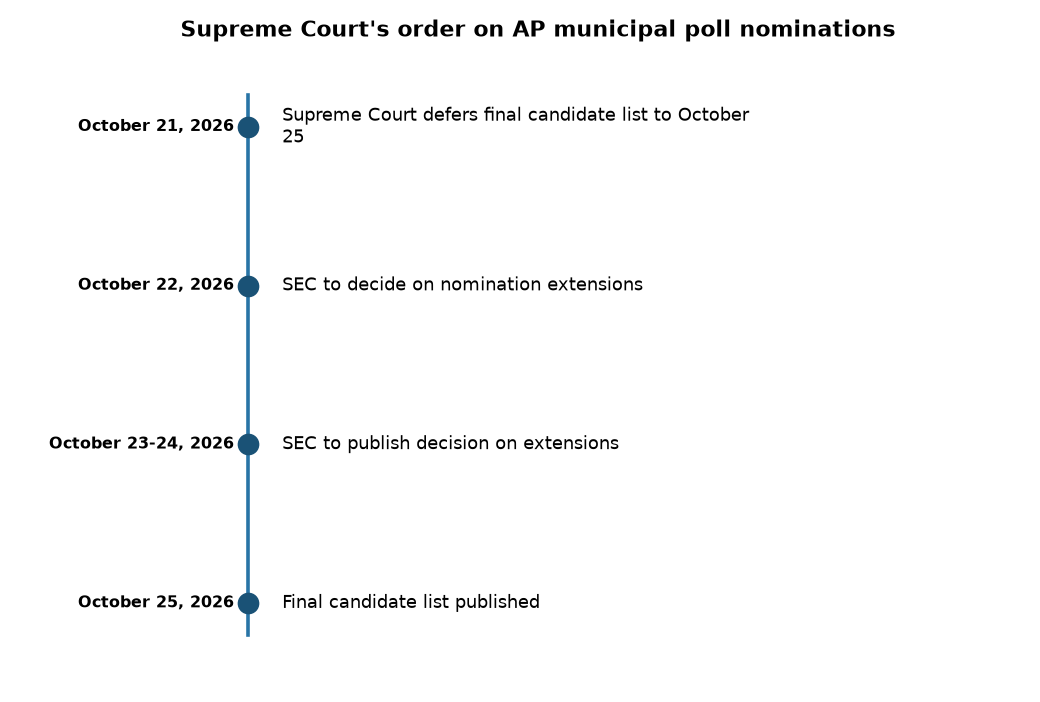
The Supreme Court of India, on 21 October 2026, deferred the publication of the final list of candidates for the Andhra Pradesh municipal polls until 25 October 2026, following a plea by the YSR Congress Party (YSRCP) alleging systemic obstruction and violence during the nomination process. The Court directed the State Election Commission (SEC) to adjudicate on the extension of the nomination deadline, emphasising the need for electoral fairness and the protection of candidates’ constitutional rights, while ensuring the integrity of the electoral timeline.
Background
- The Andhra Pradesh State Election Commission conducts elections to urban local bodies (ULBs) such as municipal corporations, municipalities, and nagar panchayats under the constitutional framework established by the 74th Amendment Act, 1992, which inserted Articles 243K and 243ZA into the Constitution.
- The 74th Amendment Act decentralised governance by empowering ULBs with constitutional status and mandating periodic elections, thereby strengthening grassroots democracy.
- The nomination process for municipal elections in Andhra Pradesh commenced on 16 October 2026 and was originally scheduled to conclude on 18 October 2026, with the final list of candidates to be published on 21 October 2026.
- The YSRCP alleged widespread violence, including physical obstruction, assaults on candidates, and destruction of property, which impeded its ability to file nominations within the stipulated deadline.
- The High Court of Andhra Pradesh had earlier dismissed the YSRCP’s plea for an extension, citing the expiry of the nomination deadline and the principle of non-interference with the electoral process post-deadline.
- The Supreme Court’s intervention underscores the constitutional principle that electoral processes must balance strict timelines with the fundamental right to participate in elections without undue hindrance.
What is the constitutional and statutory framework governing urban local body elections in India?
- The 74th Constitutional Amendment Act, 1992, inserted Articles 243K and 243ZA, which provide constitutional status to urban local bodies (ULBs) and mandate periodic elections to ensure democratic decentralisation.
- Article 243K empowers the State Election Commission (SEC) to supervise, direct, and control the preparation of electoral rolls and the conduct of elections to ULBs, ensuring autonomy from the State government.
- Article 243ZA specifies that elections to ULBs shall be conducted in accordance with the laws made by the State Legislature, subject to the provisions of the Constitution, thereby balancing state autonomy with constitutional safeguards.
- The State Election Commission is a constitutional body, distinct from the Election Commission of India (ECI), responsible for conducting elections to local bodies, including municipal corporations, municipalities, and nagar panchayats.
- The nomination process for ULB elections is governed by the respective State Municipal Acts and the Conduct of Elections Rules, which prescribe timelines, formats, and procedures for filing nominations, scrutiny, and publication of candidate lists.
- Judicial review plays a critical role in ensuring that electoral processes adhere to constitutional principles, particularly in cases where allegations of violence or obstruction threaten the fairness of elections.
- The Supreme Court’s power under Article 136 (Special Leave Petition) allows it to intervene in electoral disputes to uphold constitutional rights and democratic principles, even in matters involving state-level institutions.
- Electoral integrity is safeguarded through mechanisms such as CCTV surveillance, police protection, and compliance reports, which ensure transparency and accountability in the conduct of elections.
Key Features
| Feature | Significance |
|---|---|
| Supreme Court’s interim order | Ensures adherence to due process while addressing allegations of procedural irregularities in urban local body elections. |
| Prima facie case by YSRCP | Demonstrates the judiciary’s role in evaluating claims of obstruction before granting relief, without prejudging merits. |
| SEC’s discretionary power | Highlights the constitutional mandate of the State Election Commission to manage electoral timelines and address grievances within statutory limits. |
| Police protection and CCTV compliance | Emphasises the State’s duty to ensure free and fair elections by providing security and maintaining transparency in electoral processes. |
| Extension of nomination deadline | Balances the need for electoral finality with the right to participate, subject to judicial and administrative oversight. |
Why it Matters
Constitutional and Electoral Governance
- The Supreme Court’s intervention underscores the judiciary’s role as a guardian of electoral fairness, ensuring that allegations of violence or obstruction do not disenfranchise candidates or voters.
- The SEC’s exercise of discretion in extending deadlines reflects the constitutional principle of ‘free and fair elections’ under Article 243K and 243ZA, read with the Representation of the People Act, 1951.
- The case highlights the balance between electoral finality and the right to participate, a core tenet of democratic governance.
- The directive to the DGP to file compliance reports reinforces the accountability of law enforcement agencies in maintaining law and order during elections.
Legal and Procedural Safeguards
- The Supreme Court’s requirement of prima facie evidence before granting relief prevents frivolous delays while ensuring substantive grievances are addressed.
- The SEC’s obligation to consider electronic and documentary evidence aligns with modern electoral practices and transparency norms.
- The court’s direction to the SEC to issue orders removing apprehensions ensures procedural justice and public confidence in the electoral process.
Security and Law and Order
- The directive to provide police protection and maintain CCTV footage addresses concerns of violence and intimidation during the nomination process.
- The DGP’s compliance report requirement ensures that the State’s response to electoral violence is documented and subject to judicial scrutiny.
- This case underscores the State’s responsibility to create a secure environment for all stakeholders in the electoral process.
Challenges
1. Allegations of Electoral Violence and Obstruction
- Instances of violence, including arson and assaults, threaten the integrity of the nomination process and the safety of candidates.
- Such incidents may deter participation and undermine public trust in the electoral system.
- The challenge lies in balancing immediate relief with the need to maintain electoral timelines and finality.
UPSC Link: GS-II: Electoral Reforms and Challenges
2. Judicial Intervention in Electoral Timelines
- The Supreme Court’s role in deferring deadlines raises questions about the boundaries of judicial interference in electoral processes.
- Balancing judicial oversight with the autonomy of the Election Commission is critical to prevent perceptions of judicial overreach.
UPSC Link: GS-II: Separation of Powers and Judicial Review
3. SEC’s Discretionary Powers and Accountability
- The SEC must exercise its discretion without compromising the fairness or finality of the electoral process.
- Ensuring transparency in decision-making and compliance with judicial directives is essential to uphold democratic principles.
UPSC Link: GS-II: Constitutional Bodies and their Functions
4. Police Role in Maintaining Electoral Order
- The DGP’s responsibility to provide security and maintain law and order during elections is crucial for a free and fair process.
- Ensuring impartiality and effectiveness in police response to electoral violence is a persistent challenge.
UPSC Link: GS-III: Role of Police and Para-Military Forces in Internal Security
5. Public Confidence in Electoral Processes
- Allegations of irregularities, even if unproven, can erode public trust in the electoral system and democratic institutions.
- The judiciary and SEC must take proactive steps to address concerns and ensure transparency in their actions.
UPSC Link: GS-II: Electoral Reforms and Voter Awareness
Challenges — UPSC Perspective
| Issue | Concern |
|---|---|
| Electoral Violence | Threatens the safety of candidates and the integrity of the nomination process. |
| Judicial Overreach vs. Autonomy | Raises questions about the limits of judicial intervention in electoral timelines. |
| SEC’s Discretionary Powers | Requires careful balance between fairness and finality in electoral processes. |
| Police Accountability | Ensuring impartial and effective response to electoral violence. |
| Public Trust | Addressing allegations of irregularities to maintain confidence in democratic processes. |
| Electoral Finality | Balancing the need for timely elections with the right to participate. |
Way Forward
- The SEC must expeditiously decide on extending nomination deadlines, ensuring transparency and adherence to constitutional and statutory provisions.
- The DGP should submit a detailed compliance report to the Supreme Court, outlining measures taken to prevent violence and ensure security during the nomination process.
- The SEC should consider establishing additional nomination centres in areas reporting incidents of violence to facilitate safe filing of nominations.
- Political parties and candidates should be sensitised to the importance of peaceful conduct during elections, with clear guidelines issued by the SEC and police authorities.
- The Supreme Court may consider issuing guidelines for the judiciary on the threshold for prima facie evidence in electoral disputes to ensure consistency.
- The State should conduct a post-election review of security arrangements and electoral processes to identify gaps and improve future conduct.
- Voter awareness campaigns should be intensified to educate the public on their rights and the importance of peaceful participation in elections.
- The SEC should ensure that all decisions regarding electoral timelines are communicated promptly to all stakeholders to avoid confusion.
UPSC Value Addition
Keywords for Mains Answer-Writing
State Election Commission · urban local body elections · Constitution of India Article 243K · State Election Commissioners · Election Commission of India · prima facie case · electoral process safeguards · electoral violence · electoral dispute resolution · electoral integrity · municipal governance · Andhra Pradesh State Election Commission · Supreme Court directions on elections · electoral deadlines · electoral security provisions
Constitutional & Policy Linkages
- Article 243K: Powers, authority and responsibilities of Municipalities, including the conduct of elections.
- Article 243ZA: Elections to the Municipalities, ensuring uniformity with the provisions of Part XV of the Constitution.
- Article 32: Writs for enforcement of rights, including electoral rights, ensuring judicial oversight.
Concept Flow
Allegations of violence and obstruction during nomination period → YSRCP files plea in Supreme Court → Supreme Court evaluates prima facie case → Directs SEC to consider extension of nomination deadline → SEC assesses evidence and decides on relief → SEC issues orders to address apprehensions → DGP ensures security and files compliance report → Supreme Court monitors compliance → Final list of candidates published after judicial and administrative scrutiny.
Prelims Practice Questions
Q1. Consider the following statements regarding the State Election Commission (SEC) in India:
1. The SEC is a constitutional body established under Article 243K of the Constitution.
2. The SEC conducts elections to the Panchayati Raj Institutions and Municipalities.
3. The SEC is appointed by the President of India.
4. The SEC is subordinate to the Election Commission of India (ECI) in matters of election conduct.
How many of the above statements are correct?
- Only one
- Only two
- Only three
- All
Answer: Only three — Statements 1 and 2 are correct as the SEC is a constitutional body under Article 243K and conducts elections to local bodies. Statement 3 is incorrect as the SEC is appointed by the Governor of the respective state. Statement 4 is incorrect as the SEC functions independently and is not subordinate to the ECI.
Q2. Assertion (A): The Supreme Court, in its directive to the State Election Commission, can extend the deadline for filing nominations in urban local body elections.
Reason (R): The Supreme Court has the power of judicial review over the electoral process to ensure fairness and adherence to constitutional principles.
Options:
A. Both A and R are true, and R is the correct explanation of A.
B. Both A and R are true, but R is not the correct explanation of A.
C. A is true, but R is false.
D. A is false, but R is true.
Answer: ? — Assertion (A) is true as the Supreme Court can issue directions to the SEC regarding electoral deadlines. Reason (R) is also true and correctly explains A, as the Court’s power of judicial review ensures fairness in the electoral process.
Q3. Match the following constitutional provisions with their respective subjects:
Column I
1. Article 243K
2. Article 324
3. Article 329
4. Article 243U
Column II
A. Elections to the House of the People and the Legislative Assemblies of States
B. Power of superintendence, direction and control of elections by the Election Commission of India
C. Reservation of seats for Scheduled Castes and Scheduled Tribes in Panchayats
D. Duration of Municipalities
- 1-C, 2-B, 3-A, 4-D; 1-D, 2-B, 3-A, 4-C; 1-A, 2-C, 3-B, 4-D; 1-B, 2-A, 3-D, 4-C
- answer
- The correct match is: 1-C (Article 243K pertains to reservation of seats in Panchayats), 2-B (Article 324 pertains to the powers of the Election Commission of India), 3-A (Article 329 pertains to elections to the House of the People and Legislative Assemblies), and 4-D (Article 243U pertains to the duration of Municipalities).
- format
Answer: 1-C, 2-B, 3-A, 4-D; 1-D, 2-B, 3-A, 4-C; 1-A, 2-C, 3-B, 4-D; 1-B, 2-A, 3-D, 4-C —
Q4. Which of the following is NOT a function of the State Election Commission under the Constitution of India?
- Conducting elections to the State Legislative Assembly
- Conducting elections to Panchayati Raj Institutions
- Conducting elections to Municipalities
- Preparing electoral rolls for local body elections
Answer: Conducting elections to the State Legislative Assembly — The State Election Commission is responsible for conducting elections to Panchayati Raj Institutions and Municipalities, and preparing electoral rolls for local body elections. Conducting elections to the State Legislative Assembly is the function of the Election Commission of India, not the SEC.
Mains Practice Question
✍ The Supreme Court’s intervention in directing the State Election Commission to extend the deadline for filing nominations in urban local body elections underscores the judiciary’s role in safeguarding electoral integrity. Critically examine the constitutional and institutional framework governing elections to local bodies in India, with particular reference to the independence and accountability of the State Election Commission. (15 Marks)
Approach: MODEL-ANSWER SKELETON:
1. Constitutional Framework:
– Article 243K of the Constitution establishes the State Election Commission (SEC) as a constitutional body.
– Article 243ZA and 243ZB provide for the composition, tenure, and conditions of service of SEC members.
– The SEC is responsible for the superintendence, direction, and control of the preparation of electoral rolls and the conduct of elections to Panchayati Raj Institutions and Municipalities.
2. Independence of the SEC:
– The SEC is appointed by the Governor, but its independence is protected by the constitutional mandate.
– The SEC is not subordinate to the Election Commission of India (ECI), though both institutions operate under the broader constitutional framework of free and fair elections.
– The Supreme Court, in *State of Kerala v. T.P. Kunhalikutty* (2017), reaffirmed the SEC’s independence from executive interference.
3. Accountability Mechanisms:
– The SEC is accountable to the state legislature and the Governor, but its decisions are subject to judicial review.
– The judiciary, including the Supreme Court, can intervene to ensure constitutional compliance, as seen in the present case where the Court directed the SEC to consider extending nomination deadlines.
– The SEC’s decisions can be challenged before the High Court under Article 226 of the Constitution.
4. Challenges to Electoral Integrity:
– Electoral violence and intimidation, as alleged in the Andhra Pradesh case, pose significant threats to free and fair elections.
– The SEC, in collaboration with the police and district administration, must ensure a secure environment for candidates and voters.
– The role of the judiciary in directing the SEC to address such challenges highlights the need for robust institutional safeguards.
5. Comparative Perspective:
– Unlike the ECI, which is a permanent constitutional body, the SEC functions at the state level and may face resource constraints.
– The independence of the SEC is often debated in the context of political interference, particularly in states where the ruling party may influence administrative decisions.
6. Conclusion:
– The SEC’s role is pivotal in ensuring democratic decentralization and local governance.
– While the judiciary’s intervention ensures accountability, the SEC must balance independence with coordination with other state institutions to uphold electoral integrity.
Source: The Hindu
Generated by AanyaAi for educational purpose.
Related guides on our sites
- Anthropology VS PSIR
- Best PSIR optional coaching
- Best PSIR optional coaching online
- Best PSIR optional teacher

- मक्का रक्षा समझौता: पाकिस्तान, सऊदी अरब और तुर्की के सैन्य सहयोग की पूरी जानकारी - October 21, 2026
- India-New Zealand FTA: MoC on Electronic Origin Data Exchange Signed - October 21, 2026
- सितंबर 2026 का कोर इंडस्ट्री इंडेक्स: जानिए अगस्त 2026 का अंतिम आँकड़ा - October 21, 2026

No Comments