


20 Aug Supreme Court Grills NTA Over NEET Paper Leak Safeguards: FAIMA Demands Stricter Laws
✎ The Public Examinations (Prevention of Unfair Means) Act, 2026, seeks to deter insider threats in examination systems by treating unauthorised disclosure of confidential material as an aggravated offence with stringent penalties…
Subject Relevance — Where This Topic Fits
- GS Paper II — Governance, Transparency and Accountability | GS Paper III — Security Challenges and Role of Institutions
- Prelims: Public Examinations (Prevention of Unfair Means) Act, 2026, National Testing Agency (NTA), NEET-UG 2024 and 2026 paper leaks, High-Level Committee of Experts under K Radhakrishnan, Task Force on Examination Reforms under Nandan Nilekani, Central Bureau of Investigation (CBI), Computer-Based Testing (CBT) vs Pen-and-Paper Testing, Data Security and Confidentiality in Examinations
- Essay: The Role of Institutions in Ensuring Fairness in Public Examinations: A Case Study of NEET and Other Competitive Tests, Balancing Transparency and Confidentiality in High-Stakes Examinations: Legal and Technological Imperatives
Quick Revision: The Public Examinations (Prevention of Unfair Means) Act, 2026, seeks to deter insider threats in examination systems by treating unauthorised disclosure of confidential material as an aggravated offence with stringent penalties, including imprisonment and fines.
Why is this in the news?
The Federation of All India Medical Association (FAIMA) has raised concerns before the Supreme Court regarding the adequacy of the National Testing Agency’s (NTA) anti-leak measures, arguing that the existing legal framework under the Public Examinations (Prevention of Unfair Means) Amendment Act, 2026 fails to address insider threats effectively. FAIMA has also questioned the non-implementation of the Radhakrishnan Committee’s recommendations, which were formulated to strengthen examination integrity, and has sought stricter legal provisions to penalise insiders involved in paper leaks. This development underscores the persistent challenges in securing competitive examinations in India and the need for robust institutional and legal mechanisms.
Background
- The National Testing Agency (NTA) was established in 2017 as an autonomous body under the Ministry of Education to conduct high-stakes examinations, including NEET-UG, JEE Main, and UGC NET.
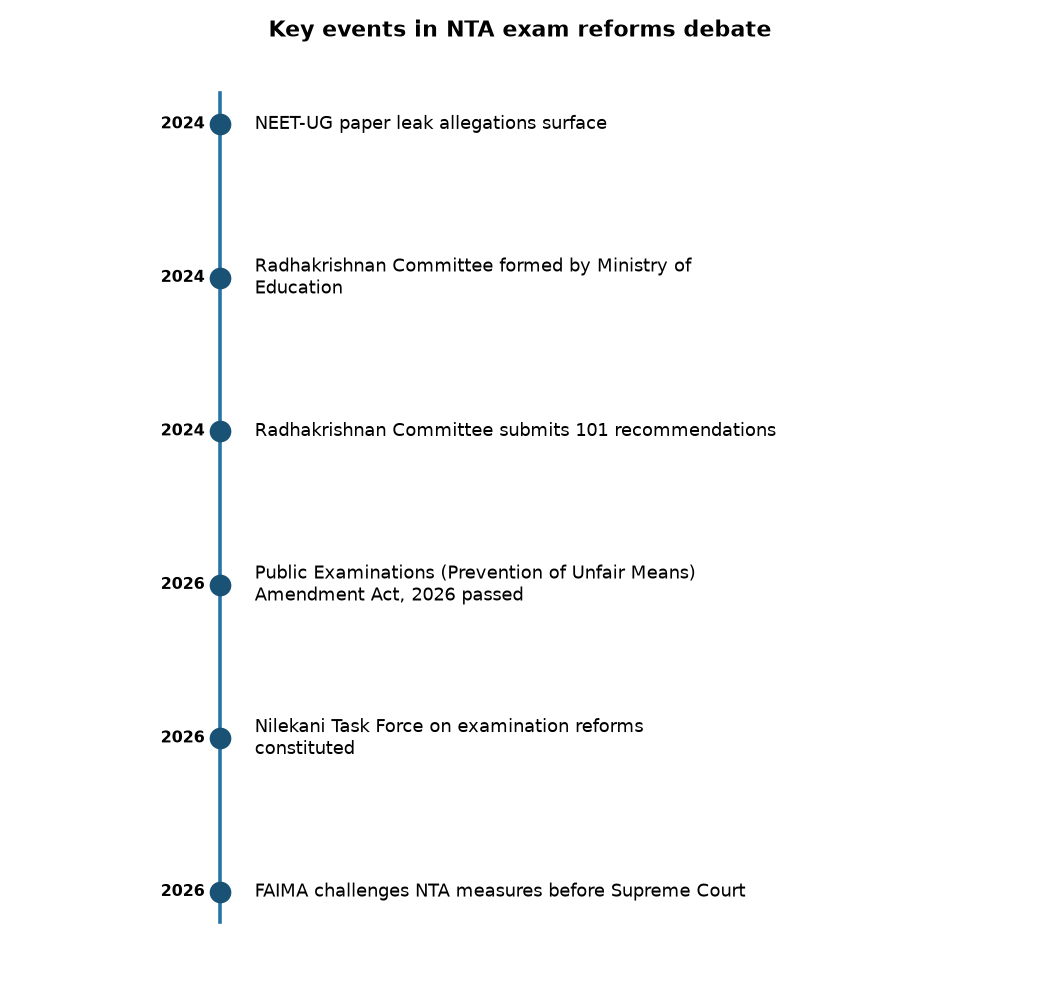
- Allegations of paper leaks in NEET-UG have surfaced periodically, with significant incidents reported in 2024 and 2026, prompting judicial scrutiny and public concern.
- The High-Level Committee of Experts, chaired by former ISRO chief K Radhakrishnan, was constituted in 2024 to recommend reforms in examination processes, data security, and institutional structures following NEET-UG 2024 paper leak allegations.
- The Radhakrishnan Committee submitted 101 recommendations, including Standard Operating Procedures (SOPs) for pre-examination, examination, and post-examination stages, but their implementation remains contested.
- The Supreme Court has been seized of multiple petitions related to NEET-UG, including pleas for restructuring the NTA and enhancing safeguards against paper leaks.
What is the Public Examinations (Prevention of Unfair Means) Act, 2026?
- The Act was enacted to address unfair means in public examinations, including paper leaks, impersonation, and tampering with answer sheets, by prescribing penalties ranging from imprisonment to fines.
- The Act defines ‘unfair means’ broadly to include any act that compromises the integrity of examinations, including unauthorised disclosure of question papers, tampering with answer sheets, or collusion with external entities.
- Penalties under the Act include imprisonment for a term not less than 3 years, which may extend to 10 years, and fines up to ₹1 crore, depending on the severity of the offence.
- The Act empowers the Central Government to constitute special courts for speedy trial of offences under the Act, ensuring expeditious justice.
- The Act also mandates the establishment of a robust grievance redressal mechanism and periodic audits of examination processes to prevent malpractices.
- Critics argue that the Act, while stringent, lacks provisions for proactive measures such as real-time monitoring of examination centres or mandatory encryption of question papers.
Key Features
| Feature | Significance |
|---|---|
| Public Examinations (Prevention of Unfair Means) Amendment Act, 2026 | Introduces stricter provisions to penalise insiders involved in examination paper leaks, treating such offences as aggravated due to breach of trust. |
| High-Level Committee of Experts (K Radhakrishnan Committee) | Submitted 101 recommendations in 2024 to reform examination processes, data security, and NTA’s structural functioning; yet some key recommendations remain unimplemented. |
| Task Force on Examination Reforms (Nandan Nilekani) | Constituted to examine structural reforms in competitive examinations, indicating a shift in governance approach post-repeated examination irregularities. |
| Central Bureau of Investigation (CBI) Investigation | Probes allegations of NEET-UG 2026 paper leak, reflecting institutional response to maintain integrity of examinations. |
| Supreme Court Directions | Issued guidelines to strengthen safeguards against paper leaks and considered petitions for NTA restructuring to ensure autonomy and robustness. |
Why it Matters
Governance and Institutional Integrity
- Examination integrity is a critical governance function, directly impacting meritocracy and public trust in recruitment and admissions systems.
- Repeated paper leaks erode confidence in national-level examinations, necessitating systemic reforms in institutional processes and accountability mechanisms.
- The legal framework’s inadequacy in addressing insider threats highlights the need for proactive governance to protect confidential examination material.
Legal and Regulatory Framework
- The amendment to the Public Examinations Act aims to criminalise insider collusion, recognising the severity of trust breaches in examination systems.
- Existing laws and institutional guidelines (e.g., Radhakrishnan Committee recommendations) must be implemented holistically to prevent procedural gaps.
- Judicial oversight through the Supreme Court ensures that examination reforms are pursued with constitutional and statutory compliance.
Societal and Educational Impact
- Fairness in examinations is essential for equitable access to higher education and professional opportunities, particularly in medical and engineering fields.
- Paper leaks disproportionately affect marginalised students, exacerbating socio-economic disparities in career advancement.
- Institutional credibility hinges on transparent, secure, and reliable examination processes to uphold national standards.
Challenges
1. Insider Threats in Examination Systems
- Authorised personnel (paper setters, vetters) with access to confidential material pose a high risk of collusion and data breaches.
- Current legal provisions lack specificity in addressing insider-driven leaks, enabling procedural and punitive loopholes.
- Implementation gaps in committee recommendations (e.g., Radhakrishnan Committee) undermine preventive measures.
UPSC Link: GS2: Role of Institutions in Governance
2. Institutional Autonomy vs. Centralised Control
- The NTA’s structural functioning is under scrutiny, with demands for greater autonomy to insulate examinations from political or administrative interference.
- Balancing centralised oversight with operational independence remains a challenge in ensuring examination integrity.
- Frequent task force formations without follow-through indicate systemic inertia in addressing root causes.
UPSC Link: GS2: Statutory, Regulatory and Quasi-judicial Bodies
3. Technological and Procedural Safeguards
- Adoption of digital examination systems (e.g., computer-based testing) introduces new vulnerabilities, including cyber threats and data breaches.
- Standard Operating Procedures (SOPs) for pre-, during, and post-examination stages must be rigorously enforced to prevent leaks.
- Lack of a unified, secure examination management system exacerbates procedural inconsistencies.
UPSC Link: GS3: Science and Technology in Governance
4. Judicial and Executive Coordination
- Supreme Court interventions, while necessary, highlight the need for executive-led reforms to preempt judicial directives.
- Delayed implementation of committee recommendations reflects poor inter-institutional coordination between the judiciary and executive.
- Ensuring that judicial directions translate into executive action remains a persistent challenge.
UPSC Link: GS2: Separation of Powers and Judicial Review
5. Public Trust and Perception Management
- Repeated examination irregularities fuel public scepticism about the fairness and transparency of national-level tests.
- Media scrutiny and political narratives around leaks can distort policy responses, necessitating evidence-based reforms.
- Restoring public confidence requires demonstrable improvements in examination security and accountability.
UPSC Link: GS4: Ethics and Integrity in Governance
Challenges — UPSC Perspective
| Issue | Concern |
|---|---|
| Insider Collusion | Authorised personnel exploiting access to confidential material to facilitate leaks. |
| Legal Gaps | Existing laws lack specificity in addressing insider-driven examination irregularities. |
| Implementation Deficits | Committee recommendations remain unimplemented, leading to recurrent vulnerabilities. |
| Technological Risks | Digital examination systems introduce cyber threats and procedural inconsistencies. |
| Institutional Autonomy | Balancing centralised control with operational independence to prevent interference. |
| Public Perception | Erosion of trust in examination systems due to repeated irregularities and delayed reforms. |
Way Forward
- Enact stricter legal provisions under the Public Examinations Act to criminalise insider collusion and mandate enhanced penalties.
- Implement the Radhakrishnan Committee’s recommendations in a time-bound manner, prioritising SOPs for data security and examination stages.
- Establish a unified, secure digital examination management system with end-to-end encryption and real-time monitoring.
- Strengthen the NTA’s autonomy by insulating it from administrative interference and ensuring transparent governance.
- Constitute a permanent, multi-stakeholder oversight body to audit examination processes and recommend corrective measures.
- Enhance cybersecurity protocols for digital examinations, including penetration testing and third-party audits.
- Introduce whistle-blower protections for insiders reporting irregularities, while ensuring due process for accused parties.
- Conduct periodic reviews of examination reforms by an independent body to assess progress and address emerging threats.
UPSC Value Addition
Keywords for Mains Answer-Writing
National Testing Agency (NTA) · Public Examinations (Prevention of Unfair Means) Amendment Act, 2026 · examination paper leaks · High-Level Committee of Experts under K Radhakrishnan · Nandan Nilekani Task Force on examination reforms · NEET-UG examination reforms · examination process safeguards · role of insiders in examination malpractices · constitutional provisions for fair examinations · Supreme Court directives on examination reforms
Constitutional & Policy Linkages
- Article 14: Right to Equality (ensuring fair and non-discriminatory examination processes)
- Article 21: Right to Life and Personal Liberty (protecting students’ legitimate expectations of fair examinations)
- Article 32: Writs for Enforcement of Rights (judicial oversight of examination irregularities)
Concept Flow
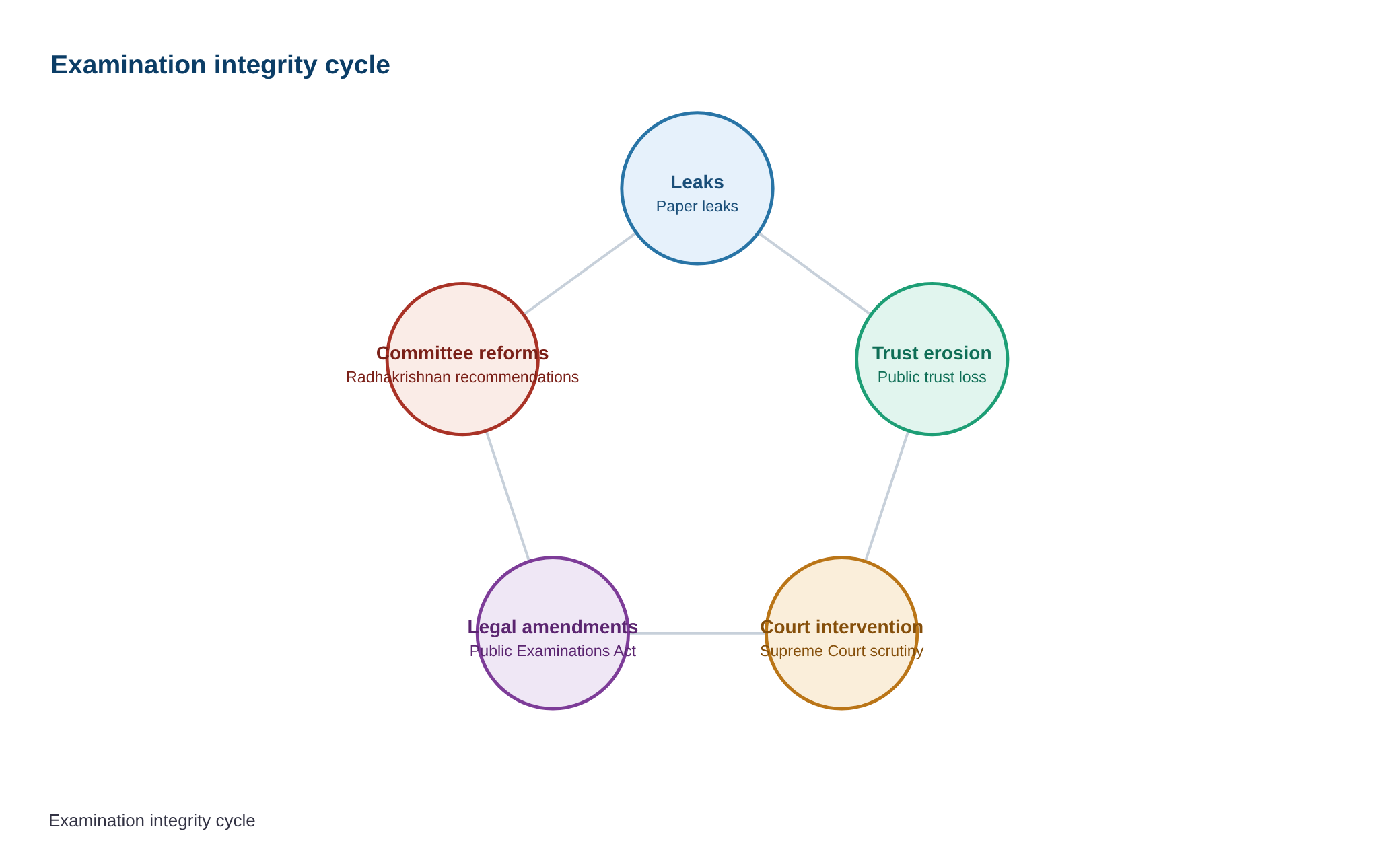
Examination paper leaks → Erosion of public trust → Supreme Court intervention → Legal amendments (Public Examinations Act) → Committee recommendations (Radhakrishnan) → Task force formation (Nilekani) → Implementation gaps → Persistent vulnerabilities → Need for systemic reforms
Prelims Practice Questions
Q1. Consider the following statements regarding the Public Examinations (Prevention of Unfair Means) Amendment Act, 2026:
1. The Act specifically addresses paper leaks by insiders such as paper setters and paper vetters.
2. It treats misuse of access to confidential examination material as an aggravated offence.
3. The Act mandates the replacement of the National Testing Agency (NTA) with a new autonomous body.
How many of the above statements are correct?
- Only one
- Only two
- All
- None
Answer: Only two — Statement 1 and 2 are correct as per the Act’s provisions. Statement 3 is incorrect as the Act does not mandate the replacement of NTA; it focuses on strengthening anti-leak measures.
Q2. Assertion (A): The High-Level Committee of Experts headed by K Radhakrishnan recommended detailed standard operating procedures for pre-examination, examination, and post-examination stages.
Reason (R): The recommendations of the Radhakrishnan Committee were fully implemented before the constitution of the Nandan Nilekani Task Force on examination reforms.
Options:
A. Both A and R are true, and R is the correct explanation of A.
B. Both A and R are true, but R is NOT the correct explanation of A.
C. A is true, but R is false.
D. A is false, but R is true.
Answer: ? — Assertion (A) is true as the Radhakrishnan Committee did recommend detailed SOPs. However, Reason (R) is false because the recommendations were not fully implemented before the constitution of the Nilekani Task Force.
Q3. Match the following committees/task forces with their respective mandates:
Column I
1. High-Level Committee of Experts under K Radhakrishnan
2. Nandan Nilekani Task Force on examination reforms
3. Central Bureau of Investigation (CBI)
Column II
A. Investigating allegations of NEET-UG 2026 paper leak
B. Examining structural reforms in competitive examinations
C. Submitting recommendations on examination process, data security, and NTA functioning
Select the correct match:
- 1-C, 2-B, 3-A
- 1-B, 2-C, 3-A
- 1-A, 2-C, 3-B
- 1-C, 2-A, 3-B
Answer: 1-C, 2-B, 3-A — 1 matches with C (Radhakrishnan Committee), 2 matches with B (Nilekani Task Force), and 3 matches with A (CBI’s role in investigating paper leaks).
Mains Practice Question
✍ Examine the efficacy of the existing legal and institutional framework in India to prevent examination paper leaks, particularly in the context of insider involvement. Also, discuss the role of the Supreme Court in ensuring accountability and reform in this domain. (15 Marks)
Approach: MODEL-ANSWER SKELETON:
1. **Legal Framework**:
– Public Examinations (Prevention of Unfair Means) Act, 2024 and its 2026 Amendment: Key provisions (aggravated offences for insiders, penalties).
– Constitutional provisions: Article 14 (equality), Article 21 (right to fair examination), and Article 32 (writ jurisdiction for enforcement).
2. **Institutional Mechanisms**:
– Role of NTA: Structure, functions, and vulnerabilities exposed by paper leaks.
– High-Level Committee under K Radhakrishnan (2024): 101 recommendations (SOPs for pre-, during, and post-examination stages, data security, NTA restructuring).
– Nandan Nilekani Task Force: Mandate to recommend structural reforms in competitive examinations.
3. **Supreme Court’s Role**:
– Judicial interventions in NEET-UG 2024 and 2026 cases: Directions to strengthen safeguards, refusal to cancel examinations but insistence on reforms.
– Writ jurisdiction under Article 32: Ensuring accountability of authorities and adherence to constitutional norms.
4. **Challenges and Gaps**:
– Delayed implementation of recommendations (Radhakrishnan Committee’s SOPs not fully adopted).
– Systemic issues: Over-reliance on paper-based examinations, lack of technological safeguards, and insider collusion.
5. **Way Forward**:
– Strengthening legal provisions for insider offences (e.g., mandatory imprisonment, confiscation of property).
– Adoption of technology (AI-based monitoring, blockchain for question papers).
– Independent oversight body for competitive examinations.
Balance of views: Critique the current system’s inadequacies while acknowledging incremental reforms. Conclude with a balanced assessment of the Supreme Court’s role in driving accountability.
Source: The Indian Express
Generated by AanyaAi for educational purpose.

- झारखंड का 1.36 लाख करोड़ का बकाया खत्म! केंद्र बनाम राज्य अब सुप्रीम कोर्ट में - September 14, 2026
- Jharkhand’s ₹1.36 Lakh Crore Dues: Supreme Court Battle Over MMDRA Amendment - September 14, 2026
- गुजरात में स्थापित होंगे भारत के 12 सेमीकंडक्टर संयंत्रों में से 6, जानिए कैसे? - September 14, 2026

No Comments