


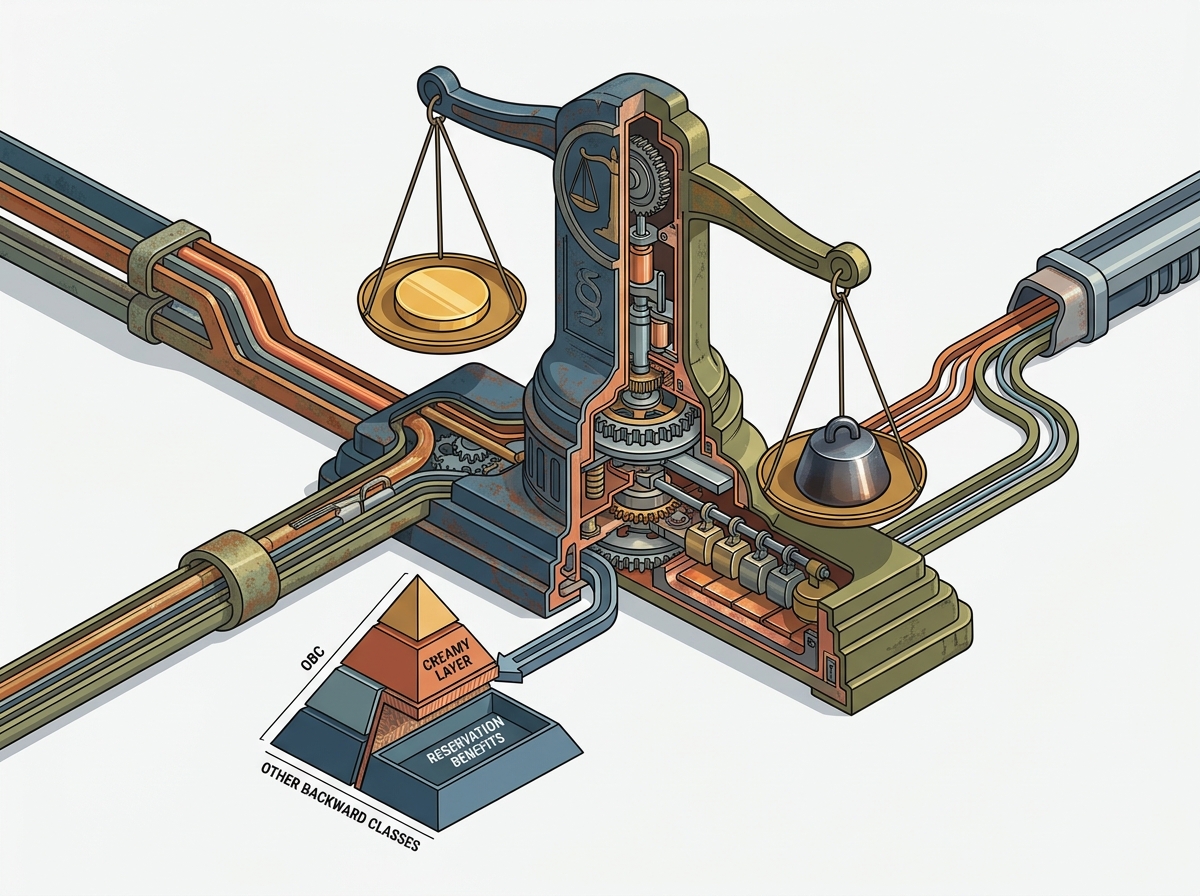
01 Sep Supreme Court Hearing on OBC Creamy Layer: Centre’s New Criteria Explained for UPSC 2025
✎ The OBC Creamy Layer exclusion is governed by the Office Memorandum dated 8 September 1993, as clarified by judicial precedent, and applies to candidates whose parents’ income, assets, or occupational status exceed specified…
Subject Relevance — Where This Topic Fits
- GS Paper II — Polity and Governance (Constitutional Provisions, Judicial Review, Reservation Policies) | GS Paper IV — Ethics, Integrity and Aptitude (Fairness in Public Administration)
- Prelims: OBC Creamy Layer, Constitutional provisions on reservations, Judicial review of reservation policies, Article 16(4) of the Constitution, Supreme Court judgments on reservation, Civil Services Examination (CSE) 2025, Service allocation in UPSC, Judicial scrutiny of administrative decisions
- Essay: Reservation policies in India: Balancing equity and efficiency, Judicial intervention in governance: Ensuring fairness in public policy implementation
Quick Revision: The OBC Creamy Layer exclusion is governed by the Office Memorandum dated 8 September 1993, as clarified by judicial precedent, and applies to candidates whose parents’ income, assets, or occupational status exceed specified thresholds, ensuring reservation benefits reach the most backward within the OBC category.
Why is this in the news?
The Supreme Court is currently hearing a case involving the Centre’s request to apply the pre-existing OBC Creamy Layer criteria for the allocation of services to 958 candidates selected in the Civil Services Examination (CSE) 2025. The Centre argues that retrospective application of a recent Supreme Court judgment could lead to inequity, as candidates had prepared and appeared for the examination under the older norms. This case raises critical questions about the balance between judicial clarity and administrative fairness in reservation policies.
Background
- The concept of ‘Creamy Layer’ within the Other Backward Classes (OBC) reservation framework was introduced to exclude the more affluent sections of OBCs from availing reservation benefits, ensuring that the benefits reach the most disadvantaged within the category.
- The Supreme Court, in its judgment dated 11 March 2026 (Union of India v. Rohit Nathani), clarified that the Office Memorandum (OM) dated 8 September 1993, which defined the Creamy Layer criteria, cannot be overridden by a subsequent clarification issued on 14 October 2004.
- The CSE 2025 notification was issued on 22 January 2025, with prelims held on 25 May 2025 and mains from 22 to 31 August 2025. Results were declared on 6 March 2026, five days before the Supreme Court’s judgment.
- The Centre contends that applying the new Creamy Layer criteria retroactively could disadvantage candidates who had relied on the older norms, particularly those whose parents’ income or assets marginally exceeded the threshold but were not in positions of significant privilege.
- The case highlights the tension between judicial pronouncements and administrative continuity, especially in high-stakes examinations like the UPSC CSE, where fairness and predictability are paramount.
What is the OBC Creamy Layer?
- The Creamy Layer refers to the relatively affluent and socially advanced sections within the Other Backward Classes (OBC) category, who are excluded from availing reservation benefits to ensure that the benefits reach the most backward sections of the OBC community.
- The concept was introduced by the Supreme Court in the *Indra Sawhney v. Union of India* (1992) judgment, which upheld the 27% reservation for OBCs but mandated the exclusion of the Creamy Layer to prevent the benefits from being cornered by the more privileged within the category.
- The criteria for identifying the Creamy Layer were formalised in the Office Memorandum (OM) dated 8 September 1993, which specified income, asset ownership, and parental occupational status as determinants.
- The OM of 14 October 2004 was issued to clarify the 1993 OM but was later held by the Supreme Court in *Union of India v. Rohit Nathani* to be unable to change the original OM, meaning the 1993 criteria remain the operative framework.
- The Creamy Layer criteria are distinct from those applicable to Scheduled Castes (SC) and Scheduled Tribes (ST), as the latter do not have a Creamy Layer exclusion principle, as affirmed by the Centre in a separate affidavit before the Supreme Court.
- The exclusion is based on economic and social indicators such as parental income exceeding ₹8 lakh per annum (as per the 2017 revision), ownership of agricultural land above a specified threshold, and the occupational status of parents (e.g., Group A officers of the Central Government or equivalent in public sector undertakings).
- The purpose of the Creamy Layer is to ensure that reservation benefits are targeted at the most disadvantaged within the OBC category, thereby promoting social justice and equity in public employment and education.
- The Supreme Court has consistently emphasised that the Creamy Layer exclusion is a dynamic concept and may be revised periodically to reflect changing socio-economic realities.
Key Features
| Feature | Significance |
|---|---|
| Supreme Court’s 11 March 2025 ruling in *Union of India v. Rohit Nathani* | Clarified that the 14 October 2004 clarification cannot override the 8 September 1993 Office Memorandum (OM) on OBC creamy layer criteria, necessitating a re-examination of existing norms. |
| Centre’s plea for retrospective application of old creamy layer rules for CSE-2025 | Seeks to prevent procedural inequity for candidates who prepared under pre-11 March 2025 norms, ensuring fairness in service allocation. |
| Expansion of creamy layer criteria beyond parental income alone | Includes parental position, assets, and socio-economic status to determine eligibility, aligning with the principle of proportional reservation. |
| Potential disruption to CSE-2025 service allocation timeline | Delays in LBSNAA foundation course and IAS/IPS cadre training, affecting administrative preparedness and cadre management. |
| Judicial scrutiny of administrative discretion in reservation norms | Highlights the constitutional balance between affirmative action and meritocracy, reinforcing judicial oversight over executive policies. |
Why it Matters
Constitutional and Legal
- Reinforces the constitutional mandate of Article 16(4) for reservation while ensuring that creamy layer exclusion remains non-arbitrary and evidence-based.
- Clarifies the hierarchy of administrative instructions (OMs vs clarifications) in reservation policy, preventing executive overreach.
- Upholds the principle that reservation benefits must reach the most marginalised within OBC communities, preventing elite capture.
Administrative and Governance
- Exposes the administrative challenge of retroactive policy changes in high-stakes examinations like the CSE, where preparation cycles span years.
- Highlights the need for synchronised judicial and executive timelines to avoid procedural conflicts in governance.
- Demonstrates the operational complexity of implementing reservation policies across multiple stages (examination, allocation, training).
Social Justice
- Reaffirms the creamy layer concept as a tool for social justice, ensuring that reservation benefits are not monopolised by the affluent sections of OBCs.
- Emphasises the need for a nuanced, multi-dimensional assessment of socio-economic status rather than relying solely on income thresholds.
- Raises awareness about the unintended consequences of policy shifts on aspirants, particularly those from lower socio-economic backgrounds.
Judicial-Executive Interface
- Illustrates the dynamic interplay between judicial pronouncements and executive actions in governance, necessitating adaptive policy frameworks.
- Underscores the importance of judicial clarity in resolving ambiguities in reservation policies to prevent administrative paralysis.
- Demonstrates how judicial decisions can create retrospective legal obligations, affecting ongoing administrative processes.
Challenges
1. Retrospective Policy Application
- Risk of procedural inequity for candidates who prepared under pre-ruling norms, leading to potential legal challenges and administrative delays.
- Undermines the predictability of examination processes, discouraging aspirants from long-term preparation.
- Creates administrative burden of re-evaluating thousands of cases, diverting resources from core governance functions.
UPSC Link: GS-II: Constitutional and Legal Framework
2. Operationalisation of Multi-Factor Creamy Layer Criteria
- Difficulty in standardising assessment metrics for parental position, assets, and income across diverse socio-economic contexts.
- Risk of subjective interpretation leading to inconsistent application of creamy layer norms.
- Increased administrative workload in verifying socio-economic status for millions of applicants.
UPSC Link: GS-II: Governance and Social Justice
3. Judicial-Executive Coordination in High-Stakes Examinations
- Need for synchronised timelines between judicial rulings and executive implementation to avoid procedural conflicts.
- Challenge of balancing judicial independence with administrative exigencies in governance.
- Risk of judicial overreach in policy domains traditionally reserved for the executive.
UPSC Link: GS-II: Judiciary and Governance
4. Impact on Cadre Management and Training
- Delays in service allocation disrupt the LBSNAA foundation course, affecting the preparedness of civil servants.
- Potential cascading effects on IAS/IPS cadre seniority, promotions, and postings due to altered service allocation timelines.
- Undermines the efficiency of administrative training programmes, which are time-bound and structured.
UPSC Link: GS-II: Civil Services and Governance
5. Public Trust and Perception of Reservation Policies
- Risk of eroding public confidence in reservation systems due to perceived arbitrariness or inconsistency in policy application.
- Need for transparent communication to prevent misinformation and maintain social harmony.
- Challenge of balancing equity with meritocracy to ensure public acceptance of reservation policies.
UPSC Link: GS-II: Social Justice and Governance
Challenges — UPSC Perspective
| Issue | Concern |
|---|---|
| Retrospective application of new creamy layer norms | Procedural inequity for candidates who prepared under old norms, leading to potential legal and administrative disruptions. |
| Multi-factor assessment of creamy layer eligibility | Operational complexity in standardising metrics for income, assets, and parental position across diverse socio-economic contexts. |
| Judicial-Executive coordination in policy implementation | Risk of administrative paralysis due to misalignment between judicial rulings and executive timelines. |
| Impact on CSE service allocation and cadre training | Delays in LBSNAA training and IAS/IPS cadre management, affecting administrative efficiency. |
| Public perception and trust in reservation systems | Potential erosion of confidence in reservation policies due to perceived inconsistency or arbitrariness. |
Way Forward
- The Supreme Court should expedite the hearing to provide clarity on the retrospective application of creamy layer norms, ensuring minimal disruption to CSE-2025 service allocation.
- The Centre must develop a standardised framework for multi-factor creamy layer assessment, incorporating income, assets, and parental position, with clear guidelines for verification.
- Judicial and executive bodies should establish a coordination mechanism to synchronise policy changes with administrative timelines, particularly for high-stakes examinations.
- The Department of Personnel and Training (DoPT) should proactively communicate policy changes to aspirants, ensuring transparency and reducing procedural inequity.
- A pilot programme for creamy layer assessment should be initiated to test the feasibility of multi-factor criteria before full-scale implementation.
- The Centre should explore phased implementation of new norms to mitigate retrospective challenges, balancing social justice with administrative feasibility.
- Judicial pronouncements on reservation policies should include a transition period for executive adaptation, preventing abrupt disruptions in governance processes.
- Aspirants should be encouraged to maintain detailed records of parental income, assets, and position to facilitate accurate creamy layer assessment.
UPSC Value Addition
Keywords for Mains Answer-Writing
OBC Creamy Layer · Constitutional provisions for reservation · Supreme Court judgment on OBC reservation · Article 16(4) and 16(4A) · Indra Sawhney case · Rohit Nathani case · CSE 2025 service allocation · Creamy Layer criteria · Judicial review of reservation policies · Administrative efficiency in civil services · Constitutional morality · Reservation in promotions · Backward Class Commission · Equality of opportunity · Social justice and affirmative action
Constitutional & Policy Linkages
- Article 16(4): Empowers the State to make provisions for reservation in favour of backward classes of citizens.
- Article 340: Provides for the appointment of a Commission to investigate the conditions of socially and educationally backward classes.
- Article 335: Ensures that claims of Scheduled Castes and Scheduled Tribes shall be taken into consideration in the administration of services.
Concept Flow
Supreme Court’s 11 March 2025 ruling clarifies creamy layer criteria → Centre seeks retrospective application of old norms for CSE-2025 → Potential procedural inequity for aspirants → Judicial-Executive coordination required → Multi-factor creamy layer assessment introduced → Operational challenges in verification → Impact on service allocation and cadre training → Need for standardised framework and transparency → Long-term implications for reservation policy and social justice.
Prelims Practice Questions
Q1. Consider the following statements regarding the OBC Creamy Layer criteria in India:
1. The Creamy Layer concept was first introduced by the Supreme Court in the Indra Sawhney case (1992).
2. The criteria for identifying the Creamy Layer is solely based on the income of the parents.
3. The Supreme Court in the Union of India v. Rohit Nathani case (2024) held that the 2004 Office Memorandum cannot override the 1993 criteria for Creamy Layer.
4. The Creamy Layer principle applies to Scheduled Castes (SC) and Scheduled Tribes (ST) as well.
How many of the above statements are correct?
- Only one
- Only two
- Only three
- All
Answer: Only three — Statements 1 and 3 are correct. The Creamy Layer concept was introduced in the Indra Sawhney case (1992), and the Supreme Court in Union of India v. Rohit Nathani (2024) reiterated that the 2004 Office Memorandum cannot override the 1993 criteria. Statement 2 is incorrect as the criteria include income, parental occupation, and assets. Statement 4 is incorrect as the Creamy Layer principle applies only to OBCs and SEBCs, not to SCs and STs.
Q2. Assertion (A): The Supreme Court in the Indra Sawhney case (1992) upheld the 50% ceiling on reservations in public employment.
Reason (R): The Court held that exceeding the 50% ceiling would violate the principle of equality enshrined in Article 14 of the Constitution.
In the context of the above two statements, which one of the following is correct?
- Both A and R are true, and R is the correct explanation of A
- Both A and R are true, but R is not the correct explanation of A
- A is true, but R is false
- A is false, but R is true
Answer: Both A and R are true, and R is the correct explanation of A — Both Assertion (A) and Reason (R) are true, and Reason (R) correctly explains Assertion (A). The Supreme Court in the Indra Sawhney case (1992) upheld the 50% ceiling on reservations, citing the principle of equality under Article 14 to prevent excessive reservations that could undermine merit and administrative efficiency.
Q3. Match the following judicial pronouncements with their respective cases related to reservation policies in India:
Column I (Case) | Column II (Key Holding)
1. Indra Sawhney v. Union of India (1992) | A. Creamy Layer principle applies only to OBCs and SEBCs, not to SCs and STs
2. Union of India v. Rohit Nathani (2024) | B. Upholding the 50% ceiling on reservations in public employment
3. M. Nagaraj v. Union of India (2006) | C. Clarified that the 2004 Office Memorandum cannot override the 1993 criteria for Creamy Layer
4. Ashoka Kumar Thakur v. Union of India (2008) | D. Laid down conditions for reservation in promotions for SCs and STs
Select the correct match:
- 1-B, 2-C, 3-D, 4-A
- 1-A, 2-B, 3-C, 4-D
- 1-D, 2-A, 3-B, 3-C
- 1-C, 2-D, 3-A, 4-B
Answer: 1-B, 2-C, 3-D, 4-A — The correct matches are: 1-B (Indra Sawhney upheld the 50% ceiling), 2-C (Rohit Nathani clarified the 2004 OM cannot override 1993 criteria), 3-D (M. Nagaraj laid down conditions for reservation in promotions), and 4-A (Ashoka Kumar Thakur held Creamy Layer applies only to OBCs and SEBCs).
Mains Practice Question
✍ Critically examine the constitutional and judicial framework governing the OBC Creamy Layer criteria in India. How does the recent Supreme Court judgment in Union of India v. Rohit Nathani (2024) refine or alter this framework? Also, analyse the implications of this judgment on the civil services recruitment process, particularly the CSE 2025 service allocation. (15 Marks)
Approach: MODEL-ANSWER SKELETON:
1. **Constitutional Basis**:
– Article 16(4) and 16(4A) empower the State to make provisions for reservation in favour of backward classes.
– The Creamy Layer concept was introduced by the Supreme Court in the Indra Sawhney case (1992) to exclude the more advanced sections of OBCs from availing reservation benefits.
– The criteria for Creamy Layer were laid down in the 1993 Office Memorandum (OM), which included income, parental occupation, and assets.
2. **Judicial Evolution**:
– Indra Sawhney (1992): Introduced the 50% ceiling on reservations and the Creamy Layer concept.
– Ashoka Kumar Thakur (2008): Held that the Creamy Layer principle applies only to OBCs and SEBCs, not to SCs and STs.
– M. Nagaraj (2006): Laid down conditions for reservation in promotions for SCs and STs, emphasizing the need for quantifiable data on backwardness.
– **Rohit Nathani (2024)**: Clarified that the 2004 Office Memorandum (OM) cannot override the 1993 OM, reinforcing the original criteria for Creamy Layer.
3. **Recent Judgment (Rohit Nathani, 2024)**:
– The Supreme Court held that the 2004 OM, which sought to limit the Creamy Layer criteria to parental income alone, is invalid.
– The Court reiterated that the criteria must include parental occupation and assets, not just income.
– This judgment ensures that the Creamy Layer criteria remain comprehensive and prevent the exclusion of deserving candidates from reservation benefits.
4. **Implications for CSE 2025 Service Allocation**:
– The judgment was delivered after the CSE 2025 examination process had begun, leading to potential inconsistencies in the application of Creamy Layer criteria.
– The Centre’s plea to apply the old criteria for service allocation highlights the administrative challenges posed by retrospective judicial interpretations.
– The judgment underscores the need for clarity in reservation policies to avoid procedural ambiguities in civil services recruitment.
5. **Balancing Social Justice and Administrative Efficiency**:
– The Creamy Layer criteria aim to balance social justice with meritocracy, ensuring that reservation benefits reach the most disadvantaged sections of OBCs.
– However, retrospective judicial interpretations can create administrative hurdles, as seen in the CSE 2025 case, where the Centre sought to avoid re-evaluation of candidates.
6. **Conclusion**:
– The Rohit Nathani judgment reinforces the original Creamy Layer criteria, ensuring a more equitable application of reservation policies.
– The case highlights the need for proactive judicial-legislative coordination to prevent procedural ambiguities in high-stakes recruitment processes like the CSE.
Source: bhaskar.com
Generated by AanyaAi for educational purpose.
Related guides on our sites
- Current affairs for upsc 2026
- Best PSIR optional coaching for upsc
- Best PSIR optional teacher for upsc
- Best teacher of PSIR optional for upsc

- सुप्रीम कोर्ट ने शिक्षक भर्ती में ट्रांसजेंडर्स को शामिल न करने पर सरकार से पूछा सवाल - October 20, 2026
- SBI SCO 2026 Recruitment: AI & Tech Posts Open for Experts - October 20, 2026
- दिल्ली में प्रदूषण नियंत्रण: 1 नवंबर से लागू होंगे 10 प्रमुख उपाय - October 20, 2026

No Comments