


08 Aug Supreme Court Highlights Gaps in Women’s Justice Implementation
✎ The gap between India’s progressive legal framework for women’s justice and its ground-level implementation—marked by judicial delays, revictimisation, and gender biases—demands structural reforms, including time-bound trials…
Subject Relevance — Where This Topic Fits
- GS Paper II — Polity and Governance (Judiciary, Gender Justice) | GS Paper III — Social Justice (Women Empowerment, Judicial Reforms)
- Prelims: Protection of Women from Domestic Violence Act, 2005, National Legal Services Authority (NALSA), Dowry Prohibition Act, 1961, Criminal Law (Amendment) Act, 2013, Gender Sensitisation in Judiciary, Victim Compensation Scheme, Judicial Backlog, Revictimisation in Legal Proceedings
- Essay: Justice for Women: Bridging the Gap Between Legal Rights and Ground Reality, Judicial Reforms: The Key to Empowering Women in India
Quick Revision: The gap between India’s progressive legal framework for women’s justice and its ground-level implementation—marked by judicial delays, revictimisation, and gender biases—demands structural reforms, including time-bound trials, robust victim compensation, and mandatory judicial sensitisation.
Why is this in the news?
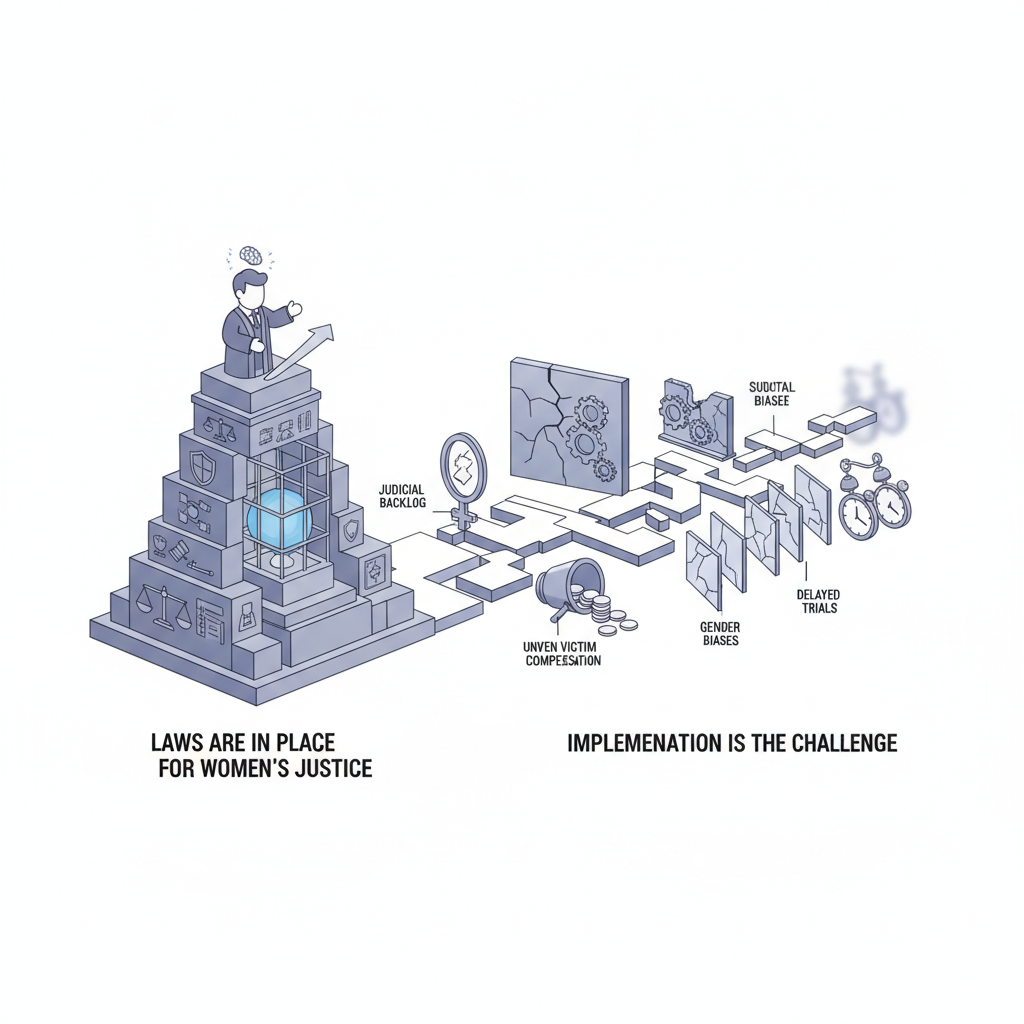
Supreme Court Judge B.V. Nagarathna highlighted the critical disparity between India’s robust legal framework for women’s justice and its inadequate implementation, emphasizing systemic challenges such as judicial backlog, revictimisation, and societal biases. Her remarks, delivered at a South Zone conference on ‘Justice for Women’ in Bengaluru, underscore the urgent need for structural reforms in the justice delivery system to ensure timely and equitable justice for women. The discourse also surfaced issues like uneven victim compensation, delayed trials, and the persistence of gender bias despite legislative progress.
Background
- The Indian legal system has progressively strengthened women’s rights through landmark legislations such as the Protection of Women from Domestic Violence Act (2005), Criminal Law (Amendment) Act (2013), and the Dowry Prohibition Act (1961), alongside constitutional provisions like Articles 14, 15, and 21.
- The National Commission for Women (NCW) and the National Legal Services Authority (NALSA) were established to address gender-based injustices and provide legal aid, yet implementation remains uneven across states.
- Judicial backlog and delays in trials disproportionately affect women, particularly in cases of domestic violence, dowry harassment, and sexual offences, where timely justice is critical to prevent further victimisation.
- Societal attitudes, economic dependence, and deep-rooted gender biases continue to impede women’s access to justice, despite legislative progress.
- The Supreme Court and High Courts have repeatedly stressed the need for gender sensitisation in the judiciary, including training modules for judicial officers to mitigate biases in evidence recording and judgment delivery.
What is the Challenge in Implementing Women’s Justice in India?
- Legal Framework vs. Implementation Gap: While India’s legal framework for women’s justice is comprehensive, its implementation is hindered by systemic inefficiencies, including judicial backlog, inadequate forensic support, and delayed investigations.
- Revictimisation in Legal Proceedings: Women often face secondary victimisation during trials due to insensitive questioning, prolonged delays, and societal stigma, which deters them from pursuing justice.
- Gender Bias in the Judiciary: Deep-rooted societal biases, including stereotypes about women’s roles and credibility, persist in judicial proceedings, affecting the outcomes of cases involving women.
- Uneven Victim Compensation: Despite schemes like the Victim Compensation Scheme, implementation is uneven, reflecting administrative and procedural bottlenecks.
- Delayed Trials and Low Conviction Rates: Protracted trials and low conviction rates in cases of violence against women undermine public trust in the justice system and discourage victims from seeking redress.
- Economic Dependence and Social Barriers: Economic vulnerability and societal norms often force women to compromise on justice, particularly in cases of domestic violence or workplace harassment, where financial independence is lacking.
- Judicial Sensitisation and Training: The role of judicial academies in sensitising officers to gender-specific issues, including language used during evidence recording and judgment writing, is critical but underutilised.
Key Features
| Feature | Significance |
|---|---|
| Legal Framework for Women’s Justice | India has enacted comprehensive laws such as the Protection of Women from Domestic Violence Act (2005), Dowry Prohibition Act (1961), and Criminal Law (Amendment) Act (2013) to address gender-based violence and discrimination. |
| Judicial Sensitisation | The emphasis on judicial academies to sensitise officers on language, evidence recording, and stereotype avoidance is critical to prevent revictimisation of women in legal proceedings. |
| Victim Compensation Schemes | Schemes like the Victim Compensation Scheme under the National Legal Services Authority (NALSA) provide financial relief, but implementation gaps persist, as highlighted by over 14,000 pending applications. |
| Time-Bound Trials | The demand for expedited trials is essential to mitigate delays, which often lead to secondary victimisation and erosion of trust in the justice system. |
| Multi-Stakeholder Coordination | Collaboration between the National Commission for Women (NCW), High Courts, and judicial academies ensures a systemic approach to addressing gender-based justice issues. |
Why it Matters
Judicial Reforms
- The judiciary’s recognition of implementation gaps underscores the need for systemic reforms in the justice delivery mechanism to align with constitutional guarantees of equality and dignity.
- Judicial sensitisation programmes can reduce biases in courtrooms, ensuring fairer trials for women survivors of violence.
- The focus on time-bound trials aligns with the constitutional principle of speedy justice under Articles 21 and 39A.
Social Justice
- The persistence of gender bias, economic dependence, and unequal access to opportunities highlights the need for societal transformation to complement legal reforms.
- Preventing revictimisation ensures that the justice system does not perpetuate trauma for women survivors, upholding their right to dignity under Article 21.
- Addressing deep-rooted societal attitudes is essential for achieving substantive equality, as envisioned in the Constitution.
Institutional Accountability
- The judiciary’s self-critical stance on implementation gaps demonstrates institutional accountability and a commitment to addressing systemic failures.
- The role of judicial academies in training officers on gender sensitivity reflects a proactive approach to institutional reform.
- The NCW’s monitoring of victim compensation schemes underscores the need for institutional mechanisms to track implementation.
Challenges
1. Implementation Deficit in Justice Delivery
- Despite robust legal frameworks, delays in trials and low conviction rates undermine the efficacy of laws like the Protection of Women from Domestic Violence Act.
- Over 14,000 pending applications for victim compensation schemes indicate systemic inefficiencies in disbursement.
- Pressurising victims to settle non-compoundable offences reflects a failure to prioritise justice over societal or familial pressures.
UPSC Link: GS Paper 2: Judiciary – Functioning and Reforms
2. Judicial Bias and Stereotypes
- Deep-rooted gender biases in judicial officers and legal practitioners can lead to revictimisation of women survivors during trials.
- Stereotypical language in evidence recording and judgments perpetuates harmful narratives about women.
- Lack of gender sensitisation in judicial training exacerbates these issues, despite existing programmes.
UPSC Link: GS Paper 2: Judiciary – Gender Sensitisation
3. Systemic Delays and Backlog
- Substantial backlog in courts delays justice for women, particularly in cases of domestic violence, dowry harassment, and sexual offences.
- Inadequate forensic support and delayed investigations further compound the problem, leading to compromised evidence.
- Time-bound trials remain a challenge due to resource constraints and systemic inefficiencies.
UPSC Link: GS Paper 2: Judiciary – Pendency of Cases
4. Socio-Economic Barriers
- Economic dependence of women limits their ability to pursue legal recourse, particularly in cases of domestic violence or dowry harassment.
- Unequal access to opportunities and resources perpetuates gender-based discrimination, affecting women’s ability to seek justice.
- Cultural norms and societal attitudes often discourage women from reporting crimes or pursuing legal remedies.
UPSC Link: GS Paper 1: Social Justice – Gender Inequality
5. Institutional Fragmentation
- Fragmented implementation of victim compensation schemes across states leads to uneven access to justice.
- Lack of coordination between police, judiciary, and support services (e.g., hospitals) delays immediate legal aid for women survivors.
- Inadequate forensic infrastructure in many regions hampers the investigation and prosecution of gender-based crimes.
UPSC Link: GS Paper 2: Centre-State Relations – Implementation Gaps
Challenges — UPSC Perspective
| Issue | Concern |
|---|---|
| Low Conviction Rates | Only a fraction of aggrieved women secure justice in time, indicating systemic failures in investigation and prosecution. |
| Delayed Investigations | Inadequate forensic support and procedural inefficiencies lead to compromised evidence and prolonged trials. |
| Victim Compensation Backlog | Over 14,000 pending applications highlight delays in disbursement, denying timely financial relief to survivors. |
| Judicial Stereotypes | Stereotypical language and biases in courts perpetuate harmful narratives, leading to revictimisation. |
| Economic Dependence | Women’s limited financial autonomy restricts their ability to pursue legal recourse or escape abusive situations. |
| Cultural Stigma | Societal attitudes discourage women from reporting crimes or seeking justice, perpetuating cycles of violence. |
Way Forward
- Establish dedicated fast-track courts for gender-based violence cases to ensure time-bound trials and reduce backlog.
- Mandate gender sensitisation modules for judicial officers, police, and legal practitioners, with periodic assessments.
- Strengthen victim compensation schemes by streamlining disbursement processes and ensuring transparency in fund allocation.
- Enhance forensic infrastructure, particularly in rural and underserved regions, to support timely investigations.
- Implement immediate legal aid for women survivors at police stations and hospitals to prevent secondary victimisation.
- Promote public awareness campaigns to challenge gender stereotypes and encourage reporting of crimes.
- Foster multi-stakeholder coordination between NCW, judiciary, police, and civil society to address systemic gaps.
- Introduce incentives for states to improve conviction rates and reduce pendency in gender-based violence cases.
UPSC Value Addition
Keywords for Mains Answer-Writing
Justice for Women in India · Judicial Implementation Gaps · Gender Justice Framework · National Commission for Women (NCW) · Judicial Sensitisation · Victim Compensation Schemes · Backlog in Courts · Dowry Prohibition Act, 1961 · Protection of Women from Domestic Violence Act, 2005 · Article 21 of the Constitution · Judicial Academies · Revictimisation in Legal Proceedings
Constitutional & Policy Linkages
- Article 14: Equality before law and equal protection of laws — underscores the need for unbiased judicial proceedings.
- Article 15(3): Empowers the state to make special provisions for women — relevant to gender-sensitive legal frameworks.
- Article 21: Right to life and personal liberty — includes the right to dignity and timely justice.
- Article 39A: Equal justice and free legal aid — mandates access to legal resources for marginalised groups, including women.
- Article 42: Provision for just and humane conditions of work and maternity relief — indirectly linked to women’s economic independence.
Concept Flow
Deep-rooted gender bias and socio-economic inequalities → Persistence of violence against women → Enactment of legal frameworks (e.g., PWDVA, 2005) → Implementation gaps in justice delivery → Revictimisation and delayed justice → Need for judicial sensitisation and systemic reforms → Multi-stakeholder coordination and institutional accountability → Sustainable transformation in women’s justice.
Prelims Practice Questions
Q1. Consider the following statements regarding the legal framework for women’s justice in India: 1. The Dowry Prohibition Act, 1961, criminalises the giving or taking of dowry. 2. The Protection of Women from Domestic Violence Act, 2005, provides both civil and criminal remedies. 3. The Sexual Harassment of Women at Workplace (Prevention, Prohibition and Redressal) Act, 2013, is applicable only to the organised sector. How many of the above statements are correct?
- Only one
- Only two
- All three
- None
Answer: All three — Statements 1 and 2 are correct as they accurately reflect the provisions of the respective Acts. Statement 3 is incorrect because the Act applies to all workplaces, including the unorganised sector.
Q2. Assertion (A): The Supreme Court of India has consistently held that the right to live with dignity under Article 21 includes the right to be free from domestic violence. Reason (R): The Protection of Women from Domestic Violence Act, 2005, was enacted to give effect to this judicial interpretation.
- Both A and R are true, and R is the correct explanation of A
- Both A and R are true, but R is not the correct explanation of A
- A is true, but R is false
- A is false, but R is true
Answer: Both A and R are true, but R is not the correct explanation of A — Both the assertion and reason are correct. The Supreme Court has interpreted Article 21 to include protection from domestic violence, and the Act was enacted to provide statutory backing to this interpretation.
Q3. Match the following judicial initiatives with their objectives: 1. Fast Track Courts 2. Mahila Courts 3. Family Courts. Select the correct match:
- 1-A, 2-B, 3-C
- 1-B, 2-A, 3-C
- 1-C, 2-A, 3-B
- 1-B, 2-C, 3-A
Answer: 1-B, 2-A, 3-C — Fast Track Courts (1) are established to dispose of cases expeditiously, Mahila Courts (2) are specialised courts for women-related cases, and Family Courts (3) deal with disputes relating to marriage and family matters.
Mains Practice Question
✍ Despite a robust legal framework for women’s justice in India, the delivery of justice remains inadequate. Critically analyse the systemic challenges in the implementation of laws such as the Protection of Women from Domestic Violence Act, 2005, and the Dowry Prohibition Act, 1961, with reference to recent judicial observations. Also, suggest measures to address the issue of revictimisation in legal proceedings. (15 Marks)
Approach: MODEL-ANSWER SKELETON:
1. **Introduction (2 marks)**: Briefly outline the legal framework for women’s justice in India, citing key statutes (Protection of Women from Domestic Violence Act, 2005; Dowry Prohibition Act, 1961; Sexual Harassment of Women at Workplace Act, 2013) and constitutional provisions (Article 21, Directive Principles of State Policy).
2. **Systemic Challenges (6 marks)**:
– **Judicial Backlog**: Cite data on pending cases (e.g., NALSA figures, recent reports) and its impact on timely justice.
– **Gender Bias and Stereotypes**: Discuss judicial sensitisation gaps, citing observations from the Supreme Court (e.g., *Vijayalakshmi v. State of Karnataka*, 2021) and the role of judicial academies.
– **Revictimisation**: Explain how legal processes (e.g., cross-examination, media scrutiny) can retraumatise survivors, referencing judicial directives (e.g., *State of Maharashtra v. Madhukar Narayan Mardikar*, 1991).
– **Implementation Gaps**: Highlight issues like delayed investigations, low conviction rates, and uneven victim compensation (e.g., NCW chairperson’s remarks on pending applications).
3. **Measures to Address Challenges (5 marks)**:
– **Judicial Reforms**: Propose fast-track courts, specialised mahila courts, and mandatory gender sensitisation modules for judicial officers (e.g., NCW’s recommendations).
– **Legal Aid and Support**: Emphasise immediate legal aid post-incident (e.g., police station/hospital-based assistance) and victim compensation schemes (e.g., *Maneka Gandhi v. Union of India*, 1978).
– **Societal and Institutional Changes**: Advocate for awareness campaigns, economic empowerment, and intersectoral coordination (e.g., police, judiciary, NGOs).
4. **Conclusion (2 marks)**: Summarise the need for systemic reforms to bridge the gap between legal provisions and ground realities, citing judicial observations (e.g., Justice Nagarathna’s remarks).
Source: The Hindu
Generated by AanyaAi for educational purpose.

- KWML’s Feasibility Reports for Water Metro in 18 Cities: UPSC & PCS Insights - October 3, 2026
- ओडिशा में वन्यजीव अनुसंधान अनुदान कार्यक्रम शुरू, सिमिलिपाल में 300 कैमरे और बढ़ेंगे - October 3, 2026
- India Summons Pakistan High Commission Official Over Violation - October 3, 2026

No Comments