


30 Jul Supreme Court Judges Strength Bill 2026: Lok Sabha to Vote on 38-Judge Limit
Subject Relevance — Where This Topic Fits
- GS Paper II — Polity and Governance | GS Paper III — Economy
- Prelims: Supreme Court (Number of Judges) Act, 1956, Public Examination (Prevention of Unfair Means) Amendment Bill, 2026, MSME Development Act, 2006, Article 124 of the Constitution, Judicial Appointments Commission, MSME facilitation councils, exam paper leak prevention
- Essay: The evolving role of the judiciary in India: balancing independence and efficiency, MSMEs as engines of economic growth: policy imperatives for inclusive development
Quick Revision: The Supreme Court (Number of Judges) Amendment Bill, 2026 seeks to increase the sanctioned strength of Supreme Court judges from 34 to 38 to address judicial backlog, while the Public Examination (Prevention of Unfair Means) Amendment Bill, 2026 introduces stricter penalties for exam malpractices, and the MSME Development (Amendment) Bill, 2026 aims to enhance ease of doing business for MSMEs through single-window clearance and timely payments.
Why is this in the news?
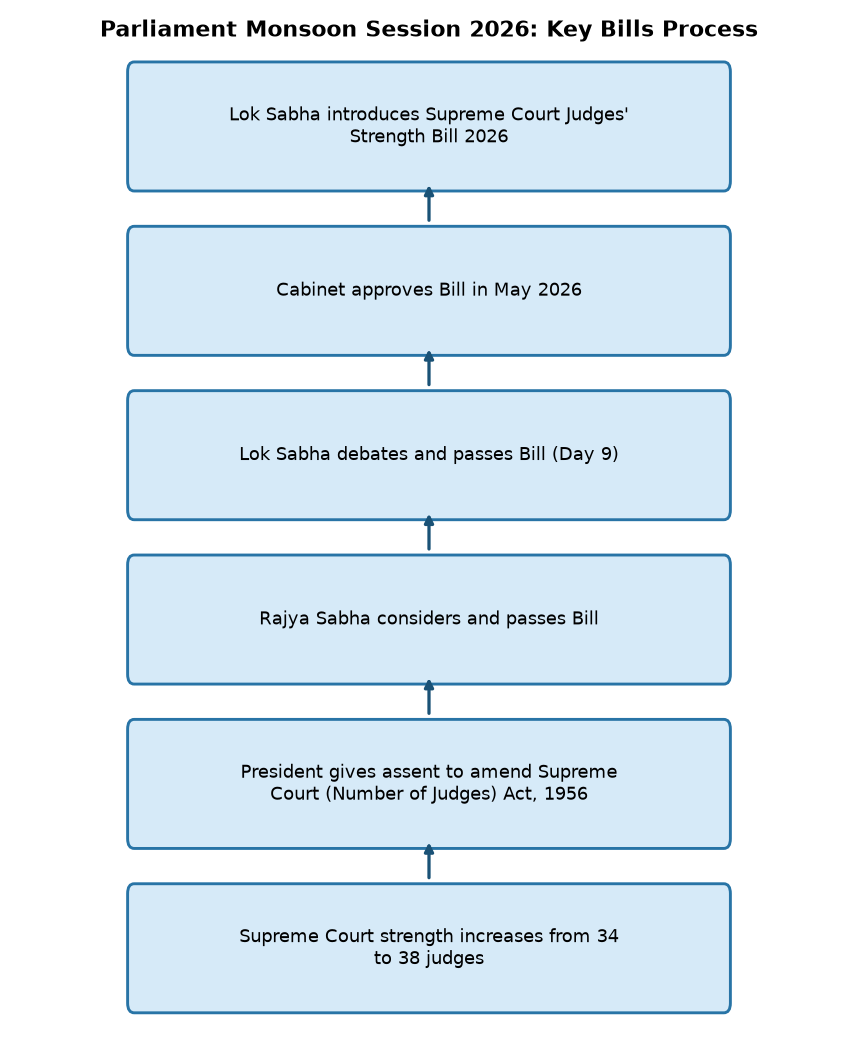
The Lok Sabha is scheduled to consider and pass the Supreme Court (Number of Judges) Amendment Bill, 2026, which seeks to increase the sanctioned strength of the Supreme Court from 34 to 38 judges, including the Chief Justice of India. This legislative initiative, approved by the Union Cabinet in May 2026, reflects the government’s response to the growing backlog of cases and the need for judicial efficiency. Concurrently, the Parliament is also deliberating on the Public Examination (Prevention of Unfair Means) Amendment Bill, 2026, aimed at strengthening measures against exam paper leaks, and the MSME Development (Amendment) Bill, 2026, which proposes reforms to enhance the ease of doing business for micro, small, and medium enterprises.
Background
- The MSME Development Act, 2006, was enacted to promote the growth of micro, small, and medium enterprises, which contribute approximately 30% to India’s GDP and employ over 110 million people.
- The Monsoon Session of Parliament in 2026 is witnessing heightened legislative activity, with a focus on judicial reforms, anti-corruption measures, and economic facilitation for MSMEs.
- The passage of these bills aligns with the government’s broader agenda of institutional strengthening and economic revival post-pandemic.
MSME Development (Amendment) Bill, 2026
- **MSME Development (Amendment) Bill, 2026**: Proposes amendments to the MSME Development Act, 2006, to enhance the ease of doing business for micro, small, and medium enterprises by improving payment systems, simplifying compliance, and expediting dispute resolution.
- The amendments aim to address challenges such as delayed payments, complex compliance procedures, and lack of access to credit, which have historically constrained the growth of MSMEs.
- The Bill is expected to boost the sector’s contribution to GDP, which currently stands at approximately 30%, and generate employment opportunities for over 110 million people.
- The MSME sector is a critical component of India’s economic growth, contributing significantly to exports and industrial output, particularly in sectors such as textiles, food processing, and manufacturing.
Key Features
| Feature | Significance |
|---|---|
| Supreme Court (Number of Judges) Amendment Bill, 2026 | Proposes to amend the Supreme Court (Number of Judges) Act, 1956, to increase the sanctioned strength of the apex court from 34 to 38 judges, excluding the Chief Justice of India. |
| Public Examination (Prevention of Unfair Means) Amendment Bill, 2026 | Introduces stricter measures to curb exam paper leaks, passed by the Lok Sabha via voice vote after a two-day debate marked by disruptions. |
| Micro, Small and Medium Enterprises Development (Amendment) Bill, 2026 | Aims to amend the MSME Development Act, 2006, to improve payment systems, simplify compliance, and expedite dispute resolution for MSMEs. |
| Cabinet approval in May 2026 | The Union Cabinet had approved the proposal to increase the Supreme Court judges’ strength, indicating government prioritisation of judicial capacity expansion. |
| Rajya Sabha consideration on Day 9 | The Upper House is scheduled to consider and pass both the exam leak bill and the MSME amendment bill, reflecting multi-party legislative scrutiny. |
Why it Matters
Judicial System
- Expansion of Supreme Court strength from 34 to 38 judges addresses the growing backlog of cases and enhances judicial efficiency in constitutional and civil matters.
- Reflects the government’s recognition of the need for greater judicial manpower to meet the increasing caseload, particularly in complex socio-economic and constitutional disputes.
- Aligns with the broader objective of reducing pendency in the apex court, which currently faces a significant number of pending cases exceeding one lakh.
Governance and Accountability
- The Public Examination (Prevention of Unfair Means) Amendment Bill, 2026, underscores the state’s commitment to ensuring transparency and fairness in competitive examinations, a critical governance issue.
- The legislative response to exam paper leaks highlights the societal and economic costs of malpractices in public examinations, which undermine meritocracy and social mobility.
- The MSME amendment bill’s focus on payment systems and dispute resolution demonstrates the government’s intent to bolster the ease of doing business for small enterprises, a key driver of economic growth.
Parliamentary Process
- The passage of the exam leak bill via voice vote, despite disruptions, illustrates the challenges of legislative consensus in a polarised political environment.
- The consideration of multiple bills in a single session reflects the government’s legislative agenda prioritisation and the Parliament’s role in deliberative democracy.
- The expungement of a word from Opposition leader Rahul Gandhi’s speech underscores the procedural rigour and potential for political friction in parliamentary proceedings.
Economic Implications
- The MSME amendment bill’s provisions on payment systems and dispute resolution are expected to reduce financial burdens on small enterprises, fostering entrepreneurship and employment generation.
- Judicial capacity expansion may indirectly support economic growth by ensuring timely resolution of commercial disputes, thereby enhancing investor confidence.
- Addressing exam malpractices ensures a level playing field for aspirants, particularly in sectors like civil services, where merit-based selection is critical.
Challenges
1. Judicial Vacancy and Pendency
- Despite the increase in sanctioned strength, the actual appointment of judges may face delays due to the collegium system’s procedural requirements.
- The existing backlog of over one lakh cases in the Supreme Court necessitates not only increased strength but also systemic reforms in case management.
- Ensuring geographical and demographic diversity in judicial appointments remains a challenge to maintain representational equity.
UPSC Link: Judicial Appointments and Collegium System
2. Political Polarisation in Parliament
- Frequent disruptions and adjournments during debates, as seen with the exam leak bill, hinder constructive legislative discourse.
- The use of voice votes and expungement of remarks reflect underlying tensions, which may impede consensus on critical bills.
- Opposition allegations of police brutality during protests highlight the need for balanced governance and respect for democratic dissent.
UPSC Link: Parliamentary Procedures and Conduct
3. Implementation of MSME Reforms
- Simplifying compliance and improving payment systems require coordination between central and state governments, as MSMEs are governed by concurrent lists.
- Dispute resolution mechanisms must be streamlined to ensure timely redressal, avoiding prolonged litigation that burdens small enterprises.
- Awareness campaigns are needed to educate MSMEs about the amended provisions to maximise their benefits.
UPSC Link: MSME Development Act and Ease of Doing Business
4. Social Impact of Exam Malpractices
- Exam paper leaks disproportionately affect marginalised sections, exacerbating socio-economic inequalities by undermining merit-based opportunities.
- The psychological and economic impact on students, particularly in competitive exams like the UPSC Civil Services Examination, necessitates robust preventive measures.
- Balancing stringent penalties with fair investigation processes is essential to avoid miscarriages of justice.
UPSC Link: Public Examination Reforms and Governance
5. Resource Allocation for Judicial Expansion
- Increasing the number of judges requires corresponding allocation of financial resources for infrastructure, salaries, and administrative support.
- The government must ensure that the expansion does not compromise the quality of judicial appointments or lead to a dilution of selection criteria.
- Long-term sustainability of judicial capacity expansion depends on periodic reviews of the sanctioned strength based on caseload trends.
UPSC Link: Judicial Infrastructure and Budgetary Allocations
Challenges — UPSC Perspective
| Issue | Concern |
|---|---|
| Collegium System Delays | Potential bottlenecks in appointing additional judges despite legislative approval. |
| Parliamentary Disruptions | Frequent adjournments and disruptions may delay the passage of critical bills. |
| MSME Awareness Gap | Lack of awareness among small enterprises about amended provisions may limit the bill’s impact. |
| Exam Leak Deterrence | Ensuring that stringent penalties act as a strong deterrent without infringing on civil liberties. |
| Judicial Infrastructure | Inadequate infrastructure to support the increased number of judges and staff. |
Way Forward
- Constitute a high-powered committee to expedite the appointment of additional Supreme Court judges under the collegium system, ensuring transparency and adherence to timelines.
- Introduce digital case management systems in the Supreme Court to streamline proceedings and reduce pendency, complementing the increase in judicial strength.
- Organise nationwide awareness campaigns for MSMEs to educate them about the amended provisions, particularly on payment systems and dispute resolution mechanisms.
- Strengthen the grievance redressal mechanism for students and aspirants to report exam malpractices, ensuring swift action and protection of whistleblowers.
- Enhance coordination between the Centre and states to ensure uniform implementation of MSME reforms, leveraging the concurrent nature of the subject.
- Conduct periodic reviews of the Supreme Court’s sanctioned strength to align it with the evolving caseload and demographic requirements.
- Promote parliamentary sessions with structured debates and limited disruptions to foster constructive legislative outcomes.
- Establish a dedicated fund for judicial infrastructure development to support the expansion of the Supreme Court’s capacity.
UPSC Value Addition
Keywords for Mains Answer-Writing
Supreme Court judges’ strength · Supreme Court (Number of Judges) Act, 1956 · Judicial appointments and vacancies · Separation of powers · Judicial independence · Judicial reforms · Constitutional amendments · Article 124 of the Constitution · Collegium system · Judicial vacancies and pendency
Constitutional & Policy Linkages
- [‘Article 124(1)’, ‘Maximum strength of Supreme Court judges.’]
- [‘Article 145’, ‘Power of Supreme Court to regulate its procedure.’]
- [‘Article 32’, ‘Writ jurisdiction of Supreme Court for enforcement of fundamental rights.’]
Concept Flow
Increasing caseload in Supreme Court → Recognition of judicial capacity deficit → Proposal to amend Supreme Court (Number of Judges) Act, 1956 → Legislative approval for increase in sanctioned strength → Collegium process for appointments → Enhanced judicial efficiency and reduced pendency. → Frequent exam paper leaks → Public outrage and governance failure → Introduction of Public Examination (Prevention of Unfair Means) Amendment Bill, 2026 → Stricter penalties and preventive measures → Enhanced transparency in competitive examinations. → MSMEs face payment delays and dispute resolution challenges → Introduction of MSME Development (Amendment) Bill, 2026 → Simplified compliance and faster redressal → Improved ease of doing business and economic growth. → Parliamentary disruptions during debates → Voice vote passage of critical bills → Potential erosion of deliberative democracy → Need for structured parliamentary procedures. → Government’s legislative agenda prioritisation → Consideration of multiple bills in a single session → Reflection of multi-party scrutiny and democratic governance.
Prelims Practice Questions
Q1. Consider the following statements regarding the Supreme Court of India:
1. The sanctioned strength of judges in the Supreme Court is currently 33, excluding the Chief Justice of India.
2. The Supreme Court (Number of Judges) Act, 1956, provides for the maximum number of judges.
3. The Chief Justice of India is included in the sanctioned strength of 33 judges.
4. The Parliament can increase the sanctioned strength of judges through a constitutional amendment.
How many of the above statements are correct?
- Only one
- Only two
- Only three
- All four
Answer: Only two — Statement 1 is correct as the sanctioned strength is 33 excluding the CJI. Statement 2 is correct as the Act governs the maximum number of judges. Statement 3 is incorrect as the CJI is not included in the 33. Statement 4 is incorrect as the strength can be increased by a simple parliamentary law under Article 124(1), not a constitutional amendment.
Q2. Assertion (A): The Supreme Court (Number of Judges) Amendment Bill, 2026 seeks to amend the Supreme Court (Number of Judges) Act, 1956.
Reason (R): The Bill aims to increase the sanctioned strength of judges from 34 to 38, including the Chief Justice of India.
- Both A and R are true, and R is the correct explanation of A.
- Both A and R are true, but R is not the correct explanation of A.
- A is true, but R is false.
- A is false, but R is true.
Answer: A is true, but R is false. — Assertion (A) is true as the Bill seeks to amend the 1956 Act. Reason (R) is false because the sanctioned strength is 33 excluding the CJI, and the Bill proposes to increase it to 37 excluding the CJI (total 38 including the CJI).
Q3. Match the following pairs related to judicial reforms in India:
Column I (Committee/Act) Column II (Purpose)
A. Supreme Court (Number of Judges) Act, 1956 1. Regulates the appointment of judges
B. Collegium System 2. Determines the sanctioned strength of judges
C. Article 124(1) of the Constitution 3. Provides for the establishment of the Supreme Court
D. National Judicial Commission Bill, 2013 4. Proposed to replace the collegium system
Choose the correct match:
- A-2, B-1, C-3, D-4
- A-1, B-2, C-3, D-4
- A-3, B-1, C-2, D-4
- A-4, B-2, C-1, D-3
Answer: A-2, B-1, C-3, D-4 — A matches with 2 (the Act determines the sanctioned strength). B matches with 1 (the collegium system regulates judicial appointments). C matches with 3 (Article 124(1) establishes the Supreme Court). D matches with 4 (the NJAC Bill proposed to replace the collegium system).
Mains Practice Question
✍ The Parliament is considering a Bill to increase the sanctioned strength of Supreme Court judges from 34 to 38. Critically examine the constitutional and institutional implications of such an increase in the context of judicial independence, pendency of cases, and the collegium system. (15 Marks)
Approach: MODEL-ANSWER SKELETON:
1. Context: Current sanctioned strength (33 excluding CJI), judicial pendency (~50 lakh cases), and the Bill’s proposal (37 excluding CJI, total 38 including CJI).
2. Constitutional provisions: Article 124(1) empowers Parliament to determine the strength; collegium system under Second and Third Judges Cases.
3. Judicial independence: Arguments for increasing strength (reducing pendency, improving access to justice) vs. risks (dilution of collegium’s primacy, executive overreach).
4. Case law: Reference to the Second Judges Case (1993) and Third Judges Case (1998) on collegium system; recent judgments on judicial vacancies (e.g., In Re: Appointment of Judges to the Supreme Court, 2021).
5. Comparative perspective: Judicial strength in other jurisdictions (e.g., USA: 9 judges, UK: no fixed strength).
6. Conclusion: Balance between efficiency and institutional autonomy; suggest measures like filling existing vacancies first, improving infrastructure, and digitalisation.
Source: The Indian Express
Generated by AanyaAi for educational purpose.

- उत्तराखंड राज्यपाल के 5 वर्ष: पांच मिशन और AI क्रांति का लेखा-जोखा - September 15, 2026
- UPSC Focus: Uttarakhand Governor’s 5-Year Journey & 5 Key Missions Explained - September 15, 2026
- AI का वादा और खतरा: क्या मानवता के लिए खतरा है कृत्रिम बुद्धिमत्ता? - September 15, 2026

No Comments