


25 Sep Supreme Court Orders Reinstatement of Ex-IAF Officer as Squadron Leader
✎ The Supreme Court’s exercise of Article 142 in reinstating a war widow as an IAF officer underscores the judiciary’s role in addressing humanitarian exigencies while ensuring that institutional policies do not override…
Subject Relevance — Where This Topic Fits
- GS Paper II — Constitutional Framework (Judicial Review and Discretionary Powers) | GS Paper III — Security Forces and Governance (Recruitment and Service Conditions)
- Prelims: Article 142, Short Service Commission (SSC), Permanent Commission (PC), War Widow, IAF Squadron Leader, Mig-21 Bison
- Essay: Role of the Judiciary in Balancing Individual Rights and Institutional Autonomy
Quick Revision: The Supreme Court’s exercise of Article 142 in reinstating a war widow as an IAF officer underscores the judiciary’s role in addressing humanitarian exigencies while ensuring that institutional policies do not override constitutional rights to fair consideration for re-employment.
Why is this in the news?
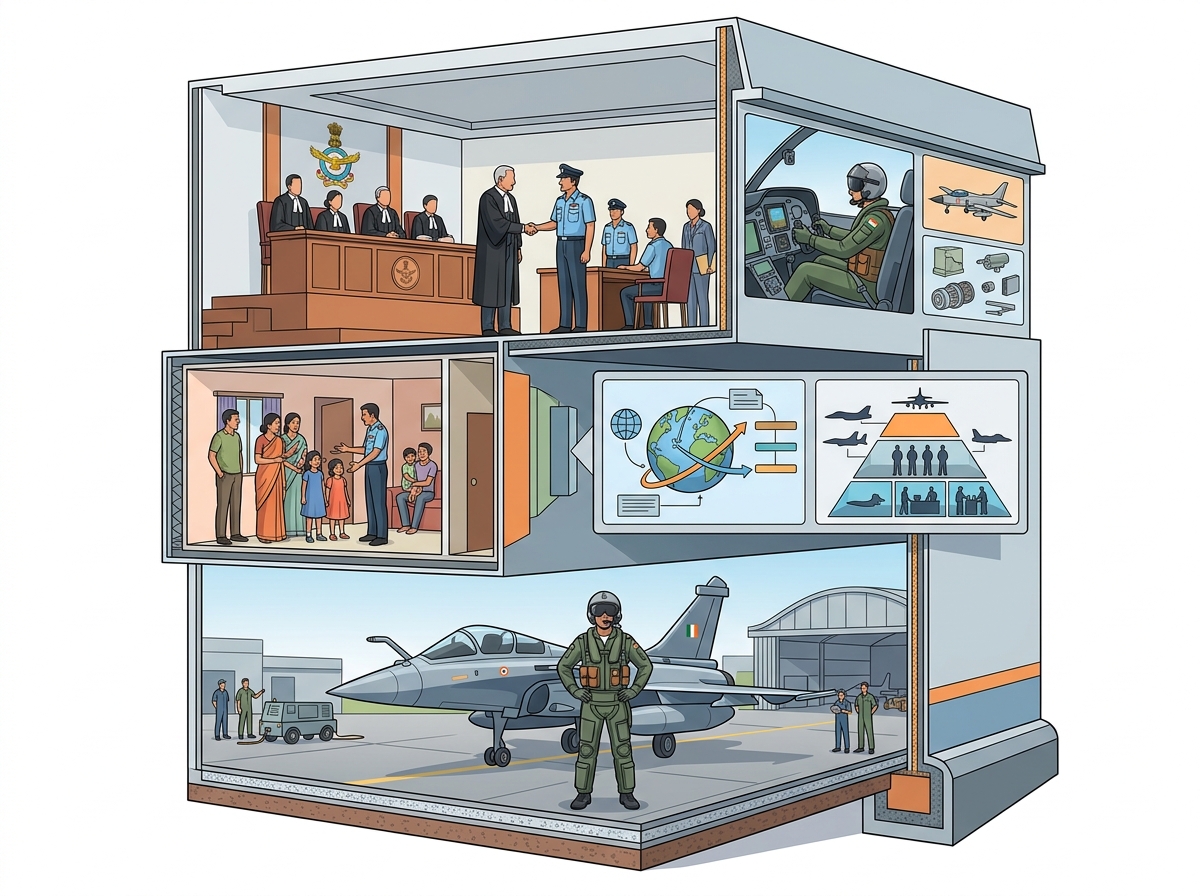
The Supreme Court, exercising its extraordinary jurisdiction under Article 142 of the Constitution, directed the reinstatement of former IAF officer Priyanka Saxena into the Indian Air Force (IAF) as a Squadron Leader, despite her prior voluntary resignation in 2013. The bench highlighted her prior service record, the circumstances of her husband’s death in a MiG-21 Bison crash during active duty, and the absence of a requirement for fresh training due to her operational experience. The judgment underscores the judiciary’s role in addressing unique humanitarian and service-related exigencies while clarifying that the precedent is case-specific.
Background
- The Indian Air Force (IAF) operates under a dual commission system: Short Service Commission (SSC) and Permanent Commission (PC), with SSC officers serving for a fixed tenure and eligible for PC based on merit and vacancy.
- Widows of defence personnel, including those from the IAF, are governed by the ‘Re-employment of Ex-Servicemen (REES) Policy’ and specific welfare schemes such as the ‘Ex-Servicemen Contributory Health Scheme (ECHS)’ and ‘War Widow Pension’ under the Pension Regulations for the Army, 2008.
- The Supreme Court’s jurisdiction under Article 142 empowers it to pass any order necessary for doing complete justice in any cause or matter pending before it, even if such relief is not explicitly provided by statute.
- The case highlights the intersection of military service, family obligations, and judicial intervention in matters of re-employment, particularly for personnel with prior operational experience.
- The IAF’s policy on re-employment of former officers, especially war widows, is governed by internal directives and may not always accommodate individual circumstances without judicial intervention.
What is the Legal and Institutional Framework Governing the Reinstatement of Priyanka Saxena?
- Article 142 of the Constitution: Grants the Supreme Court the power to pass any order necessary for securing the ends of justice, including reinstatement of individuals in service, provided the relief is case-specific and does not set a binding precedent.
- Short Service Commission (SSC) in the IAF: A tenure-based commission for officers, typically ranging from 5 to 14 years, with limited opportunities for conversion to Permanent Commission (PC) based on merit and vacancy.
- Re-employment Policies for Ex-Servicemen: The ‘Re-employment of Ex-Servicemen (REES) Policy’ and internal IAF directives govern the re-employment of former officers, often prioritising those with recent operational experience or specialised skills.
- War Widow Pension and Welfare Schemes: Widows of defence personnel are entitled to pensions and healthcare under schemes like the Ex-Servicemen Contributory Health Scheme (ECHS) and War Widow Pension, administered by the Department of Ex-Servicemen Welfare.
- Judicial Review of Service Matters: Courts may intervene in service-related disputes if there is a violation of constitutional rights, procedural fairness, or if the denial of re-employment is arbitrary or lacks reasonable justification.
- Operational Experience and Training Requirements: The Supreme Court noted that Priyanka Saxena’s prior service as an IAF officer rendered fresh training unnecessary, distinguishing her case from fresh recruits or those without operational experience.
- Humanitarian Considerations: The judgment reflects the judiciary’s sensitivity to the unique circumstances of war widows, balancing institutional autonomy with individual rights and societal expectations.
Key Features
| Feature | Significance |
|---|---|
| Supreme Court’s exercise of Article 142 | Demonstrates the apex court’s power to do complete justice in exceptional cases where statutory provisions may not provide adequate relief. |
| Reinstatement of a former Short Service Commission (SSC) officer | Highlights the judiciary’s recognition of prior military service and its potential utility in addressing contemporary needs of the armed forces. |
| Consideration of war widow status alongside prior service | Illustrates the court’s nuanced approach in balancing personal circumstances with institutional requirements. |
| Exclusion of precedential value of the judgment | Emphasizes that the ruling is case-specific and does not set a binding precedent for other similar cases. |
| Judicial intervention in administrative decisions of the armed forces | Underscores the judiciary’s role in reviewing and correcting administrative actions when they fail to account for individual merit and circumstances. |
Why it Matters
Judicial-Executive Interface
- The judgment reinforces the judiciary’s capacity to intervene in administrative decisions of the armed forces when they appear arbitrary or fail to consider exceptional personal circumstances.
- It sets a precedent for future cases involving war widows or former service personnel seeking reinstatement, though the court explicitly limited the scope of this judgment.
- The decision may prompt the armed forces to review their policies on reinstatement of former personnel, particularly those with prior service and exceptional personal circumstances.
Gender and Military Service
- The case highlights the challenges faced by women in balancing military service with family responsibilities, especially in high-risk roles like fighter pilot operations.
- It underscores the need for gender-sensitive policies in the armed forces to accommodate the unique circumstances of service personnel, particularly women who may face dual burdens of professional and familial obligations.
- The judgment may encourage a broader discussion on the integration of women in combat roles and the support systems required for their sustained participation.
Institutional Efficiency and Personnel Management
- The armed forces may need to revisit their personnel policies to better utilise the skills and experience of former personnel, particularly in critical roles where institutional memory and operational experience are valuable.
- The decision may prompt the armed forces to streamline processes for reinstatement or re-employment of former personnel, reducing bureaucratic delays and administrative hurdles.
- It raises questions about the balance between institutional needs and individual circumstances in personnel management decisions.
Challenges
1. Administrative Rigidity in Armed Forces Personnel Policies
- The armed forces’ policies on reinstatement or re-employment of former personnel may lack flexibility to accommodate exceptional circumstances, such as those faced by war widows with prior service.
- Bureaucratic inertia and rigid adherence to procedural norms may delay or deny justified reinstatement requests, necessitating judicial intervention.
UPSC Link: GS-III: Defence
2. Balancing Institutional Needs with Individual Circumstances
- The armed forces must balance the need for operational efficiency with the legitimate personal circumstances of service personnel, particularly in high-risk roles.
- Policies must evolve to accommodate the unique challenges faced by women in military service, including family responsibilities and post-traumatic circumstances.
UPSC Link: GS-I: Role of Women in Armed Forces
3. Legal Precedents and Stare Decisis
- The judgment’s explicit exclusion of precedential value raises questions about the consistency and predictability of judicial decisions in similar cases.
- Future litigants may face uncertainty in relying on this judgment as a legal precedent, despite its substantive reasoning.
UPSC Link: GS-II: Judiciary
4. Operational Readiness and Training Requirements
- The reinstatement of former personnel may require adjustments in training and operational readiness protocols to ensure seamless integration.
- The armed forces must ensure that reinstated personnel are adequately prepared for their roles, particularly in high-stakes environments like fighter operations.
UPSC Link: GS-III: Defence
5. Policy Gaps in Support for War Widows and Service Personnel
- There may be systemic gaps in the support provided to war widows and service personnel, particularly in terms of psychological, financial, and career rehabilitation.
- The case highlights the need for comprehensive policies to address the post-service challenges faced by service personnel and their families.
UPSC Link: GS-II: Social Justice
Challenges — UPSC Perspective
| Issue | Concern |
|---|---|
| Rigid personnel policies | May fail to accommodate exceptional circumstances, leading to administrative delays or denials. |
| Gender bias in military service | Lack of gender-sensitive policies may hinder the integration and retention of women in combat roles. |
| Judicial intervention in administrative matters | May undermine the autonomy of the armed forces in personnel management decisions. |
| Training and operational readiness | Reinstatement of former personnel may require adjustments in training protocols to ensure seamless integration. |
| Support for war widows | Inadequate policies may leave war widows without adequate psychological, financial, or career rehabilitation. |
Way Forward
- The armed forces should conduct a comprehensive review of their personnel policies to incorporate flexibility for exceptional circumstances, such as those faced by war widows with prior service.
- The Ministry of Defence should explore the establishment of a dedicated grievance redressal mechanism for former service personnel seeking reinstatement or re-employment.
- Policies should be developed to provide psychological and financial support to war widows and service personnel transitioning out of active duty.
- The armed forces should consider pilot programs to reintegrate former personnel with prior service, particularly in critical roles where their experience is valuable.
- Judicial training should include modules on the administrative functioning of the armed forces to ensure informed and nuanced judicial interventions.
- The government should commission a study on the challenges faced by women in military service, including family responsibilities and post-traumatic circumstances, to inform policy reforms.
- The armed forces should enhance transparency in their personnel policies and decision-making processes to reduce administrative delays and build trust.
UPSC Value Addition
Keywords for Mains Answer-Writing
Supreme Court of India · Article 142 of the Constitution · Short Service Commission (SSC) in Indian Armed Forces · Permanent Commission in Armed Forces · War Widow · Indian Air Force (IAF) · Squadron Leader · Gender and Military Service · Judicial Review of Military Decisions · Constitutional Remedies · Gender Equality in Armed Forces · Judicial Activism
Concept Flow
Personal Circumstance (war widow status and prior service) → Judicial Intervention (Article 142) → Reinstatement Order → Armed Forces Personnel Policy Review → Institutional Efficiency Enhancement → Gender-Sensitive Military Service Policies
Prelims Practice Questions
Q1. Consider the following statements regarding the Short Service Commission (SSC) in the Indian Armed Forces:
1. SSC officers can opt for Permanent Commission after completing their tenure.
2. SSC officers are eligible for pension after 10 years of service.
3. SSC officers can be granted extensions in service beyond their initial tenure.
How many of the above statements are correct?
- Only one
- Only two
- All three
- None
Answer: All three — Statements 1 and 3 are correct. SSC officers can opt for Permanent Commission after completing their tenure (Statement 1). Extensions beyond the initial tenure are granted based on service requirements (Statement 3). Statement 2 is incorrect as pension eligibility for SSC officers is subject to specific conditions and not automatic after 10 years.
Q2. Assertion (A): The Supreme Court of India can use its powers under Article 142 to grant reliefs that are not specifically provided for in existing laws.
Reason (R): Article 142 empowers the Supreme Court to pass any order necessary for doing complete justice in any cause or matter pending before it.
In the context of the above statements, which of the following is correct?
- Both A and R are true, and R is the correct explanation of A
- Both A and R are true, but R is NOT the correct explanation of A
- A is true, but R is false
- A is false, but R is true
Answer: Both A and R are true, and R is the correct explanation of A — Both Assertion (A) and Reason (R) are true. Article 142 of the Constitution empowers the Supreme Court to pass any order necessary for doing complete justice in any cause or matter pending before it, which includes granting reliefs not explicitly provided for in existing laws.
Q3. Match the following columns regarding military ranks and their equivalent ranks in the Indian Armed Forces:
Column I (Rank) | Column II (Equivalent Rank in Indian Armed Forces)
—————–|———————————————–
1. Squadron Leader | A. Colonel
2. Wing Commander | B. Lieutenant Colonel
3. Group Captain | C. Major
Select the correct match:
- 1-B, 2-C, 3-A
- 1-C, 2-B, 3-A
- 1-A, 2-B, 3-C
- 1-C, 2-A, 3-B
Answer: 1-C, 2-A, 3-B — The correct matches are: 1. Squadron Leader (Indian Air Force) is equivalent to Major (Indian Army) — Option C; 2. Wing Commander (Indian Air Force) is equivalent to Lieutenant Colonel (Indian Army) — Option B; 3. Group Captain (Indian Air Force) is equivalent to Colonel (Indian Army) — Option A.
Mains Practice Question
✍ The Supreme Court of India, invoking Article 142, reinstated a former Short Service Commission officer of the Indian Air Force as Squadron Leader after her husband, a fighter pilot, died in a MiG-21 crash. Critically examine the implications of this judgment on the principles of gender equality, judicial review of military decisions, and the balance between constitutional remedies and institutional autonomy of the armed forces. (15 Marks)
Approach: MODEL-ANSWER SKELETON:
1. **Context and Factual Background** (2 Marks):
– Brief outline of the case: reinstatement of Squadron Leader Priyanka Saxena under Article 142.
– Key facts: SSC officer, 10 years of service, family responsibilities, husband’s death in MiG-21 crash (2021), denial of re-employment.
2. **Judicial Power under Article 142** (3 Marks):
– Constitutional basis: Article 142 empowers the Supreme Court to pass any order necessary for doing complete justice.
– Judicial activism vs. institutional limits: balancing justice with separation of powers.
– Precedents: cite landmark cases (e.g., Union Carbide, Bhopal Gas Tragedy case) to illustrate the scope of Article 142.
3. **Gender Equality in Armed Forces** (4 Marks):
– Historical context: SSC vs. Permanent Commission in IAF (refer to 2020 Supreme Court judgment in ‘Babita Puniya’ case).
– Gender bias in re-employment post-family responsibilities: analyze the structural barriers faced by women officers.
– Progressive interpretation: whether the judgment reinforces equality or sets a precedent for individualized justice.
4. **Judicial Review of Military Decisions** (3 Marks):
– Scope of judicial review over military appointments, promotions, and re-employment.
– Tension between judicial intervention and institutional autonomy of the armed forces.
– Doctrine of ‘judicial deference’ to military expertise (refer to cases like *Union of India v. S.N. Prasad*).
5. **Balancing Constitutional Remedies and Institutional Autonomy** (3 Marks):
– Need for a principled approach: when should the judiciary intervene in military matters?
– Potential consequences: impact on military discipline, operational efficiency, and morale.
– Suggested framework: guidelines for future cases to avoid ad-hocism while ensuring justice.
**Concluding Remarks:**
– The judgment is a significant step toward gender inclusivity but must be balanced with institutional integrity.
– Recommendation: codify principles for re-employment of women officers post-family responsibilities to ensure consistency.
Source: amarujala.com
Generated by AanyaAi for educational purpose.
Related guides on our sites
- Anthropology VS PSIR
- Best PSIR optional coaching
- Best PSIR optional coaching online
- Best PSIR optional teacher

- NAMASTE Scheme: Enhancing Sanitation Workers’ Livelihoods & Safety - November 14, 2026
- एमएसएमई का विशेष अभियान 6.0: स्वच्छता और लंबित मामलों का निपटारा - November 14, 2026
- Sea Vigil-26: Coastal Defence Drills Off Visakhapatnam - November 14, 2026

No Comments