


11 Aug Supreme Court Questions EC on Delayed Voter List Appeals in West Bengal
✎ The Supreme Court’s directive to the Election Commission of India to provide data on pending appeals in West Bengal’s voter list deletions underscores the constitutional imperative of timely electoral justice under Article 324.
Subject Relevance — Where This Topic Fits
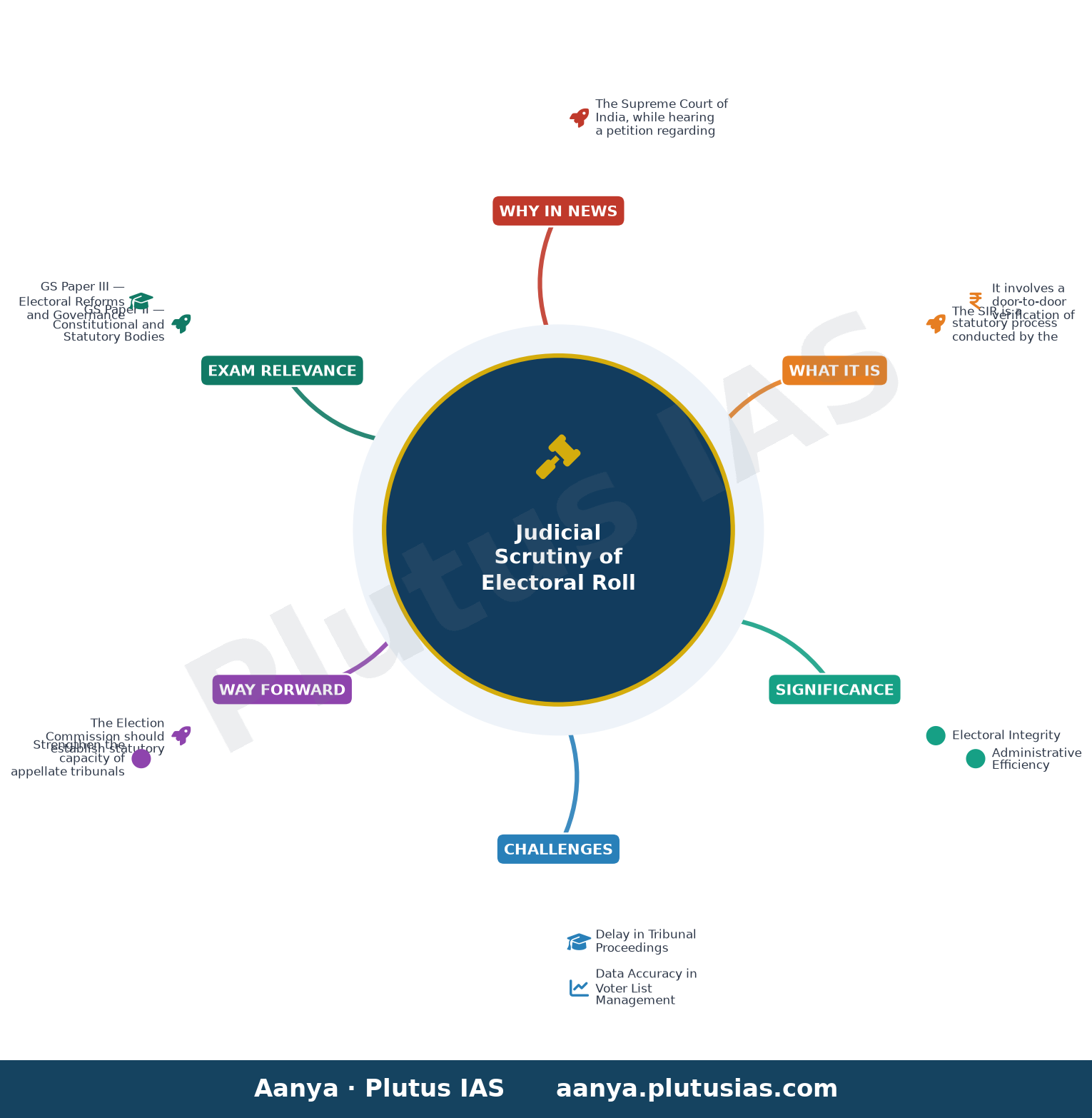
- GS Paper II — Constitutional and Statutory Bodies (Election Commission of India) | GS Paper III — Electoral Reforms and Governance
- Prelims: Voter List Revision, Special Intensive Revision (SIR), Electoral Tribunals, Article 324, Model Code of Conduct, Election Petition, Electoral Dispute Resolution
- Essay: Electoral Integrity and Democratic Governance, Judicial Oversight of Administrative Processes
Quick Revision: The Supreme Court’s directive to the Election Commission of India to provide data on pending appeals in West Bengal’s voter list deletions underscores the constitutional imperative of timely electoral justice under Article 324.
Why is this in the news?
The Supreme Court of India, while hearing a petition regarding delays in the disposal of appeals against deletions in the voter list during the Special Intensive Revision (SIR) process in West Bengal, sought detailed information from the Election Commission of India (ECI) on the functioning of appellate tribunals. The Court expressed concern over the slow pace of adjudication, noting that such delays could undermine electoral fairness and public trust in the electoral process.
Background
- The Election Commission of India (ECI) conducts periodic revisions of electoral rolls under the Representation of the People Act, 1950, to ensure accuracy and inclusivity.
- Special Intensive Revision (SIR) is a focused exercise to update voter lists by removing duplicate, erroneous, or ineligible entries, including deceased or shifted voters.
- In West Bengal, the SIR process led to the deletion of approximately 58.20 lakh names from the electoral rolls, constituting about 7.6% of the total voter base.
- The Supreme Court’s intervention underscores the constitutional mandate under Article 324 of the Constitution, which vests the ECI with the superintendence, direction, and control of elections.
- Delays in the disposal of appeals by tribunals have raised concerns about electoral justice, administrative efficiency, and the right to vote under Article 326.
What is the Special Intensive Revision (SIR) of Electoral Rolls?
- The SIR is a statutory process conducted by the Election Commission of India (ECI) under the Representation of the People Act, 1950, to ensure the purity and accuracy of electoral rolls.
- It involves a door-to-door verification of voters, removal of duplicate, erroneous, or ineligible entries (e.g., deceased, shifted, or fictitious voters), and inclusion of eligible but missing voters.
- The process is conducted in phases across states and Union Territories, with the final electoral rolls published for public scrutiny.
- The ECI has implemented SIR in multiple phases, including West Bengal, Uttar Pradesh, Bihar, and other states, to maintain the integrity of electoral rolls.
- The tribunals function as quasi-judicial bodies and are expected to dispose of appeals within a reasonable timeframe to ensure electoral justice.
- Delays in the disposal of appeals can lead to disenfranchisement, as affected voters may face difficulties in accessing electoral rights and associated benefits.
- The Supreme Court’s scrutiny highlights the need for systemic reforms to enhance the efficiency and accountability of appellate tribunals in electoral disputes.
Key Features
| Feature | Significance |
|---|---|
| Special Intensive Revision (SIR) | A statutory process under Section 21 of the Representation of the People Act, 1950, to update the electoral rolls by removing inaccuracies such as deceased, duplicate, or shifted voters. |
| Appeal Tribunals | Constitutional bodies under Article 329B read with Section 8A of the RP Act, 1950, empowered to adjudicate appeals against deletions from the electoral rolls. |
| Disposal Rate | The efficiency metric of tribunals in resolving appeals, critical for ensuring timely justice and preventing disenfranchisement. |
| Electoral Roll Integrity | The accuracy of voter lists is foundational to free and fair elections, as mandated by Articles 324, 325, and 326 of the Constitution. |
| Judicial Oversight | The Supreme Court’s suo motu or petition-based scrutiny ensures constitutional compliance and administrative accountability in electoral processes. |
Why it Matters
Electoral Integrity
- Ensures that only eligible voters remain on the rolls, preventing electoral fraud and maintaining the purity of the electoral process.
- The SIR process directly impacts voter participation, as deletions without due process may lead to disenfranchisement of legitimate voters.
- Timely disposal of appeals by tribunals is essential to uphold the right to vote under Article 326 of the Constitution.
Administrative Efficiency
- The Election Commission’s role in conducting SIR and managing tribunals is a critical function of the Election Commission under Article 324 of the Constitution.
- Delays in tribunal proceedings highlight systemic inefficiencies that may require structural reforms in the electoral adjudication machinery.
- The Supreme Court’s intervention underscores the need for data-driven governance to monitor and improve administrative performance.
Constitutional Safeguards
- The electoral process is a constitutional mandate, and any arbitrary or delayed action in voter list management must be scrutinised for compliance with Articles 325 and 326.
- The independence of tribunals under Article 329B ensures that electoral disputes are resolved without political interference.
Challenges
1. Delay in Tribunal Proceedings
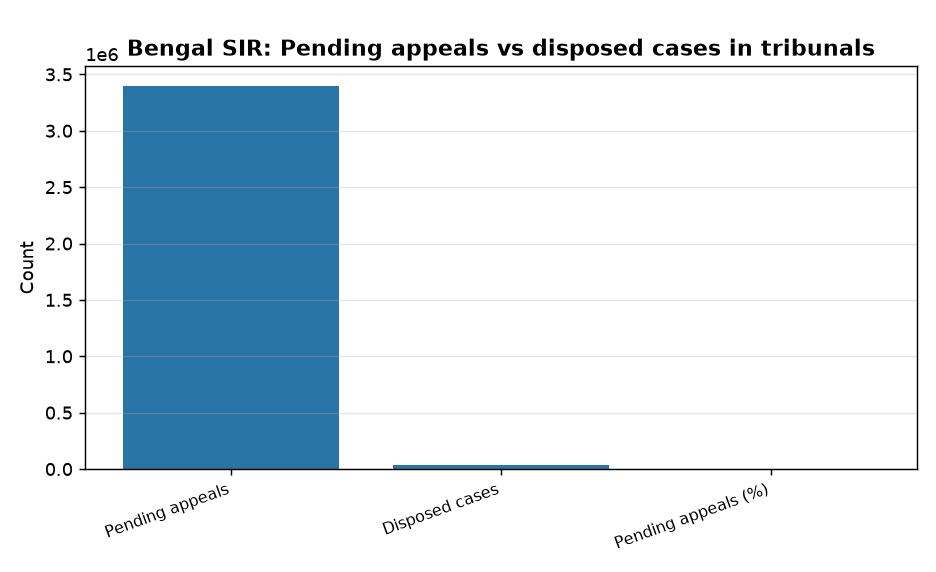
- Approximately 34 lakh appeals are pending in West Bengal alone, indicating severe backlog and potential disenfranchisement.
- The Supreme Court’s observation that ‘the next election may arrive before these appeals are disposed of’ highlights the urgency of addressing delays.
- Delays disproportionately affect marginalised groups who may lack resources to pursue appeals or face administrative hurdles.
UPSC Link: GS-II: Constitutional bodies (Article 329B)
2. Data Accuracy in Voter List Management
- The deletion of 58.20 lakh names in West Bengal raises concerns about the accuracy of the SIR process, particularly in identifying deceased, duplicate, or shifted voters.
- Errors in voter list management can lead to either disenfranchisement of eligible voters or inclusion of ineligible voters, both of which undermine electoral integrity.
- The Election Commission must ensure robust verification mechanisms to prevent arbitrary deletions.
UPSC Link: GS-II: Electoral Reforms (Section 21, RP Act, 1950)
3. Resource Constraints in Tribunals
- Tribunals may lack adequate infrastructure, staff, or training to handle the volume of appeals efficiently.
- Logistical challenges, such as limited working hours or insufficient benches, can exacerbate delays in disposal rates.
- The Supreme Court’s directive to review tribunal capacity suggests systemic resource gaps.
UPSC Link: GS-II: Governance (Judicial-Administrative Interface)
4. Legal Ambiguity in Appeal Procedures
- The lack of a statutory timeline for disposal of appeals creates ambiguity and discretionary delays.
- Applicants may face uncertainty about the duration of their appeals, leading to loss of faith in the electoral process.
- Clarification of procedural timelines under Section 8A of the RP Act, 1950, is necessary to ensure predictability.
UPSC Link: GS-II: Legal Framework (RP Act, 1950)
5. Impact on Socio-Economic Rights
- Delays in tribunal proceedings can deprive individuals of access to essential services such as ration cards, which are linked to voter list verification.
- Disenfranchisement due to procedural delays disproportionately affects vulnerable populations, including the elderly and economically disadvantaged.
- The nexus between electoral rolls and welfare delivery systems necessitates streamlined dispute resolution.
UPSC Link: GS-II: Fundamental Rights (Article 21)
Challenges — UPSC Perspective
| Issue | Concern |
|---|---|
| Pending Appeals (34 lakh) | Severe backlog leading to disenfranchisement and erosion of electoral trust. |
| Deletion Errors (58.20 lakh names) | Potential disenfranchisement of eligible voters or inclusion of ineligible voters. |
| Lack of Statutory Timelines | Ambiguity in appeal disposal, causing procedural delays. |
| Resource Constraints in Tribunals | Inadequate infrastructure and staff leading to inefficiencies. |
| Data Verification Gaps | Inaccuracies in identifying deceased, duplicate, or shifted voters. |
Way Forward
- The Election Commission should establish statutory timelines for the disposal of appeals under Section 8A of the RP Act, 1950, to ensure predictability and accountability.
- Strengthen the capacity of appellate tribunals by increasing benches, staff, and infrastructure, particularly in states with high appeal volumes.
- Implement a robust digital tracking system for appeals to monitor disposal rates and identify bottlenecks in real time.
- Conduct periodic audits of the SIR process to minimise errors in voter list deletions and ensure transparency in verification mechanisms.
- Enhance public awareness campaigns to educate voters about the appeal process and their rights, reducing procedural ignorance.
- The Supreme Court may consider issuing guidelines for the Election Commission to ensure constitutional compliance in electoral roll management.
- Explore the use of alternative dispute resolution mechanisms, such as mediation, to expedite the resolution of disputes related to voter list deletions.
UPSC Value Addition
Keywords for Mains Answer-Writing
Special Intensive Revision (SIR) of electoral rolls · Electoral Tribunals under the Representation of the People Act, 1951 · Delimitation and revision of electoral rolls · Constitutional provisions for electoral justice · Supreme Court directives on electoral disputes · Voter list deletions and appeals · Electoral roll management in India · Judicial oversight of electoral processes · Constitutional functionaries in election management · Time-bound disposal of electoral appeals
Constitutional & Policy Linkages
- Article 324: Superintendence, direction, and control of elections vested in the Election Commission.
- Article 325: Prohibition of discrimination on grounds of religion, race, caste, or sex in electoral rolls.
- Article 326: Adult suffrage as the basis of elections to the House of the People and State Legislative Assemblies.
- Article 329B: Bar to interference by courts in electoral matters, subject to constitutional provisions.
Concept Flow
Initiation of Special Intensive Revision (SIR) under Section 21 of the RP Act, 1950 → Identification and deletion of inaccuracies in electoral rolls → Appeals filed by affected voters in appellate tribunals → Delays in tribunal proceedings due to resource constraints and lack of timelines → Supreme Court’s intervention to scrutinise disposal rates → Potential disenfranchisement and erosion of electoral trust → Need for systemic reforms in tribunal capacity and procedural clarity.
Prelims Practice Questions
Q1. Consider the following statements regarding the Special Intensive Revision (SIR) of electoral rolls in India:
1. SIR is conducted in phases across different states and Union Territories.
2. The first phase of SIR was implemented in Bihar.
3. SIR involves the deletion of names of deceased, duplicate, or shifted voters from the electoral rolls.
4. The final voter list after SIR is not subject to judicial review.
How many of the above statements are correct?
- Only one
- Only two
- Only three
- All four
Answer: Only three — Statements 1, 2, and 3 are correct as per the Representation of the People Act, 1951 and Election Commission guidelines. Statement 4 is incorrect because electoral rolls and their revisions are subject to judicial review, including through Electoral Tribunals and the Supreme Court.
Q2. Assertion (A): The Supreme Court of India has the power to direct the Election Commission to provide data on pending appeals before Electoral Tribunals.
Reason (R): The Supreme Court can exercise its constitutional jurisdiction under Article 142 to ensure the timely disposal of electoral disputes.
Options:
A. Both A and R are true, and R is the correct explanation of A.
B. Both A and R are true, but R is not the correct explanation of A.
C. A is true, but R is false.
D. A is false, but R is true.
Answer: ? — Both Assertion (A) and Reason (R) are true. The Supreme Court, under Article 142, can issue directions to ensure justice, including directing the Election Commission to provide data on pending appeals. R correctly explains A.
Q3. Match the following phases of the Special Intensive Revision (SIR) with the states/UTs where it was implemented:
List-I (Phase) List-II (States/UTs)
1. First Phase A. West Bengal, Uttar Pradesh, Gujarat
2. Second Phase B. Andaman & Nicobar, Lakshadweep, Puducherry
3. Third Phase C. Bihar
Options:
A. 1-C, 2-A, 3-B
B. 1-A, 2-B, 3-C
C. 1-B, 2-A, 3-C
D. 1-C, 2-B, 3-A
- A. 1-C, 2-A, 3-B
- B. 1-A, 2-B, 3-C
- C. 1-B, 2-A, 3-C
- D. 1-C, 2-B, 3-A
Answer: A. 1-C, 2-A, 3-B — The first phase of SIR was implemented in Bihar (1-C). The second phase included West Bengal, Uttar Pradesh, Gujarat, and others (2-A). The third phase included Andaman & Nicobar, Lakshadweep, Puducherry, and others (3-B).
Mains Practice Question
✍ The Special Intensive Revision (SIR) of electoral rolls is a critical process for maintaining the integrity of the electoral rolls in India. However, delays in the disposal of appeals by Electoral Tribunals can undermine the efficacy of this process. In this context, critically examine the constitutional and statutory framework governing the disposal of electoral disputes. Also, analyse the implications of such delays on the democratic process, citing relevant judicial precedents. (15 Marks)
Approach: MODEL-ANSWER SKELETON:
1. **Introduction**: Define SIR and its purpose under the Representation of the People Act, 1951. Highlight the constitutional significance of free and fair elections (Article 324, 325, 326).
2. **Constitutional and Statutory Framework**:
– Role of the Election Commission under Article 324: Superintendence, direction, and control of elections.
– Provisions for revision of electoral rolls (Sections 21-25, 28 of the Representation of the People Act, 1951).
– Establishment of Electoral Registration Officers (EROs) and Appellate Tribunals (Section 22, 24).
– Powers of Appellate Tribunals under Section 24(2) to dispose of appeals.
3. **Judicial Oversight and Precedents**:
– Supreme Court’s role in ensuring timely disposal of electoral disputes (Article 142, 32(2)).
– Key judgments: *Union of India v. Association for Democratic Reforms* (2002) on electoral reforms; *Krishna Kumar Singh v. State of Bihar* (2017) on judicial directions.
– Recent observations by the Supreme Court on delays in disposal of appeals (e.g., *Adhir Ranjan Chowdhury v. Election Commission of India*, 2023).
4. **Implications of Delays**:
– Disenfranchisement of voters due to prolonged disputes.
– Erosion of public trust in electoral processes.
– Potential for electoral malpractices and manipulation.
– Judicial activism to ensure accountability (e.g., directions for time-bound disposal).
5. **Conclusion**:
– Balance between judicial oversight and administrative efficiency.
– Need for structural reforms in Appellate Tribunals (e.g., increasing capacity, digitalization).
– Reiterate the importance of timely disposal for upholding democratic principles.
Source: bhaskar.com
Generated by AanyaAi for educational purpose.

- Rajasthan Panchayati Raj Elections: New Rules, Fines & Disqualification - September 28, 2026
- सेना प्रमुख का बड़ा बयान: जीत जमीन से ही तय होती है, तकनीक नहीं बदल सकती युद्ध की प्रकृति - September 28, 2026
- UPSC Alert: Government Cracks Down on Patwaris for SVAMITVA Scheme Refusals - September 28, 2026

No Comments