


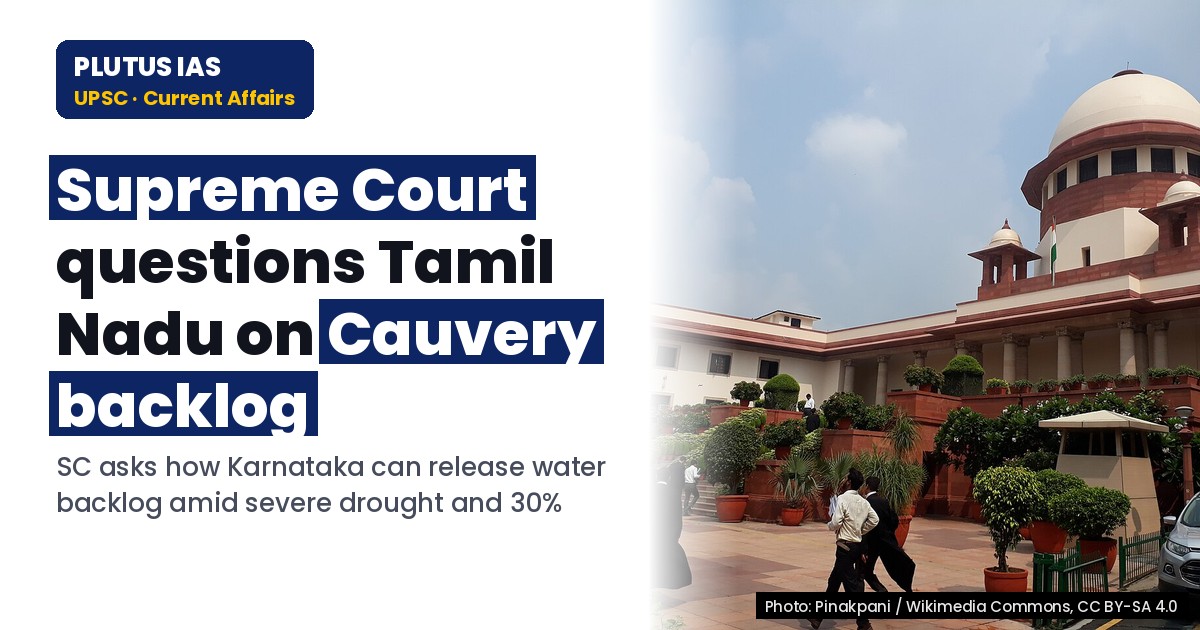
13 Oct Supreme Court Questions Tamil Nadu on Cauvery Backlog Amid Drought
✎ The Cauvery dispute is governed by the Cauvery Water Management Authority (CWMA) and the Cauvery Water Regulation Committee (CWRC), which implement the Supreme Court’s modified award of 2018, allocating 177.25 tmc ft annually to…
Subject Relevance — Where This Topic Fits
- GS Paper II — Functions and Responsibilities of the Union and the States, Issues and Challenges Pertaining to the Federal Structure | GS Paper II — Dispute Redressal Mechanisms and Institutions | GS Paper III — Conservation, Environmental Pollution and Degradation, Environmental Impact Assessment
- Prelims: Cauvery Water Disputes Tribunal (CWDT), Cauvery Water Management Authority (CWMA), Cauvery Water Regulation Committee (CWRC), Inter-State Water Disputes Act, 1956, Southwest Monsoon variability, Negative departure in rainfall, TMC (thousand million cubic feet), Cusec (cubic feet per second), Environmental flows, Riparian States, Catchment area, Reservoir storage capacity
- Essay: Federalism and Natural Resource Governance: Balancing Equity and Efficiency, Climate Change, Monsoon Variability, and Policy Responses in India
Quick Revision: The Cauvery dispute is governed by the Cauvery Water Management Authority (CWMA) and the Cauvery Water Regulation Committee (CWRC), which implement the Supreme Court’s modified award of 2018, allocating 177.25 tmc ft annually to Tamil Nadu, subject to hydrological conditions and environmental flows.
Why is this in the news?
The Supreme Court’s intervention in the Cauvery water dispute between Karnataka and Tamil Nadu in October 2026 highlights the acute challenges in inter-State water governance amid severe monsoon deficits. Tamil Nadu has petitioned the Court, citing a backlog of approximately 11.7 tmc ft in water release at the inter-State border point, while Karnataka contends with extreme drought conditions and prioritises drinking water and environmental flows. This case underscores the interplay between judicial oversight, constitutional provisions, and hydrological realities in resolving transboundary water conflicts.
Background
- The Cauvery river basin spans Karnataka, Tamil Nadu, Kerala, and the Union Territory of Puducherry, with Karnataka and Tamil Nadu being the primary disputing States.
- The Cauvery Water Disputes Tribunal (CWDT), constituted in 1990 under the Inter-State Water Disputes Act, 1956, delivered its final award in 2007, allocating water shares among the riparian States.
- The Supreme Court, in 2018, modified the CWDT award, directing the establishment of the Cauvery Water Management Authority (CWMA) and the Cauvery Water Regulation Committee (CWRC) to implement and monitor the allocation.
- The CWMA, operational since 2018, is the apex body for implementing the Cauvery water-sharing formula, while the CWRC assists in real-time regulation and data collection.
- The southwest monsoon (June–September) is critical for the Cauvery basin, contributing approximately 60% of the annual rainfall, with deficits directly impacting reservoir inflows and inter-State disputes.
- The Cauvery basin has experienced recurring droughts, with cumulative reservoir deficits exceeding 50% in recent years, exacerbating inter-State tensions.
What is the Cauvery Water Dispute and its Governance Framework?
- The Cauvery dispute is a protracted inter-State water-sharing conflict between Karnataka and Tamil Nadu, with Kerala and Puducherry as minor stakeholders, originating from historical usage patterns and competing demands for irrigation, drinking water, and industrial use.
- The Cauvery Water Disputes Tribunal (CWDT), established under the Inter-State Water Disputes Act, 1956, adjudicated the dispute and delivered its final award in 2007, allocating 419 tmc ft to Tamil Nadu, 270 tmc ft to Karnataka, 30 tmc ft to Kerala, and 7 tmc ft to Puducherry.
- The Supreme Court, in its 2018 judgment, upheld the CWDT award but modified it to ensure year-round water availability, directing the release of 177.25 tmc ft annually to Tamil Nadu, with adjustments for monsoon variability and drought conditions.
- The Cauvery Water Management Authority (CWMA), constituted in 2018, is the statutory body responsible for implementing the Supreme Court’s modified award, including monitoring water releases, resolving disputes, and ensuring compliance.
- The Cauvery Water Regulation Committee (CWRC) functions as the operational arm of the CWMA, tasked with real-time data collection, reservoir monitoring, and recommending water releases based on hydrological conditions.
- The dispute resolution mechanism operates through the CWMA’s periodic meetings, where States present data on rainfall, reservoir levels, and water demands, followed by directives for water releases.
- Environmental flows, defined as the minimum water required to sustain aquatic ecosystems, are a critical component of the CWMA’s directives, particularly during droughts to prevent ecological degradation.
- The legal framework governing the dispute includes constitutional provisions (Article 262), the Inter-State Water Disputes Act, 1956, and Supreme Court judgments, which collectively establish the primacy of judicial and institutional oversight in inter-State water governance.
Key Features
| Feature | Significance |
|---|---|
| Cauvery Water Regulation Committee (CWRC) | The statutory body that monitors and regulates water release in the Cauvery basin, ensuring adherence to the Cauvery Water Disputes Tribunal’s award and Supreme Court directives. |
| Cauvery Water Management Authority (CWMA) | The apex body established to implement the final award of the Cauvery Water Disputes Tribunal, facilitating inter-State coordination and dispute resolution. |
| Inter-State Water Disputes Act, 1956 | Provides the legal framework for resolving disputes over inter-State rivers, including the Cauvery, through adjudication and tribunal awards. |
| Southwest Monsoon Deficit (2026) | A 30% rainfall deficit in the Cauvery catchment areas, exacerbating water scarcity and intensifying disputes between Karnataka and Tamil Nadu. |
| Northeast Monsoon Replenishment | Expected to mitigate Tamil Nadu’s water deficit, though its timing and quantum remain uncertain, adding to the complexity of water-sharing negotiations. |
Why it Matters
Economic
- Agricultural productivity in both Karnataka and Tamil Nadu depends on Cauvery water, with paddy and sugarcane cultivation being particularly vulnerable to shortages.
- Industrial sectors in Tamil Nadu, including textiles and power generation, face operational disruptions due to inadequate water supply for cooling and processing.
Strategic
- Water security is a critical national resource issue, requiring balanced governance to prevent inter-State conflicts and ensure equitable distribution.
- The Cauvery dispute exemplifies broader challenges in managing transboundary river basins, necessitating robust institutional mechanisms.
Social
- Rural livelihoods in Cauvery delta regions are directly impacted, with farmers facing crop failures and economic distress due to water scarcity.
- Urban water supply in Tamil Nadu’s cities, such as Chennai, may face shortages, affecting domestic consumption and public health.
Institutional
- The CWMA and CWRC play pivotal roles in enforcing water-sharing agreements, but their effectiveness is tested during extreme climatic events like droughts.
- Judicial intervention, such as the Supreme Court’s scrutiny, underscores the need for transparent and accountable governance in inter-State water disputes.
Challenges
1. Climatic Variability and Water Scarcity
- Erratic monsoon patterns, exacerbated by climate change, disrupt predictable water-sharing mechanisms.
- Drought conditions in Karnataka reduce its capacity to meet Tamil Nadu’s water demands, despite legal obligations under the Tribunal’s award.
UPSC Link: Geography: Climate Change and Water Resources
2. Legal and Institutional Enforcement
- The CWMA’s directives are not always complied with due to competing priorities, such as drinking water and environmental flows.
- Judicial delays in resolving disputes undermine the timely implementation of water-sharing agreements.
UPSC Link: Polity: Inter-State Relations
3. Equitable Water Distribution
- Balancing the needs of upper and lower riparian States remains contentious, particularly during deficits.
- Tamil Nadu’s demand for backlog clearance conflicts with Karnataka’s immediate priorities, such as drinking water supply.
UPSC Link: Polity: Federalism
4. Monitoring and Data Transparency
- Discrepancies in rainfall and water release data between States and the CWRC can exacerbate disputes.
- Lack of real-time data sharing hampers effective decision-making in crisis situations.
UPSC Link: Governance: E-Governance
Challenges — UPSC Perspective
| Issue | Concern |
|---|---|
| Monsoon Deficit | 30% rainfall shortfall in Cauvery catchments, intensifying water scarcity and disputes. |
| Reservoir Inflows | Karnataka’s reservoirs face 54% deficit in inflows, limiting its ability to release water to Tamil Nadu. |
| Legal Compliance | Karnataka’s prioritisation of drinking water and environmental flows conflicts with Tamil Nadu’s demand for backlog clearance. |
| Judicial Intervention | Supreme Court’s scrutiny highlights the need for timely resolution but also underscores systemic delays. |
| Data Discrepancies | Differences in rainfall and water release data between States and CWRC fuel mistrust and disputes. |
| Northeast Monsoon Uncertainty | Tamil Nadu’s reliance on northeast monsoon replenishment introduces unpredictability in water availability. |
Way Forward
- Strengthen the CWMA’s enforcement mechanisms to ensure timely compliance with water-sharing directives, even during droughts.
- Enhance real-time data sharing between States and CWRC to improve transparency and reduce disputes over water release figures.
- Develop a contingency plan for extreme climatic events, including pre-emptive water rationing and alternative crop strategies.
- Promote inter-State dialogues to build consensus on equitable water distribution, leveraging the Inter-State Water Disputes Act, 1956.
- Invest in climate-resilient infrastructure, such as rainwater harvesting and wastewater recycling, to mitigate future water shortages.
- Encourage the adoption of drought-resistant crop varieties in Cauvery basin regions to reduce water dependency.
- Establish a permanent Cauvery Basin Authority to oversee long-term water management and conflict resolution.
UPSC Value Addition
Keywords for Mains Answer-Writing
Inter-State River Water Disputes Act, 1956 · Cauvery Water Management Authority (CWMA) · Cauvery Water Regulation Committee (CWRC) · Supreme Court of India · Inter-State Water Disputes Tribunal · Southwest Monsoon · Riparian States · Water scarcity and drought management · Environmental flows · Constitutional provisions on water disputes · Federalism and cooperative federalism · Cauvery river basin · Northeast monsoon · Water sharing agreements
Constitutional & Policy Linkages
- {‘Article 262’: ‘Inter-State water disputes resolution’}
- {‘Seventh Schedule’: ‘Union and State water resource jurisdiction’}
Concept Flow
Southwest Monsoon deficit (30%) → Reduced inflows into Karnataka’s reservoirs (54% deficit) → Karnataka prioritises drinking water and environmental flows → Tamil Nadu faces water shortfall (11.7 tmc ft) → Tamil Nadu demands backlog clearance → Karnataka cites inability to comply → Supreme Court intervenes to scrutinise claims → CWMA directives remain unfulfilled → Northeast monsoon uncertainty compounds the dispute → Need for institutional reforms and equitable solutions.
Prelims Practice Questions
Q1. Consider the following statements regarding the Cauvery Water Disputes Tribunal (CWDT):
1. The CWDT was constituted under the Inter-State River Water Disputes Act, 1956.
2. The final award of the CWDT was modified by the Supreme Court in 2018.
3. The Cauvery Water Management Authority (CWMA) is the implementation mechanism for the CWDT’s award.
How many of the above statements are correct?
- Only one
- Only two
- All three
- None
Answer: All three — Statements 1 and 3 are correct. The CWDT was constituted under the Inter-State River Water Disputes Act, 1956, and the CWMA is its implementation mechanism. Statement 2 is correct as the Supreme Court modified the CWDT’s final award in 2018.
Q2. Assertion (A): The Cauvery Water Regulation Committee (CWRC) assists the Cauvery Water Management Authority (CWMA) in implementing the final award of the Cauvery Water Disputes Tribunal.
Reason (R): The CWRC is responsible for monitoring and regulating the release of water from Karnataka to Tamil Nadu as per the CWMA’s directives.
- Both A and R are true, and R is the correct explanation of A.
- Both A and R are true, but R is not the correct explanation of A.
- A is true, but R is false.
- A is false, but R is true.
Answer: Both A and R are true, and R is the correct explanation of A. — Both the Assertion (A) and Reason (R) are correct, and R correctly explains A. The CWRC assists the CWMA in monitoring and regulating water releases as per the tribunal’s award.
Q3. Which of the following is NOT a function of the Cauvery Water Management Authority (CWMA)?
- To implement the final award of the Cauvery Water Disputes Tribunal
- To resolve disputes between Karnataka and Tamil Nadu over water sharing
- To monitor and regulate the release of water from Karnataka to Tamil Nadu
- To constitute the Cauvery Water Regulation Committee (CWRC)
Answer: To resolve disputes between Karnataka and Tamil Nadu over water sharing — The CWMA does not resolve disputes; it implements the final award of the Cauvery Water Disputes Tribunal. Dispute resolution is the domain of the tribunal and the Supreme Court.
Mains Practice Question
✍ The failure of the southwest monsoon in 2026 has reignited the Cauvery water-sharing dispute between Karnataka and Tamil Nadu. In this context, critically examine the institutional and constitutional mechanisms available for resolving inter-State river water disputes in India. Also, discuss the challenges posed by extreme weather events such as droughts in the effective implementation of these mechanisms. (15 Marks)
Approach: MODEL-ANSWER SKELETON:
1. Introduction (2 Marks):
– Briefly define inter-State river water disputes and their significance in India’s federal structure.
– Mention the Cauvery dispute as a classic example.
2. Constitutional and Statutory Framework (4 Marks):
– Article 262 of the Constitution: Exclusion of jurisdiction of courts in inter-State water disputes.
– Inter-State River Water Disputes Act, 1956: Provisions for tribunal formation, reference by states, and award implementation.
– Role of the Supreme Court: Original jurisdiction under Article 131 and appellate jurisdiction.
– Cauvery Water Disputes Tribunal (CWDT): Constitution, final award (2007), and Supreme Court’s modification (2018).
– Cauvery Water Management Authority (CWMA) and Cauvery Water Regulation Committee (CWRC): Structure, functions, and limitations.
3. Institutional Mechanisms and Their Challenges (5 Marks):
– Strengths: Tribunal-based resolution, Supreme Court’s role in enforcement, and institutionalised monitoring (CWMA/CWRC).
– Weaknesses: Delay in tribunal formation and award implementation, lack of permanent tribunal, and limited enforcement powers.
– Role of federalism: Cooperative vs. competitive federalism in water-sharing disputes.
– Challenges posed by extreme weather events: Droughts, monsoon variability, and climate change impacts on water availability.
– Case study: 2026 southwest monsoon failure and its impact on the Cauvery dispute.
4. Contemporary Issues and Way Forward (4 Marks):
– Need for a permanent tribunal or appellate authority for water disputes.
– Integration of climate resilience in water-sharing agreements.
– Strengthening institutional capacity for real-time data monitoring and adaptive management.
– Role of the National Water Policy and integrated river basin management.
Balance of views: Acknowledge the legal and institutional strengths while critiquing the delays and lack of adaptive mechanisms in the face of climate change.
Source: The Hindu
Tamil Nadu PCS (TNPSC) — State PCS Practice
Prelims: Which of the following statements best describes Tamil Nadu’s claim regarding the Cauvery water backlog as per the Supreme Court’s response?
- Tamil Nadu has demanded the release of the entire backlog of 1.12 TMC of water from Karnataka, as per the Cauvery Water Disputes Tribunal’s final award.
- Tamil Nadu has requested the Supreme Court to direct Karnataka to release 1.12 TMC of water as a one-time measure to compensate for the backlog.
- Tamil Nadu has sought the Supreme Court’s intervention to reduce the backlog by adjusting the water-sharing formula permanently.
- Tamil Nadu has proposed a new inter-state agreement to resolve the Cauvery water dispute without Supreme Court intervention.
Answer: Tamil Nadu has requested the Supreme Court to direct Karnataka to release 1.12 TMC of water as a one-time measure to compensate for the backlog. — The Supreme Court, in its 2018 judgment, directed Karnataka to release 1.12 TMC of water to Tamil Nadu as a one-time measure to compensate for the backlog, while upholding the existing water-sharing formula.
Mains: Critically examine the legal and political implications of Tamil Nadu’s claim of Cauvery water backlog and the Supreme Court’s response. How does this decision impact inter-state water disputes in India?
Generated by AanyaAi for educational purpose.
Related guides on our sites
- Anthropology VS PSIR
- Best PSIR optional coaching
- Best PSIR optional coaching online
- Best PSIR optional teacher

- Supreme Court Questions Tamil Nadu on Cauvery Backlog Amid Drought - October 13, 2026
- नमामी गंगे: औद्योगिक प्रदूषण नियंत्रण से गंगा की रक्षा - October 13, 2026
- DARPG Releases 50th CPGRAMS Report: Key Insights for UPSC & State PCS - October 13, 2026

No Comments