


11 Aug Supreme Court Seeks Centre’s Response on Netaji’s Ashes Repatriation Plea
✎ The repatriation of Netaji Subhas Chandra Bose’s ashes from Tokyo is a matter of diplomatic protocol, judicial review, and ethical governance, requiring the Union government to balance historical sensitivities with the family’s…
Subject Relevance — Where This Topic Fits
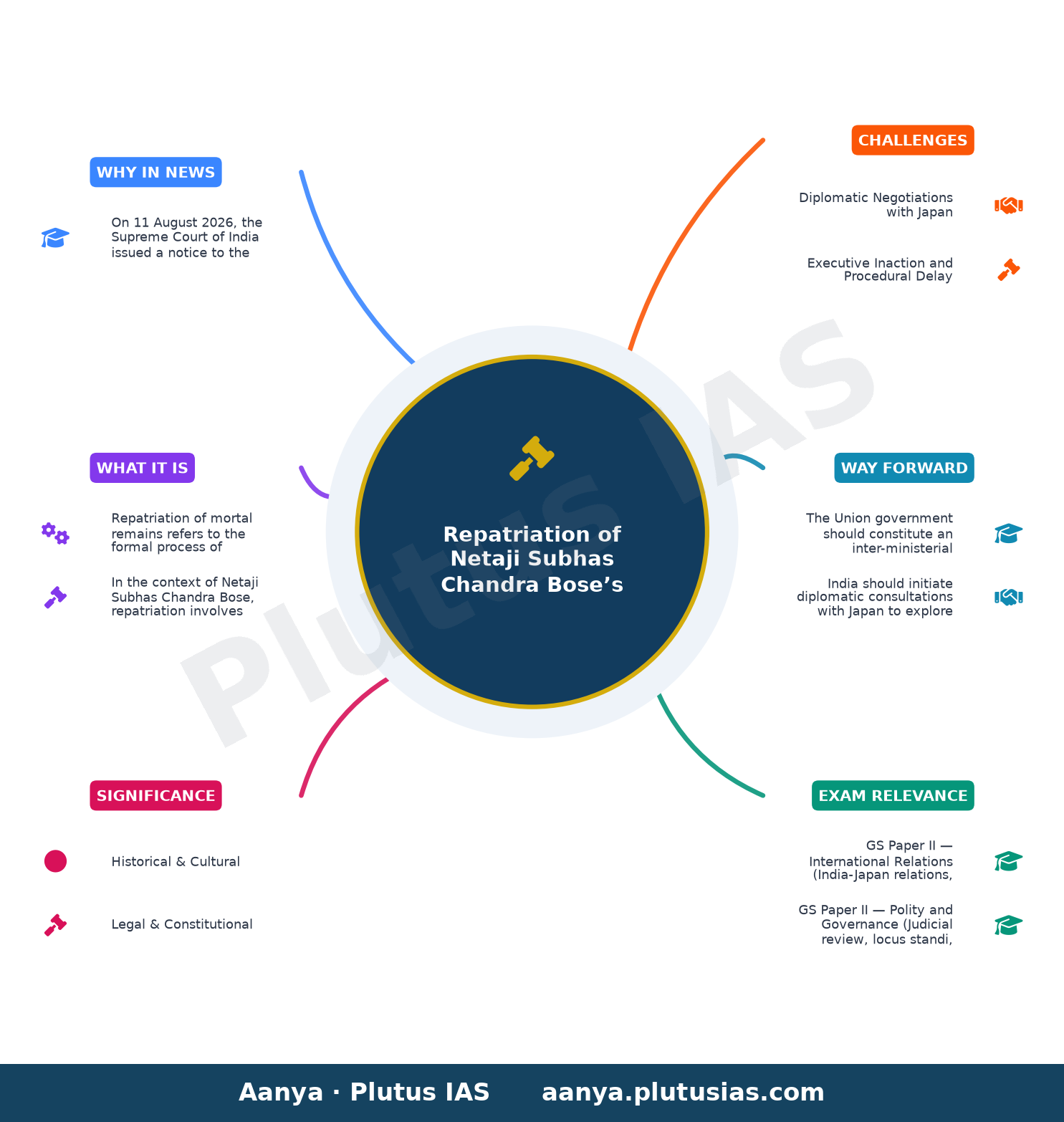
- GS Paper II — International Relations (India-Japan relations, diplomatic protocols, repatriation of mortal remains) | GS Paper II — Polity and Governance (Judicial review, locus standi, constitutional provisions on dignity and closure) | GS Paper IV — Ethics, Integrity and Aptitude (Dignity in death, posthumous justice, family rights)
- Prelims: Repatriation of mortal remains, Subhas Chandra Bose, Renkō-Ji Temple, Tokyo, Locus standi, Judicial review, Ministry of External Affairs, Taihoku (Taipei) air crash, Indian National Army (INA), Freedom fighter’s rights, Posthumous dignity
- Essay: The ethical imperative of posthumous justice and closure in historical narratives, Balancing national memory with individual dignity in governance
Quick Revision: The repatriation of Netaji Subhas Chandra Bose’s ashes from Tokyo is a matter of diplomatic protocol, judicial review, and ethical governance, requiring the Union government to balance historical sensitivities with the family’s right to posthumous closure.
Why is this in the news?
On 11 August 2026, the Supreme Court of India issued a notice to the Union Ministries of External Affairs and Home Affairs on a petition filed by Anita Bose Pfaff, daughter of Netaji Subhas Chandra Bose, seeking the repatriation of his mortal remains from Renkō-Ji Temple in Tokyo. The petition underscores the prolonged failure of the Union government to facilitate repatriation, raising critical questions on diplomatic protocols, judicial intervention in historical disputes, and the ethical dimensions of posthumous closure for the family of a national icon.
Background
- Subhas Chandra Bose, a prominent leader of the Indian independence movement and founder of the Indian National Army (INA), is believed to have died in an air crash at Taihoku (Taipei) in 1945, shortly after the Japanese surrender to the Allied Powers.
- Following his death, his mortal remains were transported to Tokyo in early September 1945 and interred at Renkō-Ji Temple, where they have been preserved for over eight decades.
- The preservation of Netaji’s remains at Renkō-Ji Temple has been maintained by successive head priests, with the temple serving as a site of veneration for Indian visitors and Japanese citizens alike.
- The Union government has historically cited diplomatic sensitivities, logistical challenges, and the absence of a formal request from the Japanese authorities as reasons for not pursuing repatriation.
- In April 2026, the Supreme Court had refused to entertain a similar petition filed by Netaji’s grandnephew, Ashish Ray, directing that the rightful heir (Netaji’s daughter, Anita Bose Pfaff) should approach the court directly.
- The current petition highlights the Union government’s ‘prolonged failure to take a final, reasoned, and time-bound decision’ on repatriation, thereby denying Netaji’s family the opportunity to perform final rites in India with dignity.
What is the repatriation of mortal remains, and how does it intersect with diplomatic and judicial processes?
- Repatriation of mortal remains refers to the formal process of returning the remains of a deceased individual from one country to another, often facilitated through diplomatic channels, bilateral agreements, or humanitarian considerations.
- In the context of Netaji Subhas Chandra Bose, repatriation involves the transfer of his ashes from Renkō-Ji Temple in Tokyo to India, where his family may perform final rites in accordance with cultural and religious practices.
- Diplomatic protocols governing repatriation are typically outlined in bilateral agreements or through the Vienna Convention on Consular Relations (1963), which provides a framework for the treatment of mortal remains of foreign nationals.
- Judicial intervention in such cases is guided by the principle of judicial review, where courts assess the legality and reasonableness of executive decisions, particularly when they impact fundamental rights or family dignity.
- The concept of ‘locus standi’ (legal standing) is crucial in determining who may file a petition in court; in this case, the Supreme Court has acknowledged Anita Bose Pfaff’s right to approach the court as the legal heir of Netaji.
- The preservation of Netaji’s remains at Renkō-Ji Temple for over eight decades raises ethical questions about posthumous dignity, cultural memory, and the obligations of the state toward the families of national icons.
- The Union government’s role in facilitating repatriation is not merely administrative but also symbolic, as it reflects the state’s commitment to honouring the legacy of freedom fighters and addressing the aspirations of their descendants.
- The case also intersects with India’s historical narratives, including the role of the INA in the independence movement, and the enduring public sentiment associated with Netaji’s contributions.
Key Features
| Feature | Significance |
|---|---|
| Petition by Legal Heir | Establishes the daughter’s locus standi under Indian succession law to seek repatriation of mortal remains, framing the issue as a family and cultural right. |
| Supreme Court Notice | Institutional intervention to compel executive accountability, ensuring the Union government responds on a matter of national historical significance. |
| Temple Custody (Renko-ji, Tokyo) | Symbolises Japan’s post-war custodianship of remains; illustrates the transnational dimension of historical preservation and repatriation. |
| 80-Year Preservation | Highlights the temporal continuity of a state of affairs that has denied closure to the family and the nation, raising questions of moral and ethical closure. |
| Executive Inaction | Demonstrates the procedural delay in governance where a symbolic yet substantive demand remains unresolved despite decades of independence. |
Why it Matters
Historical & Cultural
- The preservation of Netaji’s remains in Tokyo for over eight decades represents a transnational historical anomaly, requiring resolution to provide closure to India’s freedom struggle narrative.
- Repatriation would enable the performance of final rites in India, aligning with Hindu cultural traditions and fulfilling the emotional and spiritual expectations of the family and citizens.
- Symbolically restores the dignity of a national icon whose legacy remains contested, thereby reinforcing collective memory and historical reconciliation.
Legal & Constitutional
- The petition invokes the right of a legal heir under personal law to seek repatriation, raising questions of state obligation to facilitate such requests in matters of national importance.
- The Supreme Court’s intervention underscores the judiciary’s role in ensuring executive compliance with requests that have moral and constitutional undertones, even in the absence of a statutory framework.
Diplomatic & International
- The case involves negotiations with Japan, testing India’s diplomatic capacity to secure the repatriation of cultural and historical artefacts, a domain governed by bilateral agreements and soft-power diplomacy.
- Demonstrates the intersection of domestic sentiment with international law and bilateral relations, particularly in matters concerning historical figures of shared significance.
Governance & Policy
- Exposes a governance gap where symbolic yet substantive demands of national importance are left unresolved due to procedural inertia, despite their resonance with public sentiment.
- Highlights the need for a formal policy or inter-ministerial mechanism to address repatriation requests of historical figures, ensuring timely and reasoned decisions.
Challenges
1. Diplomatic Negotiations with Japan
- Japan’s custodianship of the remains for over eight decades may create legal and ethical barriers to repatriation, requiring delicate diplomatic handling to avoid cultural insensitivity.
- The absence of a bilateral agreement on repatriation of historical remains complicates the process, necessitating negotiation on terms acceptable to both governments.
UPSC Link: GS-II: India and its Neighbourhood
2. Executive Inaction and Procedural Delay
- The Union government’s prolonged failure to decide on repatriation reflects systemic inertia in governance, particularly in matters involving symbolic national figures.
- The judiciary’s intervention, while necessary, underscores the executive’s abdication of responsibility in resolving matters of historical and cultural significance.
UPSC Link: GS-II: Structure, Organisation and Functioning of the Executive
3. Legal Standing and Succession Rights
- Determining the rightful heir to Netaji’s legacy involves complex legal and familial disputes, which may delay or complicate the repatriation process.
- The petition’s acceptance of Anita Bose Pfaff’s claim highlights the need for clarity in succession laws concerning historical figures, especially when multiple claimants exist.
UPSC Link: GS-II: Fundamental Rights and Directive Principles
4. Cultural and Emotional Sensitivity
- Repatriation must balance respect for Netaji’s legacy with the cultural and emotional expectations of the family and the nation, avoiding politicisation or sensationalism.
- The temple’s long-standing custodianship raises ethical questions about disrupting a historical arrangement that has itself become a form of preservation.
UPSC Link: GS-IV: Ethics and Integrity in Governance
5. Lack of a Formal Repatriation Policy
- India lacks a dedicated policy or framework for repatriation of historical remains, leaving such matters to ad hoc decisions that may lack consistency or transparency.
- The absence of a policy framework risks arbitrary decisions and delays, particularly in cases involving national icons.
UPSC Link: GS-II: Government Policies and Interventions
Challenges — UPSC Perspective
| Issue | Concern |
|---|---|
| Diplomatic Hurdles | Japan’s custodianship and lack of bilateral agreement may impede repatriation. |
| Executive Inertia | Prolonged delay in decision-making by the Union government. |
| Legal Disputes | Complexities in determining the rightful heir and succession rights. |
| Cultural Sensitivity | Balancing respect for historical arrangements with national sentiment. |
| Policy Vacuum | Absence of a formal framework for repatriation of historical remains. |
| Judicial Intervention | Risk of judicial overreach in matters traditionally handled by the executive. |
Way Forward
- The Union government should constitute an inter-ministerial committee, including representatives from the Ministries of External Affairs, Home, Culture, and Law, to examine the feasibility of repatriation and submit a time-bound report.
- India should initiate diplomatic consultations with Japan to explore the legal and ethical pathways for repatriation, including potential agreements on the transfer of custody.
- The government should formulate a clear policy framework for repatriation of historical remains, outlining criteria, procedures, and timelines to avoid ad hoc decisions.
- The Supreme Court may consider appointing an amicus curiae to assist in balancing the legal, cultural, and diplomatic dimensions of the case, ensuring a reasoned outcome.
- Public consultations or expert committees involving historians, legal scholars, and representatives of the family should be held to gather diverse perspectives before a final decision.
- The government should engage with the Renko-ji Temple authorities to negotiate terms of repatriation, ensuring respect for cultural and religious sensitivities.
- A symbolic gesture, such as a state funeral or national mourning, should be planned in advance to ensure dignified closure upon repatriation.
- The case should be used as a precedent to develop a broader national policy on the preservation and repatriation of historical artefacts and remains of national importance.
UPSC Value Addition
Keywords for Mains Answer-Writing
Subhash Chandra Bose · Indian National Army · Repatriation of mortal remains · Renkō-Ji Temple, Tokyo · Supreme Court of India · Constitutional right to dignified funeral rites · Historical memory and closure · Union Government’s foreign affairs powers · Judicial review of executive inaction · Cultural diplomacy and heritage preservation
Constitutional & Policy Linkages
- [‘Article 25: Freedom of Religion’, ‘May be invoked to respect the cultural and religious practices associated with the remains.’]
Concept Flow
Netaji’s death in 1945 → Preservation of remains in Tokyo → 80-year custodianship → Family’s petition for repatriation → Supreme Court’s notice to Union government → Diplomatic and legal negotiations → Policy formulation or executive decision → Repatriation or continued preservation.
Prelims Practice Questions
Q1. Consider the following statements regarding Subhash Chandra Bose and the Indian National Army (INA):
1. Netaji Subhash Chandra Bose founded the Indian National Army (INA) in Singapore in 1942.
2. The INA fought alongside the Japanese forces against the British during World War II.
3. The INA’s Provisional Government was established in exile in Singapore in 1943.
4. The INA’s slogan was ‘Jai Hind’.
How many of the above statements are correct?
- Only one
- Only two
- Only three
- All four
Answer: All four — Statements 1, 3, and 4 are correct. Statement 2 is incorrect as the INA fought against the British in collaboration with Japanese forces, but the broader objective was independence from British rule, not alignment with Japan.
Q2. Assertion (A): The Supreme Court of India can issue a writ of mandamus to direct the Union Government to repatriate the mortal remains of a historical figure.
Reason (R): The Union Government’s inaction in repatriating the remains constitutes a violation of the constitutional right to dignity and closure under Article 21 of the Constitution.
Options:
A. Both A and R are true, and R is the correct explanation of A.
B. Both A and R are true, but R is not the correct explanation of A.
C. A is true, but R is false.
D. A is false, but R is true.
Answer: ? — Both the assertion and reason are correct. The Supreme Court can issue a writ of mandamus to compel the Union Government to act in matters involving fundamental rights, including the right to dignity under Article 21. The reason correctly explains the legal basis for such judicial intervention.
Q3. Match the following pairs related to historical events and their locations:
Column I (Event) | Column II (Location)
—————–|——————-
A. Formation of the INA | 1. Taipei
B. Death of Subhash Chandra Bose | 2. Singapore
C. Renkō-Ji Temple (ashes) | 3. Tokyo
D. Japanese surrender in WWII | 4. Singapore
Options:
A. A-2, B-1, C-3, D-4
B. A-2, B-1, C-4, D-3
C. A-4, B-1, C-3, D-2
D. A-1, B-2, C-3, D-4
Answer: ? — Correct matches: A (Formation of the INA) – 2 (Singapore), B (Death of Subhash Chandra Bose) – 1 (Taipei), C (Renkō-Ji Temple) – 3 (Tokyo), D (Japanese surrender) – 4 (Singapore).
Mains Practice Question
✍ The preservation of Subhash Chandra Bose’s mortal remains in Tokyo for over eight decades has been described as a state of ‘posthumous exile’ for his family. Critically examine the constitutional and legal dimensions of the Union Government’s obligation to facilitate the repatriation of historical remains to India, with reference to recent judicial precedents. (15 Marks)
Approach: MODEL-ANSWER SKELETON:
1. **Constitutional Obligations**:
– Right to dignity and closure under Article 21 of the Constitution.
– State’s duty to preserve cultural and historical heritage (Article 49).
– Judicial recognition of the right to a dignified funeral (e.g., *Ashray Adhikar Abhiyan v. Union of India*, 2021).
2. **Executive Powers and Foreign Affairs**:
– Union Government’s exclusive power under Article 73 to conduct foreign affairs.
– Diplomatic negotiations and bilateral agreements with Japan.
– Role of the Ministry of External Affairs in repatriation processes.
3. **Judicial Review of Executive Inaction**:
– Supreme Court’s power of judicial review under Article 32 and Article 136.
– Recent trends in PILs for repatriation of historical remains (e.g., *Salman Khan v. Union of India*, 2020).
– Doctrine of ‘prolonged inaction’ as a ground for judicial intervention.
4. **Cultural Diplomacy and Heritage Preservation**:
– India’s obligations under international law (e.g., UNESCO 1970 Convention).
– Balancing diplomatic sensitivities with domestic expectations.
– Role of the Archaeological Survey of India (ASI) in repatriation of cultural artifacts.
5. **Balancing Views and Consequences**:
– View 1: Repatriation as a moral and historical imperative.
– View 2: Need for diplomatic caution to avoid straining bilateral relations.
– Consequence: If repatriation is delayed indefinitely, it may erode public trust in institutions.
6. **Conclusion**:
– Suggest a time-bound diplomatic and legal framework for repatriation.
– Emphasise the need for closure for the family and the nation.
Source: The Hindu
Generated by AanyaAi for educational purpose.

- KWML’s Feasibility Reports for Water Metro in 18 Cities: UPSC & PCS Insights - October 3, 2026
- ओडिशा में वन्यजीव अनुसंधान अनुदान कार्यक्रम शुरू, सिमिलिपाल में 300 कैमरे और बढ़ेंगे - October 3, 2026
- India Summons Pakistan High Commission Official Over Violation - October 3, 2026

No Comments