


11 Aug Supreme Court Slams EC Over Delayed Appeals in Bengal Voter List Cases
✎ The Special Intensive Revision (SIR) is a process to purify electoral rolls, while Appellate Tribunals adjudicate voter grievances; delays in tribunal decisions undermine electoral fairness and invite judicial intervention.
Subject Relevance — Where This Topic Fits
- GS Paper II — Constitutional and Statutory Bodies (Election Commission of India) | GS Paper II — Fundamental Rights and Electoral Reforms | GS Paper III — Electoral Processes and Governance
- Prelims: Special Intensive Revision (SIR), Electoral Rolls, Appellate Tribunals under Representation of the People Act, 1951, Voter Verification, Election Commission of India, Judicial Review of Electoral Matters
- Essay: Electoral integrity and judicial oversight in democratic processes, The role of constitutional institutions in ensuring fair electoral practices
Quick Revision: The Special Intensive Revision (SIR) is a process to purify electoral rolls, while Appellate Tribunals adjudicate voter grievances; delays in tribunal decisions undermine electoral fairness and invite judicial intervention.
Why is this in the news?
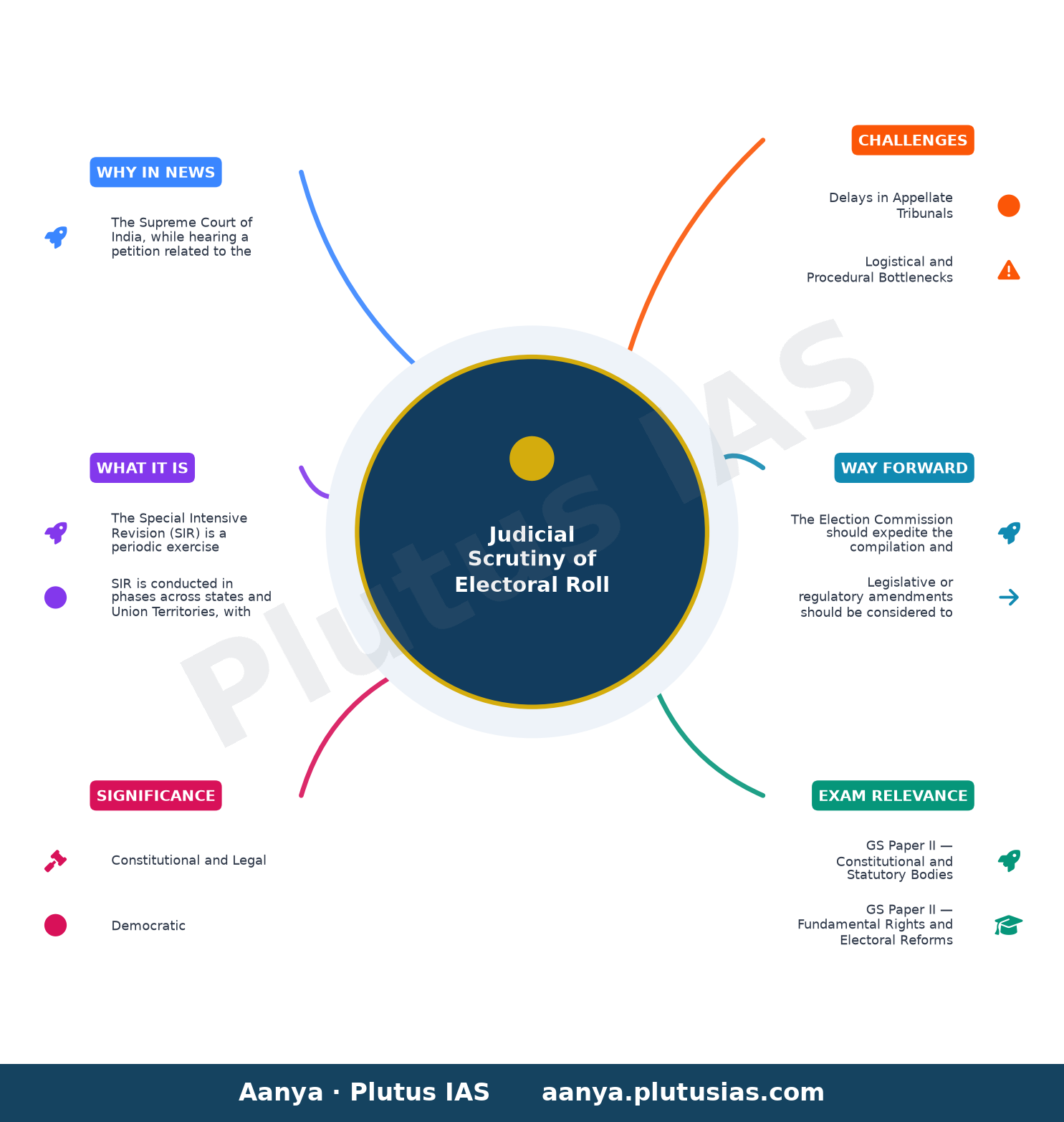
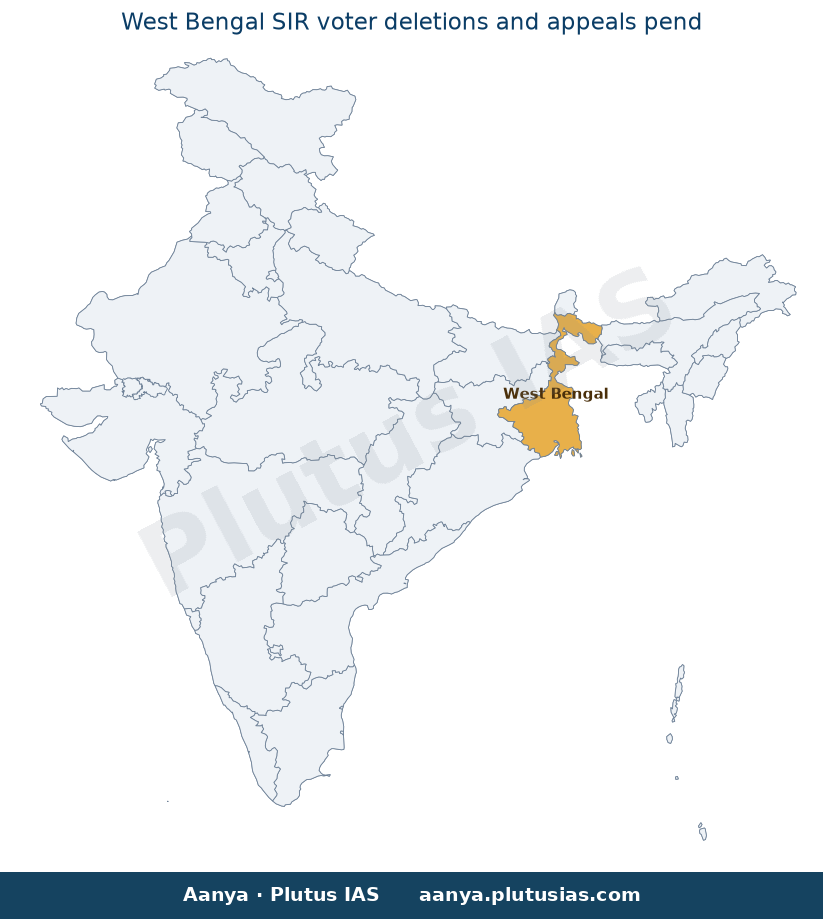
The Supreme Court of India, while hearing a petition related to the deletion of voter names during the Special Intensive Revision (SIR) process in West Bengal, has sought detailed information from the Election Commission of India (ECI) regarding the disposal rate of appeals filed against such deletions. The Court expressed concern over the slow pace of appellate tribunal decisions, noting that delays could undermine electoral fairness and potentially affect upcoming elections. This development highlights procedural challenges in the electoral roll revision process and the judiciary’s role in ensuring timely redressal of voter grievances.
Background
- In West Bengal, the SIR process resulted in the deletion of approximately 58.20 lakh voter names from the draft electoral roll, which originally contained 7.66 crore entries.
- Of the deleted names, 24.17 lakh were attributed to deceased voters, 1.38 lakh to duplicates or fraudulent entries, and 32.65 lakh to shifts, absences, or other reasons.
- Appellate Tribunals adjudicate appeals filed by aggrieved voters against deletions or other electoral roll modifications.
- The Supreme Court’s intervention underscores the constitutional mandate of the Election Commission to ensure free, fair, and timely electoral processes, as enshrined in Article 324 of the Constitution.
- Concerns about procedural delays in appellate tribunals have been raised in multiple states, indicating systemic issues in the electoral dispute resolution mechanism.
What is the Special Intensive Revision (SIR) and Appellate Tribunals?
- The Special Intensive Revision (SIR) is a periodic exercise conducted by the Election Commission of India to update and clean electoral rolls, ensuring accuracy and inclusivity.
- SIR is conducted in phases across states and Union Territories, with the first phase covering Bihar, the second phase covering states like West Bengal, Uttar Pradesh, and others, and the third phase including states such as Andhra Pradesh.
- The process involves multiple stages, including the preparation of a draft electoral roll, public display for objections, and final publication of the revised roll.
- Appellate Tribunals function as quasi-judicial bodies to hear appeals against decisions of Electoral Registration Officers (EROs) regarding voter list modifications.
- These tribunals are mandated to dispose of appeals expeditiously, though systemic delays have been observed, leading to judicial scrutiny.
- The Supreme Court’s role in this context is to ensure that the Election Commission and tribunals adhere to constitutional and statutory timelines, thereby upholding electoral integrity.
- The SIR process is critical for maintaining the purity of electoral rolls, which directly impacts the fairness of elections and the right to vote under Article 326 of the Constitution.
Key Features
| Feature | Significance |
|---|---|
| Special Intensive Revision (SIR) | A statutory process under the Representation of the People Act, 1950, to update the electoral rolls by removing inaccuracies such as deceased, duplicate, or shifted voters. |
| Appellate Tribunals | Constitutional bodies established under Section 22B of the Representation of the People Act, 1951, to hear appeals against deletions in the electoral rolls. |
| Disposal Rate of Appeals | The speed at which appellate tribunals resolve appeals, directly impacting the electoral rights of citizens. |
| Electoral Roll Accuracy | The precision of voter lists, ensuring only eligible voters are enrolled and preventing disenfranchisement. |
| Judicial Oversight | The Supreme Court’s role in monitoring the functioning of electoral institutions to uphold constitutional rights. |
Why it Matters
Constitutional and Legal
- The SIR process is a statutory mechanism mandated by the Representation of the People Act, 1950, to maintain the integrity of the electoral rolls.
- Appellate tribunals act as quasi-judicial bodies under the Representation of the People Act, 1951, ensuring due process for citizens aggrieved by deletions.
- The Supreme Court’s intervention underscores the judiciary’s role in safeguarding electoral rights and ensuring timely justice.
Democratic
- Timely resolution of appeals is critical to prevent disenfranchisement of eligible voters, particularly in states with high electoral stakes.
- Delays in the appellate process can erode public trust in electoral institutions and the fairness of the electoral process.
- The SIR process, while necessary for accuracy, must balance efficiency with the rights of voters to avoid unintended exclusion.
Administrative
- The Election Commission’s responsibility to ensure logistical and procedural efficiency in the SIR process and appellate tribunals.
- The need for standardized timelines and monitoring mechanisms to address systemic delays in electoral dispute resolution.
Challenges
1. Delays in Appellate Tribunals
- Approximately 34 lakh appeals are pending in appellate tribunals, leading to prolonged disenfranchisement of voters.
- The disposal rate of appeals is alarmingly low, with less than 1% resolved, exacerbating the issue.
- Delays disproportionately affect marginalized groups, including the elderly, disabled, and economically disadvantaged, who may lack resources to pursue appeals.
UPSC Link: GS-II: Constitutional & Statutory Bodies
2. Logistical and Procedural Bottlenecks
- The Election Commission cited logistical challenges as a reason for delays, necessitating systemic improvements in tribunal functioning.
- Inadequate staffing, infrastructure, and digitalization in appellate tribunals hinder timely resolution of appeals.
- The lack of standardized timelines for appeal disposal creates ambiguity and inefficiency in the process.
UPSC Link: GS-II: Electoral Reforms
3. Accuracy vs. Inclusivity in SIR
- The SIR process, while aimed at removing inaccuracies, risks unintentional disenfranchisement if not conducted with due diligence.
- The removal of 58.20 lakh names in West Bengal, including 32.65 lakh attributed to shifts, absences, or other reasons, highlights the need for robust verification mechanisms.
- Balancing the removal of ineligible voters with the protection of eligible voters’ rights remains a persistent challenge.
UPSC Link: GS-II: Electoral Reforms
4. Judicial Scrutiny and Accountability
- The Supreme Court’s suo motu intervention reflects concerns over the judiciary’s role in ensuring electoral fairness and institutional accountability.
- The absence of statutory timelines for appellate tribunals underscores the need for legislative or regulatory reforms to mandate efficiency.
- Judicial oversight must be complemented by administrative reforms to address systemic issues in electoral dispute resolution.
UPSC Link: GS-II: Judiciary
Challenges — UPSC Perspective
| Issue | Concern |
|---|---|
| Pending Appeals | 34 lakh appeals pending in appellate tribunals, leading to prolonged disenfranchisement. |
| Low Disposal Rate | Less than 1% of appeals resolved, indicating systemic inefficiency. |
| Logistical Challenges | Inadequate staffing, infrastructure, and digitalization in tribunals. |
| Lack of Timelines | Absence of statutory or regulatory timelines for appeal disposal. |
| Accuracy vs. Inclusivity | Risk of unintentional disenfranchisement due to stringent SIR processes. |
| Judicial Overreach vs. Accountability | Judicial scrutiny must be balanced with institutional accountability. |
Way Forward
- The Election Commission should expedite the compilation and submission of data on pending appeals, disposal rates, and tribunal functioning to the Supreme Court.
- Legislative or regulatory amendments should be considered to mandate standardized timelines for the resolution of electoral appeals in appellate tribunals.
- Enhance the digital infrastructure of appellate tribunals to streamline case management, reduce delays, and improve transparency.
- Conduct periodic audits of the SIR process to ensure accuracy while minimizing disenfranchisement of eligible voters.
- Strengthen logistical support, including staffing and infrastructure, for appellate tribunals to improve efficiency.
- Implement awareness campaigns to educate voters about the SIR process, their rights, and the appellate mechanism to facilitate timely redressal.
- Establish a dedicated grievance redressal cell within the Election Commission to monitor and address delays in electoral dispute resolution.
- Explore the possibility of setting up specialized benches for electoral appeals in high-pending states to expedite case disposal.
UPSC Value Addition
Keywords for Mains Answer-Writing
Special Intensive Revision (SIR) · Electoral Rolls · Electoral Dispute Resolution · Appellate Tribunal · Election Commission of India · Supreme Court of India · Voter List Deletions · Constitutional Provisions on Elections · Electoral Reforms · Judicial Review of Electoral Matters · Voter Verification Process · Electoral Justice Delivery System · Constitutional Functionaries
Constitutional & Policy Linkages
- Article 324: Superintendence, direction, and control of elections vested in the Election Commission.
- Article 325: Prohibition of discrimination on grounds of religion, race, caste, or sex in electoral rolls.
- Article 326: Elections to the House of the People and Legislative Assemblies to be on the basis of adult suffrage.
Concept Flow
Electoral Roll Inaccuracy → Special Intensive Revision (SIR) Process → Deletion of Names → Appeals to Appellate Tribunals → Delays in Disposal → Judicial Intervention → Supreme Court’s Directive → Data Compilation and Systemic Reforms
Prelims Practice Questions
Q1. Consider the following statements regarding the Special Intensive Revision (SIR) of electoral rolls in India:
1. SIR is conducted in phases across different states and Union Territories.
2. The process involves deletion of names from the electoral rolls based on verification of voter details.
3. Appellate Tribunals are empowered to hear appeals against deletion of names from electoral rolls.
4. The Election Commission of India (ECI) is constitutionally mandated to conduct SIR every year.
How many of the above statements are correct?
- Only one
- Only two
- Only three
- All four
Answer: Only three — Statements 1, 2, and 3 are correct. Statement 4 is incorrect as the ECI conducts SIR periodically but not every year as a constitutional mandate.
Q2. Assertion (A): The Supreme Court of India can direct the Election Commission to furnish data on pending electoral appeals.
Reason (R): The Supreme Court has the power of judicial review over the functioning of the Election Commission under Article 324 of the Constitution.
Options:
A. Both A and R are true, and R is the correct explanation of A.
B. Both A and R are true, but R is not the correct explanation of A.
C. A is true, but R is false.
D. A is false, but R is true.
- A
- B
- C
- D
Answer: B — Both the Assertion and Reason are true. The Supreme Court has the power of judicial review under Article 324, which empowers it to oversee the functioning of the Election Commission, including directing the ECI to furnish data on pending appeals.
Q3. Match the following electoral processes with their respective constitutional or statutory provisions:
Column I (Process)
A. Special Intensive Revision (SIR)
B. Appellate Tribunal for electoral disputes
C. Judicial review of electoral matters
D. Preparation of electoral rolls
Column II (Provision)
1. Article 324 of the Constitution
2. Representation of the People Act, 1951
3. Constitution of India (Article 326)
4. Supreme Court’s power under Article 136
Select the correct match:
- A-1, B-2, C-4, D-3; A-2, B-1, C-4, D-3; A-3, B-2, C-1, D-4; A-1, B-4, C-2, D-3
Answer: A-1, B-2, C-4, D-3; A-2, B-1, C-4, D-3; A-3, B-2, C-1, D-4; A-1, B-4, C-2, D-3 — A-1 (SIR is conducted under the supervision of the Election Commission under Article 324), B-2 (Appellate Tribunals are constituted under the Representation of the People Act, 1951), C-4 (Supreme Court’s power of judicial review under Article 136), D-3 (Preparation of electoral rolls is a function under Article 326).
Mains Practice Question
✍ The Special Intensive Revision (SIR) of electoral rolls is a critical process for maintaining the integrity of the electoral rolls in India. However, recent judicial observations highlight delays in the disposal of appeals against deletions from the electoral rolls by Appellate Tribunals. Critically examine the constitutional and statutory framework governing the SIR process, the role of Appellate Tribunals, and the implications of such delays on electoral justice. Also, suggest measures to expedite the disposal of appeals. (15 Marks)
Approach: [‘Article 324 of the Constitution vests the Election Commission of India (ECI) with the superintendence, direction, and control of elections, including the preparation of electoral rolls (Article 326).’, ‘The Representation of the People Act, 1951, and the Conduct of Elections Rules, 1961, govern the SIR process, including the deletion of names and the constitution of Appellate Tribunals.’, “The ECI’s Model Code of Conduct and guidelines for SIR ensure transparency and fairness in the deletion process.”] [‘Appellate Tribunals are constituted under Section 8A of the Representation of the People Act, 1951, to hear appeals against deletions from electoral rolls.’, ‘These tribunals function as quasi-judicial bodies and are expected to dispose of appeals expeditiously to ensure electoral justice.’, ‘Recent Supreme Court observations indicate a significant backlog of appeals (e.g., 34 lakh pending in West Bengal), raising concerns about the efficacy of the appellate mechanism.’] [‘The Supreme Court, under Article 136 and Article 32, can intervene in electoral disputes, including delays in appellate tribunals (e.g., recent directives to the ECI in West Bengal).’, ‘Delays in disposal of appeals can disenfranchise voters, particularly those dependent on electoral rolls for access to welfare schemes (e.g., ration cards).’, ‘The judiciary has highlighted that delays may render the electoral process ineffective, with the next election arriving before appeals are resolved.’] [‘Erosion of public trust in the electoral process due to perceived arbitrariness in deletions and delays in redressal.’, ‘Potential disenfranchisement of eligible voters, particularly marginalized sections, due to prolonged pendency.’, ‘Strain on the judiciary and electoral machinery, leading to systemic inefficiencies.’] [‘Strengthening the infrastructure of Appellate Tribunals by increasing their number, providing adequate staffing, and ensuring digitalization of records.’, ‘Implementing time-bound disposal of appeals through statutory or regulatory mandates (e.g., guidelines under the Representation of the People Act).’, ‘Leveraging technology for faster verification and disposal of appeals (e.g., e-filing, virtual hearings).’, ‘Periodic audits and performance reviews of tribunals to identify bottlenecks and address them proactively.’, ‘Sensitization and training of tribunal members on the importance of timely disposal of appeals.’] [‘While expediting appeals is critical, it must be balanced with due process and fairness to avoid erroneous reinstatements.’, ‘The ECI and judiciary must collaborate to ensure that the SIR process remains transparent, inclusive, and efficient.’]
Source: bhaskar.com
Generated by AanyaAi for educational purpose.

- Rajasthan Panchayati Raj Elections: New Rules, Fines & Disqualification - September 28, 2026
- सेना प्रमुख का बड़ा बयान: जीत जमीन से ही तय होती है, तकनीक नहीं बदल सकती युद्ध की प्रकृति - September 28, 2026
- UPSC Alert: Government Cracks Down on Patwaris for SVAMITVA Scheme Refusals - September 28, 2026

No Comments