


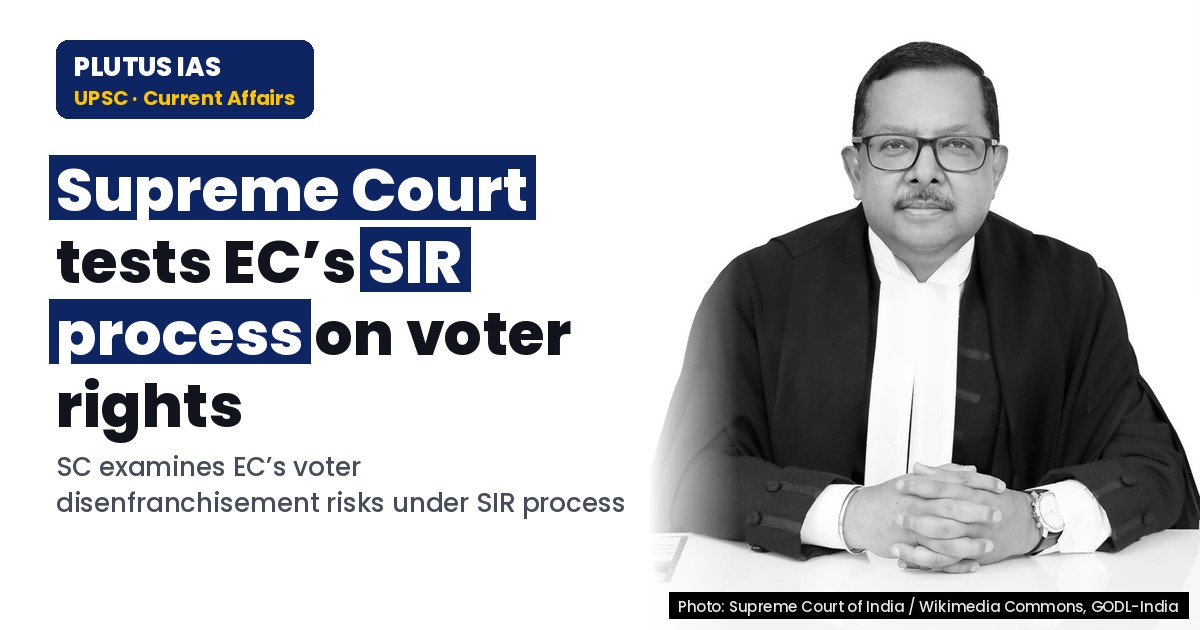
06 Oct Supreme Court to Test EC’s SIR Process on Voter Rights: Polity Analysis
✎ The Supreme Court of India is currently examining the constitutional validity of procedural changes introduced by the Election Commission of India (ECI) during the Special Intensive Revision (SIR) of electoral rolls, particularly…
Subject Relevance — Where This Topic Fits
- GS Paper II — Polity and Governance: Constitutional Bodies and Fundamental Rights | GS Paper II — Polity and Governance: Election Commission of India and Electoral Reforms
- Prelims: Universal Adult Franchise, Article 324, Special Intensive Revision (SIR), Form 6, Election Commission of India, Right to Vote, Constituent Assembly Debates, Disenfranchisement, Constitutional Morality
- Essay: The sanctity of democratic institutions in preserving the soul of the nation, Balancing inclusivity and procedural efficiency in electoral democracy
Why is this in the news?
The Supreme Court of India is currently examining the constitutional validity of procedural changes introduced by the Election Commission of India (ECI) during the Special Intensive Revision (SIR) of electoral rolls, particularly the modifications to Form 6, which have been criticised for creating barriers to voter registration. This scrutiny arises against the backdrop of concerns over large-scale disenfranchisement and the potential violation of the fundamental right to vote, as highlighted by observations from Justices Ujjal Bhuyan and former Supreme Court judge Rohinton Fali Nariman. The case underscores the judiciary’s role in safeguarding the integrity of the electoral process and the constitutional principle of universal adult franchise.
Background
- The Special Intensive Revision (SIR) is a periodic exercise conducted by the Election Commission of India (ECI) to update and purify electoral rolls, ensuring accuracy and inclusivity.
- The right to vote is a fundamental political right guaranteed under Article 326 of the Constitution and is intrinsic to the democratic framework of India.
- The Constituent Assembly debates emphasised the adoption of universal adult franchise as a cornerstone of India’s democratic republic, reflecting the vision of equality and participation.
- The Election Commission of India, a constitutional authority under Article 324, is tasked with the superintendence, direction, and control of elections, ensuring fairness, inclusivity, and transparency.
- Recent investigations have raised concerns about the ECI’s shift from an inclusive approach to a more restrictive one during the SIR process, particularly in the context of Form 6, which is used for new voter registration.
- The Supreme Court has historically played a pivotal role in affirming the autonomy and constitutional mandate of the ECI.
What is the Special Intensive Revision (SIR) and its constitutional significance?
- The SIR is a systematic process undertaken by the Election Commission of India (ECI) to revise, update, and purify electoral rolls to ensure accuracy and eliminate errors or duplications.
- The primary objective of the SIR is to maintain the integrity of the electoral rolls, thereby safeguarding the right to vote of all eligible citizens and preventing disenfranchisement due to administrative lapses or procedural inefficiencies.
- The SIR process involves multiple stages, including public scrutiny, verification of claims and objections, and the preparation of final electoral rolls.
- [‘The right to vote, as enshrined in Article 326, is a fundamental political right that ensures the participation of citizens in the democratic process, thereby upholding the principles of representative governance and accountability.’, ‘The ECI, as a constitutional authority under Article 324, is vested with the responsibility of ensuring free and fair elections, including the maintenance of electoral rolls, and must act as a neutral and impartial arbiter in the electoral process.’, ‘Form 6 is the application form used for the inclusion of new voters in the electoral rolls, particularly for first-time voters or those who have not been previously registered. Changes to this form, such as increased documentation requirements or procedural hurdles, can disproportionately affect marginalised or vulnerable sections of society.’, “The principle of ‘equal vote with equal value’ is a foundational tenet of democratic governance, ensuring that every eligible citizen has an equal opportunity to participate in the electoral process without discrimination.”, ‘The judiciary, particularly the Supreme Court, has a constitutional duty to safeguard fundamental rights, including the right to vote, and to ensure that the ECI adheres to the principles of constitutional morality and procedural fairness.’]
Key Features
| Feature | Significance |
|---|---|
| Special Intensive Revision (SIR) of electoral rolls | A statutory process to update electoral rolls, aimed at ensuring accuracy and inclusivity in voter registration, particularly before elections. |
| Form 6 modifications | Changes to the voter registration form that increased procedural complexity, potentially deterring eligible voters from enrolling. |
| Burden of proof on vulnerable voters | Shifting the onus of proving eligibility onto marginalised or disadvantaged citizens, contrary to the principle of inclusivity. |
| Constitutional authority of the Election Commission of India (ECI) | The ECI, a multi-member constitutional body, is tasked with conducting free and fair elections under Article 324 of the Constitution. |
| Judicial scrutiny of electoral processes | The Supreme Court’s role in interpreting constitutional provisions and ensuring that electoral processes uphold democratic principles. |
Why it Matters
Constitutional and Democratic
- The right to vote is a fundamental right enshrined in the Constitution, essential for the functioning of a representative democracy.
- The ECI’s role in maintaining electoral integrity is pivotal to preserving the sanctity of the electoral process and public trust in democratic institutions.
- Judicial oversight ensures that constitutional guarantees, such as universal adult suffrage, are not undermined by procedural or administrative lapses.
Institutional Integrity
- The multi-member structure of the ECI is designed to prevent the concentration of power and ensure checks and balances in electoral administration.
- The Supreme Court’s scrutiny of the ECI’s functioning reinforces the separation of powers and upholds the rule of law in electoral governance.
- The Court’s intervention in cases of procedural bias or exclusionary practices is critical to preventing institutional erosion.
Social Justice and Inclusivity
- Electoral inclusivity is a cornerstone of social justice, ensuring that marginalised communities have equitable access to political participation.
- Procedural hurdles in voter registration disproportionately affect vulnerable groups, undermining the principle of universal suffrage.
- Judicial and institutional accountability mechanisms must prioritise the removal of barriers to enfranchisement.
Challenges
1. Procedural Complexity in Voter Registration
- Modifications to Form 6 increased the complexity of voter registration, potentially discouraging eligible citizens from enrolling.
- The burden of proof on vulnerable voters contradicts the principle of inclusivity and ease of access.
- Administrative inefficiencies in the SIR process may lead to large-scale disenfranchisement.
UPSC Link: Polity: Electoral Reforms
2. Institutional Erosion of the ECI
- The ECI’s functioning as a multi-member body is undermined when decisions are centralised, reducing checks and balances.
- A lack of transparency in decision-making processes erodes public trust in the ECI’s autonomy and impartiality.
- The Court’s permissive approach to the ECI’s actions may inadvertently enable institutional drift from constitutional mandates.
UPSC Link: Polity: Constitutional Bodies
3. Judicial Passivity and Accountability
- The Supreme Court’s previous approach of granting the ECI the benefit of the doubt may have delayed corrective action.
- The Court must actively scrutinise electoral processes to prevent systemic violations of constitutional rights.
- Judicial intervention must be timely and decisive to uphold the sanctity of the electoral process.
UPSC Link: Polity: Judicial Review
4. Disenfranchisement of Marginalised Groups
- Vulnerable voters, including women, minorities, and economically disadvantaged groups, face disproportionate barriers in voter registration.
- Exclusionary practices in the SIR process risk deepening social inequalities and eroding democratic legitimacy.
- The Court must ensure that electoral reforms prioritise inclusivity and accessibility.
UPSC Link: Polity: Fundamental Rights
5. Constitutional Safeguards and Democratic Backsliding
- The erosion of constitutional safeguards in electoral governance threatens the foundational principles of democracy.
- The Court’s role in interpreting and enforcing constitutional provisions is critical to preventing democratic backsliding.
- Judicial activism in electoral matters must balance deference to institutional autonomy with the protection of democratic rights.
UPSC Link: Polity: Basic Structure Doctrine
Challenges — UPSC Perspective
| Issue | Concern |
|---|---|
| Form 6 modifications | Increased procedural complexity in voter registration, potentially deterring eligible voters. |
| Burden of proof on vulnerable voters | Shifting the onus of proving eligibility onto marginalised citizens, undermining inclusivity. |
| Centralisation of ECI decisions | Reduction of checks and balances within the ECI, compromising institutional integrity. |
| Judicial passivity | Delayed or insufficient judicial intervention in electoral processes, risking systemic violations. |
| Large-scale disenfranchisement | Potential exclusion of eligible voters due to procedural or administrative lapses in the SIR. |
Way Forward
- The Supreme Court must conduct a thorough review of the ECI’s decision-making processes, particularly regarding Form 6 and the SIR, to ensure compliance with constitutional mandates.
- The ECI should simplify voter registration procedures, particularly for marginalised groups, and eliminate unnecessary procedural hurdles.
- Judicial scrutiny of electoral processes should be proactive rather than reactive, with timely interventions to prevent disenfranchisement.
- Institutional reforms within the ECI should prioritise transparency, accountability, and the restoration of checks and balances.
- Public awareness campaigns should be launched to educate citizens about their right to vote and the procedures for voter registration.
- The Court should reaffirm the constitutional principle of universal adult suffrage and ensure that no eligible voter is excluded due to administrative or procedural deficiencies.
- Collaborative efforts between the ECI, civil society, and judicial bodies should be strengthened to address systemic barriers in electoral governance.
UPSC Value Addition
Keywords for Mains Answer-Writing
Election Commission of India (ECI) · Article 324 of the Constitution · Special Intensive Revision (SIR) of electoral rolls · Right to vote · Universal Adult Franchise · Constitutional provisions on electoral governance · Judicial review of electoral processes · Form 6 for voter registration · Electoral disenfranchisement · Checks and balances in constitutional bodies · Supreme Court’s role in electoral governance · Electoral reforms
Constitutional & Policy Linkages
- Article 324: Superintendence, direction and control of elections vested in the ECI.
- Article 325: No person to be ineligible for inclusion in electoral rolls on grounds of religion, race, caste, or sex.
- Article 326: Elections to the House of the People and to the Legislative Assemblies of States to be on the basis of adult suffrage.
Concept Flow
Constitutional mandate of universal adult suffrage (Article 326) → Establishment of the ECI (Article 324) as a multi-member body → Conduct of Special Intensive Revision (SIR) of electoral rolls → Modifications to Form 6 increasing procedural complexity → Burden of proof shifted to vulnerable voters → Potential disenfranchisement of marginalised groups → Supreme Court’s scrutiny of ECI’s actions → Judicial intervention to uphold constitutional guarantees → Need for institutional and procedural reforms to ensure inclusivity.
Prelims Practice Questions
Q1. Consider the following statements regarding the Election Commission of India (ECI):
1. The ECI is a multi-member body established under Article 324 of the Constitution.
2. The ECI has the power to supervise, direct, and control the entire process of elections to Parliament and State Legislatures.
3. The ECI can remove the Chief Election Commissioner or any Election Commissioner from office.
4. The ECI is responsible for the preparation of electoral rolls and the conduct of elections.
How many of the above statements are correct?
- Only one
- Only two
- Only three
- All
Answer: All — Statements 1, 2, and 4 are correct. Statement 3 is incorrect because the Chief Election Commissioner or any Election Commissioner can only be removed from office in the same manner as a Judge of the Supreme Court, i.e., by a resolution of Parliament passed by a special majority.
Q2. Assertion (A): The right to vote in India is a constitutional right guaranteed under the Constitution.
Reason (R): The right to vote is explicitly mentioned as a fundamental right under Part III of the Constitution.
- Both A and R are true, and R is the correct explanation of A.
- Both A and R are true, but R is not the correct explanation of A.
- A is true, but R is false.
- A is false, but R is true.
Answer: A is false, but R is true. — Assertion (A) is true as the right to vote is a constitutional right. However, Reason (R) is false because the right to vote is not explicitly mentioned as a fundamental right under Part III; it is a constitutional right derived from the constitutional scheme and the principle of universal adult franchise.
Q3. Match the following pairs related to electoral governance in India:
Column I
A. Article 324
B. Form 6
C. Special Intensive Revision (SIR)
D. Universal Adult Franchise
Column II
1. Document for new voter registration
2. Constitutional provision for electoral governance
3. Principle ensuring voting rights for all adults
4. Process of updating electoral rolls
Which of the following is the correct match?
- A-2, B-1, C-4, D-3
- A-1, B-2, C-3, D-4
- A-3, B-4, C-1, D-2
- A-4, B-3, C-2, D-1
Answer: A-2, B-1, C-4, D-3 — A-2 (Article 324 establishes the Election Commission), B-1 (Form 6 is used for new voter registration), C-4 (SIR is a process for updating electoral rolls), D-3 (Universal Adult Franchise ensures voting rights for all adults).
Mains Practice Question
✍ The Supreme Court’s scrutiny of the Election Commission of India’s (ECI) functioning during the Special Intensive Revision (SIR) of electoral rolls underscores the critical role of judicial review in safeguarding the right to vote. Critically examine the constitutional safeguards for electoral governance in India, with particular reference to the ECI’s independence, the right to vote, and the judiciary’s role. Also, analyse the implications of recent judicial interventions on the sanctity of universal adult franchise. (15 Marks)
Approach: MODEL-ANSWER SKELETON:
1. **Constitutional Framework for Electoral Governance**
– Article 324: Establishes the ECI as a multi-member constitutional body with powers to supervise, direct, and control elections.
– Independence of ECI: Protection from executive interference (e.g., fixed tenure, removal process akin to Supreme Court judges).
– Role of ECI: Preparation of electoral rolls, conduct of elections, and ensuring free and fair elections.
2. **Right to Vote as a Constitutional Right**
– Derived from the principle of universal adult franchise (Constitution’s Preamble and Article 326).
– Judicially recognised as a fundamental aspect of democracy (e.g., *PUCL v. Union of India*, 2013).
– Right to vote as a means of political participation and equality.
3. **Judicial Review and Electoral Reforms**
– Supreme Court’s role in protecting electoral rights (e.g., *Lily Thomas v. Union of India*, 2013 on disqualification of convicted legislators).
– Recent interventions in SIR and Form 6: Ensuring inclusivity and preventing disenfranchisement.
– Balancing ECI’s autonomy with judicial oversight to prevent arbitrary exclusions.
4. **Challenges and Implications**
– Concerns over ECI’s functioning: Shift in burden of proof, hurdles in voter registration, and potential disenfranchisement.
– Judicial scrutiny as a check on executive overreach and bureaucratic inefficiencies.
– Implications for universal adult franchise: Ensuring no voter is left behind due to procedural hurdles.
5. **Conclusion**
– Judicial review as a safeguard for electoral democracy.
– Need for continuous reforms to align ECI’s processes with constitutional principles.
– Emphasise the balance between ECI’s independence and judicial accountability.
Source: The Indian Express
Generated by AanyaAi for educational purpose.
Related guides on our sites
- Best PSIR optional test series
- Anthropology VS PSIR
- Best PSIR optional coaching
- Best PSIR optional coaching online

- Supreme Court to Test EC’s SIR Process on Voter Rights: Polity Analysis - October 6, 2026
- उपचुनाव 2026: असम लोकसभा और 5 विधानसभा सीटों पर मतदान आज, जाने कारण - October 6, 2026
- Supreme Court Questions ECI on Unapproved Form 6 Changes: Polity Explained - October 6, 2026

No Comments