


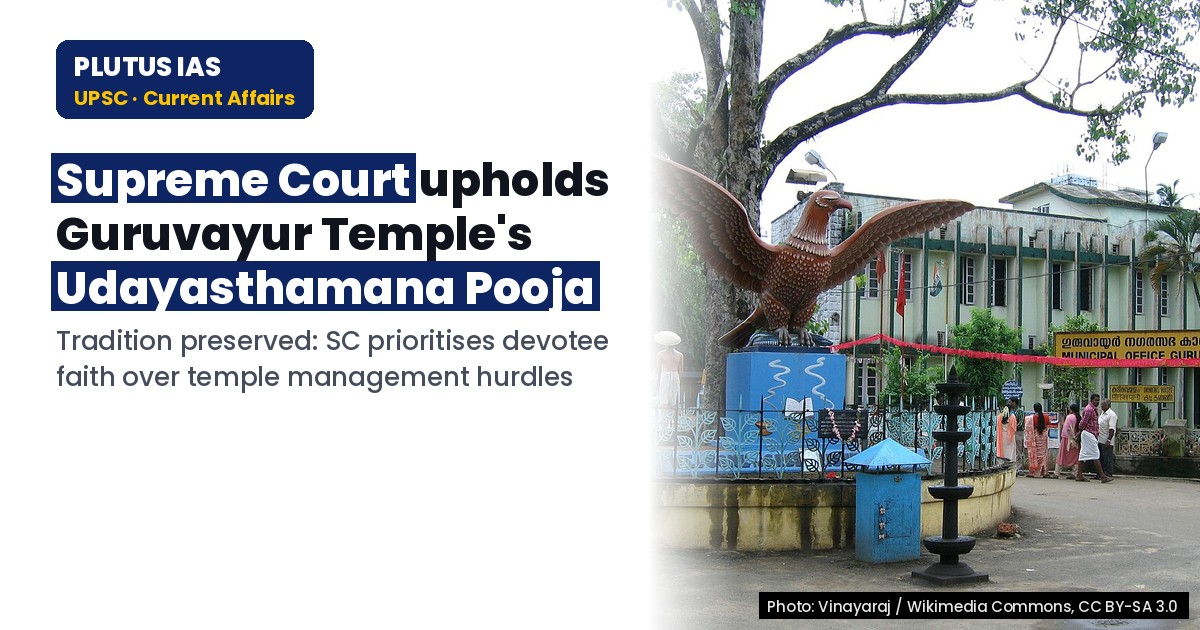
08 Oct Supreme Court Upholds Guruvayur Temple’s Udayasthamana Pooja Tradition
✎ The Supreme Court’s interim order on the Udayasthamana Pooja underscores the constitutional guarantee of religious freedom under Article 25 and the judiciary’s role in preserving religious traditions against administrative…
Subject Relevance — Where This Topic Fits
- GS Paper II — Fundamental Rights and Directive Principles of State Policy (Article 25, 26) | GS Paper II — Judicial Review and Constitutional Morality | GS Paper IV — Ethics and Integrity in Governance (Religious and Cultural Sensitivity)
- Prelims: Udayasthamana Pooja, Guruvayur Sri Krishna Temple, Vrishchikam Ekadasi, Kerala Devaswom Boards, Article 25 of the Constitution, Judicial Review, Constitutional Morality, Freedom of Religion
- Essay: The interplay between tradition and modernity in governance: A case study of temple management, Judicial intervention in religious practices: Balancing faith and administrative efficiency
Quick Revision: The Supreme Court’s interim order on the Udayasthamana Pooja underscores the constitutional guarantee of religious freedom under Article 25 and the judiciary’s role in preserving religious traditions against administrative deviations.
Why is this in the news?
The Supreme Court of India, on 8 October 2026, passed an interim order directing the Guruvayur Sri Krishna Temple in Kerala to conduct the Udayasthamana Pooja on Vrishchikam Ekadasi strictly in accordance with the temple’s established ritualistic practices. The order prioritises the faith and sentiments of devotees over logistical challenges posed by the massive influx of pilgrims during Ekadasi. This decision underscores the judiciary’s role in adjudicating disputes involving religious traditions and temple management, while also highlighting the constitutional framework governing religious freedom and temple administration in India.
Background
- The Guruvayur Sri Krishna Temple, located in Kerala, is one of the most revered Hindu temples dedicated to Lord Krishna and is renowned for its strict adherence to age-old rituals and traditions.
- The Udayasthamana Pooja is a significant ritualistic observance at the Guruvayur Temple, traditionally performed on Vrishchikam Ekadasi, a day considered highly auspicious in the Hindu lunar calendar.
- The temple is managed by the Guruvayur Devaswom, which governs the administration and management of Hindu temples in the state.
- In recent years, the temple management has faced challenges in conducting the Udayasthamana Pooja on Vrishchikam Ekadasi due to the overwhelming number of devotees, leading to logistical constraints and attempts to reschedule or alter the ritual.
- Petitioners, including traditional managing families and devotees, approached the Supreme Court after the Kerala High Court dismissed their pleas for directing the temple devaswom to conduct the pooja on the designated day.
- The Supreme Court has previously intervened in similar matters to uphold the sanctity of religious practices, as seen in its October 2025 order allowing the conduct of the pooja on Vrishchikam Ekadasi.
What is the Udayasthamana Pooja and its significance in the context of Guruvayur Temple?
- The Udayasthamana Pooja is a continuous series of 15–18 elaborate rituals performed at the Guruvayur Sri Krishna Temple, commencing at sunrise and concluding at sunset on Vrishchikam Ekadasi.
- The pooja is deeply rooted in the temple’s centuries-old traditions and is considered a sacred obligation by devotees, who believe it ensures spiritual merit and divine blessings.
- Vrishchikam Ekadasi is a lunar day in the Hindu calendar, falling in the month of Vrischikam (November–December), and is observed with great reverence across South India, particularly in Kerala.
- The ritual involves multiple stages, including archana, abhishekam, and deeparadhana, each performed with meticulous adherence to Vedic and Agamic traditions.
- The temple’s management, governed by the Guruvayur Devaswom, is responsible for ensuring the smooth conduct of the pooja while balancing administrative efficiency with religious sanctity.
- The pooja’s uninterrupted performance is seen as a matter of faith, and any deviation from the established tradition is perceived as a disruption of the temple’s spiritual heritage.
- The Supreme Court’s interim order reaffirms the principle that religious practices, when deeply embedded in tradition, must be preserved unless they violate constitutional or statutory provisions.
- The case also highlights the role of the judiciary in adjudicating disputes between devotees and temple authorities, ensuring that administrative decisions do not infringe upon the constitutional rights of worshippers.
Key Features
| Feature | Significance |
|---|---|
| Udayasthamana Pooja | A sacred ritual of the Guruvayur Sri Krishna Temple, performed as a series of 15-18 poojas from sunrise to sunset on Vrishchikam Ekadasi, integral to the temple’s centuries-old tradition. |
| Vrishchikam Ekadasi | A specific lunar day in the Malayalam calendar, traditionally fixed for the performance of Udayasthamana Pooja, embodying devotional continuity and ritual sanctity. |
| Guruvayur Devaswom Management | The statutory body responsible for the administration and preservation of rituals at the Guruvayur Sri Krishna Temple, tasked with balancing logistical constraints and religious traditions. |
| Supreme Court Interim Order | A judicial direction prioritising the faith and sentiments of worshippers over administrative hurdles, reinforcing the protection of religious practices under constitutional principles. |
| Kerala High Court Dismissal | The prior judicial stance upholding the devaswom’s discretion in ritual scheduling, later challenged before the Supreme Court for alleged deviation from established tradition. |
Why it Matters
Religious/Cultural
- Preservation of temple traditions: The order underscores the judiciary’s role in safeguarding age-old religious practices against administrative alterations.
- Devotional continuity: The Udayasthamana Pooja, performed annually on Vrishchikam Ekadasi, symbolises uninterrupted ritualistic heritage spanning centuries.
- Faith and sentiment: The Supreme Court’s emphasis on prioritising worshipper sentiments highlights the constitutional protection of religious freedom under Article 25.
Judicial
- Judicial review of religious practices: The case exemplifies the judiciary’s delicate balance between administrative efficiency and religious sanctity in temple governance.
- Interim relief in religious disputes: The order demonstrates the Supreme Court’s proactive stance in preserving religious traditions pending final adjudication.
- Hierarchy of courts: The appeal to the Supreme Court after the Kerala High Court’s dismissal underscores the appellate process in religious governance matters.
Administrative
- Temple management challenges: The devaswom’s argument regarding logistical constraints during Ekadasi reflects the practical difficulties in accommodating large-scale devotional gatherings.
- Ritual scheduling conflicts: The dispute highlights the tension between preserving tradition and addressing contemporary administrative exigencies.
- Statutory authority: The Guruvayur Devaswom’s role as a statutory body tasked with temple administration is central to the governance of religious institutions.
Challenges
1. Balancing Tradition and Administration
- Preserving centuries-old rituals while addressing logistical challenges posed by large-scale devotional gatherings.
- Ensuring that administrative decisions do not undermine the sanctity and continuity of religious practices.
- Navigating judicial scrutiny when administrative discretion conflicts with established traditions.
UPSC Link: GS-II: Fundamental Rights (Art. 25-28)
2. Judicial Intervention in Religious Matters
- Determining the extent to which courts can intervene in religious practices without encroaching on the autonomy of religious institutions.
- Balancing the protection of religious freedom with the need for administrative efficiency in temple governance.
- Ensuring that interim orders do not prejudice the final adjudication of disputes.
UPSC Link: GS-II: Judiciary and Judicial Review
3. Public Participation and Sentiment
- Addressing the expectations of devotees who view ritual scheduling as a matter of deep religious significance.
- Managing the influx of pilgrims during key religious occasions without compromising the integrity of rituals.
- Ensuring transparency and accountability in temple administration to maintain public trust.
UPSC Link: GS-II: Fundamental Duties (Art. 51A)
4. Legal Precedents and Consistency
- Maintaining consistency in judicial decisions across different levels of the judiciary regarding religious practices.
- Ensuring that interim orders do not create conflicting precedents for future disputes.
- Clarifying the legal framework governing the autonomy of religious institutions versus state regulation.
UPSC Link: GS-II: Constitutional Framework
Challenges — UPSC Perspective
| Issue | Concern |
|---|---|
| Ritual Scheduling | Conflict between traditional fixed dates for Udayasthamana Pooja and administrative flexibility. |
| Devotee Expectations | High public sentiment attached to the uninterrupted performance of rituals on Vrishchikam Ekadasi. |
| Judicial Scrutiny | Risk of excessive judicial intervention in religious practices, potentially undermining institutional autonomy. |
| Logistical Constraints | Challenges in managing large-scale devotional gatherings without compromising ritual sanctity. |
| Statutory Authority | Ensuring that the Guruvayur Devaswom’s decisions align with both legal mandates and religious traditions. |
Way Forward
- Clarify the legal framework governing the autonomy of religious institutions in scheduling rituals, balancing tradition and administration.
- Enhance transparency in temple management decisions, particularly regarding ritual scheduling, to build public trust.
- Develop logistical protocols for managing large-scale devotional gatherings during key religious occasions without disrupting rituals.
- Establish a consultative mechanism involving traditional stakeholders, temple authorities, and devotees to address disputes proactively.
- Strengthen the judicial approach to religious disputes by defining clear parameters for judicial intervention in religious matters.
- Promote documentation of temple traditions and rituals to preserve historical continuity and facilitate legal consistency.
- Encourage interfaith dialogue and comparative studies on temple governance to identify best practices in balancing tradition and modernity.
UPSC Value Addition
Keywords for Mains Answer-Writing
Guruvayur Temple · Udayasthamana Pooja · Vrishchikam Ekadasi · religious freedom · temple administration · Kerala High Court · Supreme Court · religious practices · devaswom boards · interim orders · constitutional morality · faith and sentiments · religious traditions · temple management · religious rituals
Constitutional & Policy Linkages
- Article 25: Freedom of conscience and free profession, practice, and propagation of religion.
- Article 26: Freedom to manage religious affairs subject to public order, morality, and health.
- Article 27: Freedom from payment of taxes for promotion of any religion.
- Article 28: Freedom from religious instruction in certain educational institutions.
Concept Flow
Traditional ritual practice (Udayasthamana Pooja on Vrishchikam Ekadasi) -> Administrative challenge (logistical constraints during Ekadasi) -> Legal dispute (challenge to devaswom’s scheduling decision) -> Judicial intervention (Supreme Court interim order) -> Preservation of religious freedom (prioritising faith and sentiment) -> Final adjudication pending (December hearing).
Prelims Practice Questions
Q1. Consider the following statements regarding the Udayasthamana Pooja at Guruvayur Temple:
1. The Udayasthamana Pooja is performed on Vrishchikam Ekadasi day as per traditional practices.
2. The Supreme Court has recently directed that the pooja must be held in accordance with the age-old practices of the temple.
3. The Kerala High Court had earlier allowed the devaswom board to alter the schedule of the pooja due to logistical challenges.
How many of the above statements are correct?
- Only one
- Only two
- All three
- None
Answer: All three — Statements 1 and 2 are correct. Statement 3 is incorrect as the Kerala High Court had dismissed the pleas for altering the schedule, and the Supreme Court later intervened to uphold the traditional practice.
Q2. Assertion (A): The Supreme Court, in its interim order, prioritised the faith and sentiments of worshippers over management hurdles in the Guruvayur Temple case.
Reason (R): The court held that the Udayasthamana Pooja is a sacred and integral part of the temple’s ritualistic tradition and must be conducted as per established customs.
In the context of the above two statements, which one of the following is correct?
- Both A and R are true, and R is the correct explanation of A.
- Both A and R are true, but R is not the correct explanation of A.
- A is true, but R is false.
- A is false, but R is true.
Answer: Both A and R are true, but R is not the correct explanation of A. — Both the assertion and reason are true. The Supreme Court’s interim order explicitly stated that the faith and sentiments of worshippers must be given precedence, and the reason correctly explains this priority based on the sacred nature of the pooja.
Q3. Match the following pairs related to the Guruvayur Temple administration and religious practices:
Column I
A. Udayasthamana Pooja
B. Vrishchikam Ekadasi
C. Devaswom Board
D. Supreme Court
Column II
1. Religious festival day
2. Temple management authority
3. Ritualistic tradition
4. Constitutional court
Select the correct match:
- A-3, B-1, C-2, D-4
- A-1, B-2, C-3, D-4
- A-4, B-3, C-2, D-1
- A-2, B-1, C-4, D-3
Answer: A-3, B-1, C-2, D-4 — A-3 (Udayasthamana Pooja is a ritualistic tradition), B-1 (Vrishchikam Ekadasi is a religious festival day), C-2 (Devaswom Board is the temple management authority), D-4 (Supreme Court is the constitutional court).
Mains Practice Question
✍ The Supreme Court’s interim order directing the conduct of the Udayasthamana Pooja at Guruvayur Temple in accordance with age-old practices underscores the delicate balance between religious freedom and temple administration. Critically examine the constitutional and legal dimensions of this order, with reference to the role of devaswom boards, judicial intervention in religious matters, and the principle of secularism. (15 Marks)
Approach: MODEL-ANSWER SKELETON:
1. **Constitutional Framework**:
– Article 25(1) of the Constitution guarantees the freedom of conscience and the right to freely profess, practise, and propagate religion.
– Article 26(b) guarantees the right of every religious denomination to manage its own affairs in matters of religion.
– Article 25(2) allows the state to regulate secular activities associated with religious practices.
– The Guruvayur Devaswom Board is a statutory body under the Kerala Hindu Places of Public Worship (Authorisation of Entry) Act, 1965, responsible for the administration of the temple.
2. **Judicial Intervention in Religious Matters**:
– The Supreme Court’s interim order prioritises the faith and sentiments of worshippers over management hurdles, reflecting the judiciary’s role in protecting religious freedoms.
– Landmark cases: *Commissioner, Hindu Religious Endowments, Madras v. Sri Lakshmindra Thirtha Swamiar of Sri Shirur Mutt* (1954) on the scope of Article 26.
– *S.R. Bommai v. Union of India* (1994) on secularism and the limits of state interference in religious affairs.
3. **Role of Devaswom Boards**:
– Devaswom boards are entrusted with the management of temples but must balance administrative efficiency with religious traditions.
– The Kerala High Court had dismissed pleas for altering the pooja schedule, indicating the judiciary’s deference to religious traditions in certain contexts.
4. **Principle of Secularism**:
– India’s secularism is not anti-religious but ensures equal treatment of all religions while protecting individual rights.
– The Supreme Court’s order aligns with the principle of secularism by upholding the religious practices of a specific denomination without imposing state preferences.
5. **Critical Analysis**:
– **Pros**: The order safeguards religious freedoms and preserves cultural heritage, reinforcing the constitutional guarantee under Article 25(1).
– **Cons**: It raises questions about the autonomy of temple management bodies and the potential for judicial overreach in religious matters.
– **Balancing Act**: The judiciary must tread carefully to avoid encroaching on the domain of religious denominations while ensuring that administrative decisions do not infringe upon the rights of worshippers.
6. **Conclusion**:
– The Supreme Court’s order exemplifies the judiciary’s role in protecting religious freedoms while acknowledging the administrative challenges faced by temple management bodies. It underscores the need for a nuanced approach to balancing constitutional rights and religious practices.
Source: The Hindu
Generated by AanyaAi for educational purpose.
Related guides on our sites
- Anthropology VS PSIR
- Best PSIR optional coaching
- Best PSIR optional coaching online
- Best PSIR optional teacher

- Supreme Court Upholds Guruvayur Temple’s Udayasthamana Pooja Tradition - October 8, 2026
- जीएसटी परिषद की बैठक आज: सुधारों और अपराधीकरण में क्या बदलाव आएगा? - October 8, 2026
- Sagarmanthan 2026: India’s Vision for Global Maritime Governance - October 8, 2026

No Comments