


02 Oct Swachhata Hi Seva 2026: Law Ministry’s Shramdaan Drive for Cleanliness
✎ Swachhata Hi Seva Abhiyan 2026 is a citizen-led mass movement, operationalising Article 47 of the Constitution through ‘Shramdaan’ to institutionalise public hygiene and environmental sustainability as collective responsibilities.
Subject Relevance — Where This Topic Fits
- GS Paper II — Governance, Constitution, Polity, Social Justice and International relations (Citizen participation, public health) | GS Paper III — Environment, Disaster Management and Sustainable Development (Swachh Bharat Mission, sanitation, public hygiene)
- Prelims: Swachh Bharat Mission 2.0, Shramdaan (voluntary labour), Public Health Engineering, Citizen Participation in Governance, Ministry of Law and Justice, Azadi Ka Amrit Mahotsav, Safdarjung Tomb
- Essay: Role of citizens in nation-building through participatory governance, Sustainable development and public health: the nexus of cleanliness and progress
Quick Revision: Swachhata Hi Seva Abhiyan 2026 is a citizen-led mass movement, operationalising Article 47 of the Constitution through ‘Shramdaan’ to institutionalise public hygiene and environmental sustainability as collective responsibilities.
Why is this in the news?
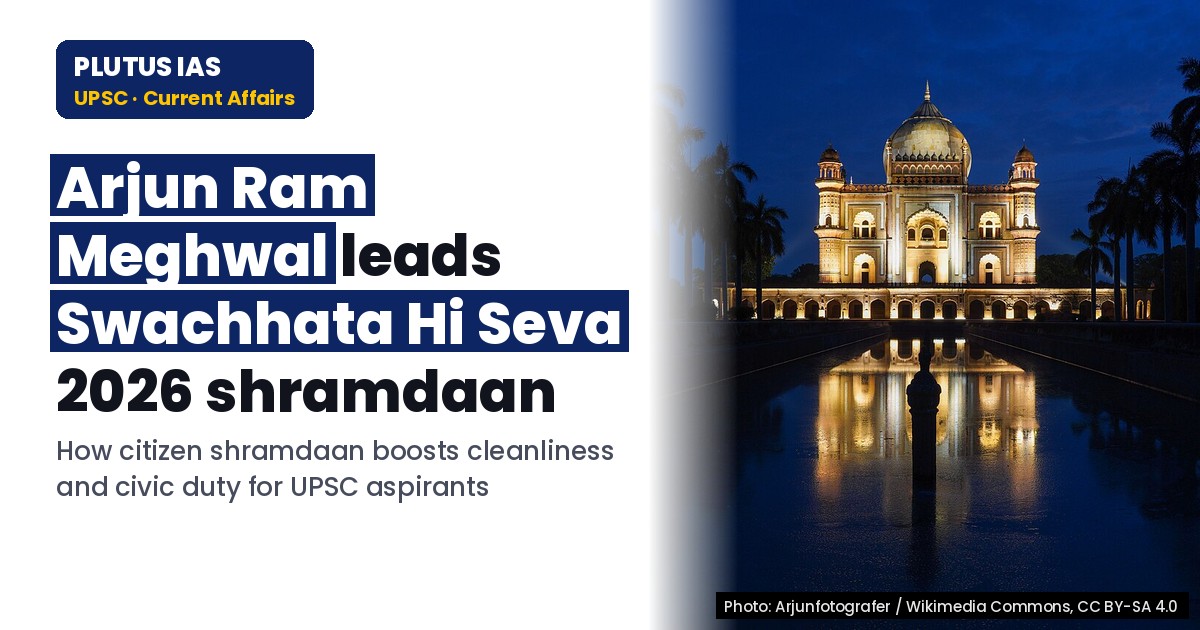
On 1 October 2026, the Department of Legal Affairs and the Legislative Department under the Ministry of Law and Justice jointly organised a shramdaan (voluntary labour) programme at Safdarjung Tomb, New Delhi, as part of the ‘Swachhata Hi Seva Abhiyan 2026’. The event, led by the Minister of State (Independent Charge), underscored the criticality of collective civic responsibility in sustaining public hygiene and environmental sustainability, aligning with the broader objectives of the Swachh Bharat Mission and constitutional directives on public health.
Background
- The Swachh Bharat Mission (SBM), launched in 2014, is a nation-wide campaign aimed at eliminating open defecation, improving solid waste management, and enhancing overall sanitation infrastructure across rural and urban India.
- Article 47 of the Directive Principles of State Policy (DPSP) in the Constitution of India enjoins the State to endeavour to bring about prohibition of the consumption of intoxicating drinks and drugs injurious to health and to improve public health.
- The ‘Swachhata Hi Seva’ campaign, initiated in 2018, is an annual mass mobilisation initiative under SBM, designed to foster citizen participation in sanitation and hygiene through shramdaan, awareness drives, and community engagement.
- The Ministry of Law and Justice, through its Legislative and Legal Affairs Departments, has historically engaged in public outreach programmes to promote constitutional values, legal literacy, and civic duties.
- Public monuments and heritage sites such as Safdarjung Tomb are maintained by the Archaeological Survey of India (ASI) under the Ministry of Culture, and their upkeep is a shared responsibility of citizens and institutions.
- The campaign’s theme ‘Ek Din, Ek Ghanta, Ek Saath’ (One Day, One Hour, Together) reflects the principle of collective action in achieving sustainable development goals (SDGs), particularly SDG 6 (Clean Water and Sanitation) and SDG 11 (Sustainable Cities and Communities).
Swachhata Hi Seva Abhiyan 2026: Institutional Framework, Objectives, and Implementation
- The Swachhata Hi Seva Abhiyan 2026 is a pan-India mass movement, focusing on the active participation of citizens, government officials, and institutions in sanitation and hygiene activities.
- The campaign is structured around the principle of ‘Shramdaan’ (voluntary labour), wherein participants engage in cleanliness drives, waste segregation, and maintenance of public spaces, thereby fostering a sense of ownership and civic duty.
- The 2026 edition, organised on 1 October, aligns with the International Day of Older Persons, emphasising intergenerational solidarity and the role of youth in promoting sustainable and inclusive public health practices.
- The Ministry of Law and Justice’s involvement underscores the integration of legal and constitutional awareness with civic engagement, reinforcing the idea that cleanliness is not merely a municipal function but a constitutional obligation.
- Key activities under the campaign include door-to-door waste collection, public awareness rallies, cleanliness drives in schools and colleges, and the distribution of hygiene kits to sanitation workers and marginalised communities.
- The campaign leverages digital platforms and social media to amplify its reach, utilising hashtags and interactive sessions to encourage widespread participation and accountability.
- Institutional partnerships with local bodies, NGOs, and educational institutions are critical to the campaign’s success, ensuring grassroots mobilisation and sustained impact beyond the event duration.
Key Features
| Feature | Significance |
|---|---|
| Joint initiative by Legislative Department and Department of Legal Affairs | Demonstrates inter-departmental synergy under the Ministry of Law and Justice to promote a unified national agenda on sanitation. |
| ‘Swachhata Hi Seva Abhiyan, 2026’ | A mass mobilisation campaign under the broader ‘Swachh Bharat Mission’ framework, aligning with the government’s flagship sanitation programme. |
| ‘Ek Din, Ek Ghanta, Ek Saath’ theme | Emphasises collective responsibility in sanitation, reinforcing the principle that cleanliness is a shared civic duty rather than a state-led obligation alone. |
| Shramdaan (voluntary labour) model | Encourages participatory governance by involving citizens, including government officials, in physical cleanliness drives, fostering ownership of public spaces. |
| Distribution of hygiene kits to sanitation workers | Recognises the critical role of sanitation workers in public health and provides tangible support to frontline staff in their daily operations. |
| Inclusion of legal fraternity (Supreme Court and High Court lawyers) | Highlights the role of the judiciary and legal professionals in promoting civic responsibility and constitutional values of cleanliness. |
Why it Matters
Public Health and Sanitation
- Sanitation is a critical determinant of public health, reducing the burden of waterborne diseases such as cholera, diarrhoea, and hepatitis.
- Clean public spaces, including heritage sites like Safdarjung Tomb, contribute to environmental sustainability and cultural preservation.
- Preventive health measures through cleanliness reduce healthcare expenditure and improve workforce productivity.
Civic Engagement and Governance
- Promotes participatory governance by involving citizens in nation-building activities, aligning with the constitutional directive of ‘Duty to the Nation’ under Article 51A (g).
- Strengthens the principle of ‘Jan Bhagidari’ (people’s participation) in public welfare initiatives, enhancing trust in governance.
- Demonstrates the role of the state in fostering a culture of responsibility rather than mere enforcement of laws.
Institutional Collaboration
- Showcases inter-departmental and inter-institutional coordination between the Legislative Department, Department of Legal Affairs, and the judiciary.
- Highlights the Ministry of Law and Justice’s role beyond legal drafting, extending to social and environmental governance.
- Serves as a model for other ministries to adopt similar collaborative approaches in public welfare programmes.
Cultural and Heritage Preservation
- Cleanliness at heritage sites like Safdarjung Tomb ensures their longevity and accessibility for future generations.
- Aligns with the ‘Adopt a Heritage’ scheme, where private and public entities contribute to the upkeep of cultural monuments.
Challenges
1. Sustaining Public Participation
- Ensuring consistent citizen engagement beyond episodic events like ‘Swachhata Hi Seva’ remains a challenge.
- Addressing apathy or lack of awareness among urban and rural populations regarding sanitation’s long-term benefits.
UPSC Link: GS2: Role of Civil Society
2. Resource Allocation for Sanitation Infrastructure
- Inadequate funding for sanitation infrastructure in urban slums and rural areas limits the effectiveness of cleanliness drives.
- Dependence on temporary measures like shramdaan without long-term investments in waste management systems.
UPSC Link: GS3: Infrastructure Development
3. Stigma and Social Inequality in Sanitation Work
- Sanitation workers often face social stigma and lack of dignity, despite their critical role in public health.
- Need for policy measures to improve working conditions, wages, and social security for sanitation workers.
UPSC Link: GS1: Social Justice
4. Monitoring and Accountability Mechanisms
- Lack of robust monitoring systems to track the impact of cleanliness drives on public health outcomes.
- Ensuring accountability of local bodies and municipal authorities in maintaining sanitation standards post-campaign.
UPSC Link: GS2: Accountability in Governance
5. Climate Change and Urbanisation Pressures
- Rapid urbanisation increases waste generation, straining existing sanitation systems.
- Climate change exacerbates sanitation challenges through increased flooding and water contamination risks.
UPSC Link: GS3: Environmental Governance
Challenges — UPSC Perspective
| Issue | Concern |
|---|---|
| Episodic Participation | Risk of citizen engagement being limited to annual events rather than a sustained habit. |
| Infrastructure Gaps | Inadequate waste management systems in peri-urban and rural areas hinder long-term sanitation goals. |
| Social Stigma | Sanitation workers face discrimination, affecting their morale and efficiency. |
| Policy Implementation | Gap between sanitation policies and their ground-level execution due to lack of resources or political will. |
| Data Deficiency | Absence of real-time data on sanitation metrics impedes evidence-based policymaking. |
| Climate Resilience | Sanitation systems are vulnerable to extreme weather events, requiring adaptive infrastructure. |
Government Initiatives — Must-Memorise for Prelims
- Swachh Bharat Mission (SBM) 2.0
- Adopt a Heritage Scheme
Way Forward
- Institutionalise ‘Shramdaan’ as a quarterly activity with measurable outcomes in sanitation improvement.
- Launch awareness campaigns in regional languages to sensitise diverse communities on the importance of cleanliness.
- Strengthen the ‘Swachhagrahis’ (sanitation volunteers) network to ensure continuous community engagement.
- Integrate sanitation education into school curricula to foster a culture of cleanliness from an early age.
- Develop public-private partnerships for waste management in urban and heritage areas to supplement government efforts.
- Establish a national sanitation dashboard to monitor progress and ensure transparency in governance.
- Enhance the dignity of sanitation workers through skill development programmes and social security measures.
- Conduct regular audits of public spaces to assess the impact of cleanliness drives and address gaps.
UPSC Value Addition
Keywords for Mains Answer-Writing
Swachhata Hi Seva Campaign 2026 · Shramdaan for cleanliness · Ministry of Law and Justice · Legislative Department · Department of Legal Affairs · Public participation in sanitation · Collective civic responsibility · Safdarjung Tomb cleanliness drive · One Day, One Hour, Together · Sustainable environment and sanitation · Citizen engagement in governance · Institutional leadership in cleanliness · Public-private partnership in sanitation · National Cleanliness Mission · Constitutional and statutory duties in sanitation
Constitutional & Policy Linkages
- Article 48A (Directive Principles of State Policy) — Protection and improvement of environment and safeguarding of forests and wildlife.
- Article 51A (g) (Fundamental Duties) — Duty of every citizen to protect and improve the natural environment including forests, lakes, rivers, and wildlife, and to have compassion for living creatures.
Concept Flow
Public Health Crisis → Sanitation as a Preventive Measure → Government Intervention (SBM) → Mass Mobilisation (‘Swachhata Hi Seva’) → Community Participation (Shramdaan) → Sustainable Sanitation Infrastructure → Environmental Preservation → National Well-being
Prelims Practice Questions
Q1. Consider the following statements regarding the ‘Swachhata Hi Seva Campaign 2026’:
1. The campaign was launched by the Ministry of Law and Justice.
2. The theme for the campaign was ‘One Day, One Hour, Together’.
3. The campaign included a shramdaan (voluntary labour) activity at the Safdarjung Tomb in New Delhi.
4. The campaign was inaugurated by the Prime Minister of India.
How many of the above statements are correct?
- Only one
- Only two
- Only three
- All four
Answer: Only three — Statements 1, 2, and 3 are correct as the campaign was launched by the Ministry of Law and Justice, followed the theme ‘One Day, One Hour, Together’, and included a shramdaan activity at Safdarjung Tomb. Statement 4 is incorrect as the campaign was led by the Minister of State (Independent Charge) for Law and Justice, not the Prime Minister.
Q2. Assertion (A): The ‘Swachhata Hi Seva Campaign 2026’ is a government initiative aimed at promoting individual and collective responsibility for cleanliness.
Reason (R): The campaign includes shramdaan (voluntary labour) activities to physically clean public spaces and raise awareness about sanitation.
Code:
- Both A and R are true and R is the correct explanation of A.
- Both A and R are true but R is NOT the correct explanation of A.
- A is true but R is false.
- A is false but R is true.
Answer: Both A and R are true and R is the correct explanation of A. — Assertion (A) is correct as the campaign promotes individual and collective responsibility for cleanliness. Reason (R) is also correct and directly explains the assertion, as shramdaan activities are a key component of the campaign to achieve its objectives.
Q3. Match the following columns related to the ‘Swachhata Hi Seva Campaign 2026’:
Column I (Component of the Campaign) | Column II (Description)
1. Shramdaan Activity | A. Distribution of cleanliness kits to sanitation workers
2. Theme | B. ‘One Day, One Hour, Together’
3. Venue | C. Safdarjung Tomb, New Delhi
4. Leadership | D. Minister of State (Independent Charge) for Law and Justice
Select the correct match:
- 1-A, 2-B, 3-C, 4-D
- 1-B, 2-A, 3-D, 4-C
- 1-C, 2-D, 3-A, 4-B
- 1-D, 2-C, 3-B, 4-A
Answer: 1-A, 2-B, 3-C, 4-D — The correct matches are: 1. Shramdaan Activity – A (Distribution of cleanliness kits to sanitation workers), 2. Theme – B (‘One Day, One Hour, Together’), 3. Venue – C (Safdarjung Tomb, New Delhi), 4. Leadership – D (Minister of State (Independent Charge) for Law and Justice).
Mains Practice Question
✍ Critically examine the role of public participation in sanitation initiatives such as the ‘Swachhata Hi Seva Campaign 2026’. How does such participation contribute to the achievement of Sustainable Development Goal 6 (Clean Water and Sanitation)? Also, analyse the challenges in sustaining public engagement in such campaigns. (15 Marks)
Approach: MODEL-ANSWER SKELETON:
1. **Introduction (2 Marks)**
– Define public participation in sanitation and its significance in India’s governance.
– Briefly introduce the ‘Swachhata Hi Seva Campaign 2026’ and its objectives.
2. **Role of Public Participation (5 Marks)**
– **Civic Responsibility and Ownership**: Explain how public participation fosters a sense of collective responsibility (e.g., shramdaan, awareness campaigns).
– **Behavioral Change**: Discuss how such campaigns influence individual habits (e.g., waste segregation, cleanliness at home and public spaces).
– **Institutional Synergy**: Highlight the role of government institutions (e.g., Ministry of Law and Justice) in mobilising citizens.
– **SDG 6 Alignment**: Link public participation to SDG 6 targets (e.g., universal access to sanitation, hygiene education).
3. **Contribution to SDG 6 (4 Marks)**
– **Access to Sanitation**: How community-driven cleanliness drives improve sanitation infrastructure.
– **Hygiene Promotion**: Role of public participation in spreading awareness about hygiene practices.
– **Data and Monitoring**: How citizen engagement aids in monitoring and reporting sanitation issues.
– **Policy Feedback**: How public feedback shapes sanitation policies (e.g., Swachh Bharat Mission).
4. **Challenges in Sustaining Engagement (3 Marks)**
– **Short-term vs. Long-term Participation**: Discuss the tendency of public engagement to wane after campaigns.
– **Resource Constraints**: Lack of infrastructure or incentives for sustained participation.
– **Awareness Gaps**: Limited understanding of sanitation’s broader impacts (e.g., health, environment).
– **Social Inequalities**: Differential access to sanitation facilities across socio-economic groups.
5. **Conclusion (1 Mark)**
– Summarise the importance of institutionalising public participation in sanitation.
– Suggest measures to sustain engagement (e.g., local leadership, community-based organisations, digital platforms).
Source: PIB (Press Information Bureau)
Generated by AanyaAi for educational purpose.
Related guides on our sites
- Anthropology VS PSIR
- Best PSIR optional coaching
- Best PSIR optional coaching online
- Best coaching for law optional

- Swachhata Hi Seva 2026: Law Ministry’s Shramdaan Drive for Cleanliness - October 2, 2026
- RoDTEP योजना को 31 दिसंबर 2026 तक बढ़ाया गया: निर्यातकों को मिलेगा लाभ - October 2, 2026
- ISRO Launches Free GIS Online Course for UPSC & PCS Aspirants - October 2, 2026

No Comments