


11 Aug Tamil Nadu Assembly Demands Withdrawal of FCRA Amendment Bill 2026
✎ The Foreign Contribution (Regulation) Amendment Bill, 2026, seeks to amend the FCRA, 2010, by introducing provisions for the Union Government to take over assets of charitable organisations under specific conditions, raising…
Subject Relevance — Where This Topic Fits
- GS Paper II — Governance, Constitution, Polity, Social Justice and International Relations | GS Paper III — Economic Development and Environment
- Prelims: Foreign Contribution (Regulation) Act, 2010, FCRA Amendment Bill, 2026, Article 25 (Freedom of Religion), Article 30 (Right of Minorities to Establish Educational Institutions), Federalism, Cooperative Federalism, Natural Justice, Proportionality, Legitimate Expectation, Charitable Organisations, Non-Profit Organisations (NPOs), Foreign Contributions, Transparency, Accountability
- Essay: Federalism and Centre-State Relations in India: Balancing Autonomy and Accountability, Regulating Foreign Funding: Striking a Balance Between National Security and Institutional Autonomy
Quick Revision: The Foreign Contribution (Regulation) Amendment Bill, 2026, seeks to amend the FCRA, 2010, by introducing provisions for the Union Government to take over assets of charitable organisations under specific conditions, raising concerns over institutional autonomy, federalism, and the principles of natural justice.
Why is this in the news?
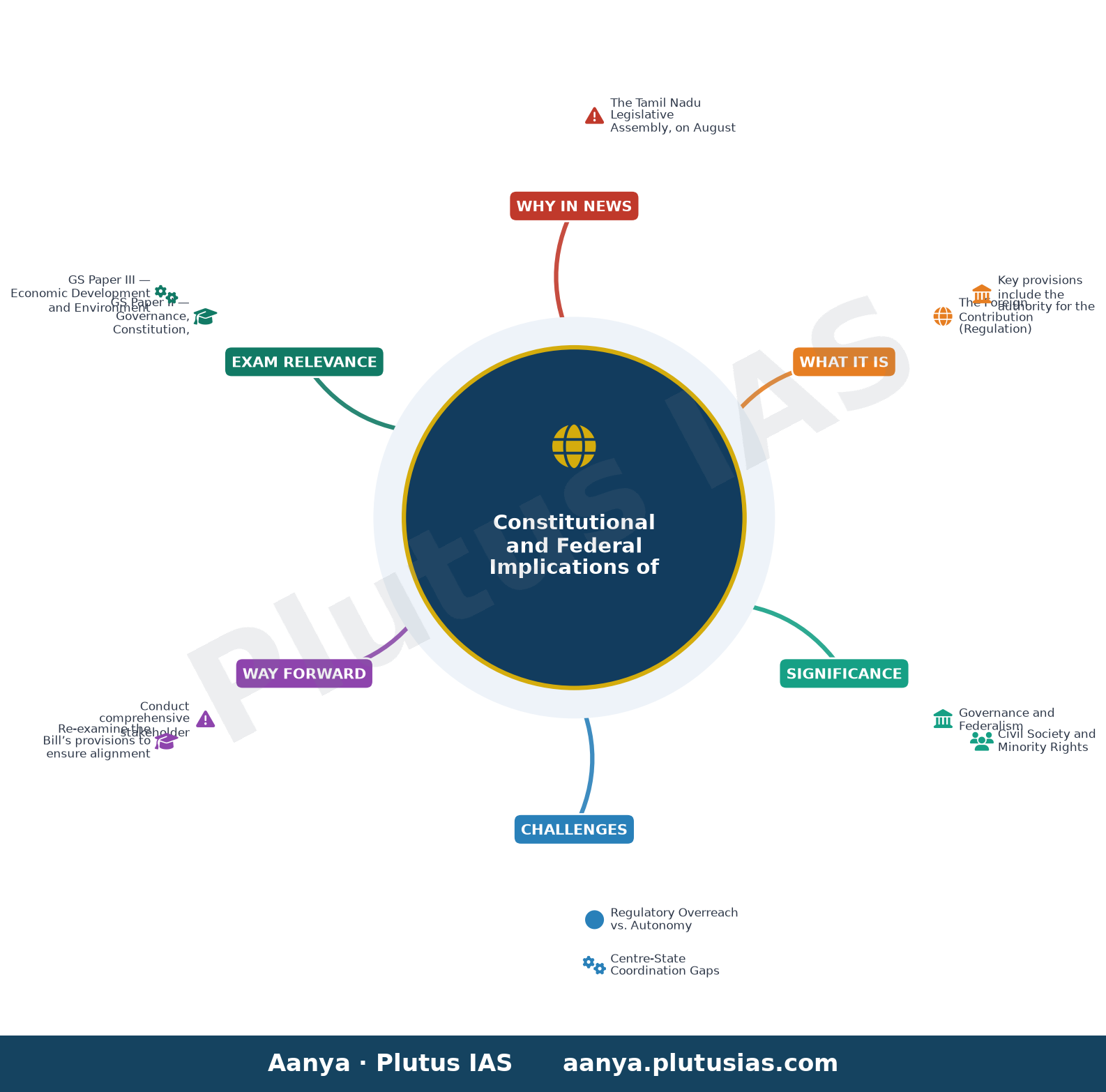
The Tamil Nadu Legislative Assembly, on August 11, 2026, unanimously passed a resolution urging the Union Government to withdraw the Foreign Contribution (Regulation) Amendment Bill, 2026, citing concerns over its potential impact on the autonomy of charitable, educational, and social welfare institutions, particularly those run by minorities. The resolution underscores the Bill’s provisions regarding the transfer, management, disposal, and sale of assets of organisations under specific conditions, highlighting constitutional principles such as federalism, natural justice, and proportionality.
Background
- The Foreign Contribution (Regulation) Act (FCRA), 2010, regulates the acceptance and utilisation of foreign contributions by individuals, associations, and companies in India to ensure transparency and prevent misuse for activities detrimental to national interest.
- The FCRA was amended in 2020, introducing stricter provisions such as reduced utilisation limits for administrative expenses, mandatory opening of FCRA accounts in the State Bank of India, and enhanced scrutiny of foreign contributions.
- The FCRA Amendment Bill, 2026, seeks to further amend the FCRA, 2010, with provisions that allow the Union Government to take over the management, disposal, or sale of assets of charitable organisations under certain conditions, including expiry, non-renewal, or cancellation of FCRA registration.
- States have historically expressed concerns over the centralisation of powers under the FCRA, particularly regarding the autonomy of non-profit organisations and the federal structure of governance.
- The Tamil Nadu Assembly’s resolution reflects broader apprehensions among states and civil society organisations regarding the potential erosion of institutional autonomy and the overreach of central regulatory mechanisms.
- The Bill’s provisions have been criticised for lacking comprehensive consultations with stakeholders, including state governments and non-profit organisations, despite its far-reaching implications.
What is the Foreign Contribution (Regulation) Amendment Bill, 2026?
- The Foreign Contribution (Regulation) Amendment Bill, 2026, is a proposed legislation aimed at amending the Foreign Contribution (Regulation) Act, 2010, to enhance regulatory oversight over foreign contributions received by individuals and organisations in India.
- Key provisions include the authority for the Union Government to take over the management, disposal, or sale of assets of charitable organisations under specific conditions, such as expiry of FCRA registration, non-renewal, refusal of renewal, cancellation of registration, or surrender of registration.
- The Bill introduces stricter conditions for the utilisation of foreign contributions, including reduced administrative expense limits and enhanced scrutiny mechanisms to prevent misuse.
- The Bill empowers the Union Government to regulate the transfer of foreign contributions between organisations, ensuring that funds are utilised for their intended purposes and not diverted for unauthorised activities.
- The Bill seeks to align the FCRA with evolving national security concerns, particularly regarding the prevention of foreign funding being used for activities that may undermine India’s sovereignty or integrity.
- The Bill has been criticised for its potential to infringe upon the autonomy of non-profit organisations, particularly those run by minorities, and for its lack of comprehensive consultations with stakeholders.
- The Bill’s provisions have raised debates on the balance between national security and the protection of institutional autonomy, as well as the federal implications of centralising regulatory powers.
Key Features
| Feature of FCRA Amendment Bill 2026 | Significance |
|---|---|
| Mandatory transfer of assets to Government | Raises concerns over autonomy of charitable organisations, particularly minority-run institutions |
| Disposal or sale of assets on FCRA registration expiry | Potential disruption to funding continuity for educational and social welfare projects |
| Provisions for non-renewal or cancellation of registration | Impacts operational sustainability of NGOs relying on foreign contributions |
| Requirement for prior Government approval for asset transfers | May introduce delays and bureaucratic hurdles in fund utilisation |
| Scope for Government intervention in asset management | Triggers debates on property rights and legitimate expectations of organisations |
Why it Matters
Governance and Federalism
- The resolution underscores the principle of cooperative federalism, asserting State governments’ role in policy consultations on matters affecting civil society organisations.
- It highlights the need for Centre-State coordination in regulatory frameworks impacting socio-economic development institutions.
- The demand for stakeholder consultations reflects a broader governance requirement for inclusive policy-making.
Civil Society and Minority Rights
- The Bill’s provisions may disproportionately affect minority-run educational and social welfare institutions, raising concerns under Articles 25, 26, and 30 of the Constitution.
- The autonomy of charitable organisations, particularly those serving marginalised communities, is central to the debate.
- The resolution emphasises the protection of legitimate expectations and property rights of lawfully functioning organisations.
Transparency and Accountability
- While the Bill aims to enhance transparency in foreign contributions, its implementation risks undermining the operational independence of NGOs.
- The balance between accountability and autonomy remains a critical governance challenge.
- The resolution advocates for proportionality in regulatory measures to avoid unintended consequences.
Legal and Constitutional Dimensions
- The Bill’s provisions intersect with fundamental rights, particularly those related to freedom of association (Article 19(1)(c)) and cultural and educational rights (Articles 29-30).
- The principle of natural justice (audi alteram partem) is invoked in the resolution, highlighting procedural safeguards in regulatory actions.
Challenges
1. Regulatory Overreach vs. Autonomy
- The Bill’s asset transfer provisions may encroach upon the autonomy of charitable organisations, potentially stifling their developmental role.
- The lack of clarity in defining ‘anti-national activities’ raises concerns over arbitrary enforcement.
- The resolution calls for a re-examination of the Bill to ensure it does not infringe upon constitutional rights.
UPSC Link: GS2: Fundamental Rights & DPSP
2. Centre-State Coordination Gaps
- The unilateral imposition of FCRA amendments without State consultations undermines cooperative federalism.
- State governments, as stakeholders, must be involved in shaping policies affecting local institutions.
- The resolution reflects a broader issue of Centre-State trust deficit in regulatory governance.
UPSC Link: GS2: Federalism & Centre-State Relations
3. Impact on Minority Institutions
- Minority-run educational and social welfare institutions may face disproportionate scrutiny under the Bill.
- The resolution highlights the need to protect the rights of minority institutions under Articles 29 and 30.
- The Bill’s provisions could inadvertently target institutions serving marginalised communities.
UPSC Link: GS2: Minority Rights & Cultural Rights
4. Operational Disruptions for NGOs
- The Bill’s asset transfer clauses may disrupt funding continuity for NGOs, leading to project closures.
- The requirement for Government approvals could introduce delays, affecting timely service delivery.
- The resolution underscores the need for a balanced approach that safeguards both accountability and operational efficiency.
UPSC Link: GS2: Role of NGOs in Development
5. Legal Ambiguity and Procedural Safeguards
- The Bill lacks clarity on the circumstances warranting asset transfers, raising concerns over arbitrary actions.
- The resolution advocates for adherence to principles of natural justice and proportionality in regulatory actions.
- The absence of a robust appeal mechanism may leave organisations without recourse against adverse decisions.
UPSC Link: GS2: Judicial Review & Writs
Challenges — UPSC Perspective
| Challenge | Concern |
|---|---|
| Autonomy of Charitable Organisations | Risk of Government overreach in asset management and operational control |
| Centre-State Coordination | Lack of prior consultation with States on policies affecting civil society |
| Minority Rights | Potential disproportionate impact on minority-run educational and social welfare institutions |
| Operational Disruptions | Delays and funding gaps due to bureaucratic hurdles in asset transfers |
| Legal Ambiguity | Unclear definitions and procedural gaps leading to arbitrary enforcement |
Way Forward
- Conduct comprehensive stakeholder consultations involving Centre, States, NGOs, and minority institutions to address concerns.
- Re-examine the Bill’s provisions to ensure alignment with constitutional principles of natural justice and proportionality.
- Clarify the definition of ‘anti-national activities’ to prevent arbitrary enforcement and protect legitimate activities.
- Establish a robust appeal mechanism for organisations aggrieved by FCRA registration decisions or asset transfer orders.
- Strengthen Centre-State coordination mechanisms to ensure inclusive policy-making on regulatory matters.
- Undertake an impact assessment of the Bill’s provisions on minority-run institutions and socio-economic development projects.
- Explore alternative regulatory frameworks that balance transparency with operational autonomy for NGOs.
- Publish detailed guidelines on the implementation of asset transfer provisions to ensure procedural fairness.
UPSC Value Addition
Keywords for Mains Answer-Writing
Foreign Contribution Regulation Act (FCRA), 2010 · FCRA Amendment Bill 2026 · Federalism and Centre-State relations · Autonomy of Non-Governmental Organisations (NGOs) · Foreign Contribution (Regulation) Amendment Bill, 2026 · Charitable and educational institutions · Natural justice and proportionality · Property rights of NGOs · Foreign funding and national security · Legitimate expectations in administrative law · State Legislative Assembly resolutions · Consultative federalism in governance
Constitutional & Policy Linkages
- Article 19(1)(c): Freedom of association and assembly
- Article 25: Freedom of conscience and free profession, practice, and propagation of religion
- Article 26: Freedom to manage religious affairs
- Article 29: Protection of interests of minorities
- Article 30: Right of minorities to establish and administer educational institutions
Concept Flow
Introduction of FCRA Amendment Bill 2026 → Concerns over asset transfer provisions → Tamil Nadu Assembly resolution → Debate on autonomy vs. accountability → Constitutional scrutiny (Articles 19, 25-26, 29-30) → Centre-State coordination gaps → Impact on minority institutions → Way forward for balanced regulation
Prelims Practice Questions
Q1. Consider the following statements regarding the Foreign Contribution (Regulation) Act (FCRA), 2010:
1. The Act regulates the acceptance and utilisation of foreign contributions by individuals, associations, and companies.
2. The Act empowers the Union Government to cancel the FCRA registration of an organisation if it is found to be involved in activities detrimental to the national interest.
3. The Act prohibits the transfer of foreign contributions to any other person or organisation without prior permission.
4. The Act mandates that all foreign contributions must be received only through designated banks and deposited in a designated FCRA account.
How many of the above statements are correct?
- Only one
- Only two
- Only three
- All four
Answer: All four — Statements 1, 2, and 4 are correct as per the FCRA, 2010. Statement 3 is incorrect because the Act allows transfer of foreign contributions to other registered organisations with prior permission, subject to conditions.
Q2. Assertion (A): The Foreign Contribution (Regulation) Amendment Bill, 2026 seeks to empower the Union Government to seize and dispose of the assets of charitable organisations upon cancellation of their FCRA registration.
Reason (R): The Bill aims to prevent the misuse of foreign funds for activities threatening national security.
Options:
A. Both A and R are true, and R is the correct explanation of A.
B. Both A and R are true, but R is not the correct explanation of A.
C. A is true, but R is false.
D. A is false, but R is true.
Answer: ? — Assertion (A) is true as the Bill includes provisions for seizure and disposal of assets of organisations whose FCRA registration is cancelled. Reason (R) is also true, but the two are not directly causally linked; the Bill’s primary aim is to regulate foreign contributions while ensuring accountability.
Q3. Match the following provisions of the Foreign Contribution (Regulation) Act (FCRA), 2010 with their respective descriptions:
Column I (Provisions)
1. Section 12(4)(a)
2. Section 17
3. Section 8(1)
4. Section 11(1)
Column II (Descriptions)
A. Prohibits acceptance of foreign contributions by certain persons or organisations.
B. Mandates opening of a designated FCRA account in a specified bank.
C. Empowers the Union Government to prohibit the acceptance of foreign contributions for up to five years.
D. Regulates the transfer of foreign contributions to other persons or organisations.
Answer: ? — 1-C, 2-B, 3-A, 4-D. Section 12(4)(a) empowers the government to prohibit acceptance of foreign contributions for a specified period. Section 17 mandates the opening of a designated FCRA account. Section 8(1) lists prohibited persons or organisations. Section 11(1) regulates the transfer of foreign contributions.
Mains Practice Question
✍ The Foreign Contribution (Regulation) Amendment Bill, 2026 introduces provisions that empower the Union Government to seize, manage, or dispose of the assets of charitable organisations upon cancellation or non-renewal of their FCRA registration. Critically examine the constitutional validity of these provisions in the context of federalism, property rights, and the principles of natural justice. Also, analyse the implications for the autonomy of non-governmental organisations engaged in educational and social welfare activities. (15 Marks)
Approach: MODEL-ANSWER SKELETON:
1. **Constitutional Framework and Federalism**:
– Reference to the Seventh Schedule (Union List Entry 18, Concurrent List Entry 10) and the doctrine of federalism.
– Role of State Governments in regulating NGOs and social welfare activities (e.g., State Social Welfare Boards).
– Principle of cooperative federalism and the need for consultation with States (as highlighted in the Tamil Nadu Assembly resolution).
2. **Property Rights and Legitimate Expectations**:
– Article 300A of the Constitution: Right to property as a constitutional right.
– Doctrine of legitimate expectations in administrative law (e.g., *State of Punjab v. Gurdial Singh*, 1980).
– Proportionality test: Whether the provisions are proportionate to the objective of preventing misuse of foreign funds.
3. **Natural Justice and Procedural Safeguards**:
– Principles of natural justice (audi alteram partem) and fair hearing (e.g., *Maneka Gandhi v. Union of India*, 1978).
– Need for clear and transparent procedures for seizure, management, and disposal of assets.
– Role of judicial review under Article 226/32 of the Constitution.
4. **Autonomy of NGOs and Social Welfare**:
– Importance of NGOs in India’s social sector (e.g., education, healthcare, poverty alleviation).
– Impact on minority-run institutions and their constitutional rights under Article 30.
– Potential chilling effect on foreign funding and operational independence of NGOs.
5. **Balancing National Security and Autonomy**:
– Legitimate state interest in regulating foreign contributions to prevent threats to sovereignty (e.g., *People’s Union for Civil Liberties v. Union of India*, 2004).
– Need for a balanced approach that does not stifle legitimate charitable activities.
6. **Recent Judicial Precedents and Committee Reports**:
– Reference to the *FCRA judgement* by the Supreme Court in 2020 (*Noida Entrepreneurs Association v. Union of India*).
– Recommendations of the *Second Administrative Reforms Commission (2009)* on transparency in NGO governance.
7. **Conclusion**:
– Synthesis of arguments: The provisions must be tested against constitutional benchmarks of proportionality, federalism, and natural justice.
– Recommendation for amendments: Incorporate safeguards such as prior notice, opportunity for hearing, and judicial oversight.
Source: The Hindu
Generated by AanyaAi for educational purpose.

- KWML’s Feasibility Reports for Water Metro in 18 Cities: UPSC & PCS Insights - October 3, 2026
- ओडिशा में वन्यजीव अनुसंधान अनुदान कार्यक्रम शुरू, सिमिलिपाल में 300 कैमरे और बढ़ेंगे - October 3, 2026
- India Summons Pakistan High Commission Official Over Violation - October 3, 2026

No Comments