


11 Aug Tamil Nadu Assembly Demands Withdrawal of FCRA Amendment Bill 2026
✎ The Foreign Contribution (Regulation) Amendment Bill, 2026, seeks to centralise regulatory powers over civil society organisations by allowing the Union Government to transfer or dispose of their assets in cases of FCRA…
Subject Relevance — Where This Topic Fits
- GS Paper II — Governance, Constitution, Polity, Social Justice and International Relations | GS Paper III — Economy — Role of Civil Society and Non-Governmental Organisations
- Prelims: Foreign Contribution (Regulation) Act, 2010, FCRA Amendment Bill, 2026, Article 246 of the Constitution, Federalism, Minority educational institutions, Natural justice, Proportionality, Property rights
- Essay: The tension between national security imperatives and the autonomy of civil society in a federal polity, Balancing transparency in foreign funding with the protection of constitutional rights and federal principles
Quick Revision: The Foreign Contribution (Regulation) Amendment Bill, 2026, seeks to centralise regulatory powers over civil society organisations by allowing the Union Government to transfer or dispose of their assets in cases of FCRA registration issues, raising constitutional and federal concerns.
Why is this in the news?
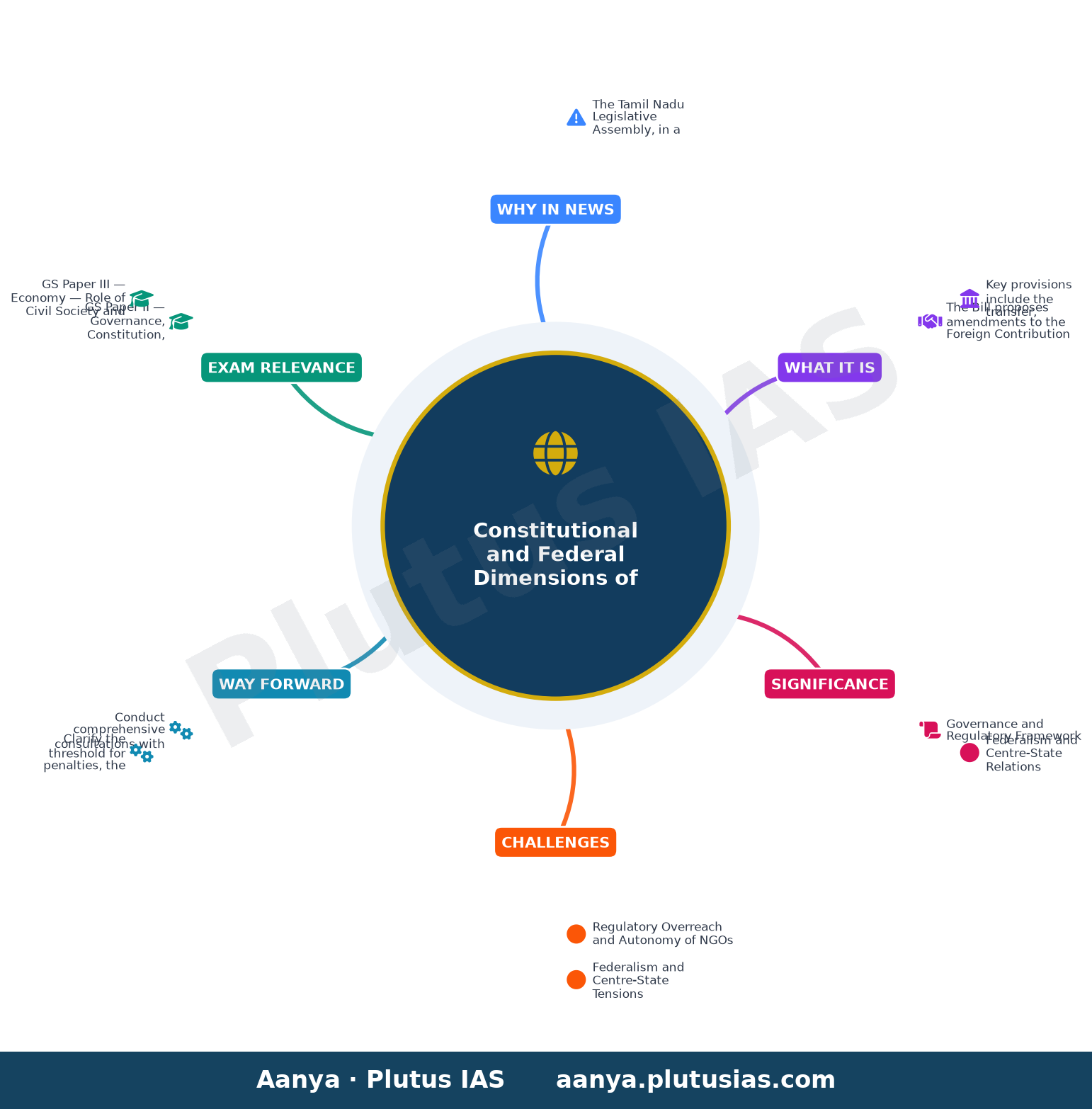
The Tamil Nadu Legislative Assembly, in a unanimous resolution passed on August 11, 2026, urged the Union Government to withdraw the Foreign Contribution (Regulation) Amendment Bill, 2026, citing concerns over its provisions that may impinge upon the autonomy of charitable, educational, and social welfare institutions, particularly those run by minorities. The resolution underscores the Bill’s potential conflict with principles of federalism, natural justice, and property rights, and calls for comprehensive consultations with stakeholders, including State governments.
Background
- The Foreign Contribution (Regulation) Act, 2010 (FCRA), regulates the acceptance and utilisation of foreign contributions by individuals, associations, and companies in India, with the stated objective of ensuring transparency and preventing foreign interference in domestic affairs.
- The FCRA was amended in 2020 to introduce stricter provisions, including reduced utilisation limits for administrative expenses, mandatory opening of FCRA accounts in designated banks, and enhanced scrutiny of foreign contributions.
- The proposed FCRA Amendment Bill, 2026, seeks to further amend the Act, with provisions that allow the Union Government to transfer, manage, dispose of, or sell the assets of charitable organisations in cases of expiry, non-renewal, refusal of renewal, cancellation, or surrender of FCRA registration.
- The Bill has been criticised for potentially centralising regulatory powers over civil society organisations, raising concerns about the erosion of their autonomy and the federal structure of governance.
- State governments, particularly those with significant minority-run institutions, have expressed apprehensions regarding the Bill’s implications for their jurisdiction over education and social welfare.
- The Constitution of India, under the Seventh Schedule, delineates the division of legislative powers between the Union and the States, with education and social welfare falling primarily under the State List (List II).
What is the Foreign Contribution (Regulation) Amendment Bill, 2026?
- The Bill proposes amendments to the Foreign Contribution (Regulation) Act, 2010, aimed at enhancing oversight over the utilisation of foreign contributions by non-governmental organisations (NGOs) and other entities.
- Key provisions include the transfer, management, disposal, or sale of assets of charitable organisations by the Union Government in cases of registration expiry, non-renewal, refusal of renewal, cancellation, or surrender of FCRA registration.
- The Bill seeks to introduce stricter compliance mechanisms, including enhanced scrutiny of foreign contributions and stricter reporting requirements for NGOs.
- The proposed amendments are framed under the Union Government’s concurrent power to regulate foreign contributions, as envisaged under Entry 18 of the Union List (List I) of the Seventh Schedule and Entry 16 of the Concurrent List (List III).
- The Bill has been justified by the Union Government as a measure to prevent the misuse of foreign funds for anti-national activities, though critics argue that the provisions may disproportionately affect legitimate civil society organisations.
- The Bill’s provisions intersect with constitutional principles such as natural justice, proportionality, protection of property rights, and legitimate expectations, as well as the federal structure of governance.
- The Bill’s passage has sparked debates on the balance between national security imperatives and the autonomy of civil society, particularly in the context of minority-run educational and social welfare institutions.
- The Bill’s potential impact on the functioning of NGOs, including those engaged in education, healthcare, and social welfare, has raised concerns about the erosion of their operational independence.
Key Features
| Feature of the FCRA Amendment Bill, 2026 | Significance |
|---|---|
| Provisions for transfer, management, disposal, and sale of assets of charitable organisations | Potential erosion of autonomy of non-governmental organisations (NGOs) and voluntary sector entities, particularly those engaged in education, healthcare, and social welfare. |
| Grounds for asset transfer: expiry of FCRA registration, non-renewal, refusal of renewal, cancellation, or surrender of registration | Increases regulatory uncertainty for organisations dependent on foreign contributions, which may disrupt long-term planning and operational continuity. |
| Requirement for prior approval of the Union Government for transfer, sale, or disposal of assets by FCRA-registered entities | Centralises control over assets acquired through foreign funds, raising concerns about federalism and the principle of subsidiarity in governance. |
| Mandatory reporting and auditing obligations for organisations receiving foreign contributions | Enhances transparency and accountability but may impose additional compliance burdens on smaller NGOs with limited administrative capacity. |
| Provisions for cancellation of FCRA registration for non-compliance with procedural or substantive requirements | Strengthens regulatory oversight but risks disproportionate penalties for minor or technical violations, potentially leading to misuse of regulatory power. |
Why it Matters
Governance and Regulatory Framework
- The Bill seeks to amend the Foreign Contribution (Regulation) Act, 2010, a key legislation governing the receipt and utilisation of foreign contributions by Indian entities.
- It reflects a centralising trend in regulatory governance, where the Union Government assumes greater control over the management and disposal of assets acquired through foreign funds.
- The provisions may impact the operational autonomy of NGOs, particularly those in education, healthcare, and social welfare sectors, which often rely on foreign contributions for sustainability.
- The Bill’s emphasis on prior approval mechanisms could lead to delays in decision-making, affecting the timely execution of projects funded by foreign contributions.
Federalism and Centre-State Relations
- The resolution passed by the Tamil Nadu Assembly highlights concerns over the encroachment of the Union Government’s powers into domains traditionally managed by State governments and civil society organisations.
- The Bill’s provisions on asset transfer and disposal may be perceived as undermining the federal structure, as State governments and local bodies have limited say in the regulation of NGOs operating within their jurisdiction.
- The demand for comprehensive consultations with stakeholders, including State governments, underscores the need for a cooperative federalism approach in regulatory policymaking.
- The Bill’s potential to disrupt the functioning of State-specific NGOs could exacerbate tensions in Centre-State relations, particularly in States with significant NGO activity.
Civil Society and Non-Profit Sector
- The Bill’s provisions could disproportionately affect civil society organisations (CSOs), including religious, educational, and cultural institutions, which often rely on foreign contributions for their operations.
- The requirement for prior approval for asset transfers may discourage foreign donors from contributing to Indian NGOs, particularly in sectors where long-term asset ownership is essential.
- The Bill’s focus on accountability and transparency is commendable, but the lack of clarity on the threshold for penalties and the process for appeals could lead to arbitrary enforcement.
- The sector’s concerns about the Bill’s potential to stifle dissent and restrict the space for advocacy and social activism are worth noting, though not explicitly addressed in the resolution.
Legal and Jurisprudential Implications
- The Bill’s provisions may raise questions about the balance between regulatory oversight and the protection of property rights, as enshrined in Article 300A of the Constitution.
- The principle of proportionality, as developed in judicial precedents, may be invoked to challenge the Bill’s provisions if they are deemed to impose disproportionate burdens on NGOs.
- The Bill’s emphasis on natural justice and legitimate expectations could lead to legal challenges if the procedures for cancellation or refusal of renewal are perceived as arbitrary or opaque.
Challenges
1. Regulatory Overreach and Autonomy of NGOs
- The Bill’s provisions for asset transfer and disposal could undermine the operational autonomy of NGOs, particularly those in education, healthcare, and social welfare sectors.
- The lack of clarity on the threshold for penalties and the process for appeals may lead to arbitrary enforcement, raising concerns about due process and natural justice.
- The centralisation of control over assets acquired through foreign funds may discourage foreign donors from contributing to Indian NGOs, particularly in sectors where long-term asset ownership is essential.
UPSC Link: GS-II: Role of NGOs in governance
2. Federalism and Centre-State Tensions
- The Bill’s provisions may be perceived as encroaching upon the powers of State governments, particularly in domains where NGOs play a significant role in service delivery.
- The resolution passed by the Tamil Nadu Assembly highlights the need for cooperative federalism in regulatory policymaking, particularly in areas affecting civil society organisations.
- The lack of consultation with State governments during the drafting of the Bill could exacerbate tensions in Centre-State relations.
UPSC Link: GS-II: Federalism
3. Compliance Burden and Administrative Capacity
- The Bill’s emphasis on mandatory reporting and auditing obligations may impose additional compliance burdens on smaller NGOs with limited administrative capacity.
- The requirement for prior approval for asset transfers could lead to delays in decision-making, affecting the timely execution of projects funded by foreign contributions.
- The lack of clarity on the process for renewal and cancellation of FCRA registration may create uncertainty for NGOs, particularly those with limited legal resources.
UPSC Link: GS-II: Governance challenges
4. Protection of Property Rights and Legal Challenges
- The Bill’s provisions may raise questions about the balance between regulatory oversight and the protection of property rights, as enshrined in Article 300A of the Constitution.
- The principle of proportionality, as developed in judicial precedents, may be invoked to challenge the Bill’s provisions if they are deemed to impose disproportionate burdens on NGOs.
- The lack of clarity on the process for appeals and grievance redressal may lead to legal challenges, particularly if the provisions are perceived as arbitrary or opaque.
UPSC Link: GS-II: Fundamental Rights
5. Impact on Civil Society Space and Advocacy
- The Bill’s provisions could disproportionately affect civil society organisations (CSOs) engaged in advocacy and social activism, particularly those critical of government policies.
- The requirement for prior approval for asset transfers may discourage foreign donors from supporting NGOs engaged in advocacy, thereby restricting the space for dissent and public debate.
- The lack of clarity on the threshold for penalties and the process for appeals could lead to self-censorship among NGOs, particularly those operating in politically sensitive areas.
UPSC Link: GS-II: Role of Civil Society
Challenges — UPSC Perspective
| Challenge | Specific Concern |
|---|---|
| Regulatory Overreach | Potential erosion of autonomy of NGOs, particularly in education and social welfare sectors. |
| Federalism | Encroachment on State government powers in domains where NGOs play a significant role. |
| Compliance Burden | Additional administrative and financial burden on smaller NGOs with limited capacity. |
| Legal Uncertainty | Lack of clarity on penalties, appeals, and renewal processes leading to arbitrary enforcement. |
| Civil Society Space | Risk of restricting advocacy and dissent through disproportionate penalties and prior approval mechanisms. |
| Donor Confidence | Potential discouragement of foreign donors due to increased regulatory control and uncertainty. |
Way Forward
- Conduct comprehensive consultations with State governments, civil society organisations, and other stakeholders to address concerns about federalism and operational autonomy.
- Clarify the threshold for penalties, the process for appeals, and the criteria for cancellation or refusal of FCRA registration to ensure proportionality and natural justice.
- Establish a transparent and time-bound mechanism for prior approval of asset transfers to minimise delays in project execution.
- Enhance the capacity of smaller NGOs to comply with reporting and auditing obligations through training and financial support.
- Ensure that the Bill’s provisions do not disproportionately affect NGOs engaged in advocacy and social activism, thereby preserving the space for dissent and public debate.
- Strengthen grievance redressal mechanisms within the FCRA framework to address concerns about arbitrary enforcement and lack of due process.
- Consider the establishment of an independent oversight body to review regulatory decisions and ensure accountability in the enforcement of FCRA provisions.
- Monitor the implementation of the Bill’s provisions to assess their impact on the operational autonomy of NGOs and the flow of foreign contributions to India.
UPSC Value Addition
Keywords for Mains Answer-Writing
Foreign Contribution (Regulation) Act, 2010 · FCRA Amendment Bill, 2026 · Federalism and Centre-State relations · Autonomy of charitable organisations · Foreign Contribution (Regulation) Amendment Bill, 2020 · Natural justice and proportionality · Right to Property (Article 300A) · Legitimate expectation · Union-State legislative relations (Article 246) · Foreign Contribution (Regulation) Act, 2010: Key Provisions · Judicial review of administrative actions · Stakeholder consultations in policy-making
Constitutional & Policy Linkages
- Article 300A: Protection of property rights
- Article 29: Protection of cultural and educational rights of minorities
- Article 19(1)(c): Right to form associations
Concept Flow
Foreign Contribution (Regulation) Act, 2010 → Regulatory oversight of foreign contributions → FCRA Amendment Bill, 2026 → Centralisation of control over assets → Concerns over autonomy of NGOs → Resolution by Tamil Nadu Assembly → Demand for withdrawal and consultations → Broader debate on federalism and civil society space
Prelims Practice Questions
Q1. Consider the following statements regarding the Foreign Contribution (Regulation) Act, 2010 (FCRA):
1. The Act regulates the acceptance and utilisation of foreign contributions by individuals, associations, and companies.
2. The Act empowers the Union Government to cancel the registration of an organisation if it violates the provisions of the Act.
3. The Act prohibits foreign contributions to political parties and electoral candidates.
4. The Act mandates that all foreign contributions must be routed through the State Bank of India, New Delhi.
How many of the above statements are correct?
- Only one
- Only two
- Only three
- All four
Answer: All four — Statements 1, 2, and 3 are correct as per the FCRA, 2010. Statement 4 is incorrect because foreign contributions must be routed through the State Bank of India, New Delhi, or any other branch authorised by the Central Government, not exclusively through the New Delhi branch.
Q2. Assertion (A): The Foreign Contribution (Regulation) Amendment Bill, 2026 seeks to vest the Union Government with the power to transfer, manage, dispose, or sell the assets of charitable organisations upon cancellation of their FCRA registration.
Reason (R): The amendment aims to ensure that foreign funds are not utilised for anti-national activities.
In the context of the above two statements, which of the following is correct?
- Both A and R are true, and R is the correct explanation of A
- Both A and R are true, but R is NOT the correct explanation of A
- A is true, but R is false
- A is false, but R is true
Answer: Both A and R are true, but R is NOT the correct explanation of A — Both the Assertion (A) and Reason (R) are factually correct. The amendment grants the Union Government powers over assets of organisations with cancelled FCRA registration, and the stated objective is to prevent misuse of foreign funds for anti-national activities. However, the reason does not fully explain the assertion, as the amendment’s provisions are broader than just anti-national activities.
Q3. Match the following provisions of the Foreign Contribution (Regulation) Act, 2010 with their corresponding descriptions:
Column I (Provision)
A. Section 7
B. Section 12
C. Section 17
D. Section 32
Column II (Description)
1. Prohibits acceptance of foreign contribution by political parties and electoral candidates
2. Mandates registration of associations receiving foreign contributions
3. Empowers the Union Government to prohibit receipt of foreign contributions by specific persons
4. Requires foreign contributions to be deposited in the State Bank of India or authorised branches
Select the correct match:
- A-1, B-2, C-4, D-3
- A-2, B-1, C-3, D-4
- A-3, B-4, C-2, D-1
- A-4, B-3, C-1, D-2
Answer: A-1, B-2, C-4, D-3 — The correct matches are: A (Section 7) – 1 (Prohibits acceptance by political parties), B (Section 12) – 2 (Mandates registration), C (Section 17) – 4 (Requires deposit in specified banks), D (Section 32) – 3 (Empowers prohibition).
Mains Practice Question
✍ The Foreign Contribution (Regulation) Amendment Bill, 2026 seeks to vest the Union Government with extensive powers over the assets of charitable organisations upon cancellation or non-renewal of their FCRA registration. Critically examine the constitutional validity of these provisions in the context of federalism, natural justice, and the right to property. Also, analyse the implications for the autonomy of non-governmental organisations (NGOs) engaged in educational and social welfare activities. (15 Marks)
Approach: MODEL-ANSWER SKELETON:
1. **Introduction (2 marks)**: Briefly define the FCRA, 2010, and outline the key provisions of the 2026 Amendment Bill, focusing on the disputed clauses regarding asset transfer, management, disposal, or sale.
2. **Constitutional Validity: Federalism (3 marks)**:
– Discuss the distribution of legislative powers under Article 246 (Seventh Schedule) and the doctrine of federalism.
– Examine whether the Union Government can legislate on matters affecting NGOs, which are largely state subjects (e.g., education, health).
– Cite relevant judicial precedents (e.g., State of West Bengal v. Union of India, 1963; SR Bommai v. Union of India, 1994) on Centre-State relations.
3. **Constitutional Validity: Natural Justice and Proportionality (4 marks)**:
– Analyse the principles of natural justice (audi alteram partem) and proportionality as enshrined in Articles 14 and 21.
– Discuss whether the provisions violate the doctrine of legitimate expectation and the right to property (Article 300A).
– Reference judicial decisions (e.g., Maneka Gandhi v. Union of India, 1978; Shayara Bano v. Union of India, 2017) on proportionality and due process.
4. **Implications for NGO Autonomy (3 marks)**:
– Explain the role of NGOs in India’s social sector, particularly in education and healthcare.
– Discuss the potential chilling effect on NGOs’ operational freedom and donor confidence.
– Reference global best practices (e.g., UN Declaration on Human Rights Defenders, 1998) on NGO autonomy.
5. **Balancing Transparency and Accountability (3 marks)**:
– Acknowledge the need for transparency in foreign contributions to prevent misuse.
– Propose alternative mechanisms (e.g., enhanced disclosures, independent audits) to achieve the same objective without compromising autonomy.
– Conclude with a balanced view, acknowledging the Union Government’s legitimate concerns while safeguarding constitutional principles.
Source: The Hindu
Generated by AanyaAi for educational purpose.

- KWML’s Feasibility Reports for Water Metro in 18 Cities: UPSC & PCS Insights - October 3, 2026
- ओडिशा में वन्यजीव अनुसंधान अनुदान कार्यक्रम शुरू, सिमिलिपाल में 300 कैमरे और बढ़ेंगे - October 3, 2026
- India Summons Pakistan High Commission Official Over Violation - October 3, 2026

No Comments