


11 Aug Tamil Nadu Assembly to Push for Freeze on Lok Sabha Seats at 543
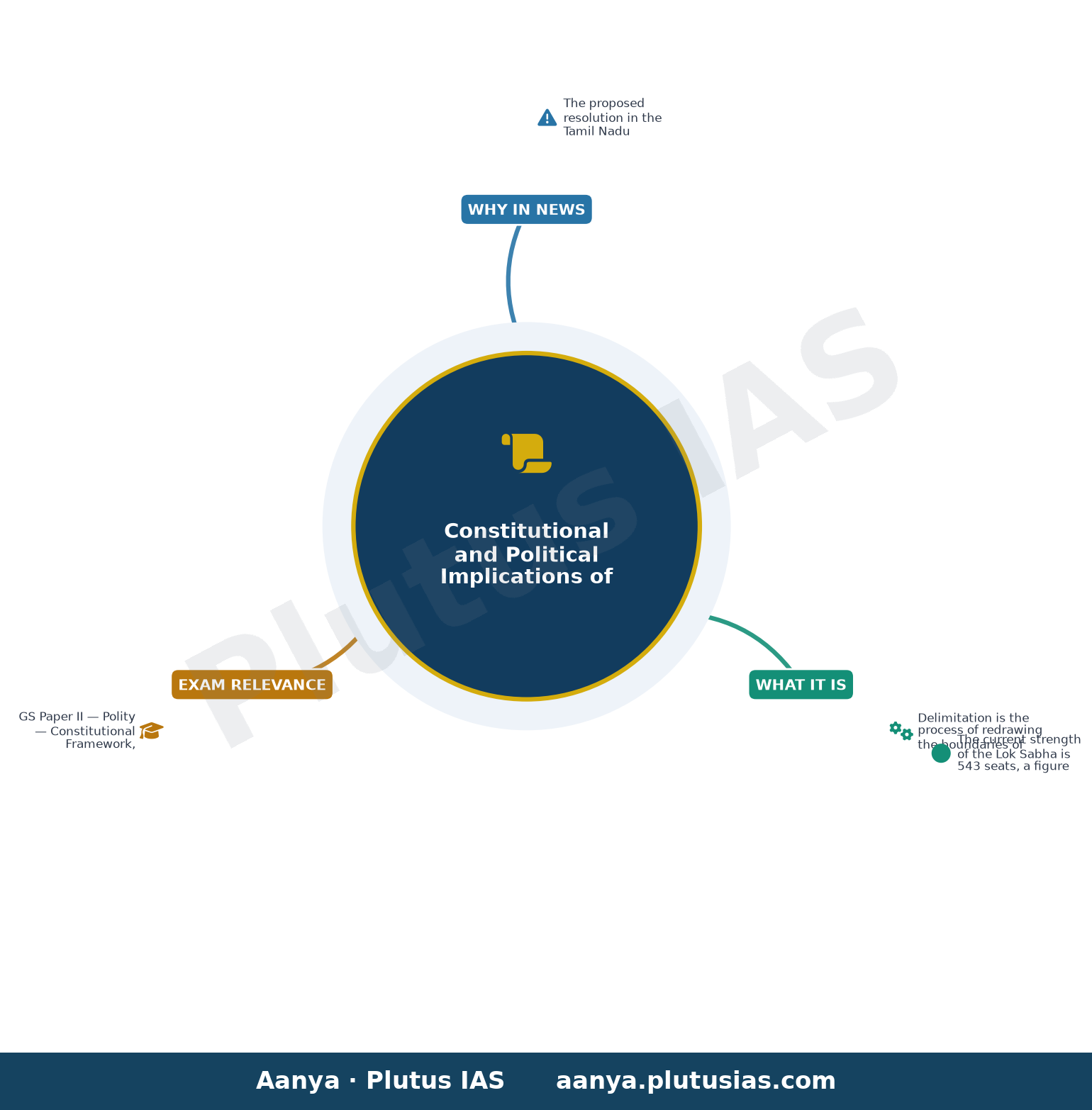
✎ The current strength of the Lok Sabha is fixed at 543 seats, a figure that may be altered only through a constitutional amendment, as the delimitation process has been deferred until after the 2026 Census.
Subject Relevance — Where This Topic Fits
- GS Paper II — Polity — Constitutional Framework, Parliament and State Legislatures, Federalism
- Prelims: Delimitation Commission, Article 82, Article 170, Article 334, Lok Sabha seat freeze, Inter-State seat distribution, Constitutional Amendment, Women’s Reservation Bill
- Essay: Federalism and the balance of power between the Union and States in India, The role of constitutional amendments in democratic governance
Quick Revision: The current strength of the Lok Sabha is fixed at 543 seats, a figure that may be altered only through a constitutional amendment, as the delimitation process has been deferred until after the 2026 Census.
Why is this in the news?
The proposed resolution in the Tamil Nadu Legislative Assembly to permanently freeze the number of Lok Sabha seats at 543 and retain the current inter-State distribution of seats has brought the issue of delimitation and its constitutional implications into focus. This move, led by the Chief Minister of Tamil Nadu, follows a meeting with MPs from the state and reflects broader concerns among southern States regarding potential demographic shifts that could reduce their political representation in Parliament.
Background
- The current strength of the Lok Sabha is 543 seats, a figure fixed since the 1971 delimitation exercise, which was based on the 1971 Census. Subsequent censuses (1981, 1991, 2001, 2011) have not led to an increase in the number of seats, as the delimitation process was deferred until after the 2026 Census.
- Delimitation is the process of redrawing the boundaries of parliamentary and assembly constituencies to reflect changes in population distribution. It is conducted by the Delimitation Commission, a statutory body established under the Delimitation Act, 2002.
- The proposed resolution in Tamil Nadu also urges the implementation of 33% reservation for women in the 2029 Lok Sabha and subsequent Assembly elections without any delay, based on the existing 543 seats.
- Southern States, including Tamil Nadu, have historically expressed concerns that a fresh delimitation exercise could reduce their relative share of seats in Parliament due to slower population growth compared to northern States.
- The Union government has not yet initiated the delimitation process post-2026 Census, but the proposed resolution in Tamil Nadu signals a proactive stance to influence the political and constitutional discourse surrounding the issue.
What is the Delimitation Process and Why is it Significant?
- Delimitation is the process of redrawing the boundaries of parliamentary and assembly constituencies to ensure that each constituency has a roughly equal population, as mandated by the Constitution.
- The current strength of the Lok Sabha is 543 seats, a figure fixed after the 1971 delimitation exercise. The next delimitation is expected to be based on the 2026 Census, which will inform the distribution of seats among States.
- The Constitution (Eighty-fourth Amendment) Act, 2001, and the Constitution (Eighty-seventh Amendment) Act, 2003, froze the number of Lok Sabha seats at 543 and State Assembly seats at their 1971 levels until the first Census after 2026. This freeze was extended to ensure political stability and avoid frequent boundary changes.
- The proposed resolution in Tamil Nadu seeks to permanently freeze the number of Lok Sabha seats at 543 and retain the current inter-State distribution of seats, which would require a constitutional amendment to override the existing provisions that allow for future delimitation.
- The resolution is also likely to emphasise maintaining the current Lok Sabha-Rajya Sabha ratio of 2.2:1.
- The proposed resolution urges the implementation of 33% reservation for women in the 2029 Lok Sabha and subsequent Assembly elections without any delay, based on the existing 543 seats.
- The issue of delimitation is closely tied to federalism, as States with slower population growth, such as those in southern India, fear a reduction in their political representation if the process is resumed without safeguards.
UPSC Value Addition
Keywords for Mains Answer-Writing
Delimitation Commission · Lok Sabha seat freeze · Constitution (84th Amendment) Act, 2001 · Article 82 of the Constitution · Inter-State seat distribution · Delimitation Act, 2002 · One Nation One Election · Reservation for women in Parliament · Federalism and Centre-State relations · Representation of the People Act, 1950
Prelims Practice Questions
Q1. Consider the following statements regarding the delimitation of Lok Sabha seats in India:
1. The present strength of the Lok Sabha is fixed at 543 seats under the Constitution (84th Amendment) Act, 2001.
2. The Delimitation Commission is constituted under the Delimitation Act, 2002.
3. The delimitation process is conducted every five years as per the provisions of the Representation of the People Act, 1950.
How many of the above statements are correct?
- Only one
- Only two
- All three
- None
Answer: Only two — Statement 1 is correct as the 84th Amendment Act, 2001 froze the number of Lok Sabha seats at 543 until the first census after 2026. Statement 2 is correct as the Delimitation Commission is constituted under the Delimitation Act, 2002. Statement 3 is incorrect as the delimitation process is not conducted every five years; it is frozen until the first census after 2026.
Q2. Assertion (A): The Constitution (84th Amendment) Act, 2001 permanently froze the number of Lok Sabha seats at 543.
Reason (R): The freeze was imposed to ensure that the existing inter-State distribution of seats remains undisturbed until the first census after 2026.
- Both A and R are true, and R is the correct explanation of A
- Both A and R are true, but R is not the correct explanation of A
- A is true, but R is false
- A is false, but R is true
Answer: ? — Assertion (A) is false because the 84th Amendment Act, 2001 froze the number of Lok Sabha seats at 543 only until the first census after 2026, not permanently. Reason (R) is true as the freeze was imposed to prevent changes in inter-State seat distribution until the next census.
Mains Practice Question
✍ The proposed delimitation exercise in India raises critical questions about the balance between demographic changes and the preservation of federal principles. Critically examine the constitutional and legal framework governing the delimitation of Lok Sabha seats, with particular reference to the provisions of the Constitution (84th Amendment) Act, 2001, and the Delimitation Act, 2002. Also, analyse the implications of freezing the number of Lok Sabha seats at 543 for federalism and representative democracy in India. (15 Marks)
Approach: 1. **Constitutional Framework**: Art. 82 provides for the readjustment of seats after each census, but the 84th Amendment Act, 2001 froze the total number of seats at 543 until the first census after 2026. Highlight the rationale behind this freeze (e.g., to prevent frequent changes in seat distribution).
2. **Delimitation Act, 2002**: Explain the role of the Delimitation Commission, its composition, and the process of delimitation. Mention that the Commission is constituted by the President and works under the supervision of the Election Commission of India.
3. **Federalism Concerns**: Discuss how freezing seats may disproportionately affect states with higher population growth (e.g., southern vs. northern states). Highlight the principle of ‘one person, one vote’ and its tension with the federal structure where states are represented equally regardless of population.
4. **Representative Democracy**: Analyse the impact on the principle of proportional representation. Discuss whether the freeze undermines the idea of ‘representative democracy’ where seats should ideally reflect population changes.
5. **Recent Developments**: Reference the Tamil Nadu Assembly resolution as a case study of state-level concerns about demographic shifts and seat distribution.
6. **Balancing Views**: Present arguments for and against the freeze. For example, proponents may argue it provides stability, while critics may argue it dilutes the principle of ‘proportional representation’.
7. **Conclusion**: Take a reasoned position on whether the freeze is justified in the context of India’s federal and democratic ethos, and suggest possible reforms (e.g., a permanent commission for periodic reviews).
Source: The Hindu
Generated by AanyaAi for educational purpose.

- KWML’s Feasibility Reports for Water Metro in 18 Cities: UPSC & PCS Insights - October 3, 2026
- ओडिशा में वन्यजीव अनुसंधान अनुदान कार्यक्रम शुरू, सिमिलिपाल में 300 कैमरे और बढ़ेंगे - October 3, 2026
- India Summons Pakistan High Commission Official Over Violation - October 3, 2026

No Comments