


11 Aug Tamil Nadu Assembly Unanimously Opposes FCRA Amendment Bill 2026
✎ The Foreign Contribution (Regulation) Amendment Bill, 2026, raises critical constitutional questions on property rights (Article 300A), natural justice, and federalism, as it empowers the Union Government to vest assets of…
Subject Relevance — Where This Topic Fits
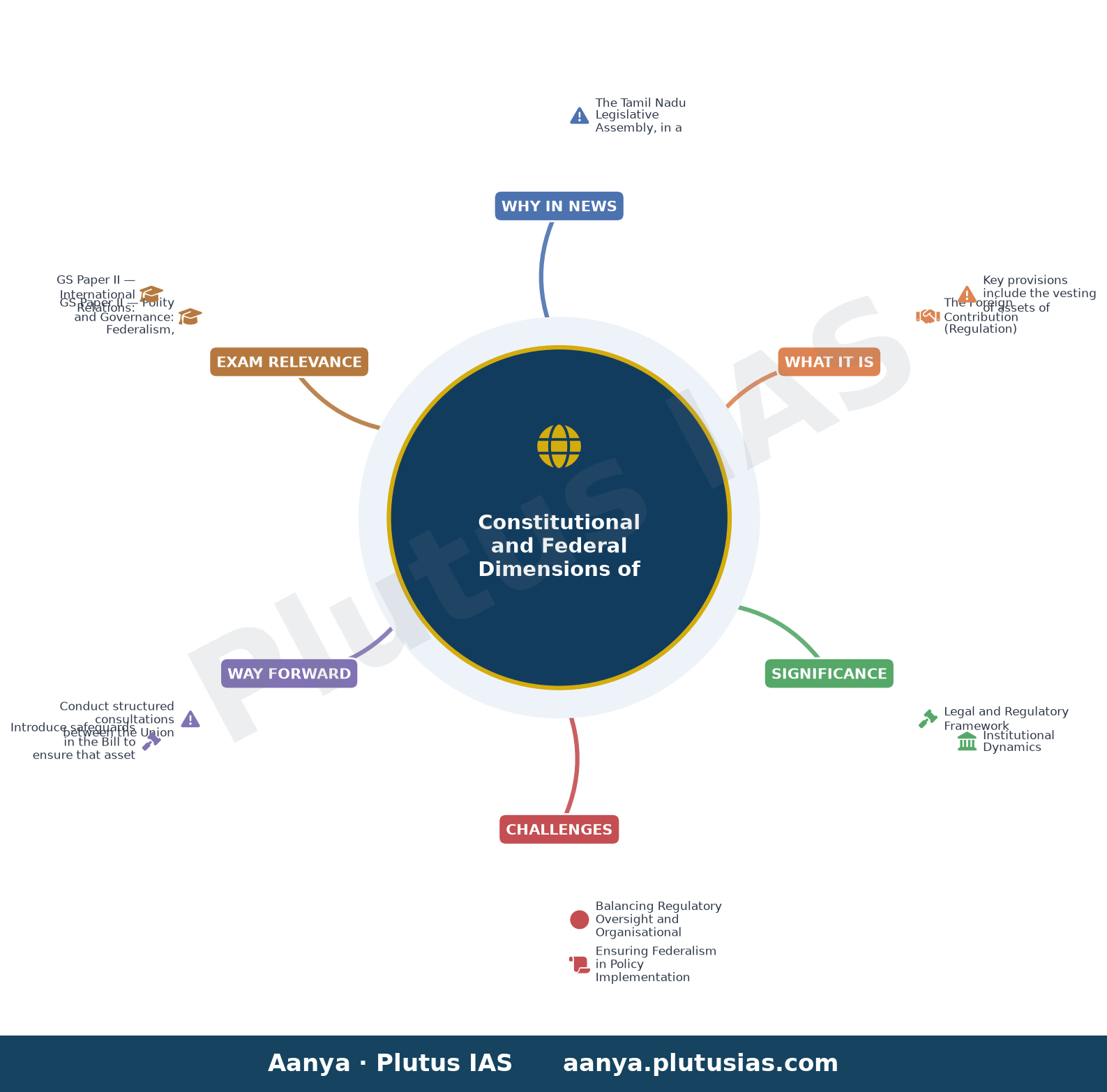
- GS Paper II — Polity and Governance: Federalism, Constitutional Provisions, Fundamental Rights | GS Paper II — International Relations: Regulation of Foreign Contributions and NGOs
- Prelims: Foreign Contribution (Regulation) Act, 2010, FCRA Amendment Bill 2026, Article 246 (7th Schedule), Article 29 and 30 (Cultural and Educational Rights), Doctrine of Proportionality, Federalism, Natural Justice, Property Rights under Article 300A
- Essay: The delicate balance between national security and institutional autonomy in regulatory frameworks, Federalism in India: Centre-State dynamics in policy implementation
Quick Revision: The Foreign Contribution (Regulation) Amendment Bill, 2026, raises critical constitutional questions on property rights (Article 300A), natural justice, and federalism, as it empowers the Union Government to vest assets of organisations upon FCRA registration lapses, necessitating a careful balance between national security and institutional autonomy.
Why is this in the news?
The Tamil Nadu Legislative Assembly, in a unanimous resolution passed on August 11, 2026, urged the Union Government to withdraw the Foreign Contribution (Regulation) Amendment Bill, 2026, citing concerns over its potential to infringe upon the autonomy of charitable organisations, particularly educational and social welfare institutions. The resolution underscores the Bill’s provisions on the transfer, management, disposal, and sale of assets of organisations upon the expiry, non-renewal, or cancellation of their FCRA registration, raising constitutional and federal questions regarding property rights and natural justice.
Background
- The Foreign Contribution (Regulation) Act (FCRA), 2010, regulates the acceptance and utilisation of foreign contributions by individuals, associations, and companies in India, with the primary objective of ensuring that such contributions do not compromise national security or public order.
- The FCRA was amended in 2020, introducing stricter provisions such as reduced utilisation limits for administrative expenses, mandatory opening of FCRA accounts in the State Bank of India, and enhanced reporting requirements, which were widely debated for their impact on NGOs and civil society.
- The 2026 Amendment Bill proposes further changes, including provisions for the vesting of assets of organisations whose FCRA registration is cancelled or not renewed, which has been perceived as a potential encroachment on the autonomy of charitable entities.
- Tamil Nadu’s resolution reflects broader concerns raised by State governments and civil society organisations regarding the Bill’s alignment with constitutional principles, particularly in the context of federalism and the rights of minority-managed institutions.
- The Bill’s passage in Parliament has been marked by debates on its necessity, with proponents arguing for stricter oversight to prevent misuse of foreign funds, while critics highlight the risk of overreach and erosion of institutional autonomy.
- The resolution also aligns with Tamil Nadu’s earlier stance on the National Eligibility-cum-Entrance Test (NEET), reflecting the State’s emphasis on legislative autonomy in matters affecting education and social welfare.
What is the Foreign Contribution (Regulation) Amendment Bill, 2026?
- The Foreign Contribution (Regulation) Amendment Bill, 2026, seeks to amend the Foreign Contribution (Regulation) Act, 2010, with a focus on enhancing oversight over the utilisation of foreign contributions by NGOs, associations, and other entities in India.
- Key provisions include the vesting of assets of organisations whose FCRA registration is cancelled, expired, or not renewed, in the Union Government or an authority designated by it, raising concerns over the potential deprivation of property rights without adequate safeguards.
- The Bill introduces stricter conditions for the renewal of FCRA registration, including enhanced scrutiny of the antecedents of office-bearers and the utilisation of funds, which may impact the operational autonomy of charitable organisations.
- The Bill also proposes to empower the Union Government to restrict the utilisation of foreign contributions in specific cases, citing grounds such as public interest, national security, or the need to prevent diversion of funds for activities detrimental to the sovereignty and integrity of India.
- The Bill has been criticised for its potential to undermine the principles of natural justice, as it does not explicitly provide for a hearing or appeal mechanism before the vesting of assets or cancellation of registration.
- The Bill’s provisions on the vesting of assets have been interpreted by some stakeholders as a violation of the constitutional guarantee of property rights under Article 300A, which protects private property from arbitrary state action.
- The Bill’s passage has reignited debates on the balance between national security imperatives and the autonomy of civil society organisations, particularly those engaged in education, healthcare, and social welfare.
- The Bill’s alignment with the doctrine of proportionality has been questioned, as the proposed measures may not be strictly necessary or the least intrusive means to achieve the stated objectives of the FCRA.
Key Features
| Feature | Significance |
|---|---|
| Transfer of assets of charitable organisations | Empowers the Union Government to seize or reassign assets of organisations whose FCRA registration is cancelled, expired, or surrendered, raising concerns over autonomy and property rights. |
| Comprehensive stakeholder consultations | The Bill mandates consultations with State governments and civil society organisations, reflecting a federal governance principle in regulatory amendments. |
| Principle of proportionality | Provisions must balance regulatory oversight with the protection of legitimate expectations and rights of lawfully functioning organisations. |
| Natural justice safeguards | Ensures procedural fairness in cancellation or refusal of FCRA registration, including opportunities for representation and redress. |
| Protection of federalism | Highlights the role of State governments in policy formulation, particularly in matters affecting social, educational, and religious institutions. |
Why it Matters
Legal and Regulatory Framework
- The FCRA Amendment Bill, 2026, seeks to amend the Foreign Contribution (Regulation) Act, 2010, which governs the receipt and utilisation of foreign contributions by individuals, associations, and companies in India.
- The Bill introduces stricter provisions for the management and disposal of assets of organisations failing to comply with FCRA norms, aligning with the Union Government’s objective of enhancing transparency in foreign funding.
- The resolution passed by the Tamil Nadu Assembly underscores the tension between regulatory oversight and the autonomy of non-governmental organisations, particularly those engaged in education, healthcare, and social welfare.
Institutional Dynamics
- The resolution reflects the role of State Legislatures in scrutinising Union Government policies, especially those impacting State-level institutions and civil society organisations.
- The Assembly’s demand for consultations with stakeholders, including State governments, highlights the federal structure of governance and the need for collaborative policymaking.
- The Bill’s provisions may impact the functioning of minority-run institutions, necessitating a balanced approach to protect their constitutional rights under Articles 25, 26, and 30.
Civil Society and Governance
- The Bill’s focus on preventing the misuse of foreign funds for anti-national activities reflects a broader governance imperative to safeguard national security while preserving the space for legitimate philanthropic activities.
- The resolution’s emphasis on natural justice and proportionality aligns with constitutional principles, ensuring that regulatory measures do not disproportionately infringe upon the rights of organisations.
- The Bill’s provisions may influence the operational autonomy of non-governmental organisations, particularly those dependent on foreign funding for critical social and educational services.
Federalism and Cooperative Governance
- The resolution underscores the importance of cooperative federalism, where State governments play a pivotal role in shaping policies that affect their citizens and institutions.
- The demand for consultations with State governments and civil society organisations reflects a recognition of the need for inclusive policymaking in matters of governance and regulation.
- The Bill’s provisions may necessitate a collaborative approach between the Union and State governments to ensure that regulatory measures are both effective and equitable.
Challenges
1. Balancing Regulatory Oversight and Organisational Autonomy
- The Bill’s provisions on asset transfer and disposal risk infringing upon the autonomy of charitable organisations, particularly those engaged in education, healthcare, and social welfare.
- The resolution highlights concerns over the potential misuse of regulatory powers to target specific organisations or communities, necessitating safeguards against arbitrary action.
- The need to balance transparency in foreign funding with the protection of legitimate rights and expectations of organisations remains a critical governance challenge.
UPSC Link: GS Paper 2: Functions and responsibilities of the Union and the States
2. Ensuring Federalism in Policy Implementation
- The resolution reflects the challenge of reconciling Union Government policies with State-level priorities, particularly in matters affecting social, educational, and religious institutions.
- The demand for consultations with State governments underscores the need for a collaborative approach to policymaking, ensuring that regulatory measures are contextually appropriate.
- The Bill’s provisions may create friction between the Union and State governments, highlighting the importance of cooperative federalism in governance.
UPSC Link: GS Paper 2: Federalism
3. Protecting Constitutional Rights of Minority Institutions
- The Bill’s provisions may disproportionately impact minority-run institutions, raising concerns over the protection of their constitutional rights under Articles 25, 26, and 30.
- The resolution’s emphasis on natural justice and proportionality reflects the need to safeguard the rights of minority organisations while ensuring regulatory compliance.
- The challenge lies in designing policies that prevent the misuse of foreign funds without infringing upon the autonomy and rights of minority institutions.
UPSC Link: GS Paper 2: Fundamental Rights
4. Preventing Misuse of Foreign Funds for Anti-National Activities
- The Bill’s objective to prevent the misuse of foreign funds for anti-national activities aligns with national security imperatives but raises concerns over the potential for overreach.
- The challenge lies in designing regulatory measures that are robust enough to prevent misuse while avoiding unintended consequences for legitimate organisations.
- The resolution’s demand for consultations with stakeholders reflects the need for a balanced approach to address this governance challenge.
UPSC Link: GS Paper 3: Security challenges and their management in border areas
5. Ensuring Transparency and Accountability in Foreign Contributions
- The Bill seeks to enhance transparency in the receipt and utilisation of foreign contributions, reflecting a broader governance imperative to prevent financial irregularities.
- The challenge lies in implementing these provisions without creating undue bureaucratic hurdles for organisations engaged in legitimate philanthropic activities.
- The resolution’s emphasis on proportionality and natural justice highlights the need for regulatory measures that are both effective and equitable.
UPSC Link: GS Paper 2: Transparency and accountability
Challenges — UPSC Perspective
| Issue | Concern |
|---|---|
| Asset transfer provisions | Risk of arbitrary seizure or reallocation of assets, infringing on property rights and organisational autonomy. |
| Consultation requirements | Potential delays in policy implementation due to the need for extensive stakeholder consultations. |
| Protection of minority rights | Concerns over disproportionate impact on minority-run institutions, raising constitutional questions. |
| Balancing security and rights | Challenge of preventing misuse of foreign funds without infringing on legitimate rights of organisations. |
| Federalism tensions | Risk of friction between Union and State governments over policy jurisdiction and implementation. |
Way Forward
- Conduct structured consultations between the Union Government, State governments, and civil society organisations to address concerns over the Bill’s provisions.
- Introduce safeguards in the Bill to ensure that asset transfer provisions are proportionate, transparent, and subject to judicial review.
- Clarify the criteria for cancellation or refusal of FCRA registration to prevent arbitrary action and protect legitimate expectations.
- Strengthen mechanisms for grievance redressal, including opportunities for representation and appeal for affected organisations.
- Enhance intergovernmental coordination to ensure that regulatory measures align with State-level priorities and constitutional rights.
- Undertake a comprehensive review of the FCRA, 2010, to identify gaps and propose amendments that balance oversight with autonomy.
- Promote awareness among civil society organisations about the Bill’s provisions and their rights under the Constitution.
- Establish a monitoring mechanism to assess the impact of the Bill on the functioning of charitable, educational, and social welfare institutions.
UPSC Value Addition
Keywords for Mains Answer-Writing
Foreign Contribution (Regulation) Act, 2010 · FCRA Amendment Bill 2026 · Foreign Contribution (Regulation) Amendment Bill, 2026 · Charitable organisations autonomy · Federalism and Centre-State relations · Natural justice and proportionality · Foreign funding and national security · Minority educational institutions · Foreign Contribution (Regulation) Rules · FCRA registration and renewal · Disposal of assets of NGOs · Union-State legislative competence · Judicial review of legislative amendments · Stakeholder consultations in policymaking · Protection of property rights under FCRA · Legitimate expectations in administrative law
Constitutional & Policy Linkages
- Article 25: Freedom of conscience and free profession, practice, and propagation of religion.
- Article 26: Freedom to manage religious affairs.
- Article 29: Protection of interests of minorities.
- Article 30: Right of minorities to establish and administer educational institutions.
Concept Flow
Introduction of FCRA Amendment Bill, 2026 → Concerns over asset transfer provisions → Tamil Nadu Assembly passes resolution → Demand for consultations and withdrawal → Debate on autonomy vs. regulatory oversight → Constitutional safeguards (Articles 25, 26, 29, 30) → Federalism and cooperative governance → Way forward for balanced policy implementation.
Prelims Practice Questions
Q1. Consider the following statements regarding the Foreign Contribution (Regulation) Act, 2010 (FCRA):
1. The Act regulates the acceptance and utilisation of foreign contributions by individuals, associations, and companies.
2. The Act empowers the Union Government to cancel the registration of an organisation if it is found to be involved in activities detrimental to the national interest.
3. The Act prohibits the transfer of foreign contributions to any other person or organisation without prior permission.
4. The Act mandates that all foreign contributions must be routed through the State Bank of India.
How many of the above statements are correct?
- Only one
- Only two
- Only three
- All four
Answer: All four — Statements 1, 2, and 3 are correct as per the FCRA, 2010. Statement 4 is incorrect because the Act does not mandate routing through the State Bank of India exclusively; it allows routing through any scheduled bank with prior approval.
Q2. Which of the following is NOT a ground for cancellation of FCRA registration under the Foreign Contribution (Regulation) Act, 2010?
- Non-utilisation of foreign contributions for the stated purpose
- Failure to submit annual returns within the stipulated time
- Acceptance of foreign contributions without prior registration
- Engagement in political activities
Answer: Failure to submit annual returns within the stipulated time — Non-utilisation of foreign contributions for the stated purpose is not explicitly listed as a ground for cancellation under FCRA, 2010. The other options are valid grounds for cancellation as per Section 14 of the Act.
Q3. Assertion (A): The Foreign Contribution (Regulation) Amendment Bill, 2026 seeks to empower the Union Government to take over the assets of charitable organisations in case of cancellation of FCRA registration.
Reason (R): The Bill aims to enhance transparency and accountability in the utilisation of foreign contributions.
Code:
- Both A and R are true, and R is the correct explanation of A
- Both A and R are true, but R is NOT the correct explanation of A
- A is true, but R is false
- A is false, but R is true
Answer: A is true, but R is false — Assertion (A) is true as the Bill includes provisions for the transfer, management, disposal, and sale of assets of charitable organisations upon cancellation of FCRA registration. Reason (R) is also true but does not directly explain the assertion, as the primary objective of the Bill is regulatory oversight rather than asset seizure.
Mains Practice Question
✍ The Foreign Contribution (Regulation) Amendment Bill, 2026 seeks to introduce stringent provisions regarding the transfer, management, disposal, and sale of assets of charitable organisations in cases of FCRA registration expiry, non-renewal, or cancellation. Critically examine the constitutional validity of these provisions with reference to the principles of federalism, natural justice, and property rights. Also, analyse the implications for minority educational and social welfare institutions in India. (15 Marks)
Approach: MODEL-ANSWER SKELETON:
1. **Constitutional Framework and Federalism (3 Marks)**
– Reference to Article 246 and Seventh Schedule: Union List (Entry 17) vs. State List (Entry 28) on ‘charitable institutions’.
– Doctrine of pith and substance and federal balance in regulatory legislation.
– Role of State governments in regulating charitable organisations under Entry 28, List III.
– Judicial precedents: State of Bombay v. F.N. Balsara (1951), State of West Bengal v. Anwar Ali Sarkar (1952).
2. **Principles of Natural Justice and Proportionality (4 Marks)**
– Right to hearing under Article 14 and 21: Audi alteram partem.
– Proportionality test: Whether the measure is least restrictive to achieve the stated objective.
– Legitimate expectation and protection of property rights under Article 300A.
– Case law: Maneka Gandhi v. Union of India (1978), Shreya Singhal v. Union of India (2015).
3. **Implications for Minority Institutions (4 Marks)**
– Constitutional protection under Article 30 for minority educational institutions.
– Judicial interpretation: T.M.A. Pai Foundation v. State of Karnataka (2002), P.A. Inamdar v. State of Maharashtra (2005).
– Impact of asset seizure on autonomy and sustainability of minority-run institutions.
– Data on minority educational institutions in Tamil Nadu (e.g., number of institutions, reliance on foreign contributions).
4. **Balancing Transparency and Accountability (4 Marks)**
– Need for foreign contribution regulation to prevent misuse (e.g., anti-national activities).
– Alternative mechanisms: Enhanced disclosure requirements, independent audits, and periodic reviews.
– Role of the National Commission for Minorities and State-level monitoring bodies.
– Global best practices: Comparative analysis with FCRA-like laws in the USA (Foreign Agents Registration Act) or UK (Charities Act).
**Conclusion (1 Mark):**
– Synthesise the arguments to assess whether the Bill strikes a balance between regulatory oversight and institutional autonomy, suggesting reforms if necessary.
Source: The Hindu
Generated by AanyaAi for educational purpose.


No Comments